
Homeowners insurance covers your house, your belongings and your liability to other people, plus the cost of living somewhere else if a covered disaster forces you out (Triple-I). It doesn't cover everything. Flooding, wear and tear and poor maintenance are excluded, and in Louisiana hurricane damage usually comes with its own deductible. Here's what each part of a policy does, and where the gaps are.
The six parts of a homeowners policy
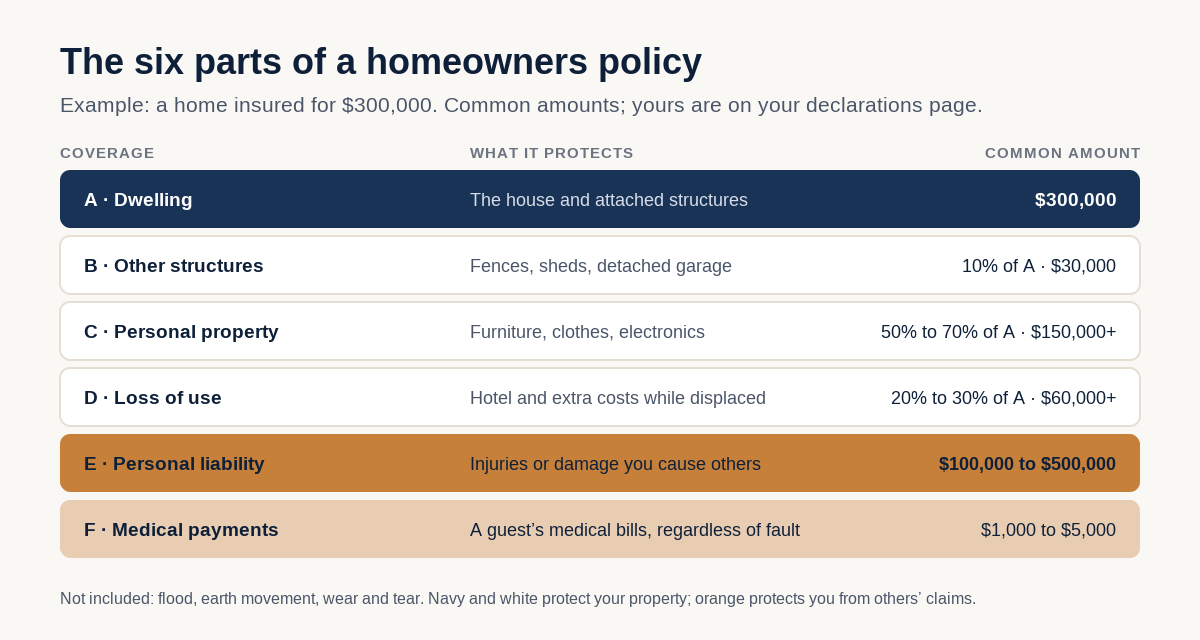
Every standard policy is built from the same six coverages, usually labeled A through F on your declarations page:
Coverage A: Dwelling
Pays to repair or rebuild the house itself and anything attached to it, like an attached garage, porch or built-in cabinets, after a covered loss such as fire, wind, hail or a fallen tree. It should equal what it would cost to rebuild your home, not its market value or what you owe on it. See what is dwelling coverage?
Coverage B: Other structures
Covers structures that aren't attached to the house: fences, sheds, a detached garage, a gazebo. It's usually about 10% of your dwelling coverage (Triple-I). If you have a large detached shop or pool house, ask about raising it.
Coverage C: Personal property
Covers your belongings, from furniture and clothes to electronics and tools, generally set at 50% to 70% of your dwelling coverage (Triple-I). A few things to know:
- It travels with you. Belongings are covered away from home too, like a laptop stolen from your car, though some policies limit that to 10% of the personal property limit.
- Valuables have low theft limits. Jewelry theft is generally capped at about $1,500 in total (Triple-I), and similar limits apply to furs, silverware, cash and collectibles. Schedule an engagement ring or other valuables separately to cover their full appraised value.
- Check how belongings are valued. Actual cash value pays what an item was worth after depreciation; replacement cost pays to buy a new one. Replacement cost on contents is usually worth the small extra premium.
Coverage D: Loss of use
Also called additional living expenses. If a covered loss makes your home unlivable, it pays the extra cost of living elsewhere: a hotel or rental, restaurant meals above your normal grocery bill, extra mileage (Triple-I). It often runs 20% to 30% of the dwelling limit, and some policies also cap how long it lasts. It's separate from the money to rebuild, so using it doesn't reduce your dwelling coverage. After a Louisiana hurricane, when repairs can take many months, this coverage matters.
Coverage E: Personal liability
Pays if you or your family are legally responsible for injuring someone or damaging their property, at home or away: a guest falls on your steps, your dog bites a neighbor, your child breaks a neighbor's window. It pays your legal defense as well as any settlement or judgment, up to the limit. Limits generally start around $100,000 (Triple-I). If you have savings, home equity or retirement accounts to protect, $300,000 or more plus an umbrella policy is common.
Coverage F: Medical payments to others
Pays small medical bills for a guest hurt at your home, regardless of fault, so a minor injury doesn't turn into a liability claim. It doesn't cover your own household. Limits are usually a few thousand dollars.
What causes of damage are covered?
Homeowners insurance pays for sudden, accidental damage from the causes your policy covers, such as fire, lightning, wind, hail, a falling tree, theft, vandalism, the weight of ice, and water that suddenly escapes from plumbing. On the most common policy form, the house itself is covered for any cause that isn't specifically excluded, while belongings are covered for a named list of causes. Your policy spells out which applies to you.
For the claims Louisiana homeowners file most:
- Roofs: storm damage is covered; an old, worn roof isn't. Roof replacement and leaks
- Water: a burst pipe is covered; a slow leak isn't. Water damage, plumbing and mold
- Trees: a tree on your house is covered, plus limited removal. Tree damage and removal
- Hurricanes: wind damage is covered, with a separate hurricane or named-storm deductible.
What homeowners insurance doesn't cover
| Not covered | What to do instead |
|---|---|
| Flooding, storm surge and rising water | A separate NFIP or private flood policy |
| Sewer or drain backup | Add a water backup endorsement |
| Earthquakes, sinkholes and settling | Separate earthquake or earth movement coverage, where available |
| Wear and tear, rot, poor maintenance | Maintain the home; insurance isn't a warranty |
| Termites, rodents and other pests | Pest control contracts and inspections |
| Most mold | Covered only after a covered water loss, often with a low limit |
| Your cars | Comprehensive on your auto policy |
| Business property and liability | A home business endorsement or business policy |
Flood is the gap that costs Louisiana homeowners the most. No homeowners policy covers rising water, and homes outside high-risk flood zones flood too, as much of the Baton Rouge area learned in 2016. See flood insurance vs. homeowners insurance.
Louisiana-specific things to know
- More than one deductible. Most Louisiana policies have a regular deductible and a percentage-based hurricane or named-storm deductible, often 2% to 5% of Coverage A. On a $300,000 home, 2% is $6,000.
- Roof age matters. Many insurers cover older roofs at actual cash value or won't start a policy on them. A FORTIFIED roof earns a required discount.
- Your rights as a policyholder. Louisiana's Policyholder Bill of Rights includes at least 60 days' written notice before most cancellations or nonrenewals, a written reason, payment or a written settlement offer within 30 days of satisfactory proof of loss, a written explanation of any denial, the right to request your claim file, and the right to a complete copy of your policy (La. R.S. 22:41).
- A last resort. If no private insurer will cover your home, Louisiana Citizens is the state's insurer of last resort.
Add-ons worth considering in Louisiana
- Water backup for sewer and drain backups during heavy rain.
- Replacement cost on personal property instead of actual cash value.
- Extended replacement cost on the dwelling, for when building costs spike after a hurricane.
- Ordinance or law coverage for the cost of bringing a damaged older home up to current code.
- Scheduled personal property for jewelry, guns, art and collectibles.
- Flood insurance, a separate policy, wherever you live.
How to see what your policy covers
Start with your declarations page, the summary at the front of your policy. It lists your Coverage A through F limits, your deductibles (including any hurricane deductible), and the endorsements you've added. Then check three things: that Coverage A would rebuild your home today, that your liability limit fits your savings, and whether you have water backup and flood coverage.
Get your homeowners policy reviewed in Baton Rouge
The Root Agency is a local Allstate agency on Goodwood Blvd. Send us your declarations page and we'll walk through all six coverages with you, point out gaps like missing water backup or low liability, and quote flood insurance alongside it. Call (225) 529-1990 or start with homeowners insurance in Baton Rouge.
This article is general information, not insurance advice. Coverage depends on your policy form, endorsements and limits; ask your agent or insurer about your own policy.