
Homeowners insurance covers water damage when it's sudden and accidental: a pipe bursts, a water heater ruptures, a washing machine hose splits, or wind opens your roof and rain pours in (Allstate). It doesn't cover a leak that dripped for months, water that backs up through a drain unless you've added that coverage, or flooding. In Louisiana that last one matters most, because rising water is never covered by a homeowners policy.
Water claims are common and expensive. Water damage and freezing made up 22% of homeowners claims in 2024, and the average claim from 2020 through 2024 was $17,240. About 1 in 70 insured homes files one every year (Triple-I).
Which water damage is covered
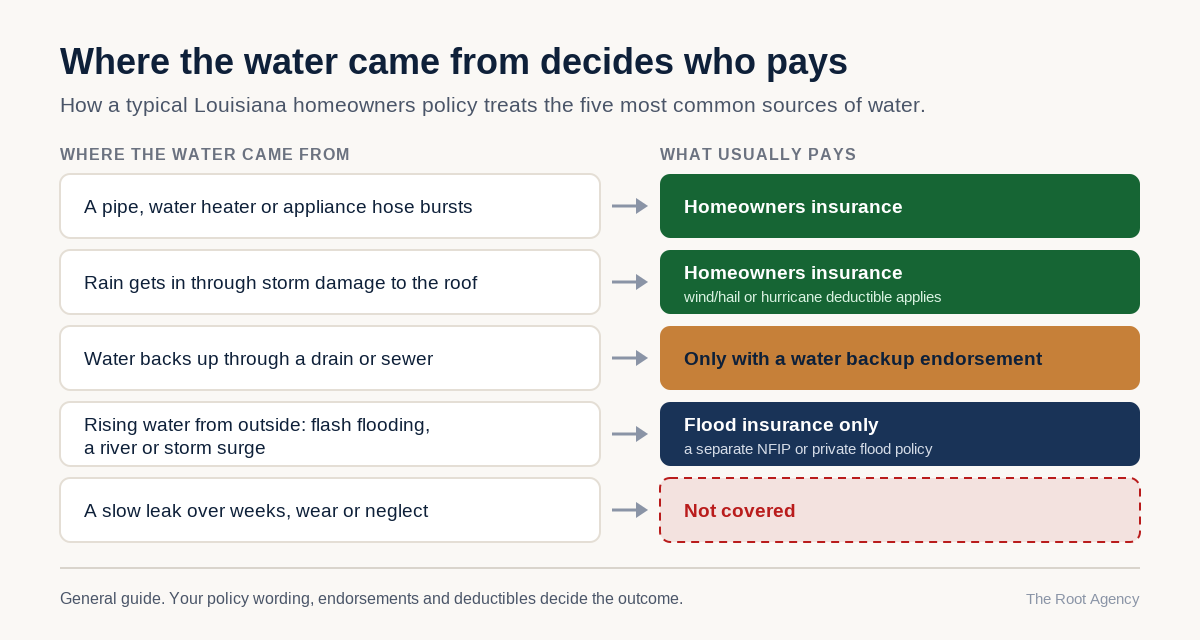
The first question an adjuster asks is where the water came from. The answer decides which coverage pays, if any:
| Usually covered | Usually not covered |
|---|---|
| A pipe that suddenly bursts or breaks | A pipe or fixture that leaked slowly for weeks |
| A water heater, dishwasher or washer hose that ruptures | Replacing the water heater, dishwasher or hose itself |
| An AC drain line or toilet that suddenly overflows | Damage from a leak you knew about and didn't fix |
| Rain through a roof or window damaged by wind or hail | Rain through an old roof, worn flashing or failed caulk |
| Frozen pipes, if you kept the heat on | Frozen pipes in a vacant house with no heat |
| Opening a wall or floor to reach the broken pipe | Sewer or drain backup, without an endorsement |
| Mold caused by a covered water loss (often with a limit) | Flooding, storm surge or rising water from outside |
The two coverages that pay are dwelling coverage for the house (drywall, floors, cabinets) and personal property coverage for your belongings. Your deductible comes off first.
Does homeowners insurance cover plumbing leaks?
It covers what the leak damages, not the plumbing that failed. If a supply line under the sink bursts and soaks the cabinets and floor, the policy pays to repair the cabinets and floor. It doesn't pay for a new supply line, and if a worn-out water heater fails, it won't buy you a new water heater (Allstate).
Many policies also pay to tear out and replace part of the house to reach the broken pipe, like cutting open a wall, and then put it back.
The line between sudden and gradual is where most denials happen. Many policies exclude water that seeps or leaks over 14 days or more. A slow drip behind the toilet that rots the subfloor, or a shower pan that has leaked for a year, counts as maintenance. Fix small leaks when you see them, and report sudden ones right away.
Slab leaks
Most Baton Rouge-area homes sit on a concrete slab, with water lines running underneath. When one of those pipes breaks:
- Usually covered: the water damage inside and, on many policies, the cost of breaking into the slab or floor to reach the pipe and restoring it afterward.
- Usually not covered: repairing the pipe itself, damage from a leak that ran for weeks, and cracks or settling in the foundation.
- Worth asking about: some insurers sell a service line endorsement that covers buried water and sewer lines on your property. Ask your agent whether it's available on your policy.
Does homeowners insurance cover mold?
Mold is the follow-up claim to almost every water loss in Louisiana's humidity, so it pays to know the rules:
- Mold from a covered water loss, like mold behind a wall after a burst pipe, is often covered, but many policies cap mold or “fungi” coverage at a lower limit than the rest of the claim. Check your declarations page and endorsements for that limit.
- Mold from humidity, condensation or a long-running leak generally isn't covered. It's treated as maintenance.
- Speed decides most mold claims. The EPA says water-damaged areas and items should be dried within 24 to 48 hours to prevent mold growth (EPA). Run fans and dehumidifiers, pull up wet rugs and call a water mitigation company if needed. Reasonable mitigation is normally part of the claim.
Frozen pipes: yes, in Louisiana too
On January 21, 2025, Baton Rouge got 7.6 inches of snow, its snowiest day since records began in 1892 (NOAA). Hard freezes are rare here, which is exactly why pipes in attics, exterior walls and crawl spaces aren't protected.
Burst pipes from freezing are covered if you used reasonable care to keep the house heated. If the home was vacant, unoccupied or under construction and you didn't keep the heat on or shut off and drain the water, the claim can be denied (Allstate). Before a freeze, drip faucets, open sink cabinets, wrap exposed pipes and know where your main shutoff is.
Water damage vs. flood damage in Louisiana
This is the distinction that costs Louisiana homeowners the most money:
- Water that comes from inside the house (pipes, appliances, AC) or falls through an opening the storm made is a homeowners claim.
- Water that rises from outside and flows in, whether from a river, storm surge, heavy rain that ponds in the yard or a street that floods, is flood damage. No homeowners policy covers it, no matter the source. Only flood insurance does.
- Water backing up through drains is its own category. A standard policy excludes it, but you can add water backup coverage for a modest cost. It's worth having in neighborhoods where heavy rain overwhelms the drainage system.
During a hurricane, one storm can cause both kinds of damage. Rain blowing through a broken window goes to the homeowners policy, under your hurricane deductible. Water that rises into the house goes to flood insurance. Most of the 2016 Baton Rouge flood damage fell into that second group. If you don't have a flood policy, read flood insurance vs. homeowners insurance and is flood insurance worth it?
Roof leaks and water damage
If wind or hail damages the roof and rain gets in, the policy covers both the roof repair and the water damage inside. If an aging roof lets water seep in, neither is covered. See does homeowners insurance cover roof replacement or leaks? for how roof claims, depreciation and Louisiana's roof rules work.
What to do when you find water damage
- Stop the water. Shut off the main valve or the fixture's valve, and turn off power to wet areas if it's safe.
- Document it with photos and video of the source and every damaged area before you clean up. Keep the failed part, like the burst hose or cracked fitting.
- Start drying within 24 to 48 hours. Keep receipts for fans, dehumidifiers, mitigation and any temporary repairs.
- Report the claim promptly to your insurer or agent. Waiting can turn a sudden loss into an argument about gradual damage.
- Don't throw out damaged items until the adjuster has seen them or told you it's fine.
- If you can't live in the house during repairs, ask about additional living expenses (loss of use) coverage for hotel and meal costs.
In Louisiana your insurer generally must start adjusting the claim within 14 days of your notice (30 days after a catastrophe) and pay within 30 days of receiving satisfactory proof of loss (La. R.S. 22:1892).
How to protect yourself before it happens
- Add water backup coverage if it isn't on your policy.
- Ask about a service line endorsement if your home is on a slab with older plumbing.
- Check your mold limit and your all-perils deductible, which is the one a burst pipe uses.
- Replace rubber washer hoses with braided steel, and replace water heaters near the end of their life.
- Install leak sensors or an automatic shutoff valve. They're inexpensive and catch leaks while they're still small. Some insurers offer a discount for them; ask your agent.
- Buy flood insurance, wherever you are in the Baton Rouge area. It's the only thing that covers rising water.
Review your water coverage with a Baton Rouge agent
The Root Agency is a local Allstate agency on Goodwood Blvd. Send us your declarations page and we'll tell you whether you have water backup coverage, what your mold limit is, which deductible a burst pipe would use, and whether you need flood insurance. We can add the missing pieces and quote flood coverage the same day. Call (225) 529-1990 or start with homeowners insurance in Baton Rouge.
This article is general information, not insurance advice. Coverage depends on your policy's wording, endorsements and limits; ask your agent or insurer about your own policy.