
Homeowners insurance pays to repair or replace your roof when something sudden damages it: hurricane or thunderstorm wind, hail, a falling tree, fire. It won't pay to replace a roof just because it's old. The details decide how big the check is: your deductible, whether your roof is covered at replacement cost or actual cash value, and in Louisiana, whether the storm had a name.
What homeowners insurance covers on a roof
A standard homeowners policy covers your roof as part of the house, under dwelling coverage. It pays for damage from the perils the policy lists, and it excludes damage that comes from wear, neglect or defects.
| Usually covered | Usually not covered |
|---|---|
| Shingles or panels torn off by wind, including hurricanes | An old roof that has reached the end of its life |
| Hail damage | Worn, curling or granule-bare shingles |
| A tree or limb that falls on the roof | Leaks from aging flashing, vents or seals |
| Fire and lightning | Damage from skipped maintenance, like clogged gutters |
| Water damage inside after a covered event opens the roof | Mold, rot or water damage that built up over time |
| Weight of ice or snow (rare here, but covered) | Poor installation or defective materials |
Flooding is different. Rising water is excluded from homeowners policies and covered by flood insurance. Rain that comes in through a storm-damaged roof is not flood. See flood insurance vs. homeowners insurance.
Does homeowners insurance cover roof leaks?
It depends on what caused the leak.
- Sudden leak from a covered event: covered. If wind rips off shingles and rain pours into the attic, the policy pays to repair the roof and the water damage to ceilings, walls, insulation and your belongings, minus the deductible.
- Slow leak from a worn roof: not covered. If old shingles or cracked flashing let water seep in over months, insurers treat it as a maintenance problem. They won't pay for the roof, and usually not for the rot or mold either.
- Gray area: a sudden leak in an old roof. If a storm damages a roof that was already worn, the storm damage is covered. Expect the adjuster to separate storm damage from wear, and expect depreciation on an older roof.
For pipes, appliances, mold and other sources of water, see does homeowners insurance cover water damage?
Whatever the cause, stop the damage. Policies require you to protect the home from further damage, so tarp the roof, catch the water and keep receipts. Reasonable emergency repairs are normally part of the claim.
Repair or full replacement?
Insurance pays to restore the damage, not to give you a new roof. If a few shingles blew off, expect a repair. If the damage is widespread, or the roof can't be repaired properly, the claim can cover a full replacement.
Matching is where many claims get stuck. Louisiana law lets an insurer repair or replace damaged property “with other of like kind and quality” (La. R.S. 22:1311), but Louisiana has no rule that forces an insurer to replace undamaged slopes so the whole roof matches. Whether you get them depends on your policy wording and on showing that the existing shingles can't be matched. Photos, the shingle brand and a roofer's written opinion help.
How much will insurance pay for a roof?
Two things set the amount: the deductible and how your roof is valued.
Your deductible
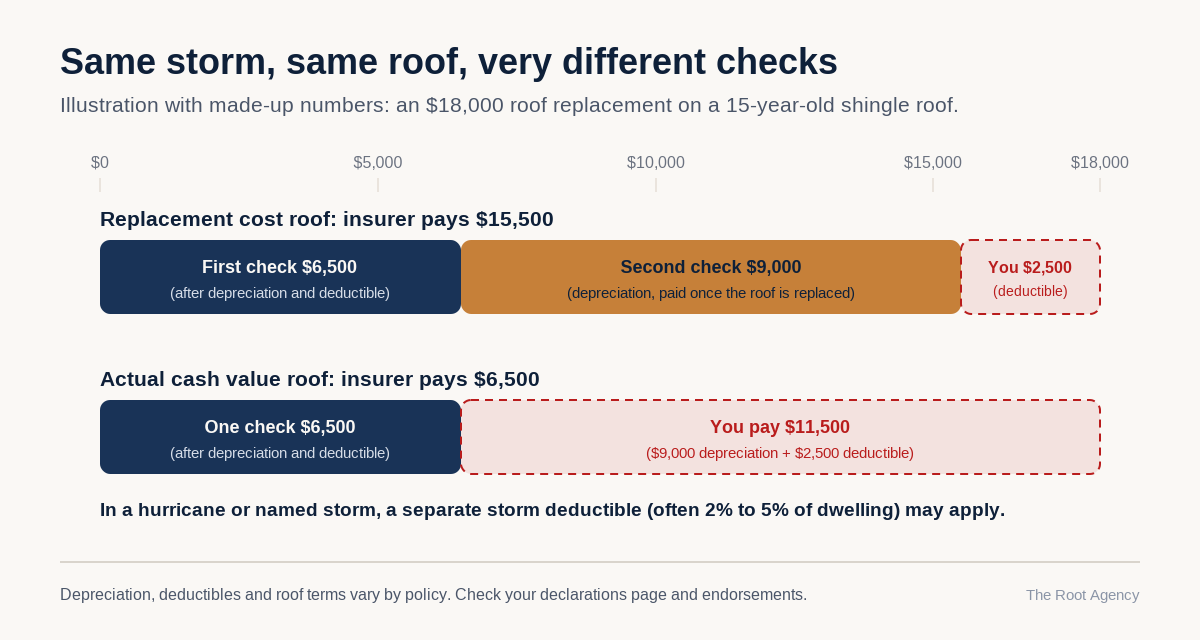
Most Louisiana homeowners policies have more than one deductible. A regular storm or hail claim uses your all-perils or wind and hail deductible. Damage from a hurricane or tropical storm can trigger a separate hurricane or named-storm deductible, usually 2% to 5% of your dwelling coverage; your policy defines which storms trigger it. On a $300,000 home a 2% hurricane deductible is $6,000, which can be more than a typical roof repair.
Replacement cost vs. actual cash value
- Replacement cost pays what it costs to put on a new roof of the same kind, minus the deductible. Insurers often pay it in two checks: the roof's depreciated value first, then the held-back depreciation once the work is done.
- Actual cash value pays what the old roof was worth, minus depreciation and the deductible. On an older roof that gap can be most of the bill. Many insurers now put older roofs on actual cash value, or on a roof payment schedule that pays a shrinking percentage as the roof ages, even when the rest of the house is covered at replacement cost.
Louisiana law sets some limits on depreciation. An insurer can depreciate labor as well as materials, but it can't deduct contractor overhead, profit or sales tax when it calculates actual cash value, and it has to explain in writing how it calculated depreciation. Since 2025, an insurer can also hold the second, recoverable-depreciation check until you show reasonable proof that you paid your deductible (La. R.S. 22:1892).
Look at your declarations page and endorsements for words like “roof surface,” “payment schedule” or “actual cash value roof.” If you see them, you'll want to know before a storm, not after.
Old roofs and Louisiana homeowners insurance
Roof age has become one of the biggest factors in whether Louisiana homeowners can get coverage and what it costs. Many insurers won't start a new policy on an older shingle roof, ask for a roof inspection, or will cover an older roof only at actual cash value.
Can my insurer drop me because of my roof?
Louisiana law gives you some protection:
- 60 days' notice, with the reason. Since July 1, 2026, an insurer that won't renew your homeowners policy has to mail or deliver notice at least 60 days before it expires (it used to be 30), including the cause (La. R.S. 22:1335).
- Extra limits for older policies only. If your policy was issued before August 1, 2024 and has been in force and renewed for more than three years, the insurer can cancel or nonrenew it only for nonpayment, fraud, a material change in the risk, two or more claims within a three-year period in the last five years, or a threat to its solvency. It can also file a plan with the Department of Insurance to nonrenew up to 5% of those policies a year for any reason. Policies issued after August 1, 2024 don't get this protection (La. R.S. 22:1265; LDI Regulation 131).
- You can ask for the reason in writing on any cancellation or nonrenewal.
What to do if your roof is the problem
- Read the notice. If it names specific defects, a repair and a roofer's letter or photos may be enough to keep or regain coverage.
- Get a roof inspection so you know the real condition and remaining life before you shop.
- Shop with an agent before the 60 days run out. Some insurers accept older roofs at actual cash value. That costs you at claim time but keeps you insured.
- Use Louisiana Citizens only as a last resort. It's there for homes no private insurer will take, and it usually costs more.
- Plan the replacement. If the roof is near the end of its life, a new one is often the cheapest long-term fix.
Does a new roof lower your insurance?
Often, yes. A new roof can bring a better rate, put the roof back on replacement cost and open up insurers that turned you down. If you're replacing it anyway, consider building it to the FORTIFIED standard. Insurers must discount the wind and hurricane part of the premium for a FORTIFIED Roof, and from January 1, 2027 the required minimum is 27% in East Baton Rouge's zone and 29% in Ascension and Livingston. A state tax credit can cover up to $10,000 of the upgrade.
Keep the paperwork. Since August 2025, parishes and cities that issue building permits must inspect roofing work as part of the permit, and the state created a voluntary Louisiana Roof Registry at the Department of Insurance to record roof permit information (American Press). A permit, the final inspection and the invoice prove your roof's age and quality the next time an insurer asks.
How to file a roof claim in Louisiana
- Make it safe and stop the water. Tarp the roof and save receipts.
- Document everything with dated photos and video of the roof, the attic and any interior damage, before cleanup if you can.
- Report the claim promptly to your insurer or agent.
- Meet the adjuster. Your roofer can be there to point out damage and defend their own estimate.
- Review the estimate line by line against your roofer's itemized estimate, and ask for the depreciation explanation in writing.
Louisiana sets deadlines for the insurer, too. It has to start adjusting a property claim within 14 days of your notice, or within 30 days after a catastrophic loss (the commissioner can extend that after a declared disaster), and it has to pay within 30 days of receiving satisfactory proof of loss (La. R.S. 22:1892). A policy can't give you less than 24 months from the loss to file suit on a property claim (La. R.S. 22:868).
Watch out for storm-chasing roofers
- “We'll cover your deductible” is illegal. A contractor can't pay, waive or rebate your deductible without your insurer's consent, or pad the bill to cover it. You can be fined too if you knowingly submit that claim: up to $500, up to 30 days in jail, or both (La. R.S. 51:451).
- Roofers can't run your claim. Since 2025 a contractor can't interpret your policy, negotiate your claim or advertise as an “insurance claim specialist,” and has to give you a good-faith itemized estimate before you sign (La. R.S. 37:2159.1).
- Read before you sign. Be careful with any contract that signs over your claim or lets the roofer deal with your insurer for you.
Check your roof coverage with a Baton Rouge agent
The Root Agency is a local Allstate agency on Goodwood Blvd. Send us your declarations page and we'll show you your roof deductibles, whether your roof is covered at replacement cost or actual cash value, and what a new or FORTIFIED roof would do to your premium. Got a nonrenewal notice over your roof? Call before the 60 days run out. Call (225) 529-1990 or start with homeowners insurance in Baton Rouge.
This article is general information, not legal or insurance advice. Coverage depends on your policy's wording and endorsements; ask your agent or insurer about your own policy.