

Dwelling coverage is the part of a homeowners policy that pays to repair or rebuild the house itself after a covered loss like fire, wind or hail. It's listed as Coverage A, and it's the most important number on the policy: your other structures, belongings and, in Louisiana, your hurricane deductible are all figured from it. The right amount is what it would cost to rebuild your home today, not what it would sell for.
Key takeaways
- Dwelling coverage (Coverage A) pays to rebuild the structure of your house: walls, roof, foundation, attached garage and built-in systems.
- Set it to your rebuild cost, not your market value, purchase price or mortgage balance. Land isn't included.
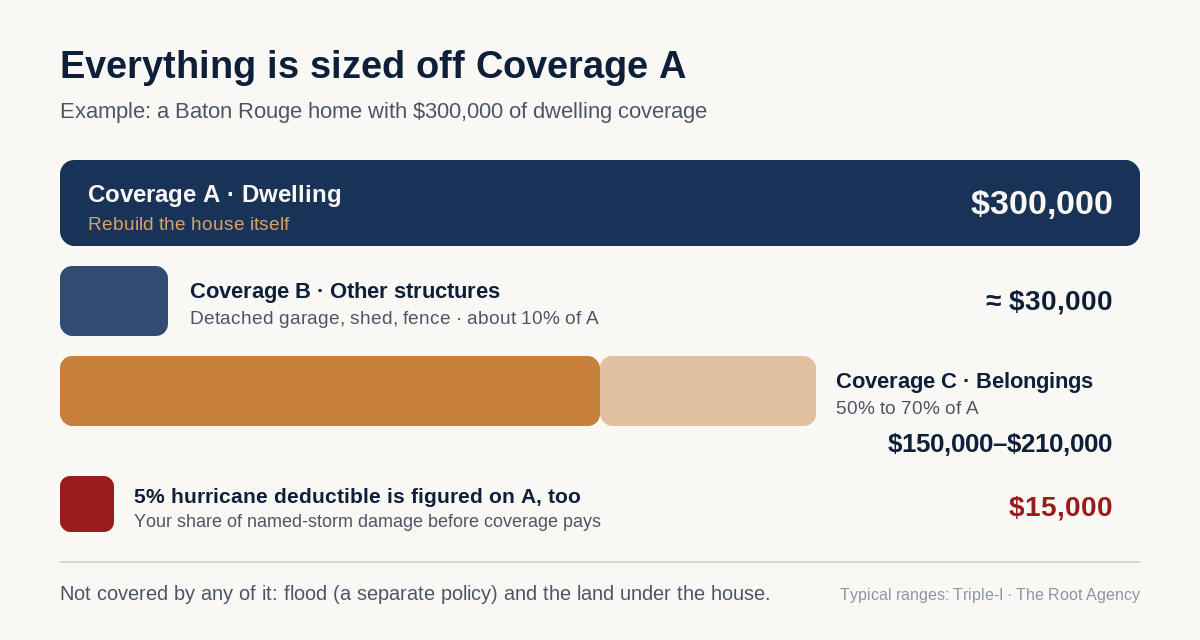
- Other structures are typically about 10% of Coverage A, and belongings 50% to 70% (Triple-I).
- In Louisiana your hurricane deductible is a percentage of Coverage A, so a $300,000 dwelling limit with a 5% deductible means $15,000 out of pocket after a named storm.
- Flood is never part of dwelling coverage. It needs a separate policy.
What does dwelling coverage cover?
Dwelling coverage pays to repair or rebuild your home if it's damaged or destroyed by fire, hurricane wind, hail, lightning or the other perils listed in your policy (Triple-I). In practice that means the physical house:
- The roof, walls, floors and foundation
- An attached garage, porch or deck
- Built-in systems: electrical, plumbing, HVAC and water heater
- Fixtures like cabinets, built-in appliances and flooring
What it doesn't cover matters just as much in Louisiana: flood, from any source, and the land under the house. Detached buildings and your belongings sit under separate parts of the same policy.
How is dwelling coverage different from the rest of the policy?
A homeowners policy is several coverages in one contract, and most of them are set as a share of Coverage A:
- Coverage A, dwelling: the house itself.
- Coverage B, other structures: a detached garage, shed, fence or gazebo, generally about 10% of your dwelling amount.
- Coverage C, personal property: your belongings, generally 50% to 70% of your dwelling amount. More in what personal property coverage pays for.
- Coverage D, loss of use: the extra cost of living elsewhere while the house is repaired, with its own limits. See loss of use coverage, explained.
Because B and C usually scale with A, an underinsured dwelling quietly underinsures the rest of the policy too.
How much dwelling coverage do you need?
Enough to rebuild your home from the ground up at today's construction prices. Triple-I puts it plainly: the price you paid or the current market price may be more or less than the cost to rebuild, and a limit based on your mortgage may not cover rebuilding at all. Land isn't part of the estimate (Triple-I).
Rebuild cost is driven by:
- Square footage and number of stories
- Construction type, roof and exterior materials
- Finishes: flooring, cabinetry, counters, fixtures
- Local labor and material prices, which can spike across the region after a major storm, when every roofer and contractor is booked
That last point is why Louisiana homeowners should treat their Coverage A as a number to revisit, not a number to set once. A limit that was right before a renovation, or before construction costs moved, can leave a gap when the whole parish is rebuilding at once.
Replacement cost, extended replacement cost and building codes
How a claim pays matters as much as the limit:
- Replacement cost pays to rebuild with materials of like kind and quality, without subtracting for age.
- Extended replacement cost is an endorsement that pays an extra 5% to 25% above your dwelling limit if rebuilding costs more than expected (Triple-I). It's the cushion for post-storm price spikes.
- Ordinance or Law coverage pays a set amount toward bringing a damaged home up to current building codes during a covered repair. Standard policies generally won't pay that extra cost on their own, which matters for older Baton Rouge homes built to earlier codes.
Why dwelling coverage matters more in Louisiana
Your hurricane deductible is figured from it
Louisiana homeowners policies carry a separate named-storm deductible, commonly 2% to 5% of your dwelling coverage. On $300,000 of Coverage A, a 5% deductible is $15,000; raise Coverage A to $350,000 and the same 5% becomes $17,500. Under Louisiana's single-deductible law it applies once per calendar year, not per storm. The full walkthrough is in hurricane deductibles in Louisiana homeowners policies.
Flood sits outside it entirely
Hurricane wind damage runs through your dwelling coverage; floodwater doesn't. Building damage from flooding needs a separate flood policy, and NFIP building coverage caps at $250,000 for a home, with $100,000 for contents. Check your address with our Louisiana flood zone lookup, and see flood insurance vs. homeowners insurance for how the two fit together.
A stronger roof can lower what you pay for it
The Louisiana Department of Insurance's Fortify Homes Program offers grants of up to $10,000 toward a FORTIFIED roof, and state law requires insurers to give a premium discount for one. For many homes it's the single upgrade that lowers both risk and price.
How to check your dwelling coverage
- Find Coverage A on your declarations page.
- Compare it to a current rebuild estimate, not a real estate appraisal or your loan balance.
- Check whether you have replacement cost, extended replacement cost and Ordinance or Law coverage.
- Multiply Coverage A by your hurricane deductible percentage so you know your storm number in dollars.
- Revisit it after any renovation, addition or new roof, and at least once a year.
Not sure your Coverage A is right?
The Root Agency reviews homeowners policies for Baton Rouge families at no charge: we'll estimate your rebuild cost, show your hurricane deductible in real dollars, and check for a flood gap. Start on our homeowners insurance in Baton Rouge page, or see home insurance across Louisiana.
This article is general information, not insurance advice. Coverage terms vary by policy; review your declarations page and talk with a licensed agent.