

Personal Property Coverage: What It Covers and How It Pays

Personal property coverage, formally called Coverage C in a standard homeowners policy, pays to repair or replace your belongings after a covered loss. Your furniture, clothing, electronics, and most household items fall under this protection. The single most important decision you will make about this coverage is whether you choose replacement cost value (RCV) or actual cash value (ACV). ACV subtracts depreciation from your payout, which can leave a gap of thousands of dollars after a major loss. Choose replacement cost when you can, start a home inventory today, and call a local agent to confirm your limits are right.
The bottom line: ACV coverage often pays only a fraction of what it costs to replace your belongings at today’s prices. Replacement cost coverage closes that gap.
Table of Contents
- Key Takeaways
- How personal property coverage actually works
- How coverage differs across homeowners, renters, and condo policies
- Coverage limits, sublimits, and when to schedule high-value items
- What standard personal property coverage usually excludes
- How deductibles and claims payouts work in practice
- How to decide how much personal property coverage to buy
- Why replacement cost matters: research and real-world examples
- How to insure items worth more than your policy’s default limits
- Questions to ask your agent before you finalize coverage
- Concise final summary
- What 20 years of Louisiana claims taught me about this coverage
- The Root Agency can review your personal property coverage today
- Key Takeaways
- Useful sources for further reading
Key Takeaways
Personal property coverage is only as strong as the limits and settlement method you choose. Here is what matters most before you move on.
- Coverage C protects your belongings against covered perils, both at home and away from home.
- Replacement cost pays to replace items at today’s prices; ACV pays depreciated value and often falls short.
- Sublimits cap payouts for jewelry, art, firearms, and electronics; scheduling removes those caps.
- A documented home inventory is the most reliable way to set the right coverage limit and speed a claim.
- Review your coverage yearly, especially after major purchases, renovations, or any storm season.
How personal property coverage actually works
Named perils vs. open perils
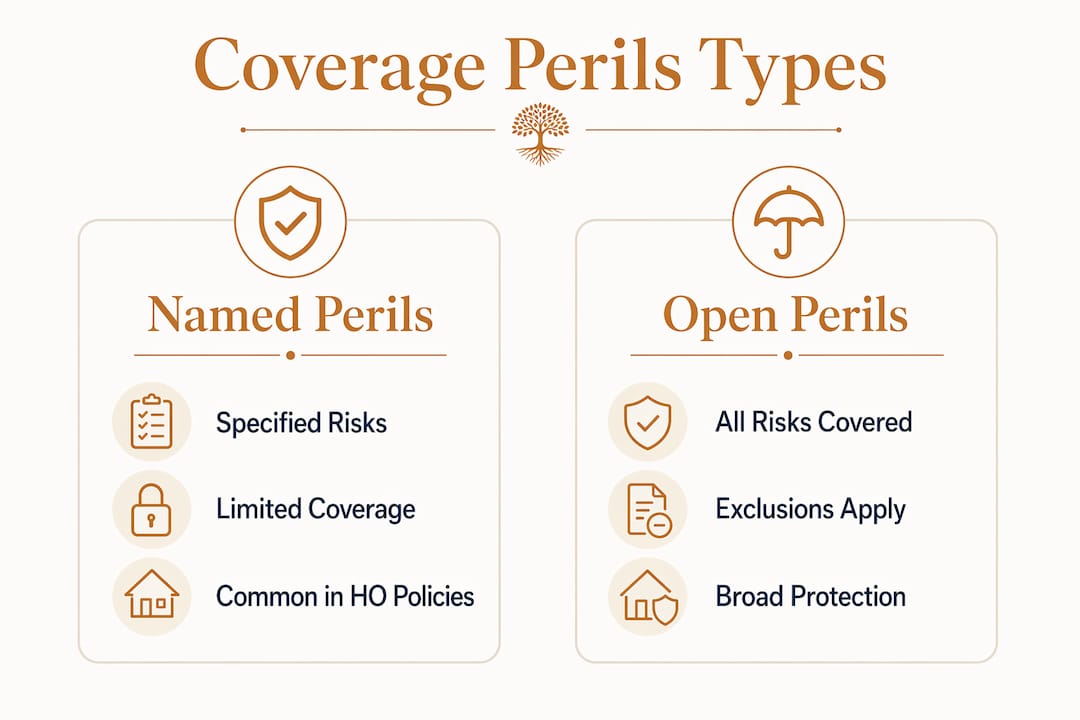
Most standard homeowners policies cover personal belongings on a named-perils basis, meaning your policy lists the specific events it will pay for: fire, theft, windstorm, vandalism, and a handful of others. If the cause of loss is not on that list, the claim is denied. Higher-tier HO-5 policies flip that logic and cover your belongings on an open-perils basis, paying for any cause of loss that is not explicitly excluded. That distinction matters most when something unusual happens, like a pipe bursting inside a wall or a freak accident that does not fit neatly into a named category.
On-premises and off-premises protection
Coverage C follows your belongings beyond your front door. If your laptop is stolen from your car, your luggage is lost on a trip, or your bicycle is taken from a hotel room, your personal property policy typically responds. That said, off-premises coverage may carry lower limits for items stored in a secondary location or storage unit, so check your declarations page if you keep valuables elsewhere.

ACV vs. RCV: a real dollar example
This is where most people get surprised at claim time. Say you bought a sofa five years ago for $1,200. Under ACV, your insurer calculates its current depreciated value, perhaps $400, and pays that minus your deductible. Under RCV, the insurer pays what it actually costs to buy a comparable sofa today, minus your deductible. Multiply that gap across an entire household of furniture, appliances, and electronics after a major loss, and the shortfall can reach tens of thousands of dollars.
Pro Tip: With RCV policies, many carriers issue an initial ACV payment first, then release the recoverable depreciation once you submit receipts proving you replaced the item. Keep every receipt from replacement purchases to collect the full amount owed.
How coverage differs across homeowners, renters, and condo policies
The policy type you carry determines how your personal property limit is set and what the underlying form covers.
| Policy Type | How the Limit Is Set | Peril Basis (Structure / Contents) | Key Consideration |
|---|---|---|---|
| HO-3 (Homeowners) | Typically a percentage of dwelling coverage (Coverage A) | Open perils / Named perils | Default percentage may underinsure high-value households |
| HO-5 (Homeowners) | Same percentage guideline | Open perils / Open perils | Broader contents coverage; usually higher premium |
| HO-6 (Condo) | Owner selects contents limit | Named perils (varies) | Must coordinate with HOA master policy |
| HO-4 (Renters) | Renter selects contents limit | Named perils | No dwelling coverage; contents limit is the whole policy |
For homeowners, the 50%–70% guideline is a starting point, not a guarantee of full coverage. If your dwelling is insured for $300,000, your personal property limit would typically range from $150,000 to $210,000, but it’s essential to assess the actual value of your belongings rather than rely on the default. Renters and condo owners choose their own limits, which makes a thorough inventory even more critical since there is no automatic percentage to fall back on.
Condo owners carry an additional layer of complexity. Your HOA’s master policy covers the building structure, but it typically stops at the walls of your unit. Your HO-6 policy picks up your personal belongings, interior fixtures you own, and any improvements you have made. Understanding exactly where the master policy ends is something worth confirming in writing with your association before you set your condo coverage limits.
Coverage limits, sublimits, and when to schedule high-value items

Standard limits and the 50%–70% rule
For homeowners, personal property limits are commonly set at 50%–70% of dwelling coverage. That percentage is a reasonable floor, not a ceiling. If your actual belongings are worth more than that default, you can and should increase the limit. Renters and condo owners should calculate their own total replacement value rather than guessing.
Common sublimits by category
Even when your overall Coverage C limit is adequate, sublimits can cap what you actually receive for specific categories:
- Jewelry and watches: Often capped at $1,000–$2,500 per occurrence under standard policies.
- Firearms: Typically limited to $2,500 for theft.
- Fine art and antiques: Sublimits vary widely; many policies offer little or no coverage without scheduling.
- Electronics: Some policies apply sublimits; others cover electronics under the general limit.
- Cash and gift cards: Usually capped at $200–$500 regardless of total loss.
These sublimits exist because high-value items in these categories are difficult to value and frequently targeted in theft claims. The cap applies even if your overall personal property limit is far higher.
When to schedule an item
Schedule a specific item when its replacement value exceeds the category sublimit, when it travels with you regularly, or when it has unique value that a standard policy cannot capture. A $6,000 engagement ring, a vintage guitar collection, or a camera kit used for professional work are all candidates. Scheduled personal property endorsements remove the sublimit and often add broader perils, including mysterious disappearance and worldwide coverage, for an additional premium.
What standard personal property coverage usually excludes
Knowing what your policy does not cover is just as important as knowing what it does. Several exclusions catch policyholders off guard.
Flood damage is excluded from every standard homeowners, renters, and condo policy. If a hurricane pushes water into your home and ruins your furniture, Coverage C will not pay. You need a separate flood policy through the National Flood Insurance Program (NFIP) or a private flood carrier. In Louisiana, this is not a hypothetical risk.
Earthquake damage is also excluded from standard forms and requires a separate endorsement or standalone policy.
Normal wear and tear is never covered. Insurance pays for sudden, accidental losses, not gradual deterioration.
Business property kept at home faces strict limits or outright exclusion under personal policies. If you run a business from home and keep inventory, equipment, or client property there, a commercial policy or home-based business endorsement is the right solution.
Automobiles are excluded from Coverage C entirely. Items stolen from your car may be covered under your homeowners or renters policy, but the vehicle itself is not.
Property belonging to roommates or your landlord is not covered under your policy. Each person needs their own coverage.
Exclusions are spelled out in your policy’s declarations page and the policy form itself. If you are unsure whether a specific loss would be covered, ask your agent before you need to file a claim, not after.
How deductibles and claims payouts work in practice
The claim workflow, step by step
- Secure the scene and document the loss. Take photos and video of every damaged or missing item before moving anything.
- File a police report if the loss involves theft, vandalism, or a crime. Your insurer will require it.
- Contact your insurer or agent to open the claim. The Root Agency provides 24/7 claims support, so you are never waiting until Monday morning.
- Meet with the adjuster. They will inspect the damage and review your documentation.
- Receive the initial payment. Under ACV policies, this is your settlement. Under RCV policies, this is the depreciated amount.
- Replace the items and submit receipts. Your insurer then releases the recoverable depreciation, completing your RCV payout.
How your deductible affects the math
Your deductible comes off the top of every claim. If you have a $1,000 deductible and your laptop is stolen, a $900 claim nets you nothing. For small losses, it often makes financial sense to pay out of pocket rather than file a claim that could affect your premium. Save claims for significant losses where the payout meaningfully exceeds your deductible.
Documentation checklist for a personal property claim
- Photos and video of every damaged or missing item
- Receipts or bank statements showing original purchase price
- Serial numbers and model numbers for electronics and appliances
- Warranty cards or owner’s manuals
- Police report (required for theft)
- Professional appraisals for jewelry, art, or collectibles
- Your home inventory list
Industry regulators, including the Texas Department of Insurance, recommend keeping your inventory and receipts backed up in the cloud so they survive the same event that damaged your belongings.
How to decide how much personal property coverage to buy
The most reliable method is a room-by-room home inventory. Walk through every space in your home and list what you own, what it would cost to replace it new, and where you bought it. Photos and video add a layer of proof that a written list alone cannot provide.
Building your inventory
- Go room by room: living room, kitchen, bedrooms, garage, attic, and any storage spaces.
- Photograph or video every item, including serial numbers on electronics and appliances.
- Save receipts digitally, or photograph paper receipts before they fade.
- Store the inventory in a cloud service (Google Drive, iCloud, Dropbox) so it is accessible if your home is destroyed.
- Use a spreadsheet or a dedicated home inventory app to track replacement values.
The Insurance Information Institute recommends this documented approach as the most accurate way to set your coverage limit, rather than relying on the default percentage your policy assigns.
When to update your coverage
Review your personal property limits every year. Specific triggers that should prompt an immediate update include:
- A major purchase (new appliances, furniture, electronics, jewelry)
- A renovation that adds built-in fixtures or upgrades
- An inheritance of art, antiques, or collectibles
- A new home-based business or side operation
Why replacement cost matters: research and real-world examples
The financial gap between ACV and RCV is not theoretical. Consider a household with $50,000 in personal belongings that suffers a total loss. Under ACV, the insurer applies depreciation across every item. Older furniture, appliances, and electronics may be worth a fraction of their replacement cost. The payout might cover $20,000–$30,000 of actual replacement purchases. The family absorbs the rest.
Under RCV, that same household receives enough to buy comparable replacements at today’s prices, minus the deductible. The NAIC explains it plainly: ACV coverage pays for your loss but often does not pay enough to fully replace your property. RCV coverage pays the cost to repair or replace damaged property using materials of like kind and quality.
| Settlement Method | Payout Basis | Depreciation Applied | Best For |
|---|---|---|---|
| Actual Cash Value (ACV) | Depreciated value | Yes | Lower-premium policies; newer households with few high-value items |
| Replacement Cost Value (RCV) | Today’s replacement price | No (paid after replacement) | Most homeowners; households with significant belongings |
Pro Tip: RCV endorsements typically add a modest amount to your annual premium. After a major loss, that difference can mean the gap between replacing everything you owned and replacing only part of it.
In Louisiana, where a single hurricane can destroy the contents of an entire home, the stakes are higher than in most states. Steve Root has seen firsthand what ACV settlements look like after a catastrophic storm. Families who chose the cheaper policy option often found themselves with a check that covered less than half of what they needed to start over. That is why The Root Agency consistently recommends replacement cost coverage and carries a mobile catastrophe response unit that deploys directly to disaster zones to help clients through the claims process in real time.
How to insure items worth more than your policy’s default limits
When a single item or a collection exceeds your policy’s sublimit, scheduling is the right move. Here is how the process works.
- Get a professional appraisal for jewelry, fine art, antiques, and collectibles. Carriers require a current appraisal, typically within the last two to five years, to set the scheduled value.
- Gather receipts and photos for items where an appraisal is not required, such as high-end electronics, musical instruments, or sporting equipment.
- Record serial numbers and model numbers for any item that has them.
- Apply for a scheduled personal property endorsement through your agent. The item is listed by description, value, and serial number on the endorsement.
- Understand the premium impact. Scheduling increases your premium, but the additional cost is typically modest relative to the item’s value. More importantly, scheduled coverage often removes the deductible for that item and adds perils like mysterious disappearance and worldwide protection.
For collectors and anyone with significant valuables, a high-value items guide can help you understand what documentation carriers typically require and how appraisal standards vary by category.
Questions to ask your agent before you finalize coverage
Bring this list to your next coverage review. The answers will tell you whether your current policy is built for a real loss or just looks good on paper.
- Am I on ACV or RCV for personal property? If ACV, what would it cost to upgrade?
- What are the sublimits for jewelry, art, electronics, and firearms? Are any of my items above those limits?
- What is my off-premises coverage limit? Does it apply to items in my car, a storage unit, or a second home?
- Can I schedule specific items, and what documentation do you need?
- How does recoverable depreciation work under my RCV policy? When do I receive the second payment?
- What perils are excluded from my personal property coverage? Do I need a separate flood or earthquake policy?
- Can I see my declarations page and a written summary of any endorsements?
Request the declarations page in writing after every policy change. If your agent discusses an endorsement verbally but it does not appear on your declarations page, it is not in force. For renters, the same questions apply. A renters policy covers your belongings but not the building, so your contents limit is the only number that matters.
Concise final summary
- Coverage C is your belongings’ safety net, but only if the limit is set correctly and the settlement method is replacement cost.
- Replacement cost endorsements and scheduled coverage prevent the shortfalls that leave families underinsured after a major loss.
- Build a home inventory, store it in the cloud, and review your coverage every year with a trusted local agent.
- Exclusions are real. Flood, earthquake, and business property require separate policies. Do not assume your standard policy covers everything.
What 20 years of Louisiana claims taught me about this coverage
Most people set their personal property limits once, when they first buy a policy, and never look at them again. That is the single most common mistake I see. A family that bought a home in 2010 with $150,000 in personal property coverage may have $300,000 worth of belongings today after years of furniture upgrades, new appliances, electronics, and inherited items. Their policy has not kept pace.
The other thing I see consistently is the shock on a client’s face when they learn their policy pays ACV. They assumed “insured” meant “replaced.” It does not, unless you specifically choose replacement cost coverage. After a hurricane strips a home down to the studs, the difference between ACV and RCV is not a technicality. It is the difference between rebuilding your life and starting over with half of what you need.
My family has been in Louisiana insurance for 40 years. I have been running The Root Agency personally for more than 20 of those years. We have 356 five-star reviews from clients who trusted us before a storm and called us after. We show up in person with our catastrophe response unit when the roads are barely passable. That experience shapes every recommendation we make, including this one: get replacement cost coverage, schedule your valuables, and do an inventory before you need it.
The Root Agency can review your personal property coverage today

If you are not certain whether your current policy pays replacement cost or actual cash value, whether your jewelry or electronics are above a sublimit, or whether your coverage limit reflects what you actually own, a declarations-page review with The Root Agency will answer all of it. We serve homeowners, renters, and condo owners across Louisiana and Mississippi, offering homeowners coverage, renters policies, condo policies, scheduled personal property endorsements, and full claims advocacy backed by 24/7 support. Our catastrophe response team has been to the disaster zones. We know what a real loss looks like, and we know how to make sure your policy is ready for one. Call us at (225) 926-0160, visit our coverage options page, or stop by our office at 8676 Goodwood Blvd Ste 303, Baton Rouge, LA 70806 to schedule an in-person coverage review or inventory walkthrough.
Key Takeaways
Personal property coverage (Coverage C) protects your belongings, but the payout you receive depends entirely on your limits, settlement method, and whether high-value items are properly scheduled.
| Point | Details |
|---|---|
| Coverage C definition | Pays to repair or replace your belongings after a covered peril, both at home and away. |
| RCV vs. ACV | Replacement cost pays today’s prices; ACV subtracts depreciation and often leaves a significant gap. |
| Sublimits and scheduling | Standard policies cap payouts for jewelry, art, and firearms; scheduling removes those caps. |
| Home inventory | A documented room-by-room inventory is the most reliable way to set the right coverage limit. |
| The Root Agency | Serves Louisiana and Mississippi homeowners, renters, and condo owners with coverage reviews, scheduled endorsements, and 24/7 claims support. |
Useful sources for further reading
These are the primary and regulatory sources that informed this article. Each one is worth bookmarking if you want to go deeper on a specific topic.
- National Association of Insurance Commissioners (NAIC): The NAIC’s consumer explainer on ACV vs. RCV is the clearest official definition of both settlement methods and how recoverable depreciation works.
- Texas Department of Insurance (TDI): TDI’s consumer guidance includes a side-by-side dollar example of how ACV and RCV pay out differently for the same roof claim. The math translates directly to personal property losses.
- Insurance Information Institute (III): The III’s home inventory guide walks through the room-by-room documentation process and explains why a documented inventory is the most accurate way to set your coverage limit.
- NC Department of Insurance: A plain-language breakdown of recoverable depreciation and how RCV policies release the second payment after you submit replacement receipts.
- FEMA / National Flood Insurance Program (NFIP): Standard personal property coverage excludes flood. The NFIP is the primary federal program for flood coverage; private flood options are also available through agencies like The Root Agency.
This article is general information, not legal or professional insurance advice. Coverage terms, limits, and exclusions vary by policy and carrier. Confirm the details of your specific policy with a licensed agent or your state’s department of insurance.