
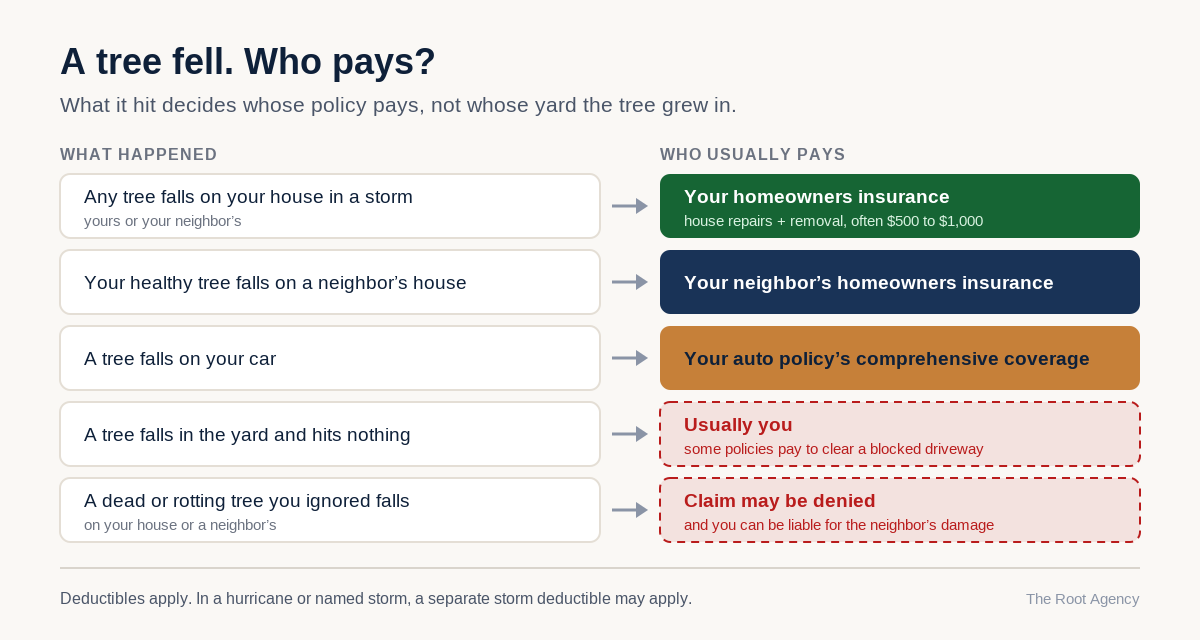
Yes. If wind, lightning or hail drops a tree on your house, your homeowners policy pays to repair the house and replace damaged belongings, and usually pays to remove the tree too (Triple-I). It doesn't matter whose yard the tree grew in. What usually isn't covered: removing a tree that fell without hitting anything, taking down a tree before it falls, and damage from a dead or rotting tree that was neglected.
In south Louisiana, with its live oaks, water oaks and pines, hurricanes and summer thunderstorms, this is one of the most common claims a homeowner files.
Who pays when a tree falls
A tree falls on your house
Your policy covers damage to the house from a tree knocked down by a covered peril such as wind, lightning or hail, along with damage to your belongings inside (Triple-I). A fence, shed or detached garage is covered too, under the other structures part of the policy.
Your deductible comes off first. If the tree came down in a hurricane or tropical storm, a separate hurricane or named-storm deductible may apply, often 2% to 5% of your dwelling coverage, which can be more than a modest tree repair. Your policy defines what triggers it: a named-storm deductible can apply to any named tropical storm, while a hurricane deductible may apply only to hurricanes. For other storms it's your regular or wind and hail deductible.
If the tree opened the roof and rain got in, the water damage is part of the same claim. See does homeowners insurance cover roof replacement or leaks?
Does homeowners insurance cover tree removal?
It depends on what the tree hit:
- It hit your house or another insured structure: removal is covered, generally up to about $500 to $1,000 depending on the insurer and policy (Triple-I). Many policies set a per-tree limit as well as a per-storm limit, so several trees don't multiply the coverage without end.
- It hit nothing: removal generally isn't covered. Some policies make an exception for a tree blocking your driveway or a ramp for a person with a disability.
- It hasn't fallen yet: preventive removal of a dead, leaning or overhanging tree isn't covered. It's maintenance.
After a big storm, tree crews are in short supply and prices jump. A large oak through a roof can cost several times the removal limit, especially when a crane is needed. Ask your agent what your policy's limit is before hurricane season, not after.
The trees themselves
Most policies also cover your trees, shrubs and plants, but only for a short list of causes: fire, lightning, explosion, theft, aircraft, vehicles not owned by someone in the household, vandalism and malicious mischief. That coverage is usually capped at 5% of your dwelling coverage, with a limit per tree (Triple-I). Windstorm usually isn't on that list, so a prized oak blown over in a hurricane typically isn't paid for as landscaping, only the damage it does and its removal.
Your neighbor's tree falls on your house
You still file with your own homeowners insurance. Each homeowner's policy generally covers their own property (Allstate), and in a hurricane, insurers rarely try to work out whose tree it was.
If the neighbor was at fault, your insurer may recover what it paid from them or their insurer, a process called subrogation, and you may get your deductible back (Triple-I).
When is a neighbor at fault in Louisiana? Under the Civil Code, the owner of a tree is responsible for damage caused by its defect only if they knew or should have known about it, the damage could have been prevented with reasonable care, and they didn't take that care (La. Civil Code art. 2317.1). A healthy tree toppled by hurricane winds usually isn't anyone's fault. A tree that was visibly dead for a year may be.
If a neighbor's tree looks dangerous, tell them in writing, with photos, and keep a copy. That record is what shows they knew. Louisiana also lets you demand that a neighbor trim branches or roots that extend onto your property and interfere with your use of it, at the neighbor's expense (La. Civil Code art. 688).
Your tree falls on your neighbor's house
If your tree was healthy and a storm brought it down, your neighbor files with their own insurance (Allstate). You're typically responsible only if neglect contributed, for example a dead tree you knew about and left standing. In that case the personal liability coverage on your homeowners policy is what responds. If you have significant assets, an umbrella policy adds protection above that limit.
A tree falls on your car
Homeowners insurance doesn't cover cars. A tree or limb on your car is a comprehensive claim on your auto policy (Allstate). Liability-only policies don't pay for your own car. If a neighbor's neglected tree did the damage, you may be able to claim against the neighbor's homeowners liability coverage instead. The same coverage handles flooding and hail; see does car insurance cover flood damage?
When a tree claim gets denied
- Neglect. Insurance usually won't pay when a tree that was rotting and ready to fall comes down (Allstate). Adjusters look at the stump and trunk for decay.
- Nothing was damaged. A tree in the yard is a cleanup cost, not a claim, unless it blocks your driveway and your policy covers that.
- Damage under the deductible. Ask your agent before filing a small claim. Claims history can affect your rate and, in Louisiana, whether your insurer renews you.
What to do after a tree falls
- Get everyone out safely and stay clear of downed power lines. Report them to your electric utility.
- Photograph everything before anything is moved: the tree, the stump or root ball, and all the damage.
- Prevent more damage. Have the roof tarped and openings covered. Reasonable emergency work is normally part of the claim, so keep every receipt.
- Report the claim to your insurer or agent promptly.
- Get written estimates from a licensed tree service and a contractor. Be wary of crews who knock on the door after a storm asking for cash up front.
How to prevent tree claims
- Have large trees near the house inspected by a certified arborist every few years, and after any big storm.
- Remove dead, leaning or hollow trees and limbs over the roof before hurricane season.
- Keep records of tree work and inspections. They show the tree wasn't neglected if it ever falls.
- Know your limits: your tree removal limit, your hurricane or named-storm deductible and your liability limit.
Check your tree coverage with a Baton Rouge agent
The Root Agency is a local Allstate agency on Goodwood Blvd. Send us your declarations page and we'll show you your tree removal limit, which deductible a fallen tree would use, and whether your liability coverage is enough if your tree lands on a neighbor's house. Call (225) 529-1990 or start with homeowners insurance in Baton Rouge.
This article is general information, not legal or insurance advice. Coverage depends on your policy's wording and limits; ask your agent or insurer about your own policy.