

The right amount of homeowners insurance isn't one number. It's five or six: one for the house, one for your belongings, one for living somewhere else while you rebuild, one for lawsuits, plus deductibles you can actually pay. Most people only think about the first, and many set it wrong by using their home's price or their loan balance. Here's how to set each one, with an example you can copy.
The short version
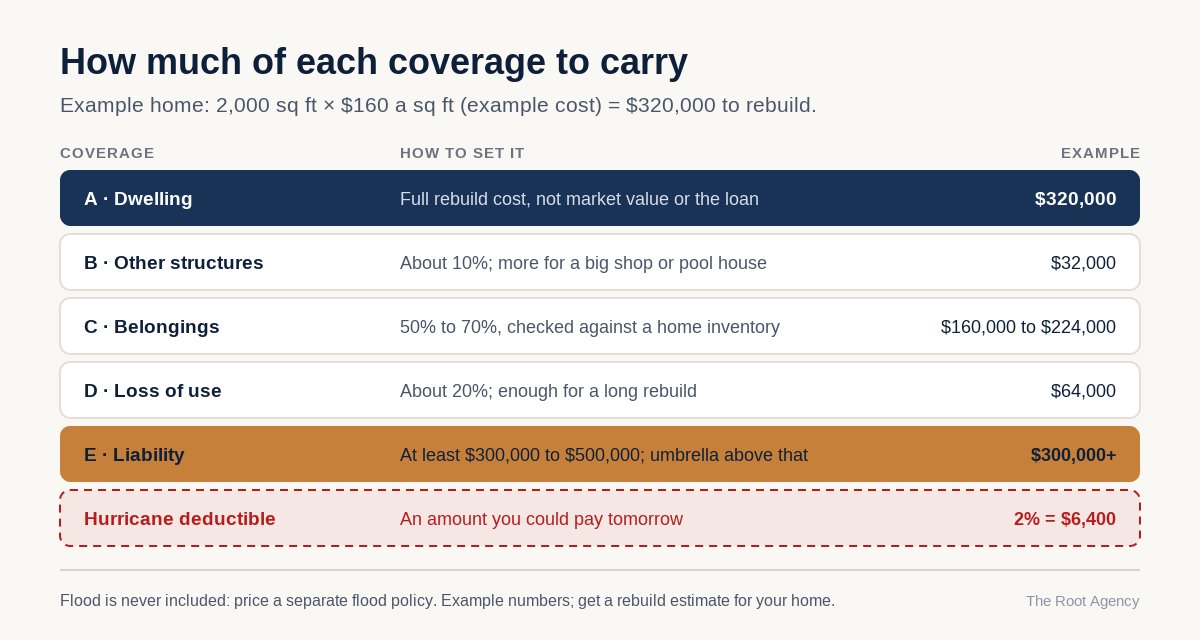
The rest of this guide explains each line, and the Louisiana wrinkles that change the answer.
1. Dwelling: insure the rebuild cost
Your dwelling coverage (Coverage A) should equal what it would cost to rebuild your home from the ground up at today's labor and material prices. Not the price you paid, not the market value and not what you owe. Market value includes the land, which doesn't need rebuilding, and a loan balance has nothing to do with construction costs (Triple-I).
A rough check: multiply your square footage by local building costs per square foot. A builder, a builders association or your agent can tell you the current figure. Then adjust for the things that raise it: brick or stone exterior, custom trim, extra bathrooms, a high-end kitchen, and any renovations you've made since the policy was written. Your insurer will also run a replacement cost estimate; ask to see it and check the square footage and features it used.
Two Louisiana add-ons are worth a look here:
- Extended replacement cost pays 5% to 25% above your limit if rebuilding costs more than expected (Triple-I). After a major hurricane, when everyone needs a roofer at once, prices jump.
- Ordinance or law pays toward bringing a damaged older home up to current code, which standard coverage generally doesn't.
Keep the limit current, too. Many policies only pay full replacement cost if your limit is at least 80% of the rebuild cost; see replacement cost vs. actual cash value. For more on Coverage A, see what is dwelling coverage?
2. Other structures: start at 10%
Other structures (Coverage B) covers fences, sheds, a detached garage or carport, a gazebo. The default is usually 10% of your dwelling coverage. That's plenty for a fence and a shed, and too little for a detached workshop, a pool house or a long run of wood fence. Add up what yours would cost to replace and raise the limit if needed.
3. Belongings: count, don't guess
Personal property coverage (Coverage C) is usually set at 50% to 70% of your dwelling coverage (Triple-I). Whether that's enough depends on what you own, and the only way to know is a home inventory: walk through each room, closet, the garage and the attic with your phone recording, then estimate what it would cost to replace everything new. Most people are surprised by the total.
- Add replacement cost for belongings. Without it, many policies pay only the depreciated value of a five-year-old couch or TV. Triple-I puts the extra cost at about 10% and calls it generally worthwhile.
- Schedule valuables. Policies cap theft of jewelry, guns, silverware, furs and collectibles at low limits; jewelry may be limited to under $2,000 (Triple-I). An engagement ring or a gun collection needs a scheduled personal property endorsement.
- Keep the inventory somewhere else. A cloud folder or email to yourself survives a fire or hurricane; a notebook in the kitchen drawer doesn't.
4. Loss of use: plan for a long rebuild
Loss of use (Coverage D), also called additional living expenses, pays the extra cost of living elsewhere while your home is repaired: rent or a hotel, meals above your normal grocery bill, extra mileage. Many policies set it around 20% of the dwelling limit, and some instead cover a set period of time (Triple-I). After a widespread storm, rebuilding can take months and rentals near Baton Rouge fill up fast, so check whether your limit, or time limit, would cover a long stay.
5. Liability: match what you could lose
Personal liability (Coverage E) pays if someone is hurt on your property or you damage someone else's, including your legal defense. Most policies start at $100,000, and $300,000 to $500,000 is increasingly recommended (Triple-I). A practical rule: carry at least as much as you could lose in a lawsuit, meaning your savings, investments and home equity.
If that's more than your homeowners policy offers, an umbrella policy adds $1 million or more on top. Most insurers require about $300,000 of underlying liability on your homeowners policy before they'll write one. A pool, a trampoline, a dog or teenage drivers in the house are all reasons to look. See is umbrella insurance worth it?
6. Deductibles: pick an amount you could pay tomorrow
Most Louisiana policies have two deductibles: a flat one, like $1,000 or $2,500, for most claims, and a hurricane or named-storm deductible that's a percentage of your dwelling coverage. On a $320,000 dwelling limit, 2% is $6,400 and 5% is $16,000. A higher deductible lowers your premium, but only choose one you could cover from savings the week after a storm. See how hurricane deductibles work in Louisiana.
If you have a mortgage, your lender may limit how high you can go. For loans sold to Fannie Mae, no deductible can exceed 5% of the coverage amount, and that applies separately to a windstorm deductible (Fannie Mae Selling Guide).
What your lender requires isn't the same as enough
Lenders set minimums to protect their loan, not your finances. Fannie Mae, for example, requires the policy to settle claims on a replacement cost basis, except the roof, which only has to be insured (Fannie Mae Selling Guide). A lender doesn't check whether your belongings, loss of use or liability limits fit your life. Those are up to you.
Don't forget flood
None of the numbers above include flood. Homeowners policies exclude it, and Louisiana homes flood outside high-risk zones, too. An NFIP flood policy covers a home up to $250,000 for the building and $100,000 for contents. If your home costs more than that to rebuild, ask about private or excess flood coverage. See how much flood insurance costs in Louisiana.
When to recheck your numbers
- Every renewal. Building costs change, and an inflation guard endorsement can raise your dwelling limit automatically (Triple-I).
- After a renovation or addition. A new kitchen, bathroom or room adds to the rebuild cost.
- After a big purchase of jewelry, guns, electronics or art.
- When your savings grow, so your liability limit keeps up.
- After a major storm, when local construction costs can stay high for a long time.
Get your coverage amounts checked in Baton Rouge
The Root Agency is a local Allstate agency on Goodwood Blvd. Send us your declarations page and we'll compare each limit to your home's rebuild cost, your belongings and your savings, show you what a different deductible would do to your premium, and quote flood insurance alongside it. Call (225) 529-1990 or start with homeowners insurance in Baton Rouge.
This article is general information, not insurance advice. The right limits depend on your home, belongings, finances and lender; ask your agent about your own policy.