

Two homeowners can have the same fire, the same deductible and the same insurer, and get very different checks. The difference is one line on the declarations page: whether the damage is settled at replacement cost or actual cash value. Replacement cost pays to put things back at today's prices. Actual cash value pays what the damaged things were worth, after depreciation (Allstate). Here's how each one works, what the gap looks like on a real-sized claim, and what Louisiana law adds.
Replacement cost vs. actual cash value, in one sentence each
- Replacement cost (RC) pays what it costs to repair or replace damaged property with new materials of similar kind and quality, without subtracting depreciation.
- Actual cash value (ACV) pays what the property was worth at the time of the loss. Most insurers figure it as replacement cost minus depreciation for age, wear and condition.
Your deductible comes off either way. Depreciation is the part that only comes off under actual cash value.
What the difference looks like on a claim
Say a kitchen fire does $40,000 of damage. The cabinets, counters and appliances are 12 years old, so the adjuster figures $14,000 of depreciation. Your deductible is $2,500.
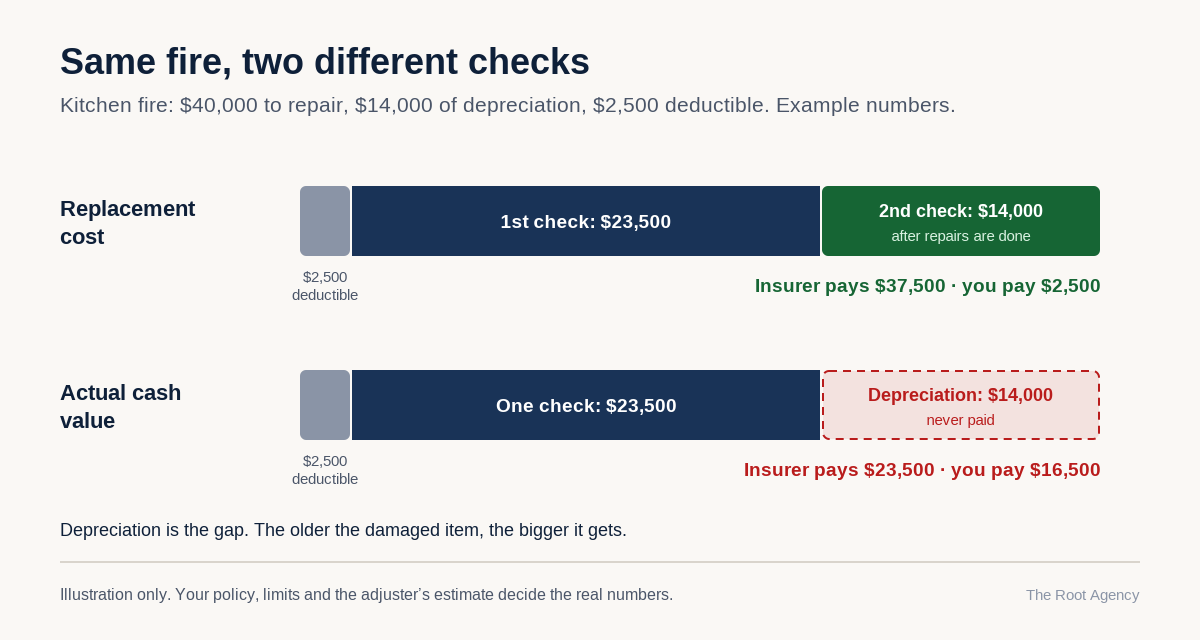
- With replacement cost: the insurer pays $37,500. You pay the $2,500 deductible.
- With actual cash value: the insurer pays $23,500. You pay $16,500 to finish the kitchen.
The older the damaged property, the bigger that gap. On something brand new there's almost no difference; on a 20-year-old roof, depreciation can be most of the bill.
Why replacement cost claims come in two checks
Even with replacement cost coverage, most insurers don't pay it all up front. They pay the actual cash value first, minus your deductible. The rest, called recoverable depreciation or the holdback, comes after you've made the repairs or bought the replacement and sent proof, such as a contractor's final invoice or receipts.
Three things to know about the holdback:
- You have to do the work to get it. If you take the first check and don't repair or replace, you generally keep only the actual cash value.
- There's usually a deadline. Policies set a time limit to complete repairs and claim the holdback. Check yours, and if a contractor shortage after a storm will push you past it, ask the insurer for an extension in writing.
- In Louisiana, prove the deductible. Since 2025, an insurer can hold the recoverable depreciation until it receives reasonable proof that you paid your deductible (La. R.S. 22:1892). Keep the receipt that shows you paid it. A contractor who offers to “cover” your deductible is offering something Louisiana law prohibits (La. R.S. 51:451).
How depreciation is calculated, and Louisiana's limits on it
The adjuster starts with what it would cost to replace the item today, then subtracts depreciation based on its age, condition and expected life. A roof with a 25-year life that's 15 years old might be depreciated 60%. A five-year-old TV might be worth a fraction of its price.
Louisiana sets some ground rules. An insurer can depreciate labor as well as materials, but it can't treat contractor overhead and profit or sales tax as depreciation when it figures actual cash value, and it has to explain in writing how it calculated depreciation (La. R.S. 22:1892). If the depreciation on your estimate looks high, ask for that written explanation and compare it to the item's real age and condition.
What's usually covered at which
| Part of the policy | Usual settlement | What to check |
|---|---|---|
| The house (Coverage A) | Replacement cost on most policies | Whether the limit would rebuild the home today |
| The roof | Often actual cash value or a payment schedule on older roofs | Endorsements that say “roof surface,” “payment schedule” or “ACV roof” |
| Belongings (Coverage C) | Actual cash value unless you add replacement cost | A personal property replacement cost endorsement |
| Older homes | Sometimes modified replacement cost | Whether plaster, old-growth wood or custom trim would be replaced with modern materials |
| Flood insurance belongings | Actual cash value only | That your flood contents limit fits what you own |
Most policies insure the house itself at replacement cost (Allstate). Belongings are where people get surprised: many policies settle them at actual cash value unless you add replacement cost coverage, which Triple-I puts at about 10% more in premium and calls generally worthwhile. Flood insurance pays for belongings only at actual cash value (Triple-I). For roofs, see does homeowners insurance cover roof replacement?
The 80% rule: when replacement cost isn't paid in full
Replacement cost coverage on the house usually comes with a condition: your dwelling limit has to be at least 80% of the cost to rebuild the home at the time of the loss. Fall below that and a partial loss is paid at the greater of actual cash value or a reduced share of replacement cost (NY Department of Financial Services). Some insurers set the line at 90% or 100%.
Here's how it works. A home costs $300,000 to rebuild, so 80% is $240,000. The owner carries $200,000. A storm does $20,000 of damage. Because $200,000 is only five-sixths of $240,000, the policy pays about $16,667 before the deductible instead of $20,000, or the actual cash value if that's higher.
Building costs have jumped since many Louisiana policies were first written, so a limit that was fine five years ago can be under 80% now. An inflation guard endorsement raises the limit at each renewal, and Coverage A should match today's rebuild cost, not the market value or the mortgage.
Upgrades beyond replacement cost
- Extended replacement cost pays a set amount above your dwelling limit, usually 5% to 25%, if rebuilding costs more than expected (Triple-I). After a major hurricane, when materials and labor spike across south Louisiana, that cushion matters.
- Guaranteed replacement cost pays whatever it takes to rebuild as the home was, even above the limit. Only a limited number of insurers offer it.
- Ordinance or law pays toward bringing a damaged home up to current building code. Replacement cost alone, even guaranteed, generally doesn't cover code upgrades.
Louisiana's valued policy law on a total loss
Louisiana has a valued policy law. If a home insured under a policy that covers fire is a total loss from a covered peril, and the insurer valued the home to set your premium, the insurer has to pay that valuation without deductions or offsets, unless the policy and application spell out a different method for figuring the loss in type of equal size (La. R.S. 22:1318). The payment can't exceed your insurable interest in the property.
Two caveats. Many policies now state another loss method, so read your loss settlement section. And it applies to destruction from a covered peril: a home destroyed by flood under a homeowners policy isn't covered in the first place. That takes a separate flood policy.
When actual cash value makes sense
Replacement cost is the better coverage for nearly everyone who plans to repair or rebuild. Actual cash value is cheaper, and it can be the only option in a few situations:
- An older roof that some insurers will cover only at actual cash value. Taking it keeps you insured, and a new or FORTIFIED roof later can move you back to replacement cost.
- A rental or vacant property you wouldn't rebuild exactly as it was.
- A tight budget, as long as you understand you're choosing a lower premium now for a bigger out-of-pocket bill after a claim.
How to tell which one you have
Look at your declarations page and the endorsements listed on it. Words to look for are “replacement cost,” “actual cash value,” “loss settlement,” “personal property replacement cost,” “roof surface payment schedule” and “extended replacement cost.” Check the dwelling, the roof and your belongings separately, because they often settle differently. For the rest of what's on that page, see what does homeowners insurance cover?
Check your loss settlement with a Baton Rouge agent
The Root Agency is a local Allstate agency on Goodwood Blvd. Send us your declarations page and we'll show you whether your house, roof and belongings are covered at replacement cost or actual cash value, whether your dwelling limit clears the 80% line, and what it would cost to upgrade. Call (225) 529-1990 or start with homeowners insurance in Baton Rouge.
This article is general information, not insurance or legal advice. How a claim is settled depends on your policy form, endorsements, limits and the facts of the loss.