
Homeowners insurance covers foundation damage when something sudden and covered caused it: a pipe bursting under the slab, a fire, an explosion, a car crashing into the house. It doesn't cover the far more common cause of foundation trouble in south Louisiana: ground that moves slowly over time. Settling, cracking with age, clay soil that swells and shrinks, poor drainage and tree roots are all excluded (Allstate). Here's how to tell which side of the line your damage falls on.
The cause decides the claim
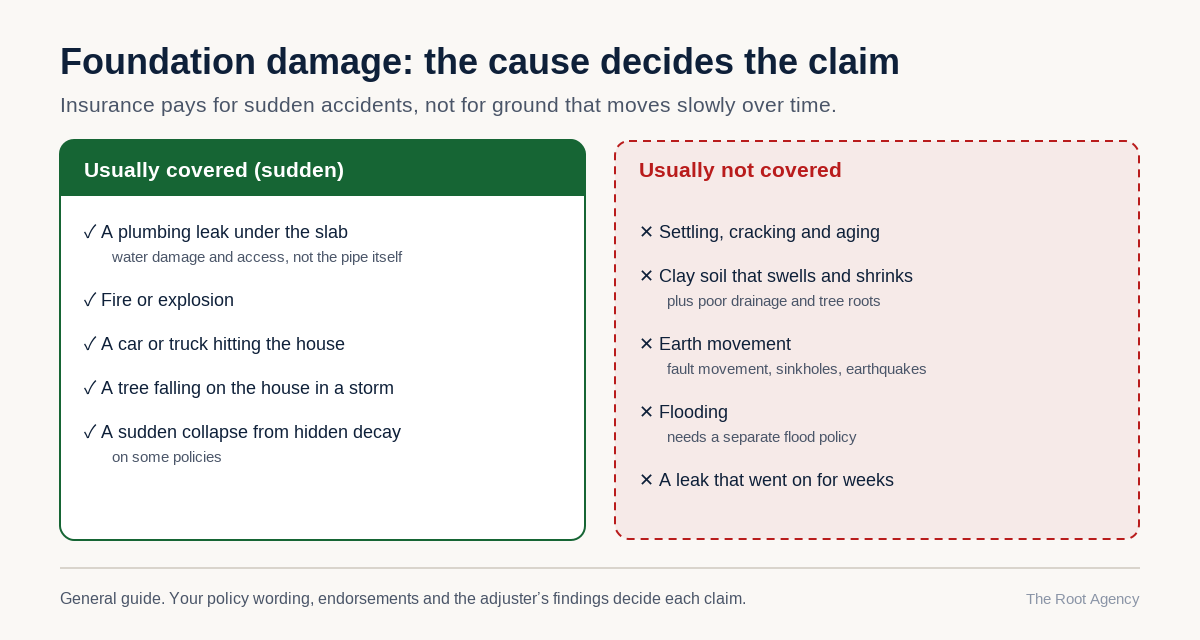
An adjuster looking at a cracked slab is asking one question: what caused it? The crack is the same either way. The answer, and the claim, depends on whether a covered event did the damage or the ground did it gradually.
When foundation damage is usually covered
- A plumbing leak under the slab. If a water line under the foundation breaks suddenly, many policies cover the resulting water damage and the cost of breaking into the slab or floor to reach the pipe and putting it back. The pipe repair itself usually isn't covered, and neither is damage from a leak that ran for weeks. See does homeowners insurance cover water damage?
- Fire or explosion. Extreme heat can crack concrete and damage footings. That's fire damage, and it's covered.
- A vehicle. A car or truck that hits the house can damage the foundation along with the walls. Your homeowners policy covers it, and you may also have a claim against the driver's insurance.
- A falling tree or other object in a storm. Wind damage that reaches the foundation is part of the wind claim. In a named storm, your hurricane deductible may apply. See does homeowners insurance cover tree damage?
- Sudden collapse, on some policies. Many policies include limited coverage when part of a house abruptly collapses because of hidden decay, hidden insect damage or defects nobody knew about. It's narrow, and gradual sagging doesn't count.
When it usually isn't
- Settling, cracking and aging. Every slab moves a little as a house ages. Insurers treat that as wear and tear.
- Soil that swells and shrinks. Clay soil expands when it's wet and contracts when it dries, pushing and dropping the slab with the seasons. Policies exclude it, along with poor soil compaction during construction (Allstate).
- Drainage and tree roots. Water pooling against the slab, gutters dumping at the foundation, and big trees pulling moisture from the soil are maintenance issues.
- Earth movement. Earthquakes, sinkholes, landslides and fault movement are excluded unless you buy separate earthquake or earth movement coverage, where it's available.
- Flooding. Floodwater that damages or undermines a foundation is a flood claim. Homeowners policies exclude it; a separate flood policy covers it.
One nuance: even when the foundation repair isn't covered, some damage that results from it can be. On many policies, if settling cracks a pipe and water suddenly pours out, the water damage may be covered even though fixing the foundation isn't. Ask your adjuster to look at each part of the damage separately.
Why foundation problems are common around Baton Rouge
Expansive clay soil
Much of Louisiana sits on clay soils that change volume with moisture. Researchers at LSU who mapped the risk found that all developed parts of the state face some risk from expansive soil, with losses concentrated in southeastern Louisiana. They estimated the historical average statewide property loss at about $66 million a year (in 2010 dollars), projected to grow 39% by 2050 (Mostafiz et al., LSU, 2021). That damage almost never shows up as an insurance claim, because policies exclude it.
Long dry spells followed by heavy rain are the hardest on slabs: the soil shrinks away from the foundation, then swells back unevenly.
The Baton Rouge fault
The Baton Rouge–Denham Springs fault system runs from Baton Rouge east toward Lake Pontchartrain and is still active. Where it crosses the lake, its faults generally move about 0.1 inch a year, with some evidence of up to 0.4 inch, and have visibly offset bridges (USGS). In Baton Rouge, damage to buildings, streets and sidewalks near the fault has been attributed to its movement (LSU thesis, 2002). Insurers treat fault movement as earth movement, so it isn't covered by a standard policy either.
Signs of foundation trouble to watch for
- Stair-step cracks in brick, or cracks running diagonally from the corners of doors and windows
- Doors and windows that stick or won't latch
- Sloping floors, or gaps between the floor and baseboards
- Cracks in tile floors over the slab
- A water bill that jumps for no reason, warm spots on the floor or the sound of running water: possible signs of a slab leak
A suspected slab leak is the one to act on fast. Shut off the water, call a plumber to locate the leak, and report it to your insurer quickly. The longer it runs, the more likely the damage is treated as gradual.
How to protect your foundation, and your claim
- Manage water. Keep gutters clean, extend downspouts several feet from the house, and grade soil so water runs away from the slab.
- Keep soil moisture steady. In long dry spells, some foundation contractors recommend watering around the perimeter so the soil doesn't shrink away from the slab.
- Mind the trees. Large trees close to the house can dry the soil under one side of it.
- Document cracks. Photograph and date them, with a ruler for scale. If a covered event happens later, a record of what was already there helps the adjuster separate old damage from new.
- Ask about a service line endorsement if your home is on a slab with older plumbing. It can cover repairs to buried pipes that a standard policy won't.
- Carry flood insurance. It's the only coverage for flood damage to your foundation.
If you think you have a covered foundation claim
- Stop the source if you can, like shutting off the water for a suspected leak.
- Photograph the damage and anything that shows the cause.
- Report the claim promptly and get a plumber's or engineer's written findings on the cause.
- Ask the adjuster which parts of the damage are covered and which aren't, in writing.
Louisiana requires insurers to start adjusting a property claim within 14 days of notice (30 days after a catastrophe) and to pay within 30 days of satisfactory proof of loss. See our roof claim guide for the details.
Questions about your coverage in Baton Rouge?
The Root Agency is a local Allstate agency on Goodwood Blvd. We can walk through what your policy says about water damage, collapse and earth movement, whether a service line endorsement is available, and quote flood insurance alongside it. Call (225) 529-1990 or start with homeowners insurance in Baton Rouge.
This article is general information, not insurance or engineering advice. Coverage depends on your policy wording, endorsements and the cause of the loss; for structural concerns, consult a licensed engineer or foundation contractor.