

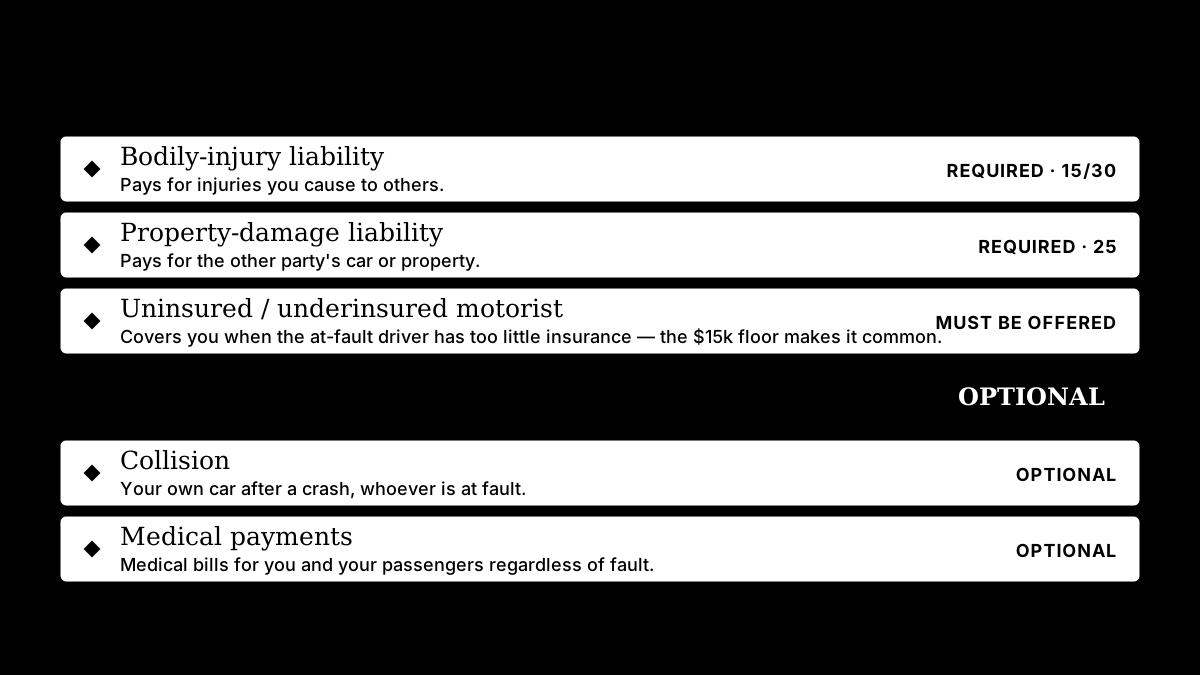
A Louisiana auto policy is built from six core coverages: bodily-injury liability, property-damage liability, uninsured/underinsured motorist, comprehensive, collision, and medical payments. Only liability — at least 15/30/25 — is legally required in Louisiana; the rest are optional but often essential. Two do especially heavy lifting here: comprehensive, because hurricanes, flooding, and hail total cars, and uninsured/underinsured motorist, because the state's $15,000 minimum leaves about a third of Louisiana drivers underinsured for a serious crash.
Most people carry auto insurance without ever being able to name what's actually on the policy — and that's where the guessing about “am I really covered?” comes from. A Louisiana auto policy is really six separate coverages, each doing a specific job, and once you can name them the whole thing stops being a mystery. This guide walks through every type of auto insurance coverage, what each one pays for, how much of it you need, and which ones matter most given Louisiana's weather, roads, and thin legal minimums. The team at The Root Agency — based in Baton Rouge and licensed statewide — helps drivers from Denham Springs across the capital region build policies around real risk, not just the legal minimum, and it starts with knowing the parts.

Key takeaways
- A standard auto policy is really six separate coverages, each paying for a different kind of loss.
- Only liability (15/30/25 minimum) is legally required to drive in Louisiana, per the Louisiana Department of Insurance.
- Comprehensive is the coverage that pays for flood, hail, wind, and theft — all very real in Louisiana.
- Louisiana is not a high-uninsured state (11.7% of drivers in 2023, below the 15.4% U.S. rate). Its problem is underinsurance — 35.6% of drivers in the IRC's latest state figures — which is exactly what UM/UIM covers.
- Your insurer must include UM/UIM, and you can only reject or reduce it in writing (R.S. 22:1295).
- “Full coverage” isn't a separate type — it's liability plus comprehensive and collision bundled together.
What auto insurance is legally required in Louisiana?
Only liability. To drive legally in Louisiana you must carry at least 15/30/25 in liability coverage — $15,000 for bodily injury to one person, $30,000 for injuries to more than one person in a single accident, and $25,000 for damage to someone else's vehicle or property — per the Louisiana Department of Insurance's Consumer's Guide to Auto Insurance (revised March 2026). Everything else on this list is optional by law, even though several of those optional coverages are the ones that actually protect you.
That distinction is the key to reading a policy. Liability protects other people from you; the rest protect you, your car, and your finances. The Insurance Information Institute lays out the same six building blocks, and the rest of this guide takes them one at a time so you can see exactly what each does. If your real question is whether the minimum is enough, our post on Louisiana's mandatory insurance minimums for 2026 goes deep on that.
What does bodily-injury and property-damage liability cover?
Liability is the required core, and it comes in two halves. Bodily-injury liability pays for injuries you cause to other people; property-damage liability pays for damage you cause to their vehicle or property. Per the LDI guide, it follows you, your family members, and anyone driving your car with your permission.
Louisiana's minimum is 15/30/25. Here's the catch: those limits are thin for how expensive real accidents get, and anything above them comes out of your pocket. A single serious injury or a totaled newer vehicle can exceed $25,000–$30,000 in minutes. For most drivers, higher liability limits are worth far more than the small premium difference. We break the concept down further in our guide to liability insurance explained simply for Louisiana residents.
What is uninsured/underinsured motorist coverage — and why does it matter here?
It's the coverage that pays when the other driver can't. Uninsured/underinsured motorist (UM/UIM) coverage steps in when you're hit by someone with no insurance, or not enough to cover your injuries and damage.
Here's the part most articles get wrong: Louisiana is not a high-uninsured state. According to the Insurance Research Council's 2023 figures, published by the Insurance Information Institute, 11.7% of Louisiana drivers were uninsured — 32nd among the states and below the 15.4% U.S. rate. The Louisiana problem is underinsurance. In the IRC's most recent state-by-state breakdown (2022 data, released April 2023), 35.6% of Louisiana drivers were underinsured — one of the five highest shares in the country — and nationally the underinsured rate had climbed to 18.0% by 2023, per the IRC's 2025 study. The reason is the $15,000 floor: a driver carrying the legal minimum is “insured,” but one hospital stay can use up their entire bodily-injury limit, and the rest falls on you unless you carry UIM.
That's why Louisiana law treats this coverage differently from the other optional ones. Under R.S. 22:1295, every auto policy must include UM/UIM at your liability limits unless you reject it, choose lower limits, or choose the cheaper “economic-only” version — and each of those choices has to be made in writing. UM has two parts, per the LDI guide: bodily injury (your medical bills and, unless you chose economic-only, pain and suffering) and an optional property-damage part that repairs your car after an uninsured driver hits it, with a $250 deductible and recovery generally capped at $25,000 or the car's actual cash value, whichever is less, unless you buy a higher limit. Dropping UM/UIM to save a few dollars is one of the riskiest trims you can make on a Louisiana policy. For a full breakdown, see our guide to uninsured motorist coverage in Louisiana.
What does comprehensive coverage pay for?
Comprehensive covers damage to your car from almost anything other than a collision. The Insurance Information Institute puts it this way: “Comprehensive covers events such as fire, falling objects, missiles, explosion, earthquake, windstorm, hail, flood, vandalism, riot, or contact with animals such as birds or deer.” Theft is covered too.
In Louisiana, this is not a throwaway coverage. This is a state of hurricanes, flooding, and hail, and comprehensive is the coverage that pays when the weather — not another driver — damages or totals your car. The LDI guide answers the question we hear after every big storm: if you drove through high water and carry comprehensive, you will “more than likely” be covered; with liability-only or liability-plus-collision, you very probably won't be. (Flooding to your home is a separate policy entirely.) On any car you couldn't easily replace out of pocket, comprehensive earns its cost here.
What does collision coverage pay for — and what is a deductible?
Collision pays to repair or replace your car after a crash — whether you hit another vehicle, a stationary object like a guardrail or mailbox, or your car rolls over. It applies regardless of who's at fault; if the other driver caused it, your insurer pays you and then pursues their insurer.
Collision is always sold with a deductible, and it's the easiest term on a policy to misunderstand. A deductible is your share of a physical-damage claim before the insurer pays: with a $500 deductible and $4,000 of damage, you pay $500 and the insurer pays $3,500. Choosing a higher deductible lowers your premium — the III estimates that moving from a $200 to a $500 deductible cuts the cost of collision and comprehensive by 15 to 30 percent, and a $1,000 deductible can save 40 percent or more (III, “Nine ways to lower your auto insurance costs”). The trade-off is that you need to have that amount on hand the day something happens. For how deductibles and limits play out in a real claim, see our companion post on how auto insurance works.
Comprehensive and collision are often bought together as the “physical damage” side of a policy. They're optional by law, but if you finance or lease your vehicle, your lender will require both until the loan is paid off. On an older car worth very little, collision can eventually cost more than it would ever pay out — the LDI guide suggests comparing your annual premium to the car's book value minus your deductible.
What is medical payments coverage — and does Louisiana use PIP?
Medical payments coverage (often called MedPay) helps pay medical bills for you, your family members, and your passengers after an accident, no matter who caused it. It pays for a set period after the crash up to your chosen limit and, per the LDI guide, includes funeral expenses.
You'll see “personal injury protection” (PIP) on national explainers; that's the no-fault version sold in no-fault states. Louisiana is a fault state, so the coverage sold here is MedPay, and it's optional. Think of it as fast, fault-neutral help for injuries — it kicks in without waiting to sort out blame, which can matter in the days right after a crash. If you have good health insurance you may not need it for yourself (the LDI guide says as much), but it's an inexpensive way to cover passengers and your health plan's deductible.
What optional add-ons round out a policy?
Beyond the core coverages, a few optional add-ons handle specific gaps. Each solves a real problem for the right driver.
- Gap insurance — pays the difference between what you owe on your loan or lease and what your car is actually worth if it's totaled. Valuable if you financed with little down or lease. Our Louisiana gap insurance guide covers who needs it and who can skip it.
- Rental reimbursement — covers a rental car while yours is being repaired after a covered claim.
- Roadside assistance — towing, jump-starts, lockouts, and flat-tire help.
None of these are required, but each can be worth adding depending on your situation. Bundle the core coverages plus the add-ons you need and you get what people casually call “full coverage” — which isn't a separate product at all. See our guide to what full coverage auto insurance means for drivers.
How much coverage do you need?
More than the minimum on the liability side, and a deductible you could actually pay tomorrow on the physical-damage side. The state minimum is a legal floor, not a recommendation: the III's guidance is blunt that “accidents cost more than the minimum limits,” and in Louisiana anything above your $15,000/$30,000/$25,000 comes out of your savings and future wages.
A practical way to size it:
- Liability limits — pick limits that cover what you could lose in a lawsuit: home equity, savings, income. If that exceeds what an auto policy will sell you, an umbrella policy adds $1 million or more on top for, per the III, typically $200 to $300 a year. See what a personal umbrella policy does.
- UM/UIM — match your liability limits. It's priced well below liability, and it's the coverage that pays you.
- Comprehensive and collision — carry both on any car you couldn't replace out of pocket, with a deductible you can cover today.
- MedPay — a few thousand dollars is cheap and useful if your health plan has a high deductible.
Our post on Louisiana's 2026 mandatory minimums walks through why the legal floor is where the conversation starts, not where it ends, and our Louisiana auto insurance guide ties the coverages, the law, and the costs together in one place.
Who is covered, and when?
Your policy follows your household and, in most cases, your car. Per the LDI guide, liability coverage applies to you, your family members, and anyone driving your vehicle with your permission — a licensed friend who borrows your car with your say-so is covered under your policy, unless they've been specifically excluded on it. You and your family members are also covered when driving someone else's car, including a rental.
The gaps to know: a company car or another vehicle “regularly available” to you may not be covered without an endorsement; personal policies exclude carrying passengers for hire, so driving for a ride-share app needs its own coverage; and physical-damage coverage doesn't automatically extend to a trailer you're towing. When in doubt, the LDI's advice is ours too — ask your agent before you assume.
Not sure which coverages you actually have?
The best way to know whether your policy fits your real risk is to see it laid out coverage by coverage. The team at The Root Agency will walk through your auto policy with you, explain what each type covers, and flag any gaps — like missing uninsured-motorist or comprehensive coverage — that could leave you exposed. When you're ready, start on our auto insurance page or reach the team serving Denham Springs — we're based in Baton Rouge and licensed across Louisiana — and we'll make sure your coverage matches your life.
This article is general information, not a quote or insurance advice. Coverage details and requirements vary by your specific situation — talk with a licensed agent about your policy.