

What Does Full Coverage Auto Mean for Drivers?

Full coverage auto insurance is an informal term for a policy that combines liability, collision, and comprehensive coverages to protect you, your vehicle, and others from a wide range of financial losses. The phrase “what does full coverage auto mean” has no single legal definition in any state, including Louisiana. No standardized definition exists across insurers, which means two drivers paying similar premiums can have very different levels of protection. Understanding exactly what sits inside your policy is the difference between being covered and being caught off guard.
What does full coverage auto mean, simply?
Full coverage auto insurance is a shorthand term, not an official insurance product. Liability, collision, and comprehensive are the three distinct coverage categories that typically make up what people call full coverage. Each one serves a different purpose, and none of them is optional in the same way.
Liability coverage pays for injuries and property damage you cause to other people. Louisiana law requires every driver to carry minimum liability limits. Collision and comprehensive are separate categories that protect your own vehicle, and they are generally optional under state law but frequently required by lenders.

The term “full coverage” became popular because it sounds complete. The reality is that your actual protection depends entirely on the limits, deductibles, and add-ons written into your specific declarations page.
What are the main components of full coverage auto insurance?
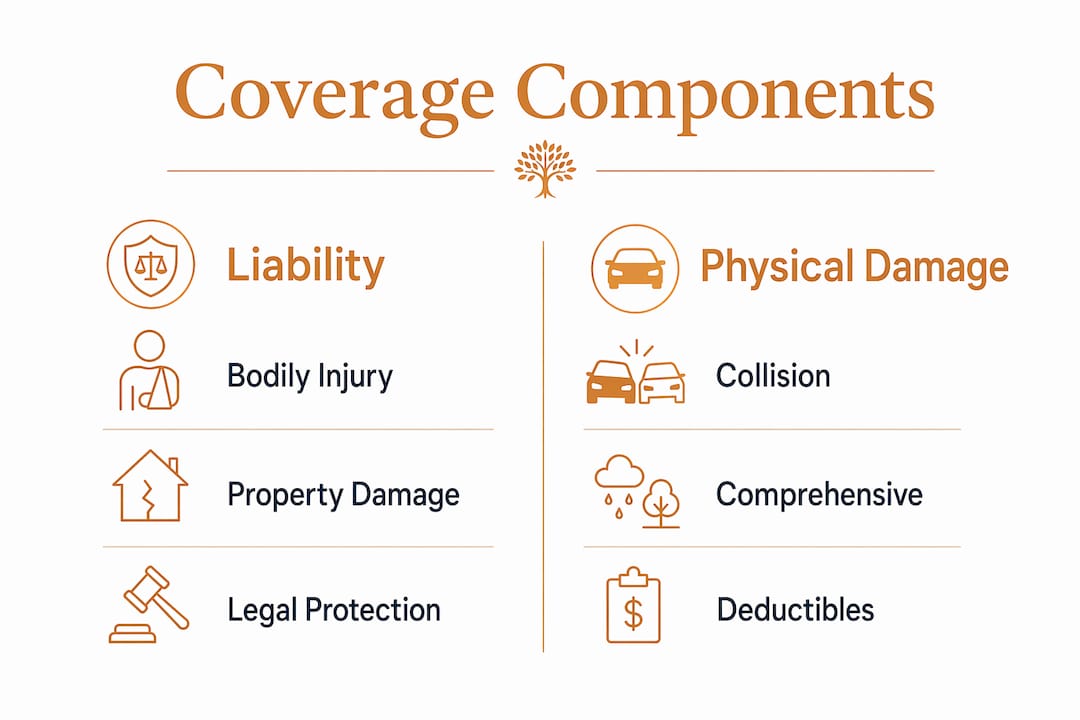
Three coverage types form the foundation of any full coverage auto policy.
- Liability coverage pays for bodily injury and property damage you cause to others in an at-fault accident. Louisiana sets minimum liability limits by law, but those minimums are often too low to cover a serious crash. Carrying higher limits protects your personal assets if a judgment exceeds your coverage.
- Collision coverage pays to repair or replace your vehicle after a crash, regardless of who caused it. Collision covers crash damage with a deductible you select, typically ranging from $250 to $1,500. A higher deductible lowers your premium but increases your out-of-pocket cost after a loss.
- Comprehensive coverage pays for damage caused by events other than collisions. Theft, vandalism, fire, hail, and flooding all fall under comprehensive. For Louisiana drivers, this coverage matters enormously. The state sits in the path of Gulf storms, and hail and flood damage are real, recurring risks.
Pro Tip: Review your declarations page every renewal period. The page lists your exact coverage types, limits, and deductibles. If you cannot find collision or comprehensive listed there, you do not have full coverage regardless of what you were told at the time of purchase.
Each coverage type has a separate deductible and limit. Buying all three together is what most people mean when they say full auto coverage, but the quality of that coverage depends on the numbers attached to each component.
How do lender requirements affect full coverage auto insurance?
Lenders require collision and comprehensive coverage as a contractual condition of your auto loan or lease. This is a contractual requirement, not a state law mandate. Your lender has a financial interest in the vehicle until you pay off the loan, and they want that asset protected against physical damage.
Most lenders also specify deductible caps, often $500 or $1,000 maximum, and may require you to list them as a lienholder on your policy. Failing to meet these requirements gives your lender the right to purchase force-placed insurance on your behalf. Force-placed insurance protects only the lender’s interest, not yours, and it typically costs significantly more than a standard policy.
Here is what to verify before assuming your policy satisfies your lender:
- Confirm collision and comprehensive are both listed on your declarations page.
- Check that your deductibles do not exceed the cap your lender specifies.
- Verify your lender is listed as a lienholder or loss payee on the policy.
- Confirm your liability limits meet or exceed any minimums your lender requires.
Pro Tip: When you finance or lease a vehicle, ask your lender for their written insurance requirements before you shop for coverage. Bring that document to your agent so your policy is built to satisfy both state law and your loan agreement from day one.
Lender requirements exceed state minimums in almost every case. Treating your policy as compliant without verifying the details is a common and costly mistake.
What are common misconceptions about full coverage auto insurance?
The biggest misconception is treating full coverage as a guaranteed, all-inclusive package. Full coverage does not mean unlimited protection. Gaps exist in almost every policy, and most drivers do not discover them until they file a claim.
Here are the most common gaps to watch for:
- Rental reimbursement is not automatic. If your car is in the shop after a covered loss, you may be paying for a rental out of pocket unless you specifically added rental reimbursement coverage to your policy.
- Roadside assistance is a separate add-on. Towing, flat tire service, and lockout assistance are not included in standard collision or comprehensive coverage.
- Gap insurance is not part of full coverage. If you owe more on your loan than your car is worth, gap insurance pays the difference after a total loss. Without it, you could owe thousands to your lender after your insurer settles.
- Liability limits do not increase automatically. Inadequate liability limits expose you to personal financial risk even when you carry collision and comprehensive. Many drivers assume full coverage means high liability limits. It does not.
- Uninsured motorist coverage is separate. Louisiana has a significant number of uninsured drivers on the road. Without uninsured motorist protection, you may have no recourse if an at-fault driver carries no insurance.
Pro Tip: Ask your agent to walk through your declarations page line by line at least once. Most coverage gaps are discovered in five minutes of conversation that never happened at the time of sale.
Insurers vary widely in what they bundle under the full coverage label. Never assume two policies with the same name offer the same protection.
Full coverage vs. liability-only: what is the real difference?
Liability-only coverage pays for damage and injuries you cause to others. It does not pay a single dollar toward repairing or replacing your own vehicle. Full coverage adds collision and comprehensive to that foundation, which means your car is also protected after a crash, a theft, or a storm.
Full coverage costs about $136 per month on average, compared to $67 per month for liability-only. That difference reflects the added financial protection for your own vehicle. For a financed or newer vehicle, the math almost always favors full coverage.
| Coverage Feature | Liability Only | Full Coverage |
|---|---|---|
| Damage you cause to others | Covered | Covered |
| Your vehicle after a crash | Not covered | Covered (collision) |
| Theft, weather, vandalism | Not covered | Covered (comprehensive) |
| Required by lenders | No | Yes |
| Average monthly cost | ~$67 | ~$136 |
| Protects your financial assets | Partially | More completely |
The right choice depends on your vehicle’s value, your loan status, and your ability to absorb a large out-of-pocket loss. For Louisiana drivers, where hail, flooding, and storm damage are annual realities, liability-only coverage leaves a wide-open gap that can cost tens of thousands of dollars to fill after a single weather event.
What practical steps should you take to choose the right policy?
Choosing the right full coverage auto policy starts with knowing your specific situation, not just picking a number from an online quote tool.
- Know your state minimums. Louisiana requires minimum liability coverage, but those minimums are a floor, not a recommendation. Most experienced agents suggest carrying significantly higher limits to protect your savings and assets.
- Check your lender’s requirements. Pull out your loan or lease agreement and confirm the exact coverage types, deductible caps, and lienholder listing requirements before you shop.
- Assess your vehicle’s value. If your car is worth less than $4,000, the cost of collision and comprehensive may exceed the potential payout. For newer or financed vehicles, full coverage is almost always the right call.
- Add the coverages that match your life. Rental reimbursement, roadside assistance, gap insurance, and uninsured motorist coverage each address a specific risk. Review the Louisiana auto insurance guide to understand which add-ons matter most for drivers in this state.
- Review your policy every year. Your vehicle depreciates, your loan balance changes, and your life circumstances shift. A policy that was right two years ago may leave gaps today.
Working with a knowledgeable local agent is the most reliable way to build a policy that fits your actual situation. Online quotes give you a price. A trusted agent gives you coverage that holds up when you need it.
Key takeaways
Full coverage auto insurance is not a standardized product. Its value depends entirely on the specific coverages, limits, and deductibles written into your policy.
| Point | Details |
|---|---|
| Full coverage is informal shorthand | No legal definition exists; always verify your declarations page for actual coverages. |
| Three core components | Liability, collision, and comprehensive each serve a distinct purpose and have separate limits. |
| Lenders require physical damage coverage | Collision and comprehensive are contractually mandated for financed or leased vehicles. |
| Gaps are common | Rental reimbursement, gap insurance, and roadside assistance are not automatic inclusions. |
| Cost difference is significant | Full coverage averages $136 per month versus $67 for liability-only, reflecting broader vehicle protection. |
What i’ve learned after years of watching clients discover their gaps
The most difficult conversations I have with clients happen after a loss, not before one. A driver calls after a hailstorm totals their car and learns their deductible is $2,000 because they picked the cheapest option online. Another client finds out their “full coverage” policy never included comprehensive because the quote tool defaulted to collision only. These are not rare situations. They happen regularly.
The phrase “full coverage” gives people a sense of security that the actual policy may not support. I have seen clients with financed vehicles, years into their loans, who had no idea their lender required them to carry specific deductible limits. They were technically in breach of their loan agreement and did not know it.
Louisiana adds another layer of risk that drivers in other states do not face at the same level. Hail, flooding, and hurricane-related losses are not hypothetical here. They are annual events for many families. A policy that looks fine on paper but excludes comprehensive, or carries a $2,500 deductible, is not adequate protection for this state.
My advice is direct: do not let price be the primary filter when choosing auto coverage. The $30 you save each month is not worth the $15,000 gap you discover after a total loss. Work with an agent who reads your policy with you, not just at you. Ask about every line on your declarations page. And review that page every single year.
— David
Get the right auto coverage for louisiana roads
At Steverootagency, we have spent more than 20 years helping Louisiana drivers build auto policies that actually hold up when something goes wrong. Steve Root and the team at The Root Agency carry a 40-year family legacy in Louisiana insurance, 356 Google reviews at 4.9 stars, and the kind of local knowledge that only comes from staying in this state through every storm season.
We do not sell you the cheapest policy. We build you the right one. Whether you are financing a new vehicle, reviewing an existing policy, or starting from scratch, we will walk through every coverage type and limit with you. Get your auto insurance quote today, or call us at (225) 926-0160 to speak with an agent who knows Louisiana roads and Louisiana risks.
FAQ
What does full coverage auto mean simply?
Full coverage auto insurance is an informal term for a policy that includes liability, collision, and comprehensive coverage. It is not a legally defined product, so actual protection varies by insurer and policy terms.
Is full coverage required by law in louisiana?
Liability coverage is required by Louisiana law, but collision and comprehensive are not state mandates. Lenders require collision and comprehensive as a contractual condition for financed or leased vehicles.
Does full coverage pay for a rental car after an accident?
Not automatically. Rental reimbursement is a separate add-on that must be specifically included in your policy. Without it, you pay for a rental out of pocket while your vehicle is being repaired.
How much more does full coverage cost than liability only?
Full coverage averages about $136 per month compared to $67 per month for liability-only coverage. That difference reflects the added cost of collision and comprehensive protection for your own vehicle.
What is gap insurance and is it part of full coverage?
Gap insurance pays the difference between what you owe on your loan and what your car is worth after a total loss. It is not included in standard full coverage policies and must be added separately.