

Auto insurance works as a trade: you pay a predictable premium, and in exchange your insurer pays for covered losses — up to your policy limits and after your deductible — when something goes wrong. If you cause a crash in Louisiana, your liability coverage (the state requires at least 15/30/25) pays the other party; if your own car is damaged, your collision or comprehensive coverage pays to repair or replace it. Because Louisiana is a fault-based state, who caused the crash decides whose insurance pays — and since January 1, 2026, a driver who is 51% or more at fault recovers nothing.
Auto insurance is one of those things almost everyone buys and very few people fully understand — until they're standing at an intersection after a fender-bender wondering what happens next. At its core, it's a simple trade you make before anything goes wrong: you pay a predictable premium so the insurer absorbs an unpredictable, expensive loss. This plain-English guide walks through how auto insurance actually works in Louisiana — the basic deal, what the state requires, how a claim plays out step by step, how fault decides who pays, and what sets your premium. The team at The Root Agency in Baton Rouge — licensed statewide — explains these mechanics to drivers every day, and they click fast once you see them in action.

Key takeaways
- You pay a premium; the insurer covers losses up to your limits after you pay your deductible.
- A “limit” is the most your policy pays for a covered loss; a “deductible” is your share before coverage kicks in.
- Louisiana requires 15/30/25 liability coverage. Driving without it means $100–$500 reinstatement fees, losing your plate, and — under “No Pay, No Play” — forfeiting the first $100,000 of your own injury and damage claims.
- In Louisiana's fault-based system the at-fault driver's insurance pays; under Act 15 of 2025, a driver 51% or more at fault recovers nothing for crashes on or after January 1, 2026.
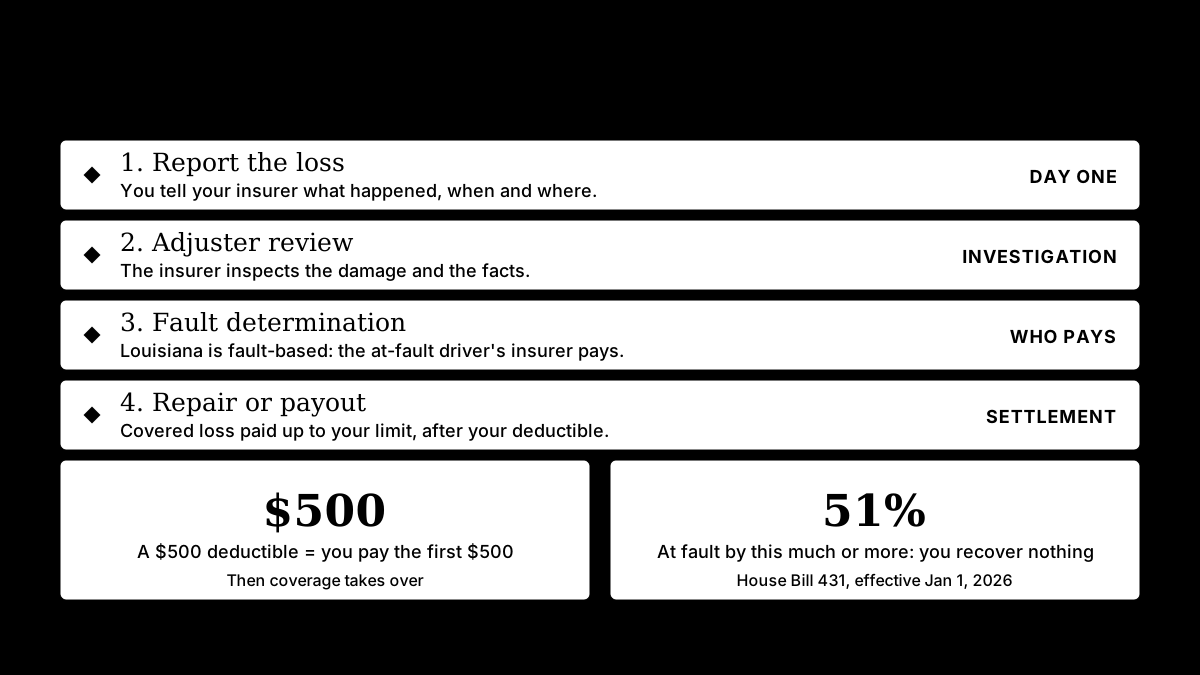
- A claim runs report → adjuster review → fault determination → repair or payout.
- Your premium is priced from rating factors — some fixed, many you can influence. Louisiana's average auto premium fell 5.8% in 2025, per the Louisiana Department of Insurance.
How does auto insurance actually work?
It's a risk trade. You pay a set premium, and in return the insurer agrees to pay for specific covered losses — up to the limits you chose, after you pay your deductible. That's the whole engine underneath every policy.
Four terms make it make sense:
- Premium — what you pay for the coverage, monthly or in full.
- Deductible — your share of a claim before the insurer pays. A $500 deductible means you pay the first $500.
- Limit — the most your policy will pay for a covered loss. Anything above it is your responsibility.
- Covered vs. excluded — policies pay for specific events (a covered crash, theft, hail) and exclude others (normal wear, intentional damage).
Raise your deductible and your premium usually drops, because you're taking on more of each claim yourself. Choose your limits well and you're protected when a loss is large. The Insurance Information Institute lays out the six standard coverages a policy is built from — liability for injuries and for property damage, collision, comprehensive, uninsured/underinsured motorist, and medical payments — and our companion post on the types of auto insurance coverage takes each one apart. Your declarations page, the first page of the policy, lists exactly which of those you bought, at what limits, with what deductibles, for what premium. The rest of insurance is just this deal applied to real events.
What does Louisiana require you to carry — and what if you drive without it?
At least 15/30/25 liability coverage on every vehicle you own: $15,000 for bodily injury to one person, $30,000 for injuries to more than one person in a single accident, and $25,000 for damage to other people's property, per the Louisiana Department of Insurance's Consumer's Guide to Auto Insurance. You also have to carry proof of it in the car, on paper or on your phone. That minimum is a floor — a totaled newer car alone can pass $25,000 — and our post on Louisiana's mandatory insurance minimums for 2026 explains why most drivers should buy more.
Driving without it is expensive in three separate ways:
- Roadside and OMV penalties. Under R.S. 32:863.1, an officer can remove your licence plate on the spot (you get a three-day temporary sticker to get home) or have the vehicle impounded, and reinstating costs $100 for a first offense, $250 for a second, and $500 for any offense after that. Separately, the Louisiana Office of Motor Vehicles charges a fee based on how many days you went without insurance: $125 for 2–30 days, $275 for 31–90 days, and $525 for 91 days or more, capped at $850 per cancellation plus a $25 administrative fee ($250 if you're 65 or older).
- “No Pay, No Play.” Since August 1, 2025, an uninsured driver who is hit by someone else forfeits the first $100,000 of bodily-injury damages and the first $100,000 of property damage they would otherwise recover — even when the crash wasn't their fault (R.S. 32:866, as amended by Act 16 of 2025). The older $15,000/$25,000 figures still appear in a lot of guides, including the LDI's printed booklet; the statute now reads $100,000 for both.
- The uninsured crash itself. The LDI guide notes that being in an accident without liability insurance can mean a 180-day licence and registration suspension, and falsely claiming coverage can cost you your licence for 12 to 18 months.
How does a claim work, start to finish?
A claim is the moment the trade pays off, and it follows a predictable path. Picture a common Louisiana scenario: someone rear-ends you at a Baton Rouge intersection.
- Report the crash. Call the police — 911 if anyone is hurt — photograph the scene, and exchange names, addresses, phone numbers, plate numbers, licence numbers, and insurance information. Then notify your agent or insurer and get a copy of the police report no matter who was at fault. That's the LDI guide's own five-step checklist.
- An adjuster reviews. The insurer opens a claim file and assigns an adjuster to investigate: photos, statements, repair estimates, and the police report if there is one.
- Fault is determined. The adjuster decides who was responsible and to what degree. In our rear-end example, the driver who hit you is typically at fault.
- The claim is paid. The at-fault driver's liability coverage pays for your repairs and injuries up to its limits. If you go through your own collision coverage instead, you pay your deductible and your insurer covers the rest — and, as the LDI guide spells out, what your insurer paid and the deductible you paid may then be recouped from the at-fault driver's insurer.
The smoother your documentation and the clearer your coverage, the faster this moves. This is also where having an agent who knows your policy — and picks up the phone — makes the difference between a quick resolution and a frustrating one.
How does fault decide who pays in Louisiana?
In Louisiana, fault is the whole ballgame. It's a fault-based (at-fault) state, which means the driver who causes a crash — and their insurer — is responsible for the resulting damage. It is not a no-fault state.
Louisiana also uses modified comparative fault, and the rule changed recently. Act 15 of 2025 (House Bill 431) rewrote Civil Code article 2323 effective January 1, 2026: if you're partly to blame, your recovery is reduced by your percentage of responsibility, but a driver whose share of the fault is “equal to or greater than fifty-one percent” is not entitled to recover at all (statute text as quoted by the law firm Gordon Arata). So if you're found 20% at fault, you still recover, minus 20%; at 51%, you recover nothing. Crashes before January 1, 2026 are generally handled under the old pure system, where you could recover something at any fault share short of 100%.
Fault and insurance status also interact: under No Pay, No Play (above), an uninsured driver forfeits the first $100,000 even when the other driver is entirely at fault. All of this is why we push solid liability limits and uninsured/underinsured motorist coverage — if you're at fault, your liability pays the other party up to your limits, and if the other driver is uninsured or carrying the $15,000 minimum, your UM/UIM protects you. For the bigger picture, see our Louisiana auto insurance guide.
What determines your premium?
Your premium is calculated from rating factors — the pieces of information an insurer uses to estimate your risk. Some you can't change; many you can influence.
Mostly fixed: your age, where you live, your vehicle's make and model, and the litigation and weather risk of the state. Flexible — where you have leverage: your coverage limits and deductibles, the discounts you qualify for, your driving record over time, your annual mileage, and your insurance score. On deductibles alone, the III estimates that moving from $200 to $500 trims collision and comprehensive costs by 15 to 30 percent, and $1,000 can save 40 percent or more (III).
Louisiana starts from a high baseline. In the National Association of Insurance Commissioners' 2023 Auto Insurance Database Average Premium Supplement, Louisiana's average auto insurance expenditure was $1,749 per insured vehicle — among the three highest in the country — against $1,282 countrywide. The direction has finally turned, though: the Louisiana Department of Insurance reported on February 23, 2026 that private-passenger auto premiums fell an average of 5.8% in 2025, more than $340 million statewide, largely because accident frequency dropped. Working the flexible factors still matters. For the full breakdown, see how car insurance rates are calculated in Louisiana.
What does a policy not cover?
Wear and tear, intentional damage, business use, and anything you didn't buy. A personal auto policy pays for sudden, accidental losses that fall inside the coverages on your declarations page — and the policy form's exclusions section is the fine print that draws the line. The common ones:
- Mechanical failure and normal wear and tear. Collision “will not reimburse you for mechanical failure or normal wear-and-tear on your car,” per the III.
- Commercial use. Deliveries and driving for hire are excluded from a personal policy; the LDI guide notes most personal policies exclude coverage while you're carrying a passenger for hire, so ride-share driving needs its own endorsement or the app company's coverage.
- Intentional damage and damage while committing a crime.
- Weather and flood, if you only carry liability. The LDI guide's answer on driving through high water: comprehensive very likely covers it; liability-only or liability-plus-collision very likely doesn't.
- Vehicles regularly available to you but not on the policy — a company car, for instance — and physical damage to a trailer you tow, both per the LDI guide.
- Anything above your limits. That's not an exclusion so much as the deal itself — which is why limits matter more than most people think.
How do you get a policy?
You gather a few facts, choose your coverages, compare like for like, and confirm the company is licensed. The LDI's own quote worksheet is a good map:
- Gather the details. Each vehicle's year, make, model, and VIN; every driver's licence number and date of birth; each driver's accidents and moving violations over the past three years; and how far each car is driven to work.
- Choose limits and deductibles. Decide your liability limits, whether to keep UM/UIM at the same limits, and what deductible you can actually pay tomorrow. Our post on the types of auto insurance coverage explains each choice.
- Compare the same coverages side by side. The LDI's first rule is don't buy the first policy you find; a quote is only comparable when limits and deductibles match.
- Check the company. Buy only from insurers licensed by the LDI — those are backed by the Louisiana Insurance Guaranty Association if the company ever fails.
- Pay and keep the paperwork. Get a detailed receipt showing the policy number, payment date, and coverage period, and keep the ID card in the car or on your phone.
When you're ready to run those numbers for your own cars, our auto insurance page is the place to start.
Where does an agent fit versus the insurance company?
They play different roles, and knowing the difference helps. The insurance company underwrites the policy, sets the rates, and pays the claims. The agent is your local guide — the person who helps you choose the right coverage up front and helps you use it when something goes wrong. We lay out the split in insurance agent vs. company: roles every homeowner should know, and the logic is the same for your car.
A good local agent sizes your limits to your real risk, finds the discounts you qualify for, and advocates for you during a claim instead of leaving you to navigate an app alone. That's the value of buying through someone based in your community rather than a faceless portal — especially in a state with Louisiana's weather and roads. The policy is the same product either way; the service around it is not.
Have questions about how your policy works?
Understanding the mechanics is the first step; the next is making sure your own policy is set up to protect you. The team at The Root Agency will walk through how your coverage works, what your limits and deductibles actually mean for you, and where a gap might leave you exposed. When you're ready, start on our auto insurance page or contact your Baton Rouge team — licensed across Louisiana — and we'll explain it in plain English.
This article is general information, not a quote or insurance advice. Coverage and claims depend on your specific policy and situation — talk with a licensed agent about your policy.