

Personal umbrella insurance is a type of excess liability coverage that extends your financial protection beyond the limits of your existing auto and homeowners policies. When a lawsuit or accident produces damages that exceed what your base policies will pay, umbrella coverage steps in to cover the remainder. For residents of Louisiana and Mississippi, where auto accident litigation and property liability claims run high, this extra layer of protection is not a luxury. It is a practical safeguard for everything you have worked to build. The Root Agency helps families across both states find the right umbrella coverage to match their real-world risk.
What is personal umbrella insurance and how does it protect you?
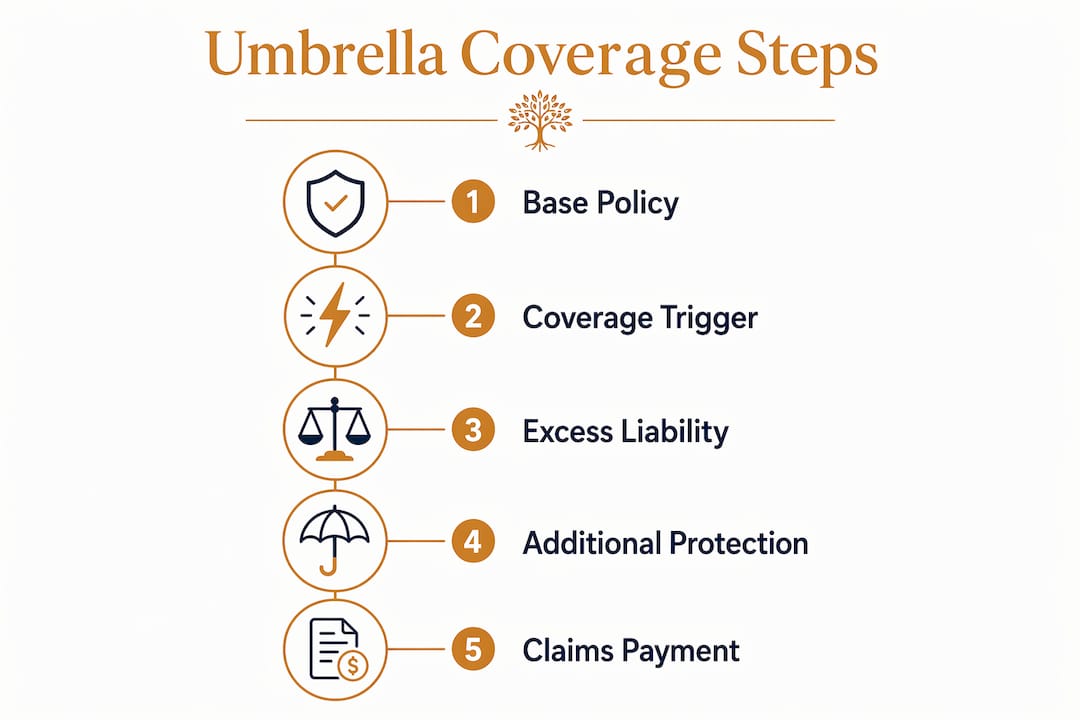
Personal umbrella insurance is defined as a standalone liability policy that activates after underlying limits on your auto or homeowners policy are fully exhausted. Think of it this way: your auto policy might carry $250,000 in bodily injury liability. If a serious accident results in $600,000 in damages and legal costs, your auto policy pays its limit and stops. Your umbrella policy then covers the remaining $350,000. Without it, that gap comes directly out of your savings, your home equity, or your future wages.
Most umbrella policies start at $1 million in coverage and are available in increments of $1 million beyond that. The cost is surprisingly low relative to what you get. Umbrella insurance is designed specifically for low-probability, high-impact events that could otherwise devastate personal finances. A single serious car accident, a slip-and-fall on your property, or a defamation claim can produce judgments that no standard policy is built to absorb.

How does umbrella coverage work and what does it include?
Umbrella coverage activates only after your base policy limits are fully paid out. That trigger mechanism is exactly why premiums stay low. You are not paying for first-dollar coverage. You are paying for protection against the rare but catastrophic claim.
Here is what a personal umbrella policy typically covers:
- Bodily injury liability: Injuries to other people caused by you, a family member, or even a pet on your property
- Property damage liability: Damage you or a covered family member causes to someone else's property
- Personal liability claims: Libel, slander, false arrest, and invasion of privacy are often covered by umbrella policies but excluded from standard home and auto coverage
- Legal defense costs: Attorney fees and court costs are typically covered outside the liability limits, meaning they do not reduce your available coverage amount
- Incidents involving rental properties or watercraft: Many umbrella policies extend to liability from boats or rental units you own
Umbrella policies do not cover everything. Personal injuries to yourself, intentional acts, and business-related liabilities are standard exclusions. If you run a business from home, a separate commercial policy is required to cover that exposure.
Pro Tip: Before purchasing umbrella coverage, confirm that your auto and homeowners policies meet the minimum liability limits your insurer requires. If they fall short, your umbrella policy may not activate when you need it most.
What are the underwriting requirements to qualify?
Insurers do not sell umbrella policies in isolation. They require you to carry minimum liability limits on your underlying auto and homeowners policies before they will extend umbrella coverage. Meeting those minimums is a prerequisite, not a suggestion.
Here are the typical requirements you will need to satisfy:
- Auto liability minimum: Most carriers require at least $250,000 per person and $500,000 per accident in bodily injury liability on your auto policy, or a combined single limit of $300,000.
- Homeowners liability minimum: A minimum of $300,000 in personal liability coverage on your homeowners or renters policy is the standard threshold.
- Consistent carrier alignment: Some insurers require that your auto and home policies be placed with the same carrier or an approved partner before they will issue an umbrella policy.
- No major coverage gaps: Gaps in underlying coverage due to mismatched renewal dates or policy lapses can temporarily render your umbrella policy ineffective. Monitoring expiration dates across all policies is critical.
Umbrella policy effectiveness depends entirely on the strength of the underlying policies beneath it. Raising your base limits to meet insurer minimums is the most common prerequisite step before placing umbrella coverage.
Pro Tip: Review your auto and homeowners policies every year at renewal. If your underlying limits have changed, your umbrella coverage could be compromised without any notice from your insurer.
What are the benefits of umbrella insurance for Louisiana and Mississippi residents?
Louisiana and Mississippi residents face a specific set of liability risks that make umbrella coverage especially valuable. Louisiana consistently ranks among the top states for auto accident litigation, and both states carry significant property liability exposure given the density of residential pools, boats, and recreational vehicles.
Umbrella insurance acts as a backstop against large judgments that your base policies simply cannot absorb. The benefits for residents of these two states include:
- Asset protection: Your home, savings accounts, investment accounts, and personal property are all at risk in a major liability judgment. Umbrella coverage shields those assets directly.
- Coverage for regional risks: Boat ownership is common across coastal Louisiana and Mississippi. Many umbrella policies extend liability protection to watercraft, supplementing your boat insurance coverage when damages exceed its limits.
- Affordable premiums: Umbrella coverage costs typically range from $200 to $300 annually for $1 million in protection. That is less than most people spend on a single car payment.
- Protection for future income: Courts can garnish wages to satisfy judgments. Umbrella coverage protects not just what you own today but what you will earn in the future.
- Broader liability scope: Standard home and auto policies do not cover defamation claims. Legal defense costs for a slander lawsuit, for example, can reach six figures before a verdict is even reached.
“Umbrella insurance provides essential protection against large liability claims that could otherwise threaten assets, especially given regional risks in Louisiana and Mississippi.” InsuredBetter
The affordability factor deserves emphasis. Because umbrella premiums are low relative to the coverage provided, many residents with modest assets still benefit significantly. The exposure to a large judgment does not require wealth. It requires only one bad accident.
How do you know if you need umbrella coverage and how much to buy?
The decision to purchase umbrella coverage comes down to two factors: what you own and how exposed you are to liability claims. Both are worth examining honestly.
Coverage limits should match your net worth minus any federally protected assets like retirement accounts. If your total assets exceed your base policy limits, you have a gap that umbrella coverage is designed to fill.
| Situation | Recommended coverage level |
|---|---|
| Net worth under $500,000, no high-risk features | $1 million umbrella policy |
| Net worth $500,000 to $1 million, pool or teen driver | $1 to $2 million umbrella policy |
| Net worth over $1 million or multiple properties | $2 to $5 million umbrella policy |
| Business owner with personal assets at risk | $3 million or more, plus commercial coverage |
Risk factors that increase your exposure include owning a swimming pool, trampoline, or trampoline park, having a teen driver in the household, owning rental property, or regularly hosting large gatherings at your home. Each of these creates a scenario where a single incident could produce a claim that exceeds standard policy limits.
Pro Tip: Do not anchor your coverage decision to current assets alone. A court judgment can attach to future income as well. Buy enough umbrella coverage to protect what you have and what you expect to earn.
Key takeaways
Personal umbrella insurance is the most cost-effective way to protect your assets, income, and financial future from large liability judgments that exceed standard auto and homeowners policy limits.
| Point | Details |
|---|---|
| Definition and trigger | Umbrella coverage activates only after base policy limits are fully exhausted. |
| Coverage scope | Includes bodily injury, property damage, libel, slander, and legal defense costs. |
| Underwriting requirements | Requires minimum auto liability of ~$250,000 and homeowners liability of ~$300,000. |
| Cost vs. protection | Premiums typically run $200 to $300 per year for $1 million in coverage. |
| Who needs it most | Anyone with assets exceeding base policy limits, teen drivers, pools, or boats. |
Why umbrella coverage is the most underused policy in Louisiana
After more than two decades helping Louisiana and Mississippi families protect what they own, I have noticed one consistent pattern: umbrella insurance is the last policy people buy and the first one they wish they had bought sooner.
Most people assume umbrella coverage is for the wealthy. That assumption is wrong, and it is costly. A serious car accident in Baton Rouge or Gulfport does not care about your net worth. If you are found liable for $800,000 in damages and your auto policy tops out at $300,000, the remaining $500,000 becomes your personal problem. That can mean liens on your home, garnished wages, and years of financial recovery.
What I tell every client is this: the question is not whether you can afford umbrella insurance. At $200 to $300 per year, almost everyone can. The real question is whether you can afford to go without it. Louisiana sits in the bullseye for high-stakes auto litigation, and Mississippi is not far behind. The legal environment in both states makes large verdicts more common than residents expect.
I also see people overlook the policy alignment issue. They buy an umbrella policy and then let their auto liability limits slip at renewal to save a few dollars. That creates a gap that can invalidate the umbrella coverage entirely. Review all your policies together, every year, as a complete picture. That is the only way to know your protection is actually working.
For local guidance on insurance costs in Louisiana and how umbrella policies fit into your overall coverage, the Root Agency blog is a solid starting point.
— David
How The Root Agency can help you get covered
The Root Agency is an Allstate exclusive agency based in Baton Rouge, serving all of Louisiana and Mississippi with more than 20 years of hands-on experience. We offer personal umbrella insurance alongside auto, home, flood, boat, and life insurance, so we can review your entire coverage picture in one conversation.
Whether you need to raise your underlying liability limits to qualify for umbrella coverage or you are ready to add a $2 million policy today, we will walk you through every option. Our team provides bilingual service in English and Spanish, 24/7 claims support, and the kind of local knowledge that only comes from staying in Louisiana through every storm. Explore all coverage options or call us at (225) 529-1990 to get started.