

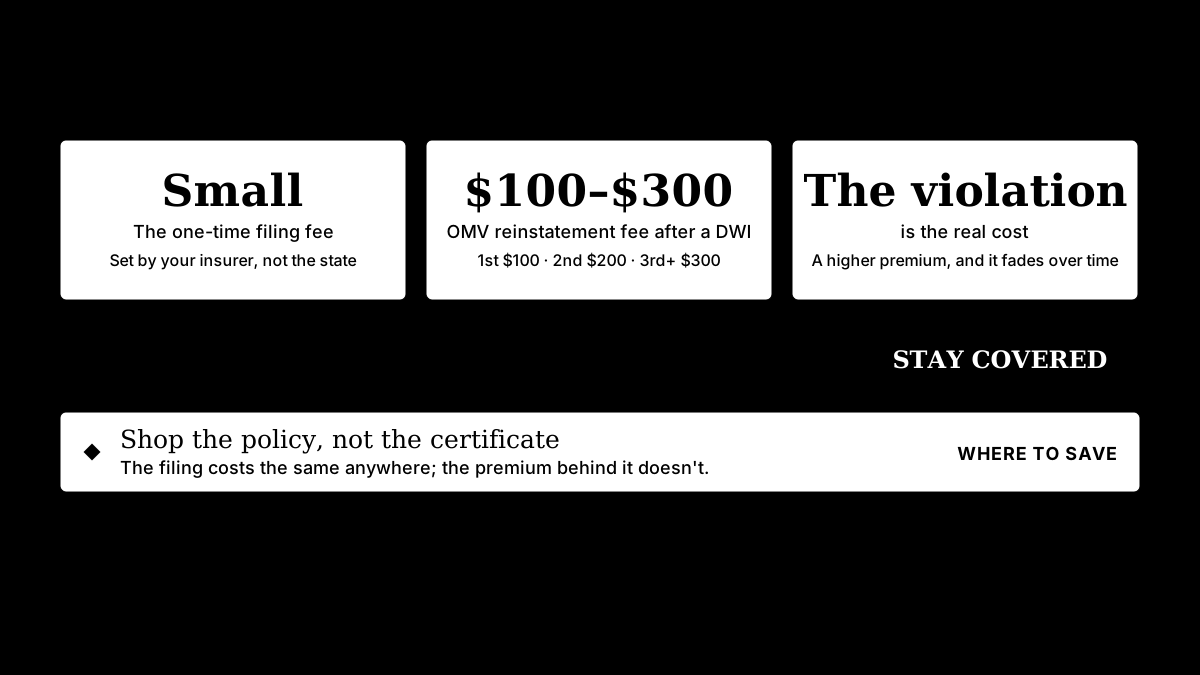
An SR-22 in Louisiana has three costs, and the form is the smallest. The filing fee is set by your insurer — MoneyGeek's 2026 Louisiana survey puts it at about $15 to $25, paid once. The Louisiana OMV then charges its own reinstatement fee ($100 for a first DWI, $200 for a second, $300 for a third), and the violation behind the filing raises your premium: MoneyGeek's 2026 Louisiana analysis puts a minimum-coverage policy after a DUI about 48% above a clean-record policy. The filing runs three years from the conviction or arrest date, and a lapse doesn't restart it — you re-file for the remainder.
If you're facing an SR-22 requirement in Louisiana, here's the good news: the part everyone worries about — the SR-22 itself — is the cheap part. The filing is a small one-time fee. What actually raises your bill is the violation that required the SR-22, which moves you into a higher-risk pricing tier, with the state's own reinstatement fees sitting in between. Once you see those three numbers separately, you can focus on the one you can actually influence. This guide puts real figures on each: what an SR-22 costs in Louisiana, what the OMV charges, why your premium goes up, how long it lasts, and the honest ways to bring it down. (If you're still working out whether you need one, start with our SR-22 insurance page.) The team at The Root Agency, serving Denham Springs and the greater Baton Rouge area and licensed statewide, helps drivers work through exactly this.

Key takeaways
- The SR-22 filing fee is set by your insurer; MoneyGeek's 2026 survey puts it at about $15 to $25, paid once.
- The OMV's reinstatement fee is $100, $200 or $300 for a first, second or third DWI; $50 for a refusal; $60 for driving while suspended.
- If a registered vehicle's insurance lapsed, the OMV adds $125 (2–30 days), $275 (31–90 days) or $525 (91+ days), plus a $25 admin fee, capped at $850.
- The premium is the big number: about 48% above a clean-record policy after a DUI, per MoneyGeek's 2026 Louisiana data.
- The SR-22 runs three years from the DWI conviction or refusal arrest. A lapse re-suspends your license but does not restart the three years.
- Louisiana uses the SR-22, not the FR-44, and the policy behind it must carry at least 15/30/25.
What does an SR-22 actually cost in Louisiana?
Three separate numbers, and they're not remotely the same size: your insurer's filing fee, the state's reinstatement fees, and the premium on the policy behind the certificate.
The filing fee is a one-time charge your insurer adds to file the SR-22 with the Louisiana Office of Motor Vehicles, and the insurer sets it — there is no state-mandated amount. MoneyGeek reports Louisiana insurers charge “$15 to $25” to file. It's the smallest line on the bill, and your agent can tell you the exact figure before you file.
The reinstatement fees go to the OMV, not your insurer. They're fixed, published amounts tied to the violation, and we list them in the next section.
The premium is the real cost — and it isn't a fee for the SR-22 at all. It's the price of insuring a driver whose record now includes the violation that triggered the filing. The policy underneath has to carry at least Louisiana's minimum liability limits of 15/30/25 — $15,000 for bodily injury to one person, $30,000 per accident, $25,000 for property damage — as set out in the Louisiana Department of Insurance's Consumer's Guide to Auto Insurance. Louisiana uses the SR-22 for this, not the higher-limit FR-44 that a couple of other states require after a DUI; if a website quotes you an FR-44 figure, it isn't a Louisiana figure.
One alternative worth knowing about: the OMV's own SR-22 policy (3-3.00) lets you prove financial responsibility with a $30,000 cash or securities deposit with the State Treasurer, or a $30,000 surety bond, instead of an insurance certificate. Almost nobody does — it ties up $30,000 for three years — but it puts the insurance route, filing fee and all, in perspective.
What does the Louisiana OMV charge on top of the insurance?
A reinstatement fee fixed by the violation, and — if a registered vehicle's insurance was cancelled — a lapse fee that scales with how long you went uninsured. These are the OMV's published amounts, not estimates.
Reinstatement fees, per the OMV's suspensions page:
- DWI, first offense: $100
- DWI, second offense: $200
- DWI, third or later: $300
- Underage DWI (UDUI): $60
- Refusing (or failing) a chemical test: $50
- Driving while suspended: $60
If a vehicle registered to you went without insurance, the OMV's cancellations and revocations page adds a separate fee based on the number of days without coverage:
- 2 to 30 days: $125
- 31 to 90 days: $275
- 91 days or more: $525
- Plus a $25 administrative fee per cancellation. The total is capped at $850 ($250 if you're 65 or older) when paid the same day; if the debt has gone to the Office of Debt Recovery, a 15% collection fee is added and the cap no longer applies.
So a first DWI with no coverage gap costs $100 at the OMV window. Let a registered car sit uninsured for three months on top of it and you add $275 plus $25. These are one-time payments. The number that keeps charging every month is the premium.
Why does your premium go up with an SR-22?
Because the violation reprices your risk — not because the SR-22 adds a surcharge. The OMV requires an SR-22 after three events — a DWI conviction, an arrest for refusing a chemical test, or an unpaid accident judgment, per its SR-22 policy — and each one tells an insurer you're statistically more likely to file a claim.
How much more you'll pay depends on your record, but one independent estimate shows the shape. MoneyGeek's 2026 Louisiana SR-22 analysis, built on Quadrant Information Services rate data, found a driver with a DUI paying about $155 a month for minimum-coverage SR-22 insurance against $105 a month with a clean record — a 48% increase, or roughly $600 more a year. That's an estimate for one driver profile (a 40-year-old with good credit), not a quote; your figure moves with your ZIP code, your vehicle, your age, and your credit, which Louisiana allows insurers to use. But the proportions hold: the filing fee is measured in tens of dollars, the premium increase in hundreds.
It also stacks on an already-high base. Louisiana runs some of the most expensive average auto premiums in the country, for reasons we cover in our guide to why insurance is so expensive in Louisiana. The takeaway: your bill rose because of what's on your record, and that's the number worth working on.
How long does the higher cost last?
Two separate clocks are running, and neither is “forever.”
The first is the SR-22 requirement itself: three years, and the OMV is specific about the start date. For a DWI conviction it's three years from the date of conviction; for a refusal it's three years from the date of arrest, per the OMV's suspensions page — which applies the same from-arrest rule to the administrative suspension for failing the test. For an accident judgment it's three years from the date of full release (OMV policy 3-3.00). You'll see third-party sites, MoneyGeek among them, describe it as three years from the date your license is reinstated. The OMV's own pages are the authority; confirm your exact end date with the OMV, because the date on your record is the one that counts. We walk through the full rulebook — triggers, dates, and what happens on a lapse — in our guide to Louisiana SR-22 requirements.
The second clock is the rating impact: how long the violation influences your premium. That lessens gradually as you build clean time behind it, and it can run longer than the SR-22, because insurers look back at your record for their own set period. A clean stretch of driving is the single most powerful thing that brings the premium back down. For how rating factors move your number, see our guide to how car insurance rates are calculated in Louisiana.
What happens to the cost if your coverage lapses?
Your insurer tells the state, your license can be suspended again, and you pay to reinstate again — but the three-year period does not start over.
Louisiana law makes the notice automatic. Under R.S. 32:901, an insurer cannot cancel a certified (SR-22) policy until at least ten days after it has filed a notice of cancellation with the state — the form insurers call an SR-26. There's no quiet way to let a policy slide for a few weeks; the state knows before the cancellation even takes effect.
What comes next is the part most articles get wrong. Under R.S. 32:908(C), if you apply for your license again within the original three years, you must “reestablish such proof for the remainder of such three year period” — the remainder, not a fresh three years. So a lapse costs you another reinstatement fee, the OMV's lapse fees if a vehicle is registered to you, and possibly a higher premium for the gap in coverage. What it doesn't do is start the three years over. A new qualifying violation, on the other hand, starts its own three-year requirement from its own date.
How do you lower what you pay while carrying an SR-22?
Focus on the premium, since that's the real cost — and there's more room than most drivers expect. A few honest moves make a measurable difference.
- Keep coverage continuous. A lapse means an SR-26 to the state, a fresh suspension, another reinstatement fee, and the OMV's lapse fees on any vehicle in your name. Never let the policy lapse between payments.
- If you don't own a car, don't insure one. A non-owner SR-22 policy satisfies the filing at liability-only pricing — see our guide to non-owner SR-22 insurance in Louisiana.
- Consider a usage-based/telematics program. If you drive safely, pricing based on your actual habits can help offset the higher rate. Allstate's option is one example — see our Drivewise discount guide.
- Stack the discounts you still qualify for. Bundling with home or renters, multi-vehicle, paperless, and pay-in-full credits still apply.
- Right-size your coverage. Carry the coverage you actually need at limits that protect you — an agent can make sure you're not overpaying while staying compliant.
- Build clean time. Every month without a new violation moves you toward the lower rate on the other side.
The one thing not to do is chase the lowest possible number by risking a lapse — that's the mistake that costs the most on an SR-22.
Facing an SR-22 and worried about the cost?
The filing is the easy part — the real work is keeping your premium as low as possible while you carry it. The team at The Root Agency can file your SR-22, keep your coverage continuous so the state never gets an SR-26, and stack every discount you still qualify for to soften the cost. When you're ready, start on our SR-22 insurance page or contact your Denham Springs team, and we'll help you keep it affordable.
This article is general information, not a quote or insurance advice. Third-party cost figures are estimates for sample driver profiles, not offers. SR-22 costs and requirements vary by your specific situation — verify fees and dates with the Louisiana Office of Motor Vehicles, and talk with a licensed agent about your policy.