
Non-owner SR-22 insurance is a liability-only auto policy for drivers who must file an SR-22 with Louisiana but don't own a vehicle. It carries at least the state's 15/30/25 minimum, your insurer files the SR-22 against it, and you can reinstate your license without paying to insure a car you don't have. It covers your liability when you drive cars you don't own — not comprehensive or collision, and not a car that lives in your household — and it runs the same three years as any other Louisiana SR-22.
If Louisiana requires you to file an SR-22 but you don't own a vehicle, you can feel stuck — the SR-22 is tied to insurance, and you don't have a car to insure. A non-owner SR-22 policy is the missing piece. It gives you the liability coverage the state needs to reinstate your license, without paying to insure a car you don't have. This guide explains what non-owner SR-22 insurance is, who qualifies for it in Louisiana, what it covers and doesn't, what it costs, how it differs from a standard SR-22, and what happens when you eventually buy a car. (For what an SR-22 is in the first place, start with our SR-22 insurance page.) The team at The Root Agency, serving Gonzales and the greater Baton Rouge area and licensed statewide, helps drivers in exactly this situation stay legal.
Key takeaways
- A non-owner SR-22 is liability-only coverage that satisfies Louisiana's SR-22 requirement when you don't own a car.
- It must carry at least 15/30/25 — Louisiana's minimum liability limits, per the Louisiana Department of Insurance.
- You qualify only if you don't own a vehicle and don't have regular use of one in your household.
- It usually costs less than an owner SR-22 policy: MoneyGeek's 2026 Louisiana data averages a non-owner SR-22 at about $115 a month.
- The filing runs three years from the DWI conviction or refusal arrest, per the OMV. A lapse re-suspends your license but does not restart the three years.
- If you buy a car during the three years, the SR-22 moves to an owner policy — arrange it before you drive the car home.
What is non-owner SR-22 insurance?
It's a liability-only policy for people who need an SR-22 but don't own a car. The non-owner policy provides the bodily-injury and property-damage liability coverage Louisiana requires — at least 15/30/25, meaning $15,000 for bodily injury to one person, $30,000 per accident and $25,000 for property damage, per the Louisiana Department of Insurance's Consumer's Guide to Auto Insurance — and your insurer files the SR-22 certificate against it, satisfying the state's financial-responsibility requirement so you can reinstate your license.
The key idea is that an SR-22 has to attach to a policy, and a non-owner policy is that policy when you have no vehicle of your own. The Louisiana Office of Motor Vehicles expects this: its own SR-22 policy (3-3.00) provides for filers who “own no vehicles,” because proof of financial responsibility follows the driver, not the car. Your license stays valid and you stay legal to drive, without buying coverage for a vehicle that doesn't exist.
Who needs a non-owner SR-22 in Louisiana — and who doesn't qualify?
You need one when the state requires an SR-22 and you don't own a vehicle to insure. The OMV requires the filing after three events — a DWI conviction, an arrest for refusing a chemical test, or an unpaid accident judgment, per its SR-22 policy — and a few situations account for most non-owner cases:
- You had a license suspension and must file an SR-22 to reinstate — but you've sold your car or never owned one.
- You drive borrowed or rented cars and need to stay legally covered while doing so.
- You're between vehicles and want your license valid and your three-year period running until you buy again.
- You want no gap in your filing during a stretch without a car, since a lapse re-suspends your license.
Who doesn't qualify is just as important. Non-owner policies are written for people with no regular access to a car. If you own a vehicle — or there's one in your household you drive regularly, a spouse's or a parent's — a non-owner policy isn't the right tool: that car needs its own policy, with you listed as a driver and the SR-22 filed on it. WalletHub puts the industry rule plainly: “many insurers will not write a non-owner policy if a driver has access to a vehicle in their household.” Answer the application honestly; a non-owner policy written for someone who really has a household car is the kind of misstatement that can put a claim at risk when you need it most.
What does a non-owner SR-22 cover — and what doesn't it?
It covers your liability when you drive vehicles you don't own — and that's the extent of it. If you're at fault in a car you've borrowed or rented, your non-owner policy's liability coverage can pay for the other party's injuries and property damage, up to your limits.
What it does not include is comprehensive and collision, because those cover a specific owned vehicle — and you don't have one. It also generally won't cover vehicles regularly available or furnished to you, such as a car in your own household; those are meant to be insured on the vehicle's own policy. So a non-owner SR-22 is genuine liability protection for occasional driving of cars you don't own, not a substitute for insuring a car you drive every day. Because it's liability-only, it's related to — but narrower than — standard liability-only car insurance in Louisiana.
One coverage question worth asking: liability pays the other party, not you. Uninsured motorist coverage is the part that pays for your own injuries when the at-fault driver has nothing, and Louisiana requires insurers to include it on an auto policy unless you reject it in writing — so ask specifically how your non-owner policy handles it rather than assuming it's there. Our guide to uninsured motorist coverage in Louisiana explains what it does and why the written rejection matters.
What does a non-owner SR-22 cost in Louisiana?
Less than an owner SR-22 policy, usually, because there's no vehicle to cover — but more than a plain non-owner policy, because of the violation behind it. There are three numbers.
The filing fee is set by your insurer, not the state, and it's paid once. MoneyGeek reports Louisiana insurers charge “$15 to $25” for it. Ask your agent for the exact figure.
The OMV's reinstatement fee depends on the violation, per the OMV's suspensions page: $100 for a first DWI, $200 for a second, $300 for a third or later, $60 for an underage DWI, $50 for refusing or failing a chemical test, and $60 for driving while suspended. One fee you won't pay: the OMV's lapse-in-coverage fees of $125 to $525 (listed on its cancellations and revocations page) attach to a registered vehicle's plate. With no vehicle in your name there's no plate to lapse — the risk on a non-owner filing is your license, not a plate.
The premium is the number that recurs. MoneyGeek's February 2026 Louisiana non-owner analysis, built on Quadrant Information Services quotes, averages a plain non-owner policy at about $69 a month (roughly $830 a year) and a non-owner policy with an SR-22 at about $115 a month (roughly $1,380 a year). Those are estimates for a sample profile, not quotes — your figure depends on the violation, your age and your ZIP code — but they show the shape: the SR-22 adds roughly two-thirds to the base cost. An owner SR-22 policy costs more again, because it covers a car; we put figures on that in how much SR-22 insurance costs in Louisiana.
How does a non-owner SR-22 differ from a standard SR-22?
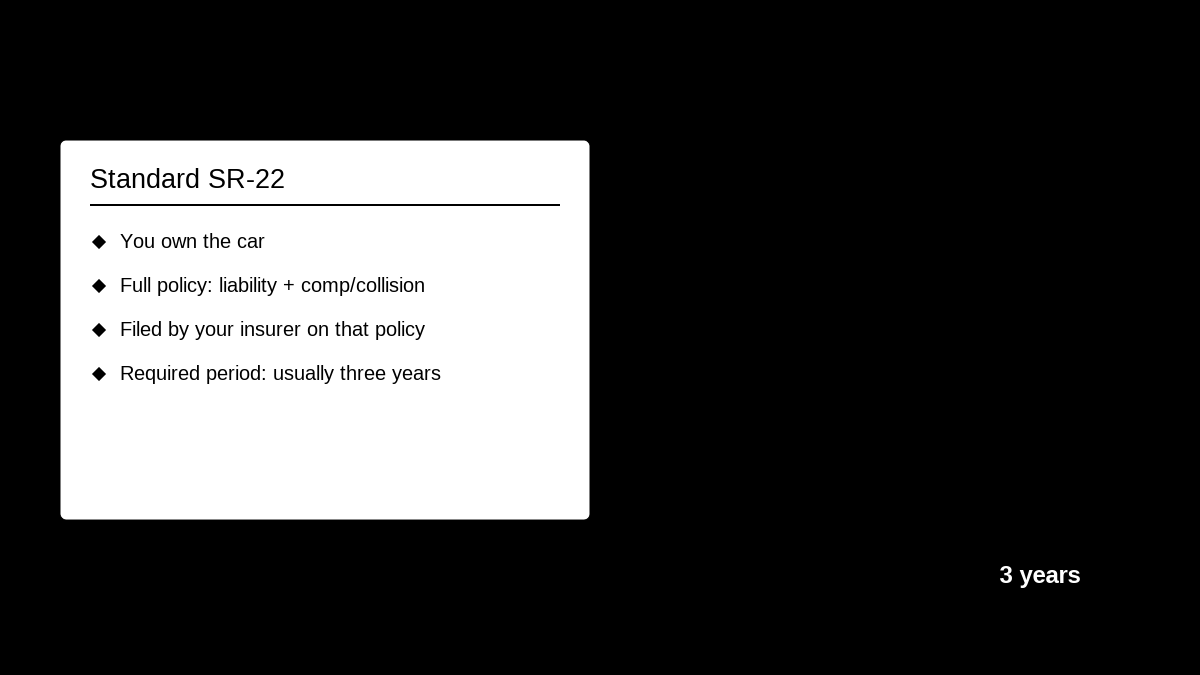
The difference is the policy the SR-22 attaches to, not the certificate itself. A standard (owner) SR-22 is filed against a regular auto policy that insures a specific vehicle you own — including, if you choose, comprehensive and collision on that car. A non-owner SR-22 is filed against a liability-only non-owner policy with no specific insured vehicle.
Everything else works the same way in Louisiana. Your insurer files it with the OMV; it certifies you carry at least 15/30/25; and it runs three years from the DWI conviction date or the refusal arrest date, per the OMV's suspensions page. A lapse works the same way too: your insurer must file a cancellation notice with the state before the policy ends (R.S. 32:901) — the form insurers call an SR-26 — and your license can be suspended again. What a lapse does not do is start a new three years: R.S. 32:908(C) requires you to re-establish proof “for the remainder of such three year period.” The choice between the two comes down to one question — do you own a vehicle that needs to be insured? If yes, a standard SR-22 policy fits; if no, a non-owner SR-22 is the honest match. Our guide to Louisiana SR-22 requirements covers the triggers, dates and the SR-26 in full.
What happens to your non-owner SR-22 when you buy a car?
The SR-22 moves with you to an owner policy, and your three-year period keeps running — as long as there's no gap between the two policies. The moment a vehicle is titled to you, you no longer qualify for a non-owner policy, so the switch isn't optional.
Do it in this order:
- Call your agent before you buy, or at the latest before you drive the car off the lot. Have the VIN ready.
- Start the owner policy first, with the SR-22 filed on it from day one, so your insurer sends the OMV a new certificate.
- Then cancel the non-owner policy, dated after the new policy's start. Never the other way round: even a one-day gap shows up at the OMV as a cancellation with nothing behind it, and that's how licenses get re-suspended.
- Register the car with insurance already in place. Once a vehicle is in your name, the OMV's lapse fees ($125 to $525) apply to it too.
Your end date doesn't change — it's still three years from the original conviction or arrest — and the filing simply continues on the new policy. Expect the premium to rise, because the policy now covers a car, and if a lender is involved it will want comprehensive and collision as well.
How do you get a non-owner SR-22 filed through your agent?
Work with an agent who can write a non-owner policy and file the SR-22 with the state. The steps mirror a standard filing: you secure a non-owner liability policy at or above 15/30/25, request the SR-22 filing, and your insurer submits the certificate to the OMV. Once the state has it, you've paid the reinstatement fee, and any other conditions are met, your license can be restored.
From there, the same discipline applies as any SR-22: keep the policy continuously active for the full three years so the state never receives a cancellation notice. A local agent can confirm a non-owner policy is the right fit — including the household-car question — handle the filing correctly, and help you keep it in force, so you stay legal without paying for coverage you don't need.
Need an SR-22 but don't own a car?
You don't have to buy a vehicle just to satisfy an SR-22 requirement — a non-owner policy can keep you legal at a lower cost. The team at The Root Agency can confirm whether a non-owner SR-22 fits your situation, file it with the state, and help you keep it continuous so the OMV never sees a lapse. When you're ready, start on our SR-22 insurance page or contact your Gonzales-area team, and we'll walk you through it.
This article is general information, not legal or insurance advice. Third-party cost figures are estimates for sample driver profiles, not offers. SR-22 requirements depend on your specific situation — verify your obligation and dates with the Louisiana Office of Motor Vehicles, and talk with a licensed agent about your policy.