

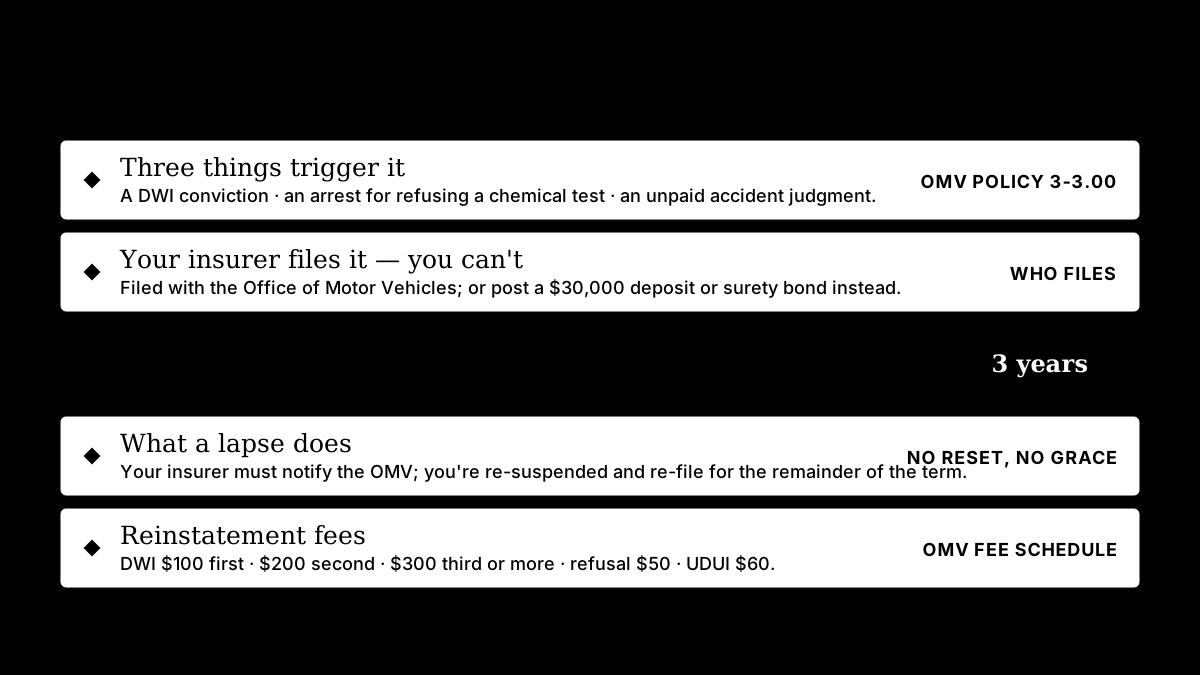
Louisiana requires an SR-22 in three situations set out in the Office of Motor Vehicles' own policy: a DWI conviction, an affidavit of arrest for refusing a chemical test, or an unsatisfied accident judgment. Your insurer files it electronically, and you carry it for three years measured from the conviction or arrest date (or from when an accident judgment is paid off), on a policy with at least 15/30/25 liability limits. If the policy lapses, the insurer notifies the OMV, your license is re-suspended, and you re-file for the remainder of the period — the clock does not reset to zero.
If you've searched for Louisiana SR-22 requirements, you've probably found six different answers — and most of them were written for other states. This guide uses the sources that actually govern the requirement: the Louisiana Office of Motor Vehicles' Suspensions page, its written SR-22 policy, and the statutes both cite. You'll get the three real triggers, who files and how, when the three-year clock starts, what a lapse truly does, every fee, and how the filing ends. Think of it as the detail layer under our SR-22 insurance page, which covers what an SR-22 is and how we file one. The Root Agency handles these filings for drivers across Louisiana from our Baton Rouge office.

Key takeaways
- OMV Policy 3-3.00 names three SR-22 triggers: a DWI conviction, a refusal arrest, and an accident judgment. Driving uninsured by itself brings plate and reinstatement penalties, not an SR-22.
- The requirement lasts three years from the date of conviction (DWI) or the date of arrest (refusal), per the OMV's Suspensions page.
- OMV reinstatement fees: DWI 1st $100, 2nd $200, 3rd+ $300; underage DWI $60; refusal $50; driving while suspended $60.
- The alternative to an insurer's filing is $30,000 in cash or securities with the State Treasurer, or a $30,000 surety bond (R.S. 32:904; OMV).
- A lapse means an SR-26 notice, re-suspension, and re-filing for the remainder of the three years (R.S. 32:908). A new conviction can extend it; a lapse doesn't restart it.
What triggers an SR-22 requirement in Louisiana?
Three things, according to the OMV's own written policy — Policy 3-3.00 SR22, revised July 6, 2026, published on the OMV's Safety Responsibility Laws page. The OMV requires an SR-22 to be filed for:
- A DWI conviction. Required for three years from the date of conviction. The policy excludes convictions handled under Code of Criminal Procedure Article 894 — the deferred-sentence route where the court can later set the conviction aside — so ask your attorney which kind you have. The OMV's Suspensions page applies the same three-year filing to underage DWI (UDUI) convictions.
- An affidavit of arrest for refusing a chemical test. Required for three years from the date of arrest — note, the arrest, not a conviction.
- An accident judgment. If you enter an installment agreement to pay a judgment from a crash, the SR-22 must be maintained while you're paying and for three years after payment in full, or for three years from the date of full release.
What does not trigger one: driving without insurance, by itself. Louisiana's penalty statute for that, R.S. 32:863.1, is about the vehicle — the officer removes the plate, issues a three-day temporary sticker, and the car can be impounded; reinstatement fees run $100 for a first offense, $250 for a second and $500 after that, plus a $10 administrative fee. If your insurer reports a lapse, the OMV's Cancellations & Revocations page lists the fees: $125 for a lapse of 2–30 days, $275 for 31–90 days, $525 for 91 days or more, capped at $850 plus a $25 administrative fee per cancellation. Neither the statute nor the OMV page mentions an SR-22.
You'll see longer lists online — “too many points,” “reckless driving,” “any license reinstatement.” They aren't in the OMV's policy. Before you buy anything, run the OMV's free Driver License Status Inquiry with your license number; it shows every flag on your record, including whether an SR-22 is one of them.
Who files the SR-22, and how?
Your insurer files it — you can't. Under R.S. 32:898, proof of financial responsibility is furnished by filing an electronic certificate from an insurance carrier authorized to do business in Louisiana, certifying that a motor vehicle liability policy is in effect for you. The SR-22 is that certificate.
The steps are short. You buy a policy carrying at least Louisiana's minimum liability limits — $15,000 per person and $30,000 per accident for bodily injury and $25,000 for property damage under R.S. 32:900, the same 15/30/25 printed in the Louisiana Department of Insurance's Consumer's Guide to Auto Insurance. You tell the insurer you need an SR-22 filing; the insurer transmits the certificate to the OMV; you pay your reinstatement fee and clear any other flags; your license is reinstated. Two details most guides skip: R.S. 32:898(B) says no vehicle can be registered, or stay registered, in your name unless it's designated on the certificate — so every car you own must be on the certified policy — and Louisiana uses the SR-22 only, not the higher-limit FR-44 form some other states require.
If you live outside Louisiana, or your cars are registered elsewhere, or you own no vehicle, the OMV policy allows an insurer that isn't licensed in Louisiana to file for you — provided it has filed a Power of Attorney with the OMV and agreed in writing to follow Louisiana's liability-policy rules. For the everyday version of the process, and how our office handles it, see our SR-22 insurance page.
Is there an alternative to an SR-22 filing?
Yes — two, and both are expensive. The OMV policy accepts, in place of an insurer's certificate, cash or unencumbered negotiable securities of $30,000 deposited with the State Treasurer, or a $30,000 surety bond posted with the OMV. The deposit route is R.S. 32:904, which puts the $30,000 with the state treasurer; the bond route is R.S. 32:903, which requires a surety company authorized in Louisiana (or two individual sureties with Louisiana real estate worth at least twice the bond) and can't be cancelled without ten days' written notice.
Either way, the money is tied up for the full period and stands behind any judgment against you. That's why almost everyone uses the insurance certificate: a 15/30/25 policy costs a fraction of $30,000 and does the same job.
How long does Louisiana require an SR-22, and when does the clock start?
Three years, and the start date is fixed by the trigger — not by the day you get your license back. The OMV's Suspensions page states it plainly: file proof of financial responsibility for three years from the date of conviction for DWI or UDUI, and for three years from the date of arrest for a refusal. For an accident judgment, the OMV policy runs the three years from payment in full or from full release.
The statute behind that is R.S. 32:908, which lets the commissioner release the requirement “at any time after three years from the date such proof was required,” so long as no conviction or bail forfeiture that would require a suspension has been recorded in the three years before the request. In practice this helps you: if your license sat suspended for months before you reinstated, that time counts toward the three years, because the clock started at the conviction or arrest. Some guides say the period starts at reinstatement; the OMV's page measures from conviction or arrest, and the OMV is the one keeping the calendar. Your court paperwork or the status inquiry above will show your date.
What happens if your SR-22 policy lapses?
The insurer tells the OMV, your license is suspended again, and you re-file for the time you have left. The mechanics are written into R.S. 32:901: once a policy has been certified as proof, it can't be cancelled or terminated until at least ten days after the insurer files an electronic notice of cancellation with the OMV. That notice is the SR-26 — the form that ends the certificate — and the OMV acts on it.
What a lapse does not do is restart your three years. Two sources say so. First, the OMV measures the period from the conviction or arrest date, and a lapse doesn't move that date. Second, the only re-filing rule in the statute, R.S. 32:908(C), says a driver whose proof was cancelled who re-applies within the three years must re-establish proof “for the remainder of such three year period” — remainder, not a fresh term. Pages that say a lapse “resets the clock” aren't quoting anything the OMV or the statute says.
What can extend the requirement is a new violation. R.S. 32:908(A) releases the filing only after a clean three years — no conviction or bail forfeiture that would require a suspension — so a fresh DWI or refusal inside the window starts its own three-year filing and pushes your release date out. A lapse also costs you money and a suspension you have to clear again. Two rules keep you safe: never cancel a policy carrying an SR-22 until the replacement certificate is confirmed filed (R.S. 32:901 says a newly certified policy terminates the previous certification on its own effective date, so switching insurers is fine if the new filing lands first), and never let a payment slide past the due date — the insurer files the notice automatically. If money is the issue, our guide to liability-only car insurance in Louisiana covers what a compliant minimum policy looks like.
What does an SR-22 cost in Louisiana?
Three separate amounts, and the form itself is the smallest. First, the OMV's reinstatement fee, published on its Suspensions page: $100 for a first DWI, $200 for a second, $300 for a third or later; $60 for underage DWI; $50 for a refusal; and $60 for driving while suspended. If an insurance lapse is also on your record, the cancellation fees above ($125–$525, capped at $850 plus $25) apply as well.
Second, the insurer's filing fee — a one-time charge for transmitting the certificate, set by the insurer and typically small. We'll tell you our exact figure when we quote you rather than print a number that may change. Third, and much larger, the premium: the violation that triggered the SR-22, not the certificate, is what raises your rate. That's a longer conversation, and we've written it up separately in how much SR-22 insurance costs in Louisiana.
How do you remove an SR-22 when the period ends?
It doesn't fall off on its own — confirm with the OMV, then tell your insurer to stop filing. R.S. 32:908(A) says the commissioner “shall, upon request” consent to cancelling the certificate once three years have passed from the date proof was required, with no qualifying conviction or bail forfeiture in the preceding three years. The request is the point: the OMV releases the requirement when it's asked and satisfied, so check first.
The safe order is this. Run the Driver License Status Inquiry and confirm no SR-22 flag remains on your record; if one does, contact the OMV before touching your policy. Only then ask your insurer to remove the SR-22 endorsement and its fee. Do it the other way round — cancel the filing first — and the insurer sends the SR-26, the OMV reads it as a lapse, and you're back in the section above. If you used the deposit or bond route instead of insurance, R.S. 32:908(B) adds one more condition: the state won't return your money while a damages suit or an unsatisfied judgment is pending against you, or if you've been in an injury or damage accident in the past year.
What if you move out of state — or don't own a car?
The requirement follows you. Louisiana's three years don't end because you left the state; the OMV policy spells out exactly how a resident of another state files an SR-22 in Louisiana — through an insurer licensed where they now live, as long as that insurer has a Power of Attorney on file with the OMV and has agreed in writing to Louisiana's policy rules. Keep filing until the OMV clears the flag, or the suspension stays on Louisiana's record.
If you don't own a car, the OMV policy expressly contemplates filers who own no vehicle. You'll need a non-owner policy — liability coverage that follows you into cars you borrow or rent — with the SR-22 attached. That has its own rules about household cars and what happens when you buy one; we cover them in non-owner SR-22 insurance in Louisiana.
Not sure which trigger applies to you?
Start with the OMV's free status inquiry — it takes a minute and tells you exactly what's flagged. Then bring the letter or the screen to us. We'll read it with you, write a policy that meets or beats 15/30/25, file the SR-22 promptly so your reinstatement isn't waiting on paperwork, and note your end date so you aren't paying a filing fee a month longer than the OMV requires. Start on our SR-22 insurance page or our auto insurance page, or contact our Baton Rouge team, and we'll take it from there.
This article is general information, not legal or insurance advice. SR-22 requirements depend on your record and your court order — verify yours with the Louisiana Office of Motor Vehicles, and talk with a licensed agent about your policy.