

Your homeowners deductible is the part of a covered loss you pay before insurance pays the rest. Most Louisiana policies have at least two: a flat-dollar deductible for most claims, and a percentage-based hurricane or named-storm deductible that's usually much larger. Here's how each one works, what's typical, how to choose, and the Louisiana law that keeps a busy hurricane season from costing you two storm deductibles.
How a deductible works
You don't write a check to the insurer. The deductible is subtracted from what the insurer pays:
- A covered kitchen fire does $12,000 of damage. Your deductible is $1,000. The insurer pays $11,000.
- A covered leak does $800 of damage. The deductible is $1,000. The insurer pays nothing, though a reported claim can still show up in your claims history.
The deductible applies to damage to your own property: the house, other structures and belongings. Personal liability and medical payments to others generally pay without one. For most claims it applies each time you file (Triple-I). (Example numbers.)
The two kinds of deductibles on a Louisiana policy
Flat-dollar deductible
A set amount, like $500, $1,000, $2,500 or $5,000, for fire, theft, water from a burst pipe, a fallen tree outside a named storm, and most other claims. Most insurers offer a minimum of $500 or $1,000, and raising it above $1,000 can lower your premium (Triple-I).
Percentage deductible for hurricanes and named storms
Most Louisiana policies apply a separate deductible to damage from a hurricane or named storm, set as a percentage of your dwelling coverage. On a home insured for $300,000:
- 1% = $3,000
- 2% = $6,000
- 5% = $15,000
Because it's tied to your dwelling limit, it grows when your coverage goes up. Some policies instead or also have a wind and hail deductible, typically 1% to 5% (Triple-I). For what triggers the storm deductible, see hurricane deductibles in Louisiana.
Louisiana's once-a-year rule for hurricane deductibles
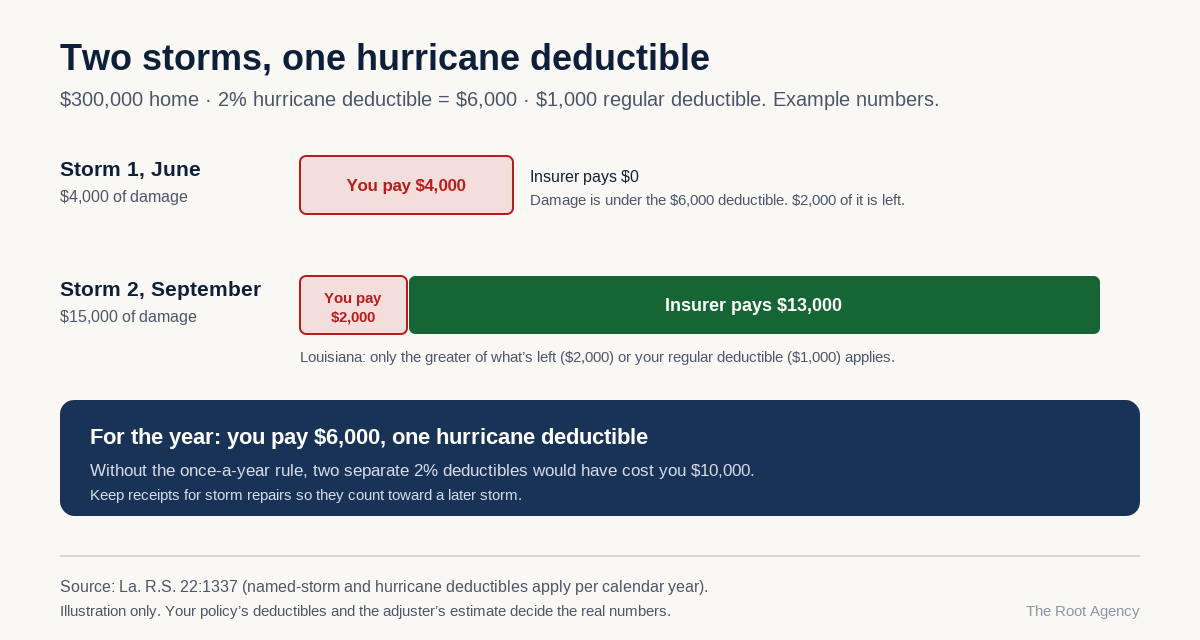
Louisiana law requires a separate named-storm or hurricane deductible on a homeowners policy to apply on an annual basis to all named-storm and hurricane losses during the calendar year. If a second storm hits the same year, the insurer can apply only the greater of what's left of your storm deductible or your regular deductible. Insurers can ask for receipts or other records of the earlier losses (La. R.S. 22:1337).
Two practical points: keep receipts for repairs after any named storm, even small ones you paid yourself, and report storm damage even if it's under the deductible, so it's on record if a bigger storm follows.
You should have signed a deductible form
For new Louisiana homeowners policies starting after January 1, 2023, insurers must give you a state form listing your named-storm, hurricane and wind and hail deductibles, as percentages, dollar amounts or both, and ask you to sign it. If the insurer later changes the percentage or dollar amount, it has to send a new form (La. R.S. 22:1337). If you don't remember seeing it, your declarations page lists the same deductibles.
What's a typical deductible?
For the flat deductible, $1,000 is a common choice, and $500 or $1,000 is the usual minimum (Triple-I). Higher deductibles are increasingly common as premiums rise: in J.D. Power's 2026 claims study, 19% of homeowners who filed claims faced a combination of insurer-initiated premium increases, out-of-pocket costs and a deductible of $1,000 or more (J.D. Power).
In Louisiana, the hurricane deductible is usually the one that matters most, because it's a percentage of a large number.
How to choose your deductibles
- Start with your emergency fund. Your deductible should be an amount you could pay from savings the week after a loss without borrowing.
- Convert percentages to dollars. Multiply your dwelling coverage by the hurricane percentage. That's your real storm deductible.
- Price two or three options. Ask your agent what the premium would be at $1,000, $2,500 and $5,000, and at a lower or higher storm percentage. Divide the deductible increase by the yearly savings to see how many claim-free years it takes to break even.
- Check your lender's limit. For loans sold to Fannie Mae, no deductible can exceed 5% of the coverage amount, including a separate wind or hurricane deductible (Fannie Mae Selling Guide).
- Use small-claim discipline. A higher flat deductible works best if you'd skip filing small claims anyway, which also keeps your claims history clean.
Deductibles and claim checks in Louisiana
- You have to actually pay it. Louisiana prohibits contractors from offering to pay, waive or rebate your deductible (La. R.S. 51:451).
- Keep proof. On a replacement cost claim, an insurer can hold the second, recoverable-depreciation check until you show reasonable proof that you paid your deductible (La. R.S. 22:1892). See replacement cost vs. actual cash value.
- Flood is separate. A flood policy has its own deductible, apart from your homeowners deductibles.
Review your deductibles with a Baton Rouge agent
The Root Agency is a local Allstate agency on Goodwood Blvd. Send us your declarations page and we'll show you your flat and hurricane deductibles in dollars, price a couple of alternatives so you can see the trade-off, and check them against your lender's limits. Call (225) 529-1990 or start with homeowners insurance in Baton Rouge.
This article is general information, not insurance or legal advice. Deductibles, triggers and amounts depend on your policy and endorsements.