

In August 2012, the ground opened up near Bayou Corne in Assumption Parish and forced hundreds of people from their homes. Closer to Baton Rouge, orange barricades around caved-in yards and roadsides are a familiar sight. If the ground under your house gives way, here's what your insurance will and won't do.
The short answer: usually not
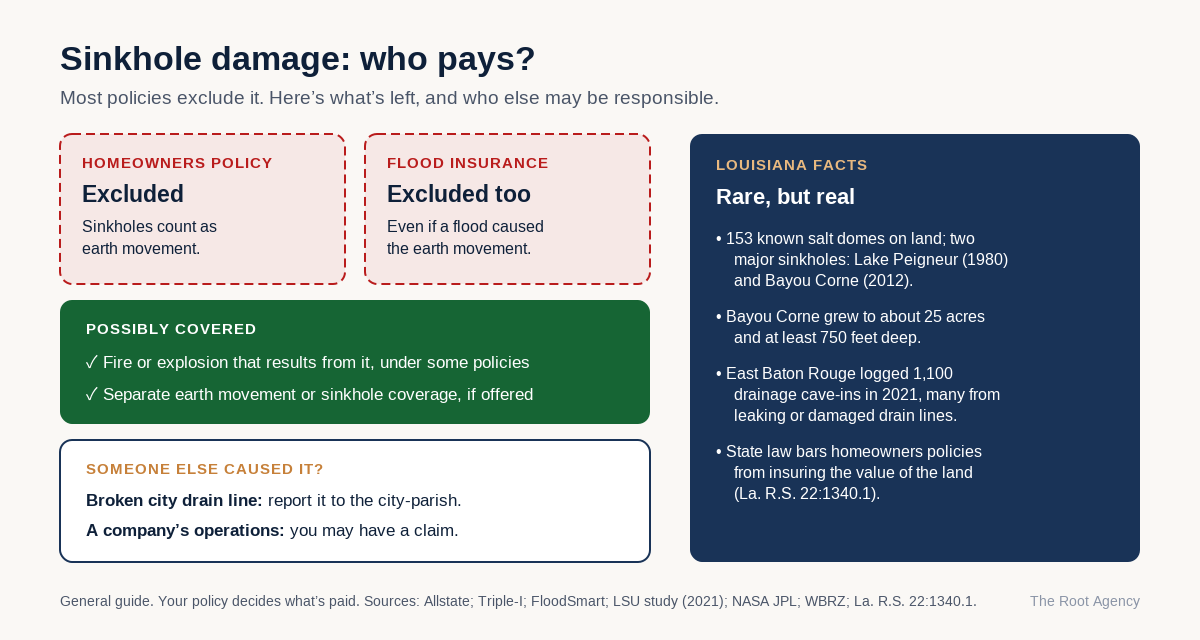
Standard homeowners policies exclude earth movement, and sinkholes count as earth movement. Allstate lists sinkholes, along with earthquakes and landslides, among the types of damage homeowners insurance doesn't commonly cover (Allstate). Most property insurance policies in the U.S. exclude damage from earth movement (Triple-I).
Louisiana's regulators have said as much. A state insurance commission report noted that sinkhole claims haven't been a problem in Louisiana partly because most homeowners policies exclude earth movement (Louisiana Property and Casualty Insurance Commission).
Why insurers exclude sinkholes
Homeowners insurance is priced on what it costs to rebuild the house, not the value of the land under it. Sinkholes are hard to predict, hard to investigate and very expensive to fix, so insurers leave them out of the standard policy, much like earthquakes (Triple-I).
In Louisiana, the value of the land itself is never part of the coverage. State law bars an insurer from issuing or renewing a homeowners policy that includes the value of the unimproved land in its coverage limits (La. R.S. 22:1340.1). Repairing the ground is a separate question. Some policies add a limited amount for stabilizing land under the house when a covered, sudden loss damages the dwelling. One Allstate policy form, for example, adds up to $10,000 for that (Allstate policy form). Whether yours does depends on your policy and what caused the loss, so ask your agent.
What might still be covered
- Fire or explosion that follows. Some policies cover sudden and accidental loss from a fire or explosion that results from earth movement. One Allstate policy form, for example, lists sinkholes in its earth movement exclusion, applying it “whether or not the earth movement is combined with water,” but still covers that fire or explosion (Allstate policy form). Wording differs, so read the exclusion in your own policy.
- Separate coverage. Some states require insurers to offer optional sinkhole coverage, sold as an endorsement or a standalone policy. Florida and Tennessee are examples. If you're worried about your property, ask your agent whether earth movement coverage is available. Insurers typically inspect the home before issuing it (Triple-I).
- Someone else's responsibility. If a city drain line, a utility or a company's operations caused the collapse, the fix or the compensation may come from them, not your insurer. More on that below.
For damage that starts with water, like a burst pipe under the slab, see does homeowners insurance cover water damage and does homeowners insurance cover foundation repair.
Flood insurance won't fill the gap
The federal flood policy doesn't cover loss caused directly by earth movement, even if a flood caused the earth movement. FloodSmart lists land subsidence and sinkholes as examples (FloodSmart). You still need flood insurance for flooding itself; see flood vs. homeowners insurance.
Sinkholes in Louisiana
Louisiana isn't limestone country like Florida. Its big sinkholes come from salt domes, huge underground salt deposits that are mined and used to store fuel and brine. An LSU study counted 153 known salt domes on land in Louisiana and two major sinkholes tied to them over the last 70 years: Lake Peigneur in 1980 and Bayou Corne in 2012 (LSU study). The same study found the risk is small statewide but substantial for homes sitting over a salt dome. Terrebonne Parish has the most salt domes, Madison Parish has the largest share of its area at risk, and St. Mary Parish has the greatest risk of property loss.
Bayou Corne shows what's at stake. The sinkhole formed on Aug. 3, 2012, when the wall of an underground storage cavern operated by Texas Brine Company collapsed inside the Napoleonville salt dome. It grew to about 25 acres and at least 750 feet deep (NASA JPL). More than 350 residents had to evacuate. Texas Brine, not homeowners insurers, ended up offering settlements and buyouts, and residents said insurers canceled their policies (Insurance Journal).
Baton Rouge cave-ins: usually a drain problem
Most “sinkholes” around Baton Rouge are much smaller and have a plainer cause. In 2021, East Baton Rouge's city-parish had a log of 1,100 drainage cave-ins, many caused by leaking or damaged stormwater and drain lines (WBRZ).
If a hole opens near a storm drain, ditch, culvert or the street, report it to the city-parish. Your homeowners policy likely won't pay to fill it. If the collapse damages your house, call your agent too, so the cause can be looked at before anything is repaired.
Warning signs and what to do
There's no easy way to tell whether a sinkhole is forming under your property. The U.S. Geological Survey suggests watching for small holes in the ground and new cracks in your foundation (Triple-I).
- Keep people and pets away from the hole, and don't try to fill a large one yourself.
- Take photos of the hole, any cracks and any damage to the house, with dates.
- Report it to the city-parish if it's near a drain, ditch or street.
- Call your agent if the house is damaged, so you know what your policy says before repairs start.
- If a company or utility caused it, keep records and talk to an attorney about a claim against them.
Talk to a Baton Rouge agent
The Root Agency is a local Allstate agency on Goodwood Blvd. We can walk through the earth movement exclusion in your policy, tell you what is and isn't covered, and check your flood coverage while we're at it. Call (225) 529-1990 or start with home insurance in Baton Rouge.
This article is general information, not insurance or legal advice. Coverage depends on your policy and the facts of each claim.