
Yes. Fire is one of the core risks every standard homeowners policy covers. Whether it starts on the stove, in the wiring or from a lightning strike, your policy can pay to rebuild the house, replace what you own and house your family in the meantime. Here's how each coverage works, what's excluded, and the Louisiana law that decides how a total loss is paid.
What homeowners insurance pays after a fire
Four parts of your policy work together (Allstate):
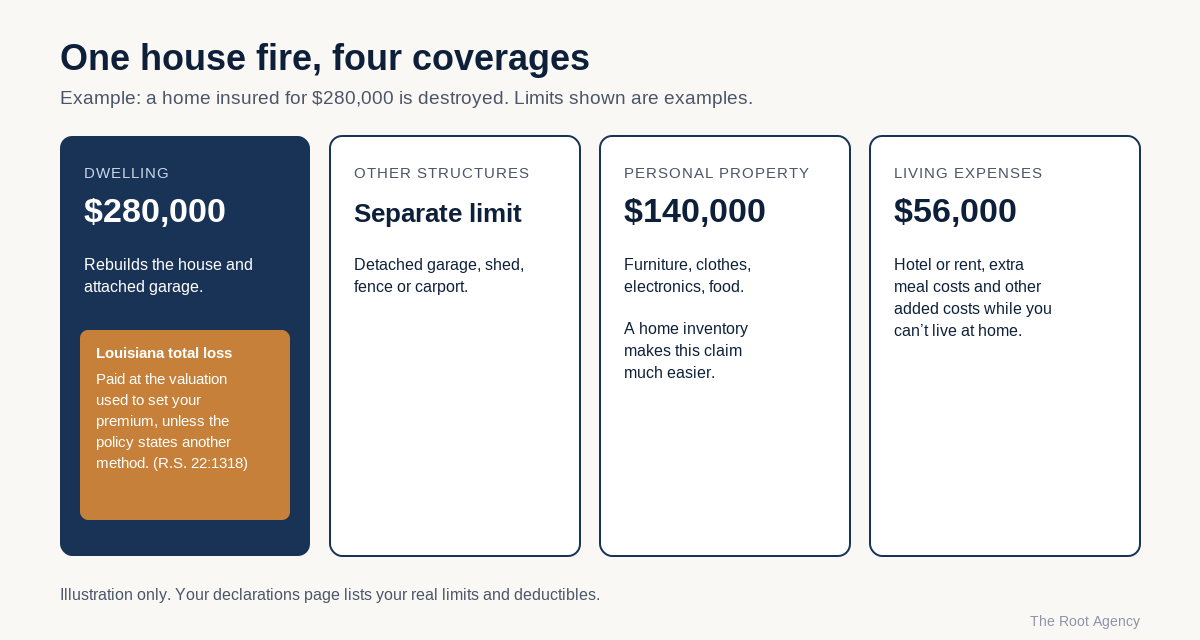
- Dwelling coverage repairs or rebuilds the house and attached structures like an attached garage. A kitchen fire from a potholder left too close to the stove is the kind of loss it's built for. See what dwelling coverage is.
- Other structures coverage pays for a detached garage, shed or fence.
- Personal property coverage repairs or replaces furniture, clothes, appliances and electronics damaged or destroyed by fire.
- Additional living expenses pay the extra costs of living somewhere else while your home is repaired, like a hotel or rental and restaurant bills (Allstate).
Smoke damage is covered too. A standard HO-3 policy covers fire, lightning, smoke and vandalism (Triple-I), so soot in the walls, carpet and closets is part of the same claim. On a partial loss, your regular deductible applies.
Louisiana's valued policy law on a total loss
If fire destroys your home, Louisiana law changes the math. Under the valued policy law, when a policy covering fire places a value on the home and uses it to set your premium, a total loss must be paid at that value without deduction or offset, unless the policy and application spell out a different method of computing the loss in type of equal size (La. R.S. 22:1318).
In plain terms: the dwelling limit you're paying for is the number that matters on a total loss. That's why it should match what it would cost to rebuild your home today, not its sale price or your mortgage balance. See how much homeowners insurance you need.
For partial losses, how belongings and repairs are valued depends on whether your policy pays replacement cost or actual cash value. See replacement cost vs. actual cash value.
What fire coverage doesn't pay for
- Fires you set on purpose. Louisiana's valued policy law allows coverage to be voided for the insured's criminal fault (La. R.S. 22:1318). Accidents, even careless ones, are a different matter and are generally covered.
- Vandal fires in a long-vacant home. If a house is left unoccupied for a long time and vandals set a fire, homeowners insurance generally won't pay (Allstate). Ask about vacancy coverage if your home will sit empty.
- Acts of war (Allstate).
- Amounts above your limits. If you're underinsured, the gap is yours.
Fire risk in Louisiana
Louisiana has one of the higher fire death rates in the country. In 2023, 89 people died in fires here, a rate of 19.5 per million residents compared with 13.1 nationally, a relative risk of 1.5 (U.S. Fire Administration).
Nationally, cooking is the leading cause of home fires, behind nearly half (46.7%) of residential building fires in 2024 (U.S. Fire Administration). Working smoke alarms, never leaving the stove unattended and a fire extinguisher in the kitchen protect your family first and your claim second.
What to do after a house fire
- Get everyone out and call 911. Don't go back in until the fire department says it's safe.
- Call your insurer or agent as soon as you can, and ask about an advance on living expenses.
- Secure the property. Board windows and openings to prevent more damage, and keep every receipt.
- Document everything. Photos and video of each room, and a list of damaged belongings. A home inventory made before the fire makes this far easier; see the tips in our theft coverage guide.
- Track your extra costs. Hotel, rent, meals beyond your normal grocery bill and mileage can fall under additional living expenses.
- Know the timeline. Louisiana generally requires insurers to pay within 30 days after receiving satisfactory proof of loss (La. R.S. 22:1892).
Make sure your limits would rebuild your home
Belongings are often insured at 50% to 70% of the dwelling limit, and living expenses around 20% (Triple-I). Building costs have risen, so a dwelling limit set years ago may not rebuild your home today.
The Root Agency is a local Allstate agency on Goodwood Blvd. We can review your dwelling, belongings and living expense limits against today's rebuilding costs and walk you through what a fire claim would pay. Call (225) 529-1990 or start with homeowners insurance in Baton Rouge.
This article is general information, not insurance or legal advice. Coverage, limits and exclusions depend on your policy and endorsements.