

Collision pays to repair your car when it hits something: another car, a pole, a guardrail, or the ground in a rollover, regardless of who was at fault. Comprehensive pays when something happens to your car that isn't a crash: it's stolen, flooded, dented by hail, hit by a falling tree, or it hits a deer. Neither is required by Louisiana law, which only requires liability. But if you have a car loan or lease, your lender will require both.
Comprehensive vs. collision at a glance
| Collision | Comprehensive | |
|---|---|---|
| What it covers | Your car hitting another vehicle or object, or rolling over | Theft, vandalism, fire, flood, hail, wind, falling objects, animals |
| Fault matters? | No, it pays even when the crash was your fault | No, these events usually aren't anyone's fault |
| Most it pays | Repairs, or the car's actual cash value if totaled | Repairs, or the car's actual cash value if totaled |
| Deductible | Its own, often $500 or $1,000 | Its own, often lower |
| Required in Louisiana? | No, but required by lenders | No, but required by lenders |
| Louisiana average cost, 2024 | About $635 a year | About $412 a year |
Neither one covers your medical bills or damage you do to other people. That's liability, uninsured motorist and medical payments coverage. See types of auto insurance in Louisiana.
Which coverage pays? Common Louisiana claims
- You rear-end someone in traffic on I-10: collision for your car. Your liability pays for theirs.
- Someone else hits you: their liability insurance should pay. You can also use your own collision to get repairs moving sooner; your insurer then seeks repayment from theirs and may refund your deductible.
- An uninsured driver hits you: collision, minus your deductible. Without collision, see the uninsured motorist option below.
- You hit a deer: comprehensive. Louisiana drivers' odds of an animal collision claim are about 1 in 215 a year (State Farm).
- You swerve to miss the deer and hit a tree: collision. Insurers generally advise braking rather than swerving.
- Your car floods or is dented by hail: comprehensive (Allstate). See does car insurance cover flood damage?
- A tree or limb falls on your parked car: comprehensive. See who pays when a tree falls.
- Your car is stolen or broken into: comprehensive for the car and its built-in parts. Belongings inside fall under homeowners or renters insurance.
- A pothole bends a rim: usually collision, since the car struck something.
- A rock cracks the windshield: comprehensive. Some policies offer full glass coverage with no deductible.
What comprehensive and collision cost in Louisiana
According to the National Association of Insurance Commissioners, the average Louisiana collision premium in 2024 was $634.58, and the average comprehensive premium was $411.65 (NAIC). Comprehensive is the one that has climbed fastest, and it's where Louisiana stands out from the rest of the country:
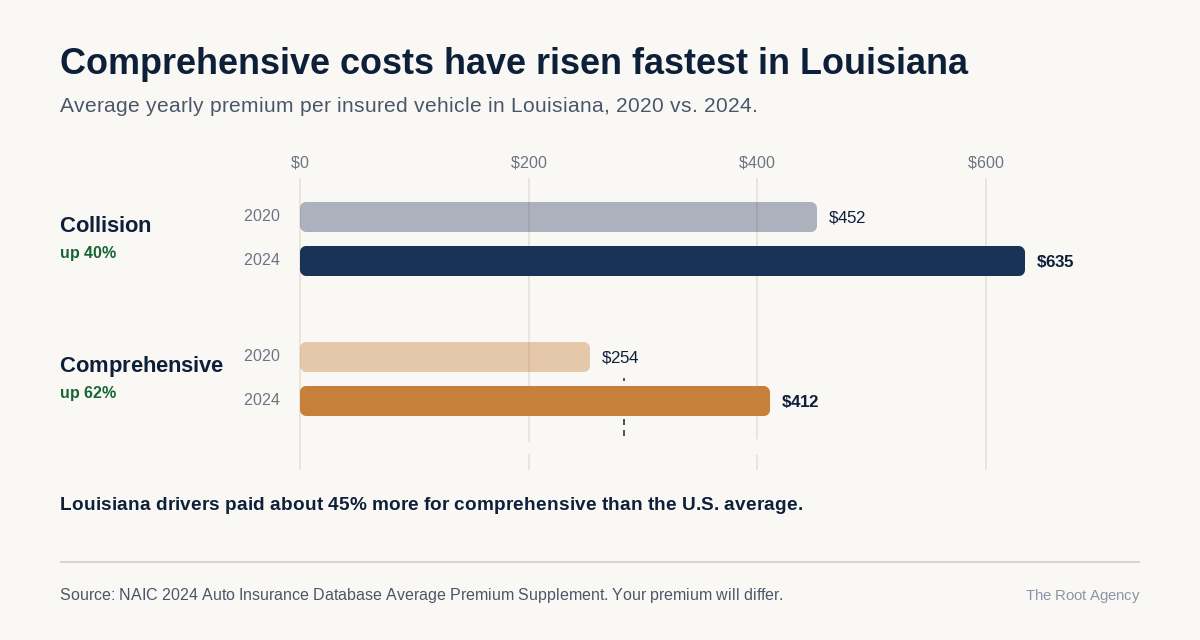
Louisiana drivers paid about 45% more for comprehensive than the national average of $283. Hurricanes, flooding, hail and theft all land on comprehensive, and they're all common here. Your own price depends on your car, deductible, driving record and where you park. See average car insurance cost in Louisiana.
Choosing deductibles
Comprehensive and collision each have their own deductible, and they don't have to match:
- Consider a lower comprehensive deductible. In Louisiana you're more likely to use it, for hail, floods, falling limbs or a broken windshield, and those claims aren't your fault.
- A higher collision deductible lowers the premium on the more expensive coverage, if you could cover it after a crash.
- Pick an amount you could pay next week. A deductible you can't afford makes the coverage hard to use.
Do you need comprehensive and collision?
If you finance or lease: yes. The lender requires both, usually with a maximum deductible. If you're upside down on the loan, add gap insurance too.
If you own the car outright: keep them if you couldn't comfortably repair or replace the car yourself. A common rule of thumb: when a year of comprehensive and collision costs more than about 10% of the car's value, it may be time to drop collision. Many Louisiana drivers keep comprehensive longer than collision, because a flood or hail storm can total an older car that would never be worth a collision claim.
If you drop to liability only: nothing pays to fix or replace your own car, whatever happens to it. See liability-only car insurance in Louisiana.
A Louisiana option if you don't carry collision
If a car has no collision coverage and you haven't rejected uninsured motorist coverage, Louisiana requires your insurer, at your written request, to provide uninsured motorist property damage coverage. It pays for damage an uninsured driver does to your car, up to the car's actual cash value or the state's minimum property damage liability limit, whichever is less, with a $250 deductible (La. R.S. 22:1295). It's a low-cost way to protect an older car from uninsured drivers.
Can you buy one without the other?
Often, yes. Many insurers let you carry comprehensive alone, which is useful for a car in storage or one you rarely drive, since it still covers theft, flood and hail. Collision is usually sold together with comprehensive. Ask your agent what your insurer allows.
Get a comprehensive and collision quote in Baton Rouge
The Root Agency is a local Allstate agency on Goodwood Blvd. We'll price comprehensive and collision at a few different deductibles so you can see the trade-off, tell you whether it still makes sense on an older car, and add gap or rental coverage if you need it. Call (225) 529-1990 or start with car insurance in Baton Rouge.
This article is general information, not insurance advice. Coverage depends on your policy; ask your agent or insurer about your own vehicles.