

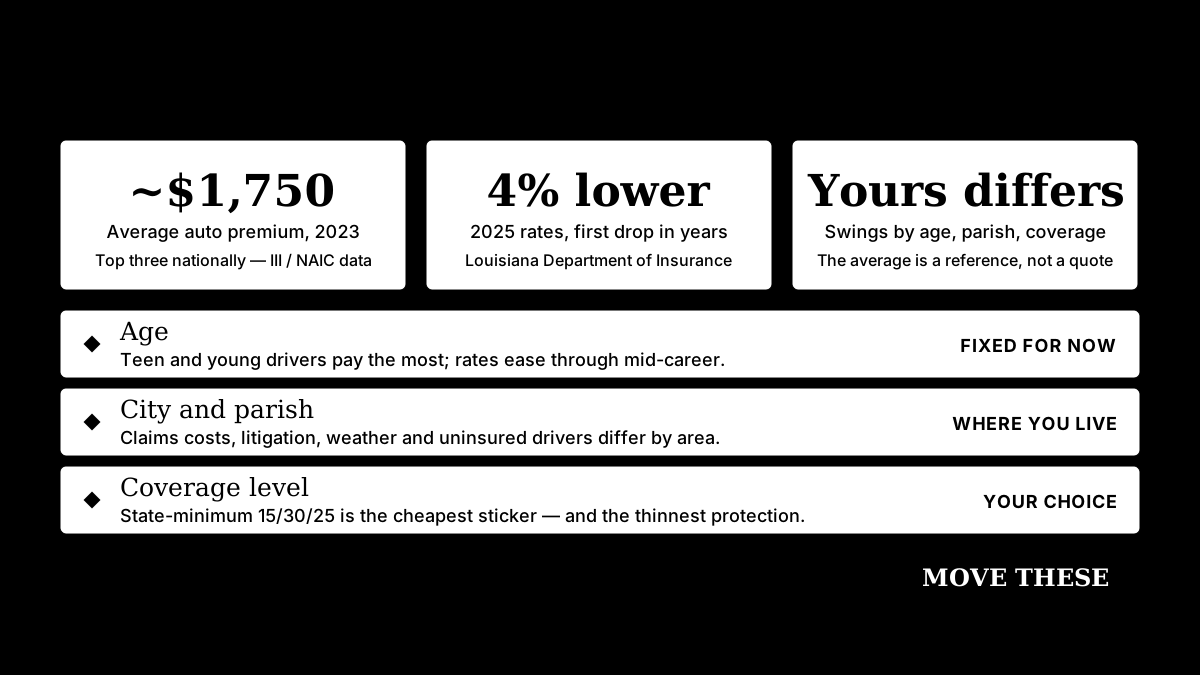
Louisiana drivers spent about $1,750 per insured vehicle on car insurance in 2023 — top three nationally alongside Florida and New York, per NAIC data reported by the Insurance Information Institute. A policy carrying all three main coverages averaged $1,979 in Louisiana (liability about $1,052, collision $581, comprehensive $346) against $1,438 nationally. Your own bill is set by your age, parish, coverage, credit history, vehicle and record — and after years of increases, the Louisiana Department of Insurance reported private-passenger auto rates fell 5.8% in 2025.
If you're trying to pin down the average car insurance cost in Louisiana, here's the honest starting point: Louisiana sits in the top three states for what drivers spend, so the average runs high — but it won't match your quote. Averages blend a 19-year-old and a 55-year-old, downtown Baton Rouge and a rural parish, minimum liability and full coverage. This guide gives you the real numbers by coverage, explains why the state's baseline is high and what finally changed in 2025, shows why age, parish, credit and vehicle move the price so much, and points to the factors you can control. The team at The Root Agency in Baton Rouge helps drivers read past the average to their own real number every day.

Key takeaways
- Louisiana's average auto insurance expenditure was about $1,750 per vehicle in 2023 — top three with Florida and New York, per NAIC data reported by the Insurance Information Institute.
- A policy with liability, collision and comprehensive averaged $1,979 in Louisiana vs $1,438 nationally (NAIC 2023 Average Premium Supplement).
- The high baseline is claim cost and litigation — Louisiana files bodily-injury claims at more than twice the national rate (III) — not uninsured drivers, who are at 11.7% here vs 15.4% nationally (IRC).
- Rates turned in 2025: private-passenger auto rates fell 5.8%, more than $340 million, per the Louisiana Department of Insurance.
- The levers you control — deductible, discounts, mileage, record and an annual review — are where your number actually moves.
What does the average driver pay for car insurance in Louisiana?
About $1,750 a year per insured vehicle, which puts Louisiana in the top three states nationally. The Insurance Information Institute, citing the National Association of Insurance Commissioners' 2022/2023 Auto Insurance Database Report, lists 2023 average expenditures of $1,865 for Florida, $1,754 for Louisiana and $1,753 for New York. The NAIC's own 2023 Auto Insurance Database Average Premium Supplement, published June 2025, prints the same three states at the top but orders them Florida $1,863.82, New York $1,752.55 and Louisiana $1,749.22 — against a countrywide average of $1,281.60.
So the accurate phrasing is “top three, essentially tied with New York,” not a flat “second-highest” — the two tables disagree by a few dollars. Either way, treat the figure as a reference point, not a prediction. “Average expenditure” blends every driver and policy in the state, including people who carry liability only, so almost nobody pays exactly the average. A young driver with full coverage in a dense parish lands well above it; a mid-career driver with a clean record and higher deductibles can land below it.
Data note: 2023 is the newest full year of state-by-state NAIC data (the supplement came out in June 2025; the full report in February 2026). We checked these figures in September 2026; 2024 state data typically lands the following summer.
How much does each coverage cost on average?
Here's the more useful version of the average — the NAIC supplement's 2023 breakdown of what each coverage cost in Louisiana, with the U.S. figure beside it:
- Liability: about $1,052 a year in Louisiana vs about $737 nationally.
- Collision: $581 vs $464.
- Comprehensive: $346 vs $238.
- All three combined: $1,979 vs $1,438.
Two things stand out. Liability — the part the state requires — is where Louisiana is most out of line with the rest of the country, which fits the claim-cost story below. And the two physical-damage coverages that turn a liability policy into “full coverage” add about $927 a year at the average. That's the price of having your own car repaired or replaced after a wreck, a hailstorm or a flood, and it's the line where your deductible choice changes the number most.
Why is the average so high in the first place?
It's the state's claim costs, not the average driver. Louisiana's high baseline comes from what it costs insurers to settle claims here, and that cost gets spread across everyone who buys a policy.
The biggest driver is bodily-injury claims and litigation. Louisiana drivers file bodily-injury claims at more than twice the national average, a pattern the Insurance Information Institute has tracked for years, and the state's litigation habits raise the legal and medical cost behind each crash. Severe weather — hurricanes, flooding, hail — adds to the comprehensive side. For the full picture, see our guide to why insurance is so expensive in Louisiana.
One thing that is not the cause: uninsured drivers. Louisiana's uninsured rate was 11.7% in 2023, below the 15.4% national figure, according to Insurance Research Council data published by the Insurance Information Institute. The real Louisiana gap is thin coverage — the state's $15,000-per-person minimum runs out fast in a serious injury — which is why uninsured/underinsured motorist coverage matters more here than the uninsured headcount suggests.
### What changed in 2025?
Rates finally turned. The Louisiana Department of Insurance reported in February 2026 that private-passenger auto rates fell 5.8% in 2025 — more than $340 million in premium — after several years of increases, with rates across all insurance lines combined down 0.4%. The Insurance Information Institute credits the 2024–2025 legal reforms and falling claim frequency and severity, noting more than 20 rate-decrease requests filed since mid-2025. A decrease your carrier filed doesn't automatically show up as the same percentage on your renewal — your own changes count too — so it's worth checking.
Why does cost vary so much by age?
Because age is a strong proxy for crash risk, and insurers price it heavily. It's one of the widest swings in any premium.
Teen and young drivers pay the most, by a lot. As the Insurance Information Institute puts it, mature drivers have fewer accidents than less experienced drivers, particularly teenagers — so adding a teen to a policy raises the household premium sharply. See our guide on adding a teen driver to your policy. Rates typically ease into the late 20s and settle through the mid-career years, when a clean record and stable history work in your favor. They can tick up again for the oldest drivers. Age itself is fixed, but its effect fades with experience and a clean record — which is why young drivers should chase every discount available.
Why does cost vary by city and parish?
Because risk is local, and your ZIP code carries real weight. Two drivers with identical records and cars can pay different premiums based purely on where they park at night.
Denser areas around Baton Rouge tend to cost more than smaller surrounding towns, for concrete reasons: more traffic means more collisions, and higher theft and vandalism rates raise comprehensive costs — the same urban-versus-rural gap the Insurance Information Institute describes nationally. Parishes closer to the coast carry more storm and flood exposure. None of this is a judgment on you as a driver — it's the claim history of the area priced into the rate. It's also why a local agent who knows the difference between parishes can help make sure your coverage fits your actual local risk, not a generic statewide default.
Do your credit history and your vehicle change the price?
Yes — both, and they're two of the factors drivers most often forget.
Credit. Most insurers, in Louisiana as elsewhere, use a credit-based insurance score as one rating factor. It isn't your lending credit score. The Insurance Information Institute describes it as a statistical tool that predicts the likelihood of your filing a claim and the likely cost of that claim; it's built from your credit history, not your income or your job. In practice, a stronger credit history usually means a lower premium, and improving it over a year or two can move your renewal price.
Vehicle. The car itself is a major factor. Insurers price what it costs to repair, how likely it is to be stolen, its engine size and its overall safety record. A pickup or SUV with expensive parts, or a model thieves favor, costs more to insure for collision and comprehensive; a car with strong crash-test results and cheap repairs costs less. Check the insurance cost before you buy, not after — a vehicle switch is one of the few moves that can change a premium by hundreds a year. Our post on how car insurance rates are calculated in Louisiana walks through the full list of factors.
Why does cost vary by coverage level?
Because you're buying different amounts of protection, and more protection costs more. The gap between minimum and full coverage is one of the largest single factors you control.
State-minimum liability (Louisiana's 15/30/25) is the cheapest sticker price, but it's thin — a serious accident can blow past those limits fast, leaving you personally on the hook. Full coverage adds comprehensive and collision, which at the 2023 averages above run about $927 a year together in Louisiana, but pay to repair or replace your own car — coverage that earns its keep in a state of hurricanes and hail. Higher liability limits and uninsured/underinsured motorist coverage add modest cost for major protection. The right question isn't “what's cheapest,” it's “what's the lowest price that still protects me” — a very different target, and usually a smarter buy. If you're weighing the bare minimum, read our take on liability-only car insurance in Louisiana first.
What can you actually control?
Plenty — just not the parts that make the headlines. You can't change Louisiana's litigation climate, its weather, or your age, so spend your energy on the flexible factors.
- Your deductible. A higher deductible lowers your premium; choose an amount you could cover after a claim.
- Your discounts. Bundling auto with home or renters is usually the biggest; multi-vehicle, safe-driver, good-student and telematics discounts like Drivewise stack on top.
- Your record. A clean record over time is one of the strongest levers you have.
- Your mileage. Driving well under average can lower a usage-based rate.
- Your annual review. Rates and discounts change — reviewing yearly catches savings and any rate decrease your carrier filed.
Focus there, and the average stops being your ceiling. A driver who stacks discounts and right-sizes coverage can land well under the state average even in a high-cost state.
Want to know your real number, not the average?
The state average is a starting point — your actual rate depends on your drivers, vehicles, and coverage, and that's where the savings live. The team at The Root Agency will review your policy, stack the discounts you qualify for, and size your coverage to your real Louisiana risk. When you're ready, start on our auto insurance page or contact your Baton Rouge team, and we'll find where your number can come down.
This article is general information, not a quote or insurance advice. Costs vary by your specific situation — talk with a licensed agent about your policy. Figures are the latest state-level NAIC data (calendar year 2023) and the Louisiana Department of Insurance's 2025 rate report, checked September 2026.