

Teen Driver Added to Insurance Policy: 2026 Guide

Adding a teen driver to an existing auto insurance policy means listing your licensed teenager as a covered driver under your household’s current car insurance. Insurers require this by law in most states, including Louisiana. Skipping this step is not a gray area. It puts your family at risk of denied claims and policy cancellation. The cost increase is real, but the financial and legal exposure of going without proper coverage is far greater. At The Root Agency, we have helped Louisiana families navigate this process for more than 20 years, and the families who plan ahead always come out ahead.
How does a teen driver added insurance policy change your rates?
Adding a teen to your policy is the single largest premium increase most families will ever see outside of a major at-fault accident. Premium increases of 112%–152% are typical when a 16-year-old is added to a parent’s policy. That translates to an additional $1,890 to $4,515 per year, with the average annual cost of insuring a teen on a parent’s policy reaching approximately $5,740 as of 2026.
That number is not a mistake. Teen drivers represent the highest statistical risk category in auto insurance. Carriers price that risk accordingly.

Several factors determine exactly where your increase lands. Age matters most. A 16-year-old costs more to insure than an 18-year-old. Gender is a factor at most carriers, with male teens typically rated higher. The vehicle your teen drives and your current carrier’s base rates also shape the final number significantly.
Pro Tip: Teen driver surcharges vary by $1,500 or more between carriers for the same driver profile. Shopping at least three carriers before committing is the single most effective way to control this cost.
Here is a general cost comparison to set realistic expectations:
| Scenario | Estimated Annual Cost | Notes |
|---|---|---|
| Family policy before teen | ~$2,100 | Baseline two-adult household |
| Family policy after adding teen | ~$5,740 | Average 2026 figure |
| Standalone teen policy | $9,400+ | Most expensive option |
| Add-on to family policy | ~$3,600 | Typical add-on cost alone |
The gap between a standalone teen policy and adding your teen to an existing family policy is not small. Standalone policies cost over $9,400 annually compared to roughly $3,600 as an add-on. That difference alone makes the family policy the right starting point for almost every Louisiana household.
When and how to add your teen to the policy
Timing is where most parents make costly mistakes. The good news is that most insurers do not charge a surcharge for a teen holding a learner’s permit. Your existing policy typically extends coverage during the permit phase at no additional cost.
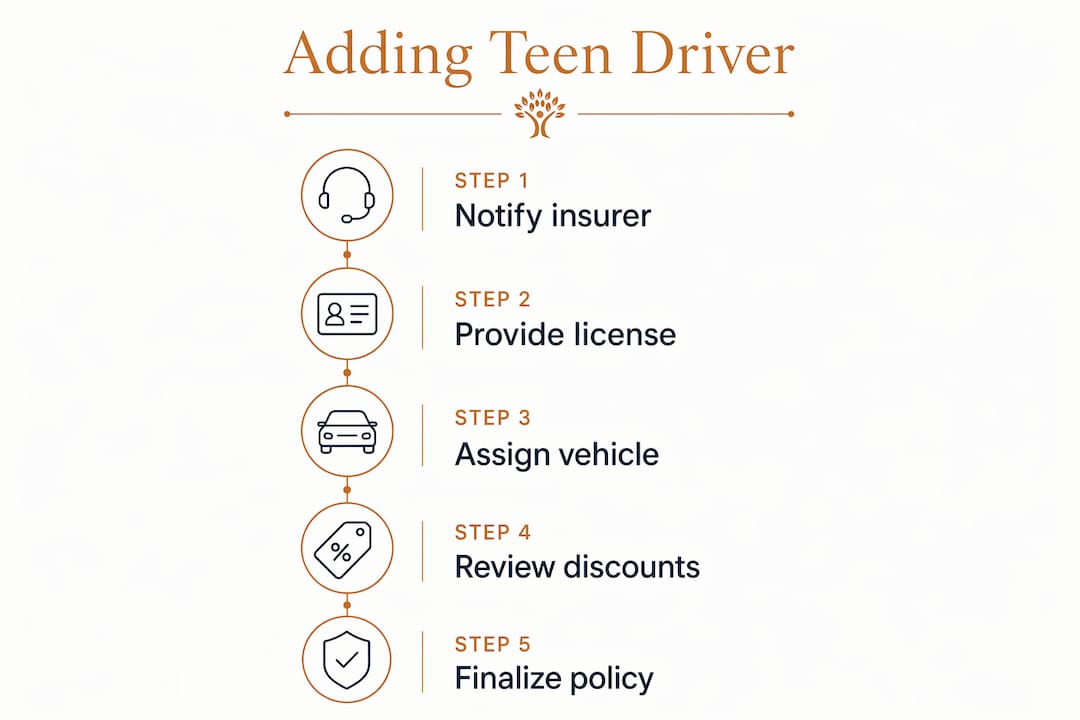
The critical window opens the moment your teen receives a provisional or full license. Most carriers require you to add a newly licensed teen within 30 to 60 days of licensure. Missing that window creates a coverage gap that can result in a denied claim if your teen is in an accident.
Follow these steps to add your teen correctly:
- Contact your agent before your teen gets their license. This gives you time to review your current coverage, understand the cost impact, and confirm your carrier’s specific rules.
- Gather the required information. You will need your teen’s full name, date of birth, driver’s license number, and the date the license was issued.
- Confirm vehicle assignment. Specify which household vehicle your teen will primarily drive. This affects the surcharge calculation directly.
- Review your liability limits. Adding a high-risk driver is the right time to confirm your liability coverage is adequate. Louisiana minimum limits are rarely enough for a serious accident.
- Get written confirmation. Ask your agent to confirm the addition in writing and verify the effective date of coverage.
Failing to disclose a licensed teen driver can lead to denied claims or policy cancellation. All licensed household drivers must be listed to maintain valid coverage. This is not a technicality. It is a condition of your policy contract.
Pro Tip: Call your agent before your teen even schedules the driving test. Knowing the cost impact in advance lets you plan, compare carriers if needed, and avoid scrambling after the license arrives.
What strategies actually reduce teen driver insurance costs?
The premium increase is real, but it is not fixed. Stacking discounts including good student, driver training, telematics, and multi-policy bundles can reduce teen driver premiums by 40%–55% within 12 months. That is a meaningful reduction on a $5,740 baseline.
Here are the discount categories worth pursuing immediately:
- Good student discount. Most carriers offer this for teens maintaining a B average or higher. Allstate, for example, offers this discount for qualifying students.
- Driver’s education discount. Completing a state-approved driver training course reduces the surcharge at most carriers.
- Telematics programs. Programs like Allstate Drivewise track driving behavior and reward safe habits with premium reductions. For a teen who drives carefully, this can be one of the fastest paths to savings.
- Multi-policy bundling. Combining your auto policy with home or renters insurance typically unlocks a discount across both policies.
- Multi-vehicle discount. If your household has more than one vehicle, confirm you are receiving the multi-car rate.
Vehicle assignment is another lever most parents overlook. Assigning a teen to the highest-premium vehicle on a multi-car policy inflates the surcharge unnecessarily. Designating the least expensive car in your household for your teen’s primary use reduces the surcharge calculation. This single adjustment can save hundreds of dollars per year without changing any coverage.
Safe driving behavior compounds over time. Every year your teen drives without an at-fault accident or moving violation, the surcharge shrinks. The families who invest in proper driver education and set clear expectations for their teens see the largest long-term savings.
Pro Tip: Ask your agent to run the numbers on every available discount before finalizing your policy. Discount programs stack, and most families leave money on the table simply by not asking.
Adding a teen to your policy vs. a standalone teen policy
The comparison here is straightforward in most cases. Adding teens to existing family policies is 40%–80% cheaper than standalone teen policies. The family policy also preserves access to multi-vehicle discounts, loyalty discounts, and bundling benefits that a standalone policy cannot offer.
There are exceptions. A teen who owns a titled vehicle and lives independently typically needs their own policy. Some carriers also require a separate policy if the teen’s vehicle is not listed on the household policy.
| Factor | Family Policy Add-On | Standalone Teen Policy |
|---|---|---|
| Annual cost | ~$3,600 add-on | $9,400+ |
| Discount eligibility | Full access | Limited |
| Coverage flexibility | Tied to household policy | Independent |
| Best for | Most Louisiana families | Independent teen with own vehicle |
Certain insurers allow teens who own titled vehicles but still live at home to remain on the parent’s policy. This preserves household discounts and is worth confirming with your carrier before any title transfer.
Understanding how car insurance rates are calculated in Louisiana helps you evaluate these options with a clearer picture of what drives your specific premium.
Pro Tip: Before transferring a vehicle title to your teen’s name, call your agent. That one conversation can save you from accidentally triggering a standalone policy requirement and a much higher premium.
Key takeaways
Adding a teen to your family auto policy is the most cost-effective and legally required path to coverage, and strategic discount stacking can reduce the surcharge by 40%–55% within the first year.
| Point | Details |
|---|---|
| Add promptly after licensure | Most carriers require notification within 30–60 days to avoid claim denial. |
| Family policy beats standalone | Adding a teen to an existing policy costs 40%–80% less than a standalone teen policy. |
| Stack discounts aggressively | Good student, telematics, and driver training discounts can cut premiums by 40%–55%. |
| Assign the right vehicle | Designating the least expensive household car to your teen reduces the surcharge. |
| Shop multiple carriers | Teen surcharges vary by $1,500 or more yearly between carriers for the same driver. |
What 20 years of louisiana families has taught me about teen driver coverage
Every year, I talk to parents who waited too long to add their teen to the policy. Sometimes it is a week after the license. Sometimes it is after an accident. The outcome is always the same: a coverage gap that costs far more than the premium they were trying to avoid.
The families who handle this well share one habit. They call before the license arrives. They ask questions, understand the cost, and make a plan. They do not treat the premium increase as a reason to delay. They treat it as the cost of keeping their family protected while their teen learns the road.
The other mistake I see regularly is fixating on the cheapest premium without reviewing the underlying coverage. Louisiana roads are not forgiving. A serious accident with minimum liability limits can expose your family to financial consequences that no discount program will fix. The right question is not “what is the lowest premium?” It is “what coverage do I need if my teen is in a serious accident?”
My advice after more than 20 years of working with Louisiana families is this: get the coverage right first, then work every legitimate discount to bring the cost down. That order matters. The families who reverse it often regret it.
— Steve Root
Let the root agency help you add your teen driver
Adding a teen to your auto policy is one of the most consequential coverage decisions a Louisiana family makes. The Root Agency has guided families through this process for more than 20 years, with 356 Google reviews at 4.9 stars and recognition as one of Baton Rouge’s best agencies by The Advocate in 2025.

We review your current policy, identify every available discount, confirm proper vehicle assignment, and make sure your teen is covered from day one. We also offer bilingual service in English and Spanish and 24/7 claims support when you need it most. Call us at (225) 926-0160 or visit us at 8676 Goodwood Blvd Ste 303, Baton Rouge, LA 70806. You can also get started with a Louisiana auto insurance quote online today.
FAQ
When do i have to add my teen driver to my policy?
Most insurers require you to add a newly licensed teen within 30 to 60 days of licensure. Permit holders are typically covered at no extra charge, but the clock starts the moment your teen receives a full or provisional license.
How much does adding a teen driver increase my insurance?
Adding a 16-year-old increases premiums by 112%–152%, or $1,890 to $4,515 per year. The average total annual cost for a family policy with a teen driver is approximately $5,740 as of 2026.
What happens if i do not add my teen to my policy?
Failing to disclose a licensed teen driver can result in a denied claim or policy cancellation. All licensed household members must be listed on the policy to maintain valid coverage.
Is it cheaper to add my teen to my policy or get them their own?
Adding a teen to an existing family policy is 40%–80% cheaper than a standalone teen policy. Standalone coverage can exceed $9,400 annually, while an add-on typically runs around $3,600.
What discounts can reduce my teen’s insurance cost?
Good student discounts, driver’s education credits, telematics programs like Allstate Drivewise, and multi-policy bundling can collectively reduce teen driver premiums by 40%–55% within the first year when stacked together.
Recommended
- Louisiana Auto Insurance Guide for Baton Rouge Drivers | The Root Agency
- Auto Insurance Baton Rouge LA | Car Insurance Quotes | The Root Agency
- Liability-Only Car Insurance in Louisiana — Who It’s Right For | The Root Agency
- Allstate Drivewise® Discount Program — How It Works in Louisiana | The Root Agency