

The cheapest full-coverage car insurance in Louisiana is the lowest price that still keeps three things intact — comprehensive, collision, and liability limits high enough to protect you — plus the uninsured/underinsured-motorist coverage Louisiana law builds into every policy unless you reject it in writing. “Full coverage” isn't a legal product; it's shorthand for liability plus comprehensive plus collision. You lower its cost through deductibles, bundling, discounts, and usage-based programs — not by quietly gutting the comprehensive coverage that pays for hail, flood, and hurricane damage in a state that sees all three.
If you want the cheapest full-coverage car insurance in Louisiana, start with what “cheapest” should actually mean: the lowest price that still keeps real protection, not the lowest number on a quote. “Full coverage” isn't a legal category — it's shorthand for liability, comprehensive, and collision working together — so the cheapest smart version trims premium without gutting those three. This guide explains what full coverage really includes, what a real quote should show, the honest levers that lower its price, when cheap full coverage is a false economy, and how Louisiana's risks and rating factors shape your number. The team at The Root Agency in Baton Rouge reviews these tradeoffs with drivers from Prairieville to Zachary every week, and there's usually more room to save than people expect.

Key takeaways
- “Full coverage” is not one product — it's liability + comprehensive + collision bundled together, per the Insurance Information Institute — and in Louisiana, comprehensive is what pays for flood, hail, wind, and theft.
- Comprehensive and collision are technically optional, but a lender or leasing company will require them on a financed car.
- In NAIC's 2023 premium supplement, Louisiana's average liability premium was $1,052 a year and a policy with all three coverages averaged $1,979 — so collision and comprehensive are where the savings levers live.
- The honest ways to cut the price: a higher deductible (15–30% off collision and comprehensive going from $200 to $500, per III), bundling, telematics, discounts, and vehicle choice — never dropping comp or collision on a car you'd need to replace.
- On an older, paid-off car worth less than about ten times the premium, dropping to liability can be smart; on a newer or financed car, it rarely is.
What does “full coverage” actually mean in Louisiana?
“Full coverage” is a nickname, not a policy you can buy off a menu. It describes a policy that combines the liability required by law with two optional physical-damage coverages: comprehensive and collision.
Here's how the Insurance Information Institute breaks down the pieces: liability pays for injuries and property damage you cause others; collision pays for damage to your car from a crash with another car or an object, or from flipping over; and comprehensive reimburses you for theft or for damage from something other than a collision — the institute's list runs from fire, windstorm, hail, and flood to vandalism and hitting a deer. Bundle those and people call it “full coverage.”
Two things surprise drivers. First, comprehensive and collision are technically optional — but if you finance or lease, your lender will require them. Second, “full” doesn't mean everything: gap coverage, rental reimbursement, and roadside assistance are usually separate add-ons. For a deeper breakdown, see our guide to what full coverage auto insurance means for drivers.
Does full coverage include uninsured motorist coverage?
Not by definition — but in Louisiana it should, and usually does. Under R.S. 22:1295, uninsured/underinsured motorist (UM/UIM) coverage is written into every Louisiana auto policy unless you reject it, choose lower limits, or pick “economic-only” coverage in writing. If a quote is cheaper because UM/UIM is missing, someone signed a rejection form to get there.
The risk isn't mainly uninsured drivers. The Insurance Research Council put Louisiana at 11.7% uninsured in 2023 — below the 15.4% national rate — per the Insurance Information Institute. The bigger problem is underinsured drivers: the IRC's 2017–2023 study found 18% of drivers countrywide underinsured in 2023 on top of the 15.4% with no coverage at all, and Louisiana's legal minimum is only $15,000 per injured person. UM/UIM is what pays when the driver who hit you is legal but nowhere near covered. Keep it at the same limits as your liability, and see our guide to uninsured motorist coverage in Louisiana for how it works in a claim.
What makes full coverage “cheap” — and what doesn't?
Cheap done right lowers the price of the same real protection. Cheap done wrong lowers the protection and calls it savings — and that's the trap on a full-coverage policy.
The number on a quote can drop for two very different reasons. The good reason: a higher deductible, stacked discounts, or a usage-based program bringing the price of intact coverage down. The bad reason: thinner liability limits or a comprehensive/collision setup that won't actually rebuild your car. Both show a smaller premium. Only one is genuinely cheaper once a claim hits. The whole skill of buying cheap full coverage is telling those two apart.
Here's what a real full-coverage quote should show before anyone talks about price:
- Liability of at least 100/300/50 — we usually recommend 100/300/100. That's $100,000 per injured person, $300,000 per accident, and $50,000–$100,000 for property damage, well above Louisiana's 15/30/25 minimum.
- Comprehensive and collision with deductibles of $500–$1,000 each — amounts you could actually pay tomorrow.
- Uninsured/underinsured motorist coverage at limits matching your liability, not a signed rejection form.
- Only the add-ons you'll use — rental reimbursement, roadside, or gap on a financed car.
If two quotes show different limits or deductibles, they aren't comparable yet. Line them up first, then compare price.
What are the honest ways to lower a full-coverage premium?
These levers cut the price without cutting the protection. Most drivers can stack several.
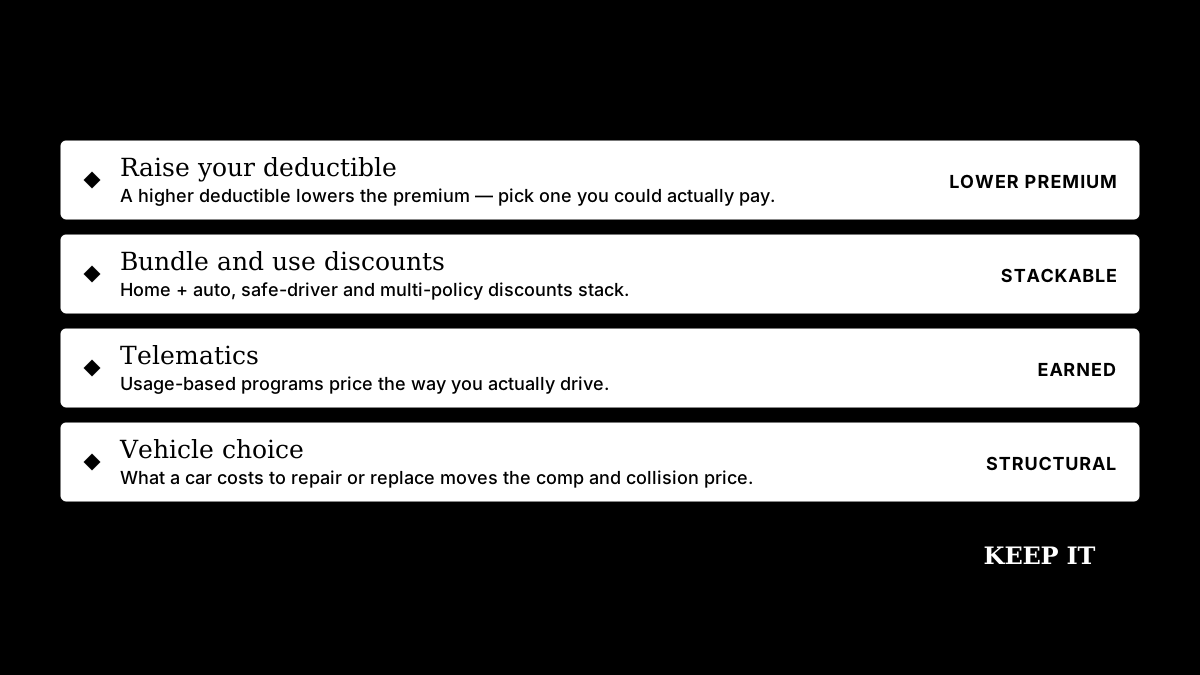
- Raise your deductible. The Insurance Information Institute's nine ways to lower your auto insurance costs puts numbers on it: moving a collision and comprehensive deductible from $200 to $500 can cut the cost of those coverages by 15 to 30 percent, and a $1,000 deductible can save 40 percent or more. Only choose an amount you could pay out of pocket after a claim.
- Bundle your policies. Carrying auto with home or renters insurance typically earns one of the largest discounts there is — and it's the one people most often skip.
- Use a telematics/usage-based program. If you drive safely or drive few miles, pricing based on your actual habits can lower your rate. Allstate's option is one example — see our Drivewise discount guide.
- Stack every discount. Multi-vehicle, good driver, good student, defensive-driving, anti-theft, paperless, autopay, and pay-in-full credits add up.
- Keep your credit healthy. The same III guide notes that most insurers use credit information to price auto policies, so a solid credit history lowers your rate over time.
- Factor insurance cost into the car itself. A vehicle that's cheaper to repair and less likely to be stolen carries a lower comprehensive and collision cost.
The single most reliable move is comparison: the same III guide says to get at least three price quotes, because the price for the same driver and the same coverage varies widely from carrier to carrier. We're an Allstate agency, so we quote one carrier — we'll tell you plainly what our number includes, and you can line it up against the others with the same limits and deductibles.
When is cheap full coverage smart, and when is it a false economy?
It comes down to one question: could you afford to replace your car out of pocket tomorrow? Your answer decides whether dropping to liability is a smart saving or a costly mistake.
Dropping comprehensive and collision can make sense on an older, paid-off car whose value has fallen so far that a year of full-coverage premiums approaches what you'd ever collect for it. Two rules of thumb put a number on it. The Insurance Information Institute's guideline: if your car is worth less than 10 times the premium for those coverages, carrying them may not be cost-effective. The Louisiana Department of Insurance's Consumer's Guide to Auto Insurance says it more simply: compare your annual premium to the car's Blue Book value minus your deductible.
It's usually a false economy on a newer or financed car. If you still owe on the loan — or couldn't comfortably replace the car yourself — comprehensive and collision are doing exactly the job you bought them for. And in Louisiana, comprehensive earns its keep: this is a state of hurricanes, flooding, and hail, and comprehensive is the coverage that pays when the weather, not another driver, totals your car. Cutting it to save a little is a bet against Louisiana's climate — not a bet most drivers should make.
How do Louisiana rating factors move your price?
Your full-coverage premium is built from dozens of factors, and knowing which ones you can move is where the savings live. Some are fixed; some are yours to control.
Louisiana starts from a high baseline. In the National Association of Insurance Commissioners' 2023 Auto Insurance Database Average Premium Supplement, Louisiana's average liability premium was $1,052 a year, collision $581, and comprehensive $346 — a combined $1,979 for a policy with all three, against $1,438 countrywide. NAIC's later 2022/2023 Auto Insurance Database Report puts Louisiana's combined figure at $1,983 and liability at $1,055. Either way, collision and comprehensive add roughly $927 a year on average here, and that slice is exactly what the levers above work on.
Mostly fixed: your age, your ZIP code and its weather and theft risk, the litigation climate of the state, and your vehicle's make and model. Flexible — where you win: your deductibles, the discounts you claim, your driving record over time, your annual mileage, and your insurance score. Because the baseline is high, a focused push on the flexible factors matters more here than almost anywhere. For the full breakdown, see how car insurance rates are calculated in Louisiana.
### What if your profile is the problem: young drivers, tickets, a DWI, or a denial?
- Young drivers. Keep a teen on a parent's policy where possible, claim good-student and driver-training credits, and put them in a modest car that's cheap to repair.
- A ticket or an at-fault crash. The surcharge fades with time — ask exactly when it drops off — and a telematics program lets better habits show up on the bill sooner.
- A DWI, a lapse, or an SR-22 filing. An SR-22 is a certificate proving you carry at least the 15/30/25 minimum; it isn't a type of coverage, and you can still carry full coverage on the same policy. The filing itself is a modest fee — the conviction is what moves the rate. Our SR-22 insurance page explains how the filing works.
- Turned down by insurers. If the standard market won't write you, the Louisiana Automobile Insurance Plan — the state's assigned-risk plan — places you with a participating insurer through any licensed agent. It costs more than the regular market and exists to get you legally insured, not to be cheap, so treat it as a bridge back to a standard policy.
- Older drivers. Ask about a mature-driver or defensive-driving course credit and a low-mileage rate if you're driving less than you used to.
How do you get a full-coverage quote reviewed the right way?
Have someone read the quote line by line, not just the bottom number. The premium is meaningless until you know what coverage sits behind it.
A good review checks three things: that your liability limits are high enough to protect your assets (Louisiana's 15/30/25 minimum is thin for how expensive accidents get here, per the Louisiana Department of Insurance's Consumer's Guide to Auto Insurance); that comprehensive, collision, and UM/UIM are actually present with deductibles you can afford; and that every discount you qualify for is applied. That's the difference between a quote that's cheap because it's efficient and one that's cheap because it's hollow — and it's exactly what a licensed local agent does in a few minutes.
Want to see where your full-coverage price can come down?
If your full-coverage premium feels high, a quick review usually finds room to lower it without touching the protection you need. The team at The Root Agency — Steve Root's Allstate agency in Baton Rouge — will check your deductibles, confirm your comprehensive, collision, and UM/UIM are right for your car, and stack every discount you qualify for. When you're ready, start on our auto insurance page or reach the team that serves Prairieville, and we'll take it from there.
This article is general information, not a quote or insurance advice. Coverage, deductibles, and savings vary by your specific situation — talk with a licensed agent about your policy.