
No Louisiana state law requires homeowners to carry flood insurance. The requirement comes from federal law: if you have a government-backed mortgage on a home in a Special Flood Hazard Area (SFHA), your lender must require flood insurance for the life of the loan. That's a very different question from “do I need it” — because much of Louisiana sits in or near high-risk zones, and a large share of flood claims come from areas that were never mandated to carry coverage at all.
A lot of Louisiana homeowners assume the state requires flood insurance — or that if no one made them buy it, they must not need it. Both assumptions can be costly. The truth is that no Louisiana law forces you to carry flood insurance; the requirement, when it applies, comes from federal law and is enforced by your mortgage lender, and only in high-risk zones. This guide explains exactly who's required to carry flood insurance, when your lender must require it, what a high-risk zone means, and why “not required” is a dangerous thing to hear in Louisiana. The team at The Root Agency in Denham Springs can pull your flood zone and quote NFIP coverage from our Baton Rouge office.
Key takeaways
- Louisiana has no state law mandating flood insurance for homeowners.
- Federal law requires it when you have a federally backed mortgage on a home in a Special Flood Hazard Area (SFHA).
- The requirement is enforced by your mortgage lender, not by FEMA.
- High-risk zones are labeled A, AE, or V on FEMA flood maps.
- “Not required” is not the same as “not needed” — much of Louisiana floods outside mandated zones.
Is flood insurance required by law in Louisiana?
No — there's no Louisiana state law that mandates flood insurance for homeowners. You won't get a state fine for going without it the way you would for driving without auto liability coverage.
But that's only half the picture. A federal requirement can still apply to your home, and it kicks in through your mortgage, not through state government. So the honest framing is: Louisiana doesn't require flood insurance, but your lender might be legally obligated to — and even where no one requires it, the risk often does. The Louisiana Department of Insurance (ldi.la.gov) provides consumer guidance, but the mandate itself is federal.
When must your mortgage lender require it?
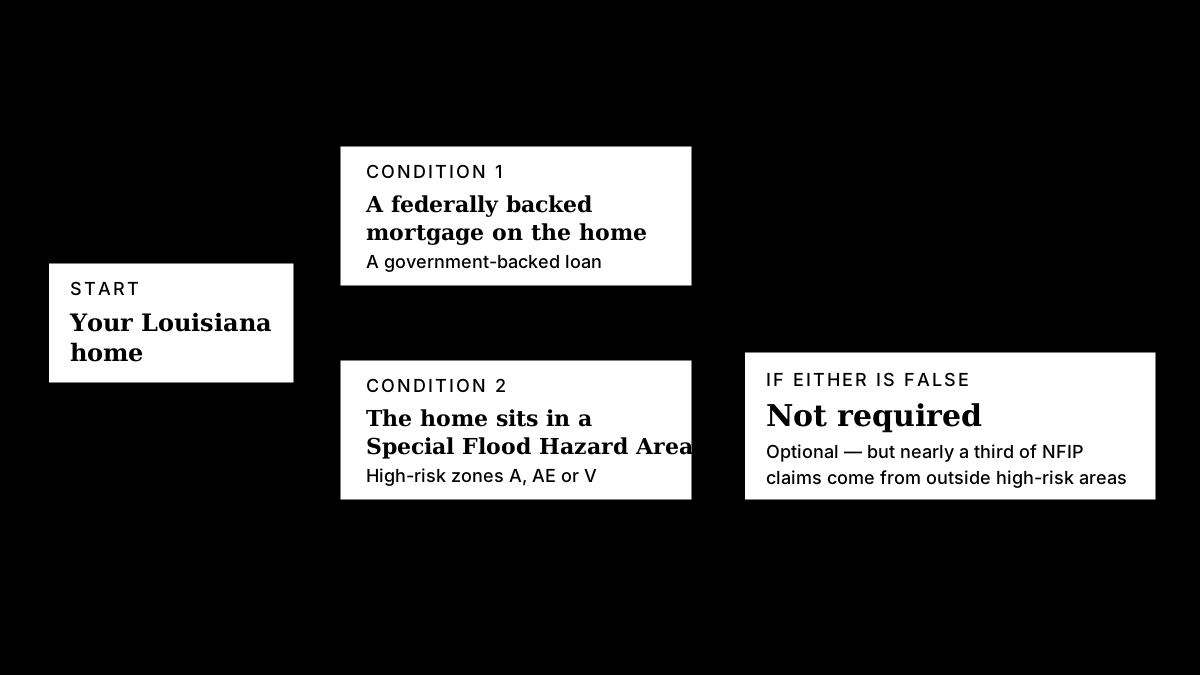
When two conditions line up: a federally backed mortgage and a home in a high-risk flood area. Under the federal mandatory purchase requirement, lenders must require flood insurance on a building that secures a loan when the structure is located in a Special Flood Hazard Area (SFHA) in a participating community.
According to FEMA, certain property owners in SFHAs are required to purchase and retain flood insurance for the life of their mortgage — and that requirement is enforced by lenders, not by FEMA itself. So if you bought a home in a high-risk zone with a typical mortgage, “my lender made me get it” is exactly why. This is common across Baton Rouge, Denham Springs, and Livingston Parish, where large areas fall inside or near SFHAs.
What does a high-risk flood zone (A, AE, V) actually mean?
It means FEMA has mapped your area as having at least a 1% annual chance of flooding — the “100-year flood” standard. On a Flood Insurance Rate Map, high-risk zones carry letters starting with A (including AE) or V:
- Zone A / AE — high-risk areas subject to river, rainfall, or general flooding; AE zones have a defined base flood elevation.
- Zone V — high-risk coastal areas with added wave/storm-surge hazard.
- Zone X — moderate-to-low risk, where flood insurance isn't federally required but is still available and often wise.
You can look up your zone by address through FEMA's Flood Map Service Center (msc.fema.gov). If you're in an A or V zone with a federally backed mortgage, expect the mandatory purchase requirement to apply. New to the state and sorting out what's required? See our guide to Louisiana insurance requirements for new residents.
Can you drop flood insurance after you pay off the mortgage?
Legally, often yes — but it's usually a mistake. The federal mandatory purchase requirement is tied to your loan, so once the mortgage is paid off, the legal obligation to carry flood insurance generally ends (assuming no other requirement applies).
The risk, of course, doesn't end with the mortgage. Your home sits in the same flood zone it did the day before you made the final payment, and now there's no lender-forced safety net. Dropping coverage to save a premium is a bet that your high-risk home won't flood — a bad bet in much of Louisiana. Before you cancel, it's worth pricing what one flood would cost versus the premium you'd save.
Why is “not required” not the same as “not needed” here?
Because Louisiana floods far beyond the zones where coverage is mandated. The mandatory purchase requirement only covers high-risk zones with federally backed mortgages — a fraction of the homes that actually flood.
Nationally, nearly one-third of NFIP flood claims over the past decade came from outside high-risk flood areas, according to FloodSmart — and Louisiana, laced with rivers, bayous, and surge paths, is exactly the kind of place where “low-risk” homes still take on water. So a home with no mortgage, or one sitting in Zone X, can be completely unrequired to carry flood insurance and still be a serious flood risk. “No one is making me” is a statement about paperwork, not about water. If you want to weigh it honestly for your address, our guide on whether you need flood insurance in Baton Rouge walks through the decision.
Not sure whether flood insurance applies to your home?
Whether it's required or just wise, the first step is knowing your flood zone — and that takes about five minutes. The team at The Root Agency can pull your flood zone, explain whether the mandatory purchase requirement applies, and quote NFIP coverage for your home. When you're ready, start on our flood insurance page or contact your Denham Springs team, and we'll sort out where you stand.
This article is general information, not legal or insurance advice. Requirements depend on your specific property and loan — verify your flood zone with FEMA and talk with a licensed agent about your coverage.