
Yes, renters insurance covers fire. A fire is exactly the kind of loss it's built for, and it's the case where renters without coverage are hit hardest: your landlord's policy won't replace your possessions or pay your living expenses while the building is repaired (Triple-I). Here's what a renters policy pays after a fire, what it doesn't, and how to file a claim in Louisiana.
The three ways renters insurance pays after a fire
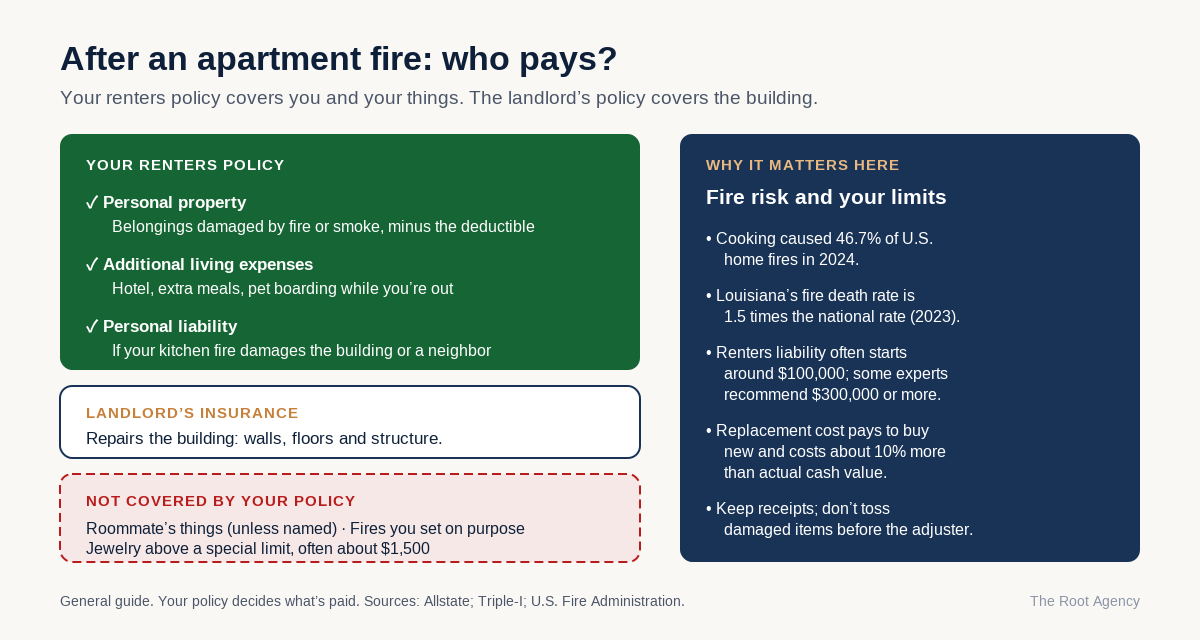
A standard renters policy has three parts, and a fire can trigger all of them (Allstate):
- Personal property coverage helps pay to repair or replace belongings damaged by fire or smoke: furniture, clothes, electronics, kitchen gear and bedding (Triple-I).
- Additional living expenses pay the extra cost of living somewhere else while your rental is unlivable, such as a hotel or temporary rental, restaurant meals and even pet boarding (Allstate). It pays the difference over your normal living costs (Triple-I), and it has a dollar limit and usually a time limit.
- Personal liability coverage helps if you're found responsible for the fire. Allstate's example is a kitchen fire you cause that damages the home you're renting (Allstate).
If you started the fire
Cooking was the leading cause of U.S. residential building fires in 2024, at 46.7% (U.S. Fire Administration). If a pan fire in your unit spreads, two things happen:
- Your own belongings are still covered under your personal property coverage.
- Damage to the building and to neighbors' things may be your responsibility. Tenants typically pay for damage they cause (Allstate), and the landlord's insurer may come after you for what it paid. Your renters liability coverage is what responds, including your legal defense, up to your limit (Triple-I).
That's why the liability limit matters. Renters policies generally start around $100,000, and some experts recommend at least $300,000 (Triple-I). A fire that damages several units can exceed $100,000 quickly. An umbrella policy adds more on top.
Two limits on that protection: liability coverage is for accidents, so a fire you set on purpose isn't covered, and if you run a business out of your apartment, renters liability likely won't cover claims against the business (Allstate).
If a neighbor or the building started it
Your renters policy pays for your belongings and your hotel no matter who started the fire. You don't have to wait for the neighbor or the landlord to accept blame. The landlord's insurance covers the structure itself, which is the landlord's responsibility (Allstate), but it doesn't replace your things (Triple-I). If someone else was at fault, your insurer may try to recover what it paid from them.
How much you'll actually get
- Replacement cost or actual cash value. Actual cash value subtracts depreciation, so a five-year-old couch pays what it's worth used. Replacement cost pays to buy new, and typically costs only about 10% more (Triple-I). After a fire that takes everything, this is the biggest difference in your check. See replacement cost vs. actual cash value.
- Your personal property limit. Add up furniture, clothes, electronics, kitchen gear, even towels and bedding. A home inventory is the easiest way to get it right (Triple-I).
- Special limits. Jewelry and other valuables are often capped around $1,500 for fire as well as theft. A floater raises that (Triple-I).
- Your deductible comes off the property claim.
What renters insurance won't pay for after a fire
- The building. Walls, floors and the rest of the structure are the landlord's to repair (Allstate).
- Your roommate's belongings, unless they're named on your policy. Even a shared policy can make a fire claim messy, because the check is made out to everyone named and you'll all have to agree on who owned what (Allstate). Separate policies are simpler.
- Fires you or someone on your policy set on purpose, and business claims, as above. If a stranger sets the fire, your own losses are generally still covered, subject to your policy's terms.
- Flood damage. Floods aren't covered by renters insurance (Triple-I); see renters insurance and flood in Louisiana.
Louisiana's fire risk
Louisiana had 89 fire deaths in 2023, a rate of 19.5 per million people. That makes the risk of dying in a fire here 1.5 times the national rate (U.S. Fire Administration). Working smoke alarms and a kitchen fire extinguisher are the cheapest protection you can buy, and some insurers discount renters policies for smoke detectors (Triple-I).
How to file a renters fire claim in Louisiana
- Get safe, then call your agent or insurer as soon as you can. Ask how long you have to file and whether you need a hotel right away.
- Keep every receipt for the hotel, meals, laundry and other extra costs (Triple-I).
- Don't throw out damaged items until the adjuster has seen them. Photograph or video everything (Triple-I).
- List what was damaged with brand, age and price. A home inventory saved in the cloud makes this far easier.
- Watch the clock. Louisiana generally requires insurers to pay within 30 days after receiving satisfactory proof of loss (La. R.S. 22:1892).
Check your renters coverage with a Baton Rouge agent
The Root Agency is a local Allstate agency on Goodwood Blvd. We can check whether your belongings are covered at replacement cost, whether your personal property and liability limits are high enough for an apartment fire, and how much living-expense coverage you have. Call (225) 529-1990 or start with renters insurance in Baton Rouge.
This article is general information, not insurance or legal advice. Coverage, limits and exclusions depend on your policy and endorsements.