
In most cases, no. Homeowners insurance doesn't pay to get rid of termites or to fix what they've eaten. That matters more in Louisiana than almost anywhere else, because Formosan termites are here in force. Here's what your policy does and doesn't cover, the one big exception, and how a Louisiana termite contract fills the gap.
Why termite damage usually isn't covered
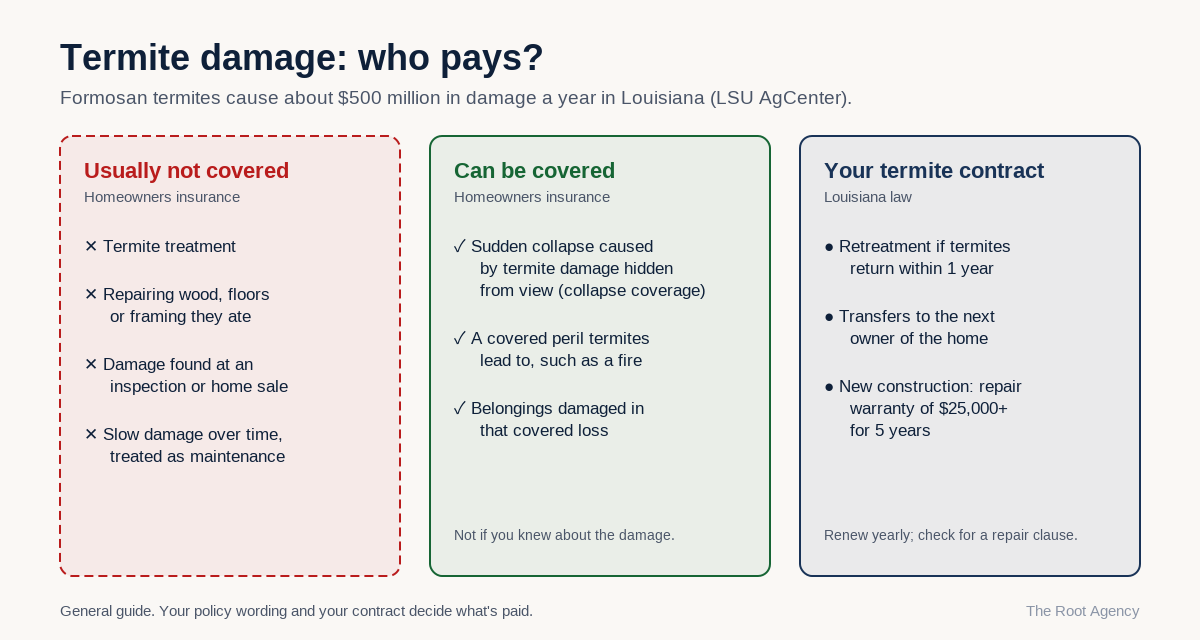
Homeowners insurance pays for sudden, accidental damage, like a fire or a tree through the roof. Termites work slowly, often for years, and preventing an infestation is treated as part of maintaining your home. That's why most policies don't pay for termite removal or the damage they cause (Allstate). Allstate lists creature infestations, including termites, among the things homeowners insurance doesn't cover (Allstate).
That means these are typically your cost:
- Termite inspection and treatment
- Replacing damaged framing, subfloors, sills, trim and siding
- Damage found during an inspection or a home sale
When homeowners insurance can pay
A sudden collapse from hidden damage
Many homeowners policies include collapse coverage, and one of the listed causes is insect or vermin damage that was hidden from view, unless you knew about it before the collapse (Robins Kaplan). The bar is high:
- It has to actually collapse. Collapse means an abrupt falling down or caving in so that part of the home can't be used. A floor that sags, a wall that cracks or a beam that bulges isn't a collapse.
- The damage has to be hidden. Formosan termites hollow out lumber from the inside and rarely break through the surface (LSU AgCenter), so this does happen.
- You can't have known. If an inspection report or earlier repair shows you knew about the termites, the exception won't apply.
Even then, the policy pays for the collapse, not for treating the termites.
A covered peril termites lead to
If termite activity results in a covered peril, such as a fire, the fire damage may be covered (Allstate). Your belongings damaged in that covered loss would go under personal property coverage. The termite damage itself still isn't.
Formosan termites and Louisiana homes
The LSU AgCenter estimates Formosan subterranean termites cause $500 million in damage a year in Louisiana, $300 million of it in the New Orleans area. They have the largest colonies of any termite in North America, can damage a home in a relatively short time, and can build nests above ground when they find water in a wall or roof (LSU AgCenter).
Signs to look for (LSU AgCenter):
- Piles of wings or swarming termites inside or outside the house
- Mud tubes on foundation walls, piers or slab edges
- Mud on door frames, walls, floors or stairs
- Blistered paint, damp spots on walls, or warped floors, windows or door frames
Swarm season runs from as early as April through June, peaking in early to mid May around Mother's Day. Formosan termites fly at dusk on warm, humid, still evenings (LSU AgCenter). If you see a swarm at your porch light in May, call a licensed company.
Your real protection: a Louisiana termite contract
Since insurance won't cover it, a termite contract (often called a termite bond) is the protection that matters. Louisiana law sets minimums:
- A written contract is required. A licensed company that treats your home for termites must give you a written standard contract (La. R.S. 3:3370).
- Retreatment for a year. If termites come back within one year of treatment, the company must retreat (La. R.S. 3:3370).
- It transfers when you sell. A current contract transfers to the next owner, and the company must give you a copy within 30 days of a written request (La. R.S. 3:3370).
- At least one inspection. The contract must include an inspection before it expires (LAC 7:XXV.119).
- New construction gets more. Pre-construction and new-construction treatment contracts must include a damage repair warranty of at least $25,000 for five years (LAC 7:XXV.119).
Beyond the minimums, contracts vary. Ask whether yours is retreatment only or also covers repairs, what the repair limit is, and what you have to do to keep it in force, usually a yearly renewal and inspection.
Buying a home? Get the wood destroying insect report
Louisiana buyers commonly order a wood destroying insect report from a licensed pest control company, on a form approved by the state (La. R.S. 3:3370). Read it closely and ask the seller for the current termite contract, which can transfer to you. Damage that's already there when you buy won't be covered by your new homeowners policy.
How to keep termites out
- Fix leaks and keep gutters and downspouts carrying water away from the foundation (Allstate).
- Keep a gap between wood and soil: don't let siding, firewood or wood trim touch the ground (Allstate).
- Get a professional inspection every year, and renew your contract on time.
- Don't treat it yourself; termites can't be effectively treated by homeowners alone (Allstate).
Cracks from settling clay soil are a separate issue; see does homeowners insurance cover foundation repair.
Talk to a Baton Rouge agent
The Root Agency is a local Allstate agency on Goodwood Blvd. We can walk you through what your homeowners policy covers, including collapse coverage, and make sure the rest of your home is protected for the risks insurance does cover. Call (225) 529-1990 or start with homeowners insurance in Baton Rouge.
This article is general information, not insurance or legal advice. Coverage depends on your policy wording; termite protection depends on your contract.