
RV Insurance in Louisiana and Mississippi: What to Cover

RV insurance is a vehicle policy built for something that is also a living space. It pays for damage to your motorhome or camper, protects you when you cause an accident, and can cover your belongings, your campsite liability and your emergency costs on a trip. In Louisiana and Mississippi, state law sets only the floor for a motorhome, and a towable camper often has no physical-damage coverage at all unless you add it. This guide explains what to cover, what the law requires, what moves the price and what to ask before you sign.
TL;DR
- A motorhome must carry state minimum liability in Louisiana and Mississippi. That minimum protects other people, not your rig.
- Your tow vehicle’s policy usually extends liability to a hitched trailer, but not collision or comprehensive for the trailer itself.
- Your auto and homeowners policies were not written for an RV, so a dedicated RV policy fills real gaps: contents, trips, campsite liability and full-time living.
- Price depends on the RV’s class, value, age, how you use it, your driving record, limits and deductible. Choose limits for the loss you could face, not the lowest payment.
- Standard flood insurance rules exclude most RVs, so wind, storm and water coverage needs a close look before hurricane season.
Table of Contents
- What RV insurance actually covers
- Motorhome, camper or travel trailer: the type decides the coverage
- What Louisiana and Mississippi require
- Why your auto or home policy is not enough
- What drives the cost of RV insurance
- Wind, hurricanes and flood: the Gulf South problem
- Is RV insurance worth it if you only use it a few weekends a year?
- How to compare RV insurance quotes
- Our perspective: coverage is for the bad day
- Talk to a Louisiana agent about your RV
- FAQ
- Sources
What RV insurance actually covers
An RV policy is a bundle of coverages. The Maryland Insurance Administration’s RV guide lists the ones you will see most often: liability, comprehensive, collision, uninsured and underinsured motorist, contents, towing and roadside assistance, emergency expenses, campsite liability and personal effects. The rules differ by state, but the building blocks are the same everywhere.
Here is what each one does in plain terms.
- Liability. Pays for injury or property damage you are legally responsible for. Louisiana’s Department of Insurance describes it the same way in its consumer guide to auto insurance.
- Collision. Pays to repair or replace your RV after a crash, whoever is at fault, less your deductible.
- Comprehensive. Pays for damage that is not a crash: fire, theft, vandalism, falling trees, hail and wind. In Louisiana, this is the coverage people reach for after a storm.
- Uninsured and underinsured motorist. Protects you and your passengers when the other driver has no coverage or too little.
- Personal effects and contents. Covers the things you carry inside: bedding, cookware, electronics, outdoor gear.
- Emergency expenses. Helps with lodging and travel costs if a covered loss leaves you stranded away from home.
- Towing and roadside assistance. Pays for a tow or a service call, which matters when a coach weighs 15 tons and the nearest shop is 90 miles away.
- Campsite or vacation liability. Covers you when someone is injured at your campsite, or when your RV is parked and used like a small home away from home.
Not every carrier offers every item, and the wording of each one matters. A policy that lists “personal effects” with a $500 limit is not the same as one with $5,000. Ask for the declarations page and read the limits, not the headings.
Motorhome, camper or travel trailer: the type decides the coverage
The label on your RV changes what the law requires and what you have to buy on your own.
Motorhomes (Class A, B and C). These are self-propelled, so they are treated as motor vehicles. They must be registered and insured. Maryland’s regulator notes that self-propelled RVs must be insured under state law, and Louisiana and Mississippi apply their liability laws to them as they do to cars.
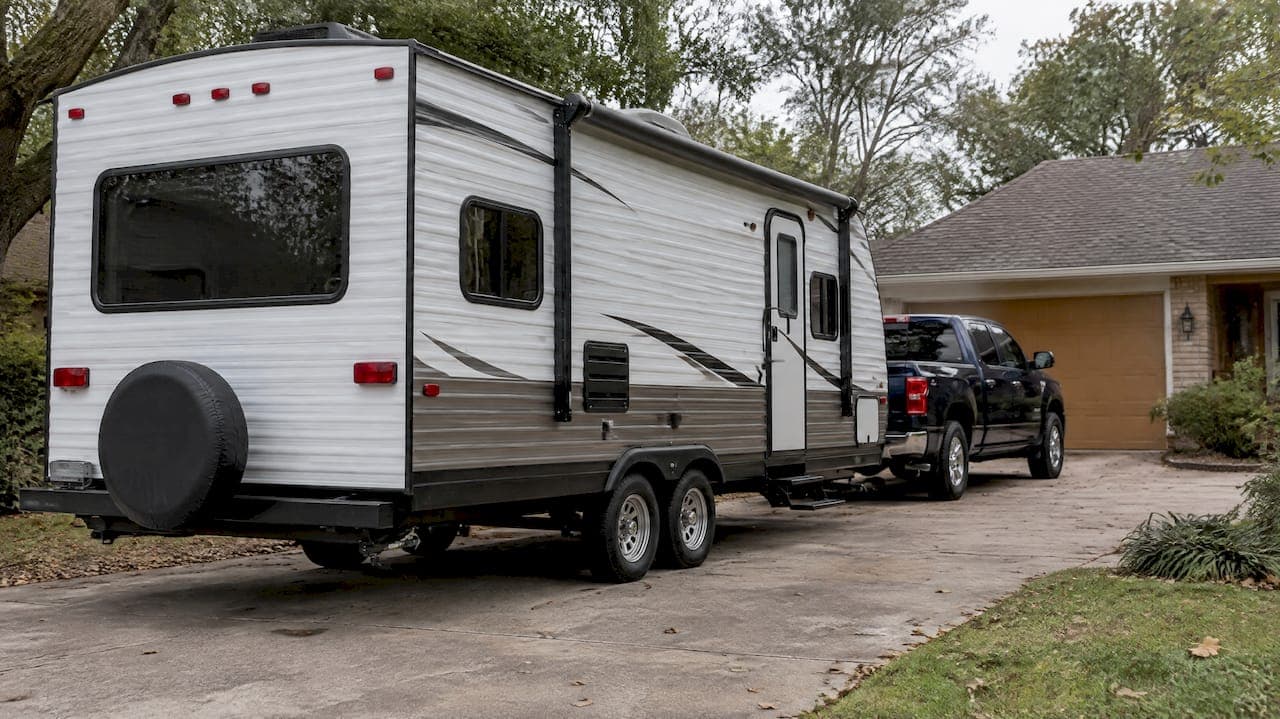
Towables (travel trailers, fifth wheels, pop-ups, toy haulers). These have no engine. Most states do not require a separate policy for them, but that is a legal point, not a protection point. A $60,000 fifth wheel that burns in a storage lot is a $60,000 loss unless you bought coverage for it.
Truck campers and slide-ins. These sit in the bed of a pickup. They are often overlooked, and an auto policy may not treat them as part of the truck. Confirm how yours is listed.
Park models and long-term sites. If your RV stays parked for months, tell your agent. Use matters to underwriting, and a unit that is lived in is a different risk from one used on weekends. For a manufactured or mobile home on a permanent foundation, see our page on Louisiana mobile home insurance.
Our own motorhome insurance guide goes deeper on what to line up before a long trip.

What Louisiana and Mississippi require
Start with the legal floor, then decide how far above it to build.
Louisiana
Louisiana requires liability coverage on any automobile you own. The state’s minimum limits are $15,000 for bodily injury to one person, $30,000 for bodily injury to more than one person in a single accident and $25,000 for property damage, according to the Louisiana Department of Insurance. We call that 15/30/25. A motorhome must carry at least that to be registered and driven.
For a towable camper, the same guide explains that most auto policies extend only the vehicle’s liability coverage to a hitched trailer. Collision and comprehensive do not follow the trailer automatically, so you may need separate physical-damage protection. If a tow goes wrong and the camper is destroyed, your truck policy will likely pay for what the camper hit, not for the camper.
For more on the state’s rules, read our guides to Louisiana’s mandatory insurance minimums and Louisiana car insurance laws.
Mississippi
Mississippi’s Vehicle Insurance Verification System states that state law requires minimum liability limits of $25,000 for bodily injury per person, $50,000 per accident and $25,000 for property damage (25/50/25), and that motorists must keep proof of insurance. Those numbers are higher than Louisiana’s, so a Louisiana RV that travels to the Gulf Coast is not automatically over Mississippi’s minimum in spirit, and buying above the floor removes the question.

Minimums versus the real world
Minimum limits are written for the average sedan. A motorhome weighs far more, carries more people and can cause far larger losses. A single hospital stay can pass $15,000 quickly, and if the other side wins a judgment above your limits, your savings and property are exposed. That is the gap we see when drivers learn the hard way what a cheap policy costs. If you own a home or have savings to protect, consider higher liability limits and an umbrella policy on top. Umbrella coverage from our agency starts at $150 per year.
Why your auto or home policy is not enough
It is a common assumption that the truck’s policy covers the camper behind it, or that the homeowners policy covers the motorhome in the driveway. Neither holds up well.
The Maryland Insurance Administration says auto policies generally do not account for living in an RV, and that homeowners policies do not cover RV loss, collision or travel-related incidents. Louisiana’s own guide supports the trailer half of that: liability extends, physical damage does not.
Here is how it plays out.
| Situation | Auto policy | Homeowners policy | Dedicated RV policy |
|---|---|---|---|
| You hit another car while towing a camper | Liability usually extends to the trailer | No | Liability, with higher limits available |
| Hail or a fallen tree damages the camper | No coverage for the camper | Generally not covered | Comprehensive can respond |
| Someone is hurt at your campsite | Not designed for it | Not designed for it | Campsite liability available |
| Your belongings inside are stolen | Not covered | Limited or none | Personal effects coverage available |
| You live in the RV part of the year | Not designed for it | No | Full-timer coverage may be offered |
For a side-by-side look at how different insurers price standard coverage, you can compare auto and home insurance rates by state and city. Then bring your actual declarations pages to us and we will show you where an RV sits relative to them.
What drives the cost of RV insurance
We do not publish an RV price because no honest number exists without your details. The Maryland Insurance Administration lists what moves the premium: vehicle class, size, use, annual miles, coverages, limits, custom features, age of the RV, claims history, driving record and deductible. In practice, these matter most:
- Value and class. A Class A diesel pusher costs more to insure than a pop-up because the repair bill is bigger.
- Use. Weekend trips, seasonal travel and full-time living are priced differently.
- Where it is kept. A covered or secure lot looks better than a driveway under pecan trees in hurricane country.
- Your record. Accidents and violations on your driving history follow you into the RV.
- Deductible and limits. Higher deductibles and lower limits can reduce the premium, but the Maryland guidance warns that low limits can leave you personally responsible for unpaid claims.
Rates also move over time. The Mississippi Insurance Department tracks filings for personal recreational vehicle programs, and its July 2024 bulletin reports a 22.1% rate impact for one such program. One filing is not the market, but it is a reminder that a price quoted three years ago is not a price you can count on.
Wind, hurricanes and flood: the Gulf South problem
No one in Louisiana needs a lecture on weather. Louisiana sits in the bullseye for hurricanes, and an RV is lighter, taller and less anchored than a house.
Two points to settle before June 1.
Comprehensive is your storm coverage. Wind, hail, falling limbs and fire fall under comprehensive on most RV policies. Check the deductible. Some policies apply a separate or higher deductible to named storms or wind, and you want to learn that before the forecast cone appears, not after.
Flood is a different question. FEMA’s standard National Flood Insurance Program policy says it excludes recreational vehicles other than travel trailers meeting its definition, as well as self-propelled vehicles licensed for public-road use. That means a motorhome is not an NFIP flood risk, and water damage to it sits with comprehensive on your RV policy, if the policy covers it. Ask your agent to show you the water and flood language in writing. If you also keep a house in a flood zone, that is a separate policy and a separate conversation; our flood insurance page covers it.
A practical storm checklist for RV owners:
- Photograph and video the exterior, interior and contents now, with serial numbers on appliances and electronics.
- Keep your declarations page in a cloud folder, not only in the glove box.
- Know your named-storm or wind deductible in dollars.
- Decide in advance where the unit goes when a storm is three days out.
- Save your agent’s number and your carrier’s claims line where you can find them without power.
Is RV insurance worth it if you only use it a few weekends a year?
Yes, and the part-time owner is often the most exposed. A camper that sits for months is still subject to theft, fire, wind and the neighbor’s tree. Mississippi Insurance Commissioner Mike Chaney has advised residents to keep coverage in place year-round, even in the off-season, to maintain continuous protection against damage.
Some carriers offer lower-cost options for stored or seasonal units. Ask about them, but be sure you understand what stops covering when you reduce the policy, especially liability and theft.
How to compare RV insurance quotes
Two quotes for the same RV can differ in ways the premium does not show. Line them up on these points:
- Valuation. Does the policy pay actual cash value, which factors in depreciation, or a stated or replacement-cost basis? For a newer unit, ask about total-loss replacement.
- Liability limits. Match them to your assets, not to the state minimum.
- Deductibles. Compare comprehensive, collision and any wind or named-storm deductible.
- Contents and attached equipment. Awnings, satellite dishes, solar panels and custom upgrades often have their own limits.
- Use. Part-time, seasonal and full-time coverage are not interchangeable.
- Claims and roadside. Who answers the phone? Is there a local person you can call?
- Exclusions. Read what is left out, such as rental use or commercial use.
A lower premium that comes with a $5,000 wind deductible and a depreciation-based payout can cost you more than the policy that looked $30 a month higher. We have watched that happen after storms.
Our perspective: coverage is for the bad day
We have spent decades in Louisiana insurance, and Steve Root has run this agency personally for more than 20 years. We were here when other carriers and agents pulled out after the hurricanes, and we were here when our clients had to file claims.
The lesson is consistent. The cheapest RV policy is rarely the best one, because the price difference is a few dollars a month and the coverage difference is the entire claim. People who have been through a storm do not ask us what the lowest number is. They ask who will answer when the roof is gone and the adjuster is three weeks out.
Our view is simple. Insure the RV for what it is worth and what it could cost you. Keep limits above the state minimum. Know your wind deductible. Put your auto, home, flood, umbrella and RV questions in front of one person who knows how they fit together. And choose an agent who knows your name.
That is what we offer. Our team answers claims calls around the clock, we serve clients in English and Spanish, and our mobile catastrophe response unit sends RVs directly into disaster zones, so we understand what it means to depend on one.
— Steve Root
Talk to a Louisiana agent about your RV
If you own a motorhome, camper or trailer, start with a policy review. Bring your current auto and homeowners declarations pages, and we will show you what they cover, what they leave out and how umbrella coverage can sit above your liability. Our agency is an Allstate exclusive agency in Baton Rouge, and we have 356 Google reviews at 4.9 stars from neighbors who have called us when it counted.
See all our coverage lines on our insurance products page, or call us at (225) 926-0160. You can also visit us at 8676 Goodwood Blvd Ste 303, Baton Rouge, LA 70806.
FAQ
What kind of insurance do you put on a camper?
A towable camper usually relies on its tow vehicle for liability while it is hitched, but the camper’s own damage is not covered by that policy. For fire, theft, storm and collision protection, you need a policy that includes comprehensive and collision on the camper, plus contents coverage if you keep belongings inside. Ask your agent to confirm in writing what happens when the camper is parked and unhitched.
Is RV insurance required in Louisiana?
For a motorhome, yes. Louisiana requires liability coverage on any automobile you own, at minimum limits of 15/30/25. A towed trailer is generally covered for liability through the tow vehicle, but physical damage to the trailer is not required and not automatic. If you have a lender, they will likely require full coverage.
Does homeowners insurance cover my RV?
Generally no. The Maryland Insurance Administration says homeowners policies do not cover RV loss, collision or travel-related incidents. Some homeowners policies extend limited coverage to items stored at the house, but you should not rely on it for the RV itself.
Does flood insurance cover a motorhome?
Not through the standard federal program. The NFIP general property form excludes self-propelled vehicles licensed for road use and most recreational vehicles. Water damage to a motorhome is generally a comprehensive-coverage question on your RV policy, so review that language before storm season.
What does RV insurance cost?
It depends on the RV’s class, value and age, how you use it, your driving record, your limits and your deductible. Instead of guessing from an average, get quotes with identical limits and deductibles so you can compare like with like.
Sources
- Insurance FAQs: Insuring Your Recreational Vehicle, Maryland Insurance Administration
- Consumer’s Guide to Auto Insurance, Louisiana Department of Insurance
- Program Information, Mississippi Vehicle Insurance Verification System
- National Flood Insurance Program General Property Form, FEMA
- Property/Casualty Rate Filing Bulletin, July 2024, Mississippi Insurance Department
- Stay Cool, Choose the Right Insurance This Summer, Mississippi Insurance Department, 2025