

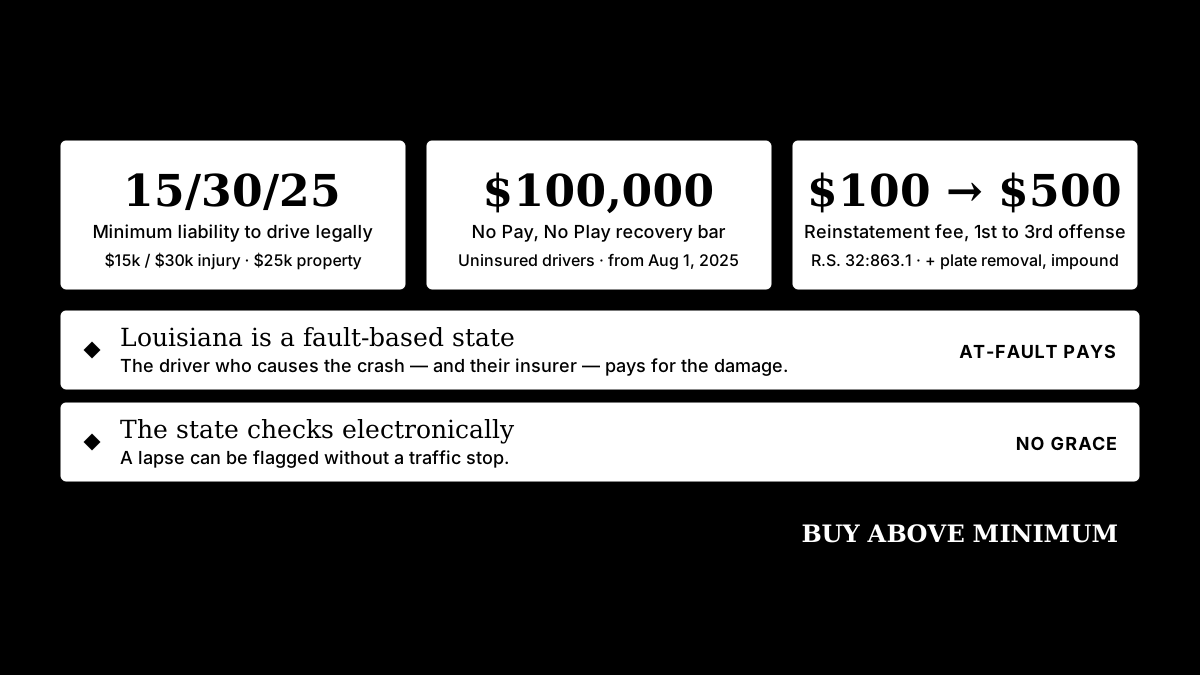
Louisiana requires liability insurance of at least 15/30/25 on every registered vehicle, and it's an at-fault state: the driver who causes a crash pays for it. Two rules changed recently. Since August 1, 2025, “No Pay, No Play” bars an uninsured driver from recovering the first $100,000 of bodily-injury and the first $100,000 of property-damage losses, even when the other driver caused the wreck. And for crashes on or after January 1, 2026, a driver 51% or more at fault recovers nothing. Get stopped without proof of insurance and the officer removes your plate on the spot, with reinstatement fees of $100, $250 and $500 for a first, second and later offense.
Louisiana car insurance laws quietly decide how much a wreck actually costs you — which is exactly why knowing them before a claim matters more than knowing them after. A handful of state-specific rules do the heavy lifting: the coverage minimums you must carry, the uninsured motorist coverage the law puts on your policy by default, the recently strengthened “No Pay, No Play” law, the new 51% fault bar, and strict proof-of-insurance enforcement. This guide covers what Louisiana legally requires, how fault is assigned, how the state checks your coverage, and what happens if you drive uninsured; how much coverage is actually enough is a separate question we answer in our minimums guide. The team at The Root Agency, serving Central and the greater Baton Rouge area and licensed statewide, helps drivers stay on the right side of these rules every day.

Key takeaways
- Louisiana's legal minimum is 15/30/25 liability, and uninsured/underinsured motorist coverage rides along at the same limits unless you reject it in writing.
- Louisiana is an at-fault state, and since January 1, 2026 a driver 51% or more at fault recovers nothing (Act 15 of 2025).
- No Pay, No Play (R.S. 32:866, as amended by Act 16 of 2025) forfeits the first $100,000 of bodily injury and the first $100,000 of property damage for uninsured drivers.
- No proof of insurance at a stop means plate removal, a three-day temporary sticker, possible impoundment, and reinstatement fees of $100/$250/$500 plus $10 (R.S. 32:863.1).
- A lapse is flagged electronically; the OMV's lapse fees run $125 to $525 depending on how long you went without coverage.
What car insurance does Louisiana legally require?
Liability insurance on every registered vehicle, at limits of at least 15/30/25 — and driving without it is illegal. Liability pays for the injuries and property damage you cause someone else; it does not repair your own car.
The requirement itself sits in R.S. 32:861: every self-propelled motor vehicle registered in Louisiana must be covered by a liability policy (or a bond or cash deposit) at the limits the state sets. Those limits, spelled out in the Louisiana Department of Insurance's Consumer's Guide to Auto Insurance, are $15,000 in bodily-injury coverage for one person, $30,000 for everyone hurt in a single accident, and $25,000 for property damage. That's the floor: enough to register and drive. Whether it's enough to protect you is a different question, and we answer it — with the numbers — in our guide to Louisiana's mandatory insurance minimums for 2026. This article stays on what the law requires, how fault is assigned, and how the rules are enforced.
Does Louisiana require uninsured motorist coverage?
Not in the way it requires liability — but the law puts it on your policy unless you sign it away. Under R.S. 22:1295, every auto liability policy issued in Louisiana includes uninsured/underinsured motorist (UM) bodily-injury coverage at the same limits as your liability coverage, unless the named insured rejects it, selects lower limits, or selects “economic-only” coverage on the form prescribed by the insurance commissioner.
That signed form is the trap. Some drivers reject UM to trim a quote and forget they did; the rejection stays with the policy. The statute's middle option is worth knowing too: “economic-only” UM, offered at a reduced premium, pays medical bills and lost wages but excludes pain and suffering and other noneconomic loss. Here's why the choice matters. Louisiana's uninsured rate was 11.7% in 2023 — below the 15.4% national figure, per Insurance Research Council data published by the Insurance Information Institute — but a driver carrying only the $15,000 minimum is underinsured the moment your injuries cost more, and UM is the coverage that steps in. Our uninsured motorist coverage guide walks through how to set the limits.
What is Louisiana's “No Pay, No Play” law?
This is the law most drivers have never heard of — and it's the one that punishes driving uninsured the hardest. Under Louisiana's “No Pay, No Play” statute, R.S. 32:866, an uninsured driver forfeits a large chunk of what they could otherwise recover after a crash, even when someone else caused it.
The stakes went up sharply in 2025. As amended by Act 16 of the 2025 Regular Session (House Bill 434), effective August 1, 2025, an uninsured owner or operator generally cannot recover the first $100,000 of bodily-injury damages or the first $100,000 of property-damage damages from the at-fault driver. The statute text now reads “no recovery for the first one hundred thousand dollars” for each; the previous thresholds were $15,000 and $25,000, and many older articles — and even some state publications — still print the old numbers. The Governor's office summary of the 2025 insurance reforms confirms the $100,000 threshold.
There are limited exceptions that restore your right to recover, including when the at-fault driver is convicted of DWI, intentionally caused the crash, fled the scene, or was committing a felony, and when your legally parked vehicle was struck. Passengers who don't own the uninsured vehicle generally aren't barred either. And there's a cost rule most summaries skip: if an uninsured driver sues and is awarded less than $100,000 in bodily-injury damages, the statute makes that driver liable for every party's court costs. The practical takeaway is blunt: in Louisiana, driving uninsured doesn't just risk a ticket — it can cost you the first $100,000 of a claim that wasn't your fault.
How does fault work in Louisiana after the 2026 change?
Louisiana is an at-fault state: the driver who causes a crash — and that driver's liability insurer — pays for the damage. Since January 1, 2026, the state also applies modified comparative fault with a 51% bar.
Act 15 of 2025 (House Bill 431) amended Civil Code article 2323. If your share of fault is 51% or more, you recover nothing from the other driver; below that, your recovery is reduced by your percentage, so a driver found 50% at fault still recovers half. The rule applies to crashes on or after January 1, 2026; earlier crashes stay under the old “pure” system, where even a mostly-at-fault driver could recover a slice. The Governor's 2025 reforms page summarizes the bill, and Louisiana law firm Gordon Arata's note on the amended article quotes the new text. You still owe your share of the other party's damages either way.
Here's why that argues for higher liability limits, not just the minimum: if you're at fault, your liability coverage pays the other party up to your limits, and anything above comes out of your own pocket. With Louisiana's 15/30/25 minimum, a serious injury or a totaled newer vehicle can exceed your coverage in an instant. Higher limits — plus the UM coverage above, for the drivers who carry only the minimum — cost far less than the personal exposure they remove. New to the state and sorting out requirements? See our guide to Louisiana insurance requirements for new residents.
How do you prove insurance — and how does the state check?
You prove it at the moments the state asks, and Louisiana also checks behind the scenes. Keep proof of insurance in your vehicle and be ready to show it during a traffic stop and when you register or renew a vehicle.
Behind the scenes, insurers report cancellations to the Office of Motor Vehicles, so a lapse gets flagged even without a stop. Per the OMV's Cancellations & Revocations page, a lapse costs $125 if it ran 2 to 30 days, $275 for 31 to 90 days, and $525 for 91 days or more, plus a $25 administrative fee, with total lapse fees capped at $850 (drivers 65 and older cap at $250). The statute behind those fees, R.S. 32:863, as printed on FindLaw still shows the earlier $100/$250/$500 schedule; the OMV's page carries the current amounts, so budget from the OMV's figures. If a car is coming off the road, cancel the plate online or by mail before the policy ends — the OMV lists that as the way to avoid the fee altogether.
Don't try to paper over a lapse. Under the same statute, submitting false insurance information brings a 12-to-18-month suspension of driving privileges plus its own fees, starting at $250 for a first violation and rising to $500 and $1,000. The simplest protection is continuous coverage: no gap between payments or carriers, because even a short one costs money.
What are the penalties for driving without insurance?
They start at the roadside, and they escalate. The controlling statute is R.S. 32:863.1, and here's what it actually says:
- Plate removed on the spot. If you can't show proof of insurance, the officer removes the license plate from a Louisiana-registered vehicle.
- A three-day temporary sticker. You get a sticker good for three calendar days, and three days (excluding weekends and holidays) to show proof of coverage at an OMV office.
- Impoundment. If you can't show compliance, the vehicle can be impounded and you're issued a notice of noncompliance.
- Reinstatement fees. $100 for a first offense, $250 for a second, $500 for any later offense — plus a $10 administrative fee.
You'll see a “$500 to $1,000 fine” quoted on many insurance-comparison sites. That figure isn't in the statute text, so we don't repeat it; the real bill is the plate, the reinstatement fee, any towing and storage, and the lapse fees from the previous section stacked on top. And if you're in a crash while uninsured, No Pay, No Play takes the first $100,000 of your own recovery. Continuous coverage is cheaper than any of it.
When does Louisiana require an SR-22?
After a DWI conviction or a chemical-test refusal, for three years. An SR-22 isn't a separate policy; it's a certificate of financial responsibility your insurer files with the OMV to prove you carry the required coverage.
Per the OMV's Suspensions page, a DWI conviction requires an SR-22 for three years from the date of conviction, and a refusal requires one for three years from the date of arrest. DWI reinstatement fees are $100 for a first offense, $200 for a second and $300 for a third or later. The filing has to stay continuous for the full term — a cancelled policy breaks it. Our SR-22 insurance page covers filings, costs and what to expect.
Not sure your coverage keeps you compliant?
Louisiana's rules are strict, and the cost of getting them wrong just went up. The easiest way to stay protected is a quick policy review to confirm you meet the state's requirements and carry limits that actually shield you if you're at fault. The team at The Root Agency will check your coverage against Louisiana law and flag any gaps. When you're ready, start on our auto insurance page or contact your Central-area team, and we'll make sure you're covered the right way.
This article is general information, not legal or insurance advice. Laws and penalties change and depend on your specific situation — verify current requirements with the Louisiana Department of Insurance or Office of Motor Vehicles, and talk with a licensed agent about your policy. Statute text and fee schedules were checked in September 2026 against FindLaw's Louisiana code and the OMV's published pages; the Louisiana Legislature's site (legis.la.gov) is the official source.