

Mortgage protection insurance pays off the rest of your home loan if you die, so your family isn't left with the house payment. The catch: the money goes to your lender, not your family, and on most policies the payout shrinks every year as the loan balance falls while the premium stays the same. For most healthy homeowners, a level term life policy sized to the mortgage does the same job better. Mortgage protection earns its place mainly when health makes regular life insurance hard to get.
Key takeaways
- Mortgage protection insurance (MPI), also sold as mortgage life insurance, pays your lender the remaining loan balance if you die. Some policies add disability coverage.
- It's optional. It is not PMI, which is the insurance a lender requires when you put down less than 20% and which protects only the lender.
- On most policies the payout falls as you pay down the loan, but the premium doesn't (Bankrate).
- Most MPI is guaranteed acceptance with no medical exam, which is its real advantage.
- A level term life policy pays the same amount for the whole term, to the people you name, and they can use it for the mortgage, taxes, insurance or anything else.
What is mortgage protection insurance?
Mortgage protection insurance is a policy that pays off the rest of your mortgage if you die, and on some policies if you become disabled and can't work. It works like life insurance with one big difference: the payment goes straight to your mortgage lender to pay off the loan, not to your spouse or children (Bankrate).
You can buy it from three places: your mortgage lender, an insurance company that sells it on its own, or a life insurer, which may call it “mortgage life insurance.” Terms generally run 10 to 30 years, usually matched to what's left on the loan.
Two details matter more than the name:
- It usually covers principal and interest only. Property taxes, homeowners and flood insurance and HOA dues are still your family's bill unless the policy has a rider for them.
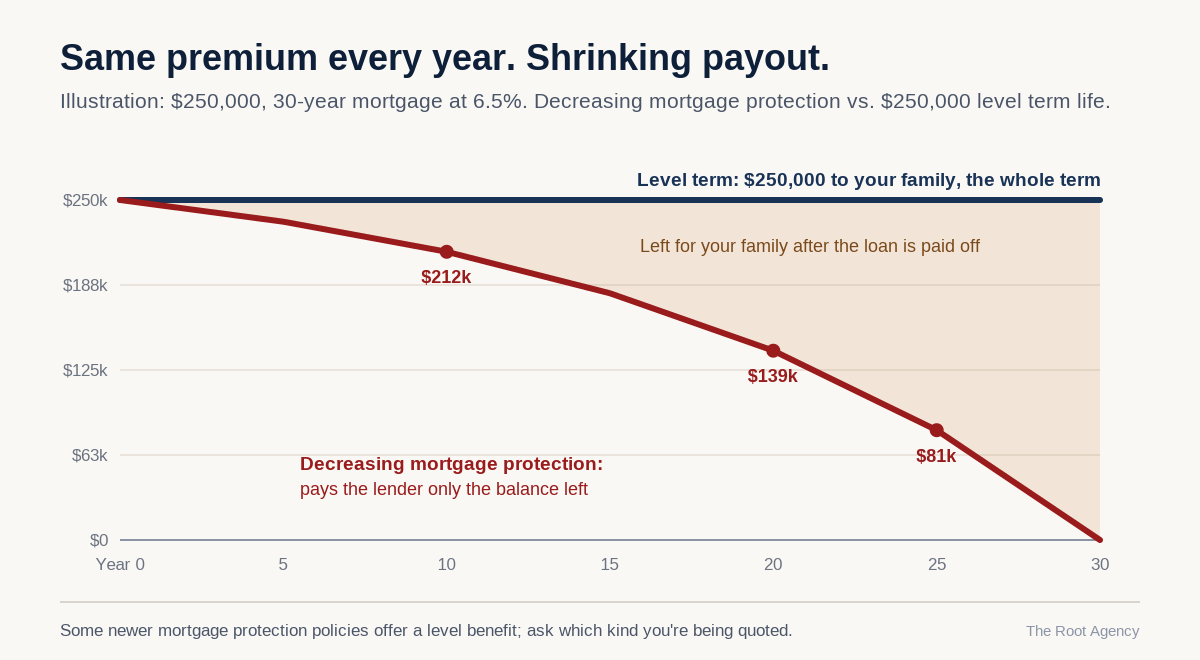
- The payout usually shrinks. As you pay down the loan, the benefit declines with the balance, but the premium stays level. Some newer policies offer a level death benefit instead, so ask which kind you're being quoted.
Mortgage protection insurance vs. PMI: not the same thing
This is the most common mix-up, and it matters because one is required and the other isn't. Mortgage insurance of any kind (PMI on a conventional loan, MIP on an FHA loan) protects the lender, not you, if you fall behind on payments (CFPB). It pays nothing to your family if you die.
| Mortgage protection (MPI) | PMI | FHA MIP | |
|---|---|---|---|
| Required? | No, optional | Usually, on conventional loans with less than 20% down | Yes, on FHA loans |
| Pays out when | You die (some policies: disability) | You default and the home sells for less than you owe | You default |
| Who gets the money | Your lender, to pay off the loan | Your lender | Your lender |
| Goes away | When you cancel or the term ends | Can be canceled under certain conditions, generally once you reach 20% equity | In most cases, lasts the life of the loan |
If you have PMI, your family is not covered if something happens to you. That's the gap mortgage protection or life insurance fills.
How much does mortgage protection insurance cost?
Bankrate puts typical premiums at a fixed $5 to $100 a month, depending on the insurer and your loan balance. Because most policies skip the health questions, the price doesn't reward good health the way an underwritten term policy can, which is why it's worth getting a term life quote for the same amount before you sign.
When you compare, compare the right things: the monthly premium, the benefit in year 10 and year 20 (not just year one), who receives the money, and whether the price can change.
Mortgage protection insurance vs. term life insurance
Take a $250,000, 30-year mortgage at 6.5%. After 10 years the balance is about $212,000; after 20, about $139,000; after 25, about $81,000. A decreasing mortgage protection policy pays the lender that shrinking balance and nothing more. A $250,000 level term policy still pays $250,000 in year 25, so after the loan is paid off, roughly $169,000 is left for your family.
| Mortgage protection | Level term life | |
|---|---|---|
| Who gets paid | Your lender | The beneficiaries you name |
| Payout over time | Usually shrinks with the loan | Stays the same for the whole term |
| How the money can be used | Pays off the loan only | Anything: the mortgage, taxes, insurance, income, college |
| Health questions | Usually none (guaranteed acceptance) | Underwritten; healthier applicants pay less |
| Coverage amount | Tied to the loan | You choose it, and it can cover more than the mortgage |
Term life also leaves your family the choice. They might pay off the house, or keep the low-rate mortgage and use the money to replace your income while the kids are home. With mortgage protection, the lender gets paid and that's the end of it.
Is mortgage protection insurance worth it?
It can be, in a few specific situations (Bankrate):
- You can't qualify for traditional life insurance, or the price is out of reach because of your health.
- Your other assets wouldn't cover the mortgage if you died.
- The mortgage protection quote is genuinely cheaper than term life for the same coverage.
- Your work is unstable and you want help with the house payment if you can't work, on a policy that includes disability.
It's usually not worth it if you're in reasonably good health and can qualify for term life, if your mortgage is nearly paid off, or if you plan to pay the loan down early, since every extra payment shrinks the benefit you're paying a flat premium for.
Why the mortgage isn't the only house bill in Louisiana
Mortgage protection pays principal and interest. In Louisiana, that's often not the biggest part of keeping a house. Homeowners insurance, flood insurance and property taxes all keep coming due after a death, and a policy that only retires the loan leaves those with your family. A term life benefit sized with room above the loan balance can cover them, along with the time it takes to settle an estate.
If you're reviewing the house side too, start with homeowners insurance in Baton Rouge and check your address with our Louisiana flood zone lookup.
How much life insurance do you need to cover a mortgage?
At least the loan balance, for at least as long as the loan has left. A 30-year mortgage generally calls for a 30-year term, not a 20-year policy that ends while you still owe. But the better number comes from the DIME method, which counts the mortgage alongside everything else your family would still have to pay for:
- Debt: car loans, cards and other debts, plus final expenses
- Income: your yearly income times the years your family would need it
- Mortgage: the remaining balance
- Education: what you want set aside for the kids
Subtract savings and any coverage you already have. Our life insurance in Baton Rouge page walks through the math.
Before you buy: five questions to ask
- Who is the beneficiary? The lender, or someone you choose?
- Does the benefit decrease? What does it pay in year 10 and year 20?
- What does it cover? Principal and interest only, or taxes and insurance too?
- What happens if I refinance or sell? Does the coverage follow me or end?
- How does it compare? Get a level term quote for the same amount and term.
A note on the mail: shortly after closing, many homeowners get letters offering “mortgage protection” that look like they came from the lender. Read the sender carefully. Mortgage protection is optional, and it's worth comparing before you reply to any of them.
Compare it with term life before you sign
The Root Agency quotes term, whole and universal life for Baton Rouge families and will put a level term quote next to any mortgage protection offer you've received, so you can see the premium, the payout and who gets paid side by side. Call (225) 529-1990, start on our life insurance in Baton Rouge page, or see life insurance across Louisiana.
This article is general information, not insurance or financial advice. Policy terms vary by insurer; read the policy and talk with a licensed agent.