
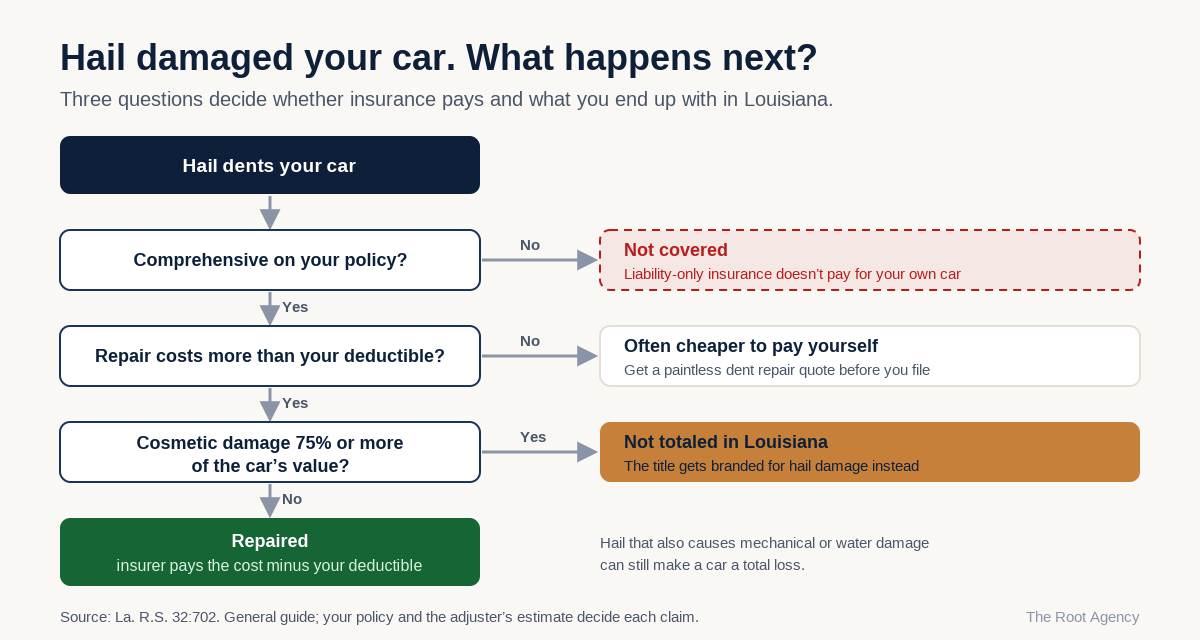
Car insurance covers hail damage if your policy includes comprehensive coverage. Comprehensive pays to repair dents in the body, cracked or shattered glass and interior water damage from a hailstorm, minus your deductible. If you carry only liability, the minimum Louisiana requires, the damage to your own car isn't covered (Allstate). Here's how a hail claim works, when it's worth filing, and the Louisiana rule that decides whether a badly dented car is totaled.
How a hail claim plays out
Which coverage pays for hail
- Comprehensive covers damage that doesn't come from a collision: hail, flood, wind, falling trees, fire, theft and hitting a deer. Hail is a comprehensive claim.
- Collision covers hitting another car or object. It doesn't cover hail.
- Liability pays for damage you cause to others. It never pays for your own car.
“Full coverage” usually means liability plus collision and comprehensive, so it normally includes hail. Comprehensive is optional under Louisiana law, but lenders require it on financed and leased cars. Louisiana drivers paid an average of $411.65 a year for comprehensive in 2024; see comprehensive vs. collision insurance for what drives that cost.
What comprehensive pays for after a hailstorm
- Dents in the hood, roof, trunk lid and panels
- Glass: a cracked or shattered windshield, windows, sunroof or rear glass
- Interior water damage when hail breaks glass and rain gets in
- Lights, mirrors and trim broken by hail
You pay your comprehensive deductible once per claim, no matter how many dents. Say paintless dent repair and a new windshield come to $4,200 and your deductible is $500: the insurer pays $3,700. (Example numbers; your estimate will differ.)
How hail damage gets repaired
Most hail dents are fixed with paintless dent repair (PDR): a technician pushes the dents out from behind the panel without sanding or repainting, which keeps the factory finish. It's usually faster and cheaper than conventional bodywork. Panels that are cracked, creased or too badly dented may need conventional repair and paint, or replacement, and broken glass is replaced.
After a big storm, out-of-town “hail chasers” often set up in parking lots. Check reviews and a local address, get the price and warranty in writing, and don't sign over your insurance check before the work is done.
Louisiana's rule: hail-damaged cars get a branded title, not a total loss
In Louisiana, a car is a total loss when damage equals 75% or more of its market value. Hail is the exception. A car with cosmetic hail damage to windshields, windows, rear glass, paint and body panels isn't treated as a total loss even when repairs reach 75% of its value. Instead it's issued a title branded to show hail damage (La. R.S. 32:702).
What that means for you:
- Older cars are the most affected. On a car worth $6,000, $4,500 of hail damage crosses the 75% line easily.
- A hail brand lowers resale and trade-in value. Factor that in when you decide between repairs and a cash settlement, and when you shop for a used car.
- Damage beyond cosmetic changes the picture. If hail also causes mechanical, electrical or water damage, the car can still be a total loss.
- You can challenge a low total-loss offer. Since 2025, Louisiana lets you challenge an auto total-loss valuation with two independent appraisals (American Press).
Will a hail claim raise your rate?
Hail isn't your fault, and Louisiana law reflects that idea. An auto insurer can't raise your rate, add a surcharge, cancel or refuse to renew based on a “nonfault incident,” meaning an accident or other incident where the driver of your car wasn't at fault. An insurer that does it owes the extra premium back plus a penalty (La. R.S. 22:1284).
Your premium can still change at renewal for reasons that have nothing to do with your claim, like statewide rate increases after a bad storm year. If your rate jumps after a hail claim, ask your agent for the reason in writing.
Should you file a claim?
- Get a quote first. A few small dings might cost less than your deductible to fix.
- File when the damage is widespread. Dents across the hood, roof and trunk, or broken glass, usually cost far more than a typical deductible.
- File quickly. Report hail damage as soon as you can, and photograph the car and the hail itself if it's safe. Prompt reports make it easier to tie the damage to a specific storm.
- Don't wait for the next storm. If unrepaired hail damage gets hit again, it's harder to separate old dents from new ones.
Hail in Louisiana
Louisiana isn't Texas or Colorado, but hail is a regular spring hazard here. From 2017 through 2019, insurers handled 40,229 hail claims in Louisiana, 18th among the states. Nationally, about one in four hail claims in that period was for a personal auto, and May and June brought the most claims (NICB).
How to protect your car from hail
- Park under cover when storms are forecast: a garage, carport or parking garage.
- Use a padded hail cover if you don't have covered parking. An ordinary dust cover won't stop much.
- Watch the forecast in spring and turn on severe-weather alerts on your phone.
- Check your coverage before storm season. If you dropped comprehensive on an older car, compare its premium to what you'd pay to fix a hailstorm yourself.
Check your auto coverage in Baton Rouge
The Root Agency is a local Allstate agency on Goodwood Blvd. We can confirm whether your policy includes comprehensive, help you pick a deductible that fits, and walk you through a hail claim if a storm has already hit. Call (225) 529-1990 or start with car insurance in Baton Rouge.
This article is general information, not insurance or legal advice. Coverage depends on your policy, deductible and the facts of the loss.