

The best car insurance in Louisiana isn't the cheapest quote — it's the policy that's priced fairly and still pays fully and quickly when you file a claim. Judge it on four things: coverage strength (limits well above the state's 15/30/25 minimum, plus uninsured/underinsured-motorist protection), claims responsiveness, the carrier's financial stability, and real local service. You can check a carrier's complaint record, license, and financial-strength rating yourself for free before you ever sign.
If you're searching for the best car insurance in Louisiana, it helps to change the question first: the best policy isn't the lowest number on a quote — it's the one that still pays fully and fast the day you actually need it. Ranking one carrier over another tells you almost nothing about how your claim will go, because the same company can be great for one driver and wrong for the next. This guide covers what “best” should really measure, how to read a policy for genuine protection, which discounts a good policy should already carry, how to check a carrier's complaint record and financial strength yourself, and the questions worth asking before you buy. The team at The Root Agency in Baton Rouge walks drivers through exactly these tradeoffs — and most people are closer to the right coverage than they think.

Key takeaways
- “Best” is about which policy protects you, not which brand name is trending — a detail most rate-table articles skip.
- Louisiana's legal minimum is only 15/30/25, and the Insurance Research Council counted 11.7% of Louisiana drivers uninsured in 2023 — so uninsured/underinsured motorist coverage is one of the most important lines on your policy.
- You can look up any carrier's complaint record through the Louisiana Department of Insurance Complaint Index and confirm it's licensed with Active Company Search — both free.
- The Louisiana Department of Insurance received 3,960 consumer complaints in fiscal year 2024–25, so a carrier's claims-handling reputation is worth checking before you buy.
- The cheapest sticker price often means thin limits or a shaky claims experience — the real cost shows up after a wreck.
What does “best car insurance” really mean in Louisiana?
It means the policy that performs when a claim hits — not the brand at the top of a list. Most “best car insurance” articles rank companies by average price, but price is only one of four things that decide whether a policy was actually a good buy.
The other three only show up at claim time: how well the coverage matches your real risk, how the carrier handles the claim, and whether the company is financially strong enough to pay. A rock-bottom quote with thin limits and a slow claims process isn't a bargain — it's a bill you haven't received yet.
Price matters here because the baseline is high. In the National Association of Insurance Commissioners' 2023 Auto Insurance Database Average Premium Supplement, Louisiana's average auto insurance expenditure was $1,749 per insured vehicle, against $1,282 countrywide — and a policy carrying liability, collision, and comprehensive averaged $1,979 here versus $1,438 nationally. (NAIC's later 2022/2023 Auto Insurance Database Report, adopted December 2025, nudges those Louisiana figures to $1,754 and $1,983.) Part of the reason is that accidents are expensive in Louisiana: the Insurance Information Institute reports a rate of bodily-injury claims more than twice the national average, though it also counts more than 20 rate-decrease filings since mid-2025 as the state's legal reforms take hold. When claims cost more, the quality of your coverage and your carrier matters more. For what drives your own number, see how car insurance rates are calculated in Louisiana.
What actually makes a car insurance policy good?
A genuinely good policy does four jobs well. Judge any quote against these instead of the monthly number alone.
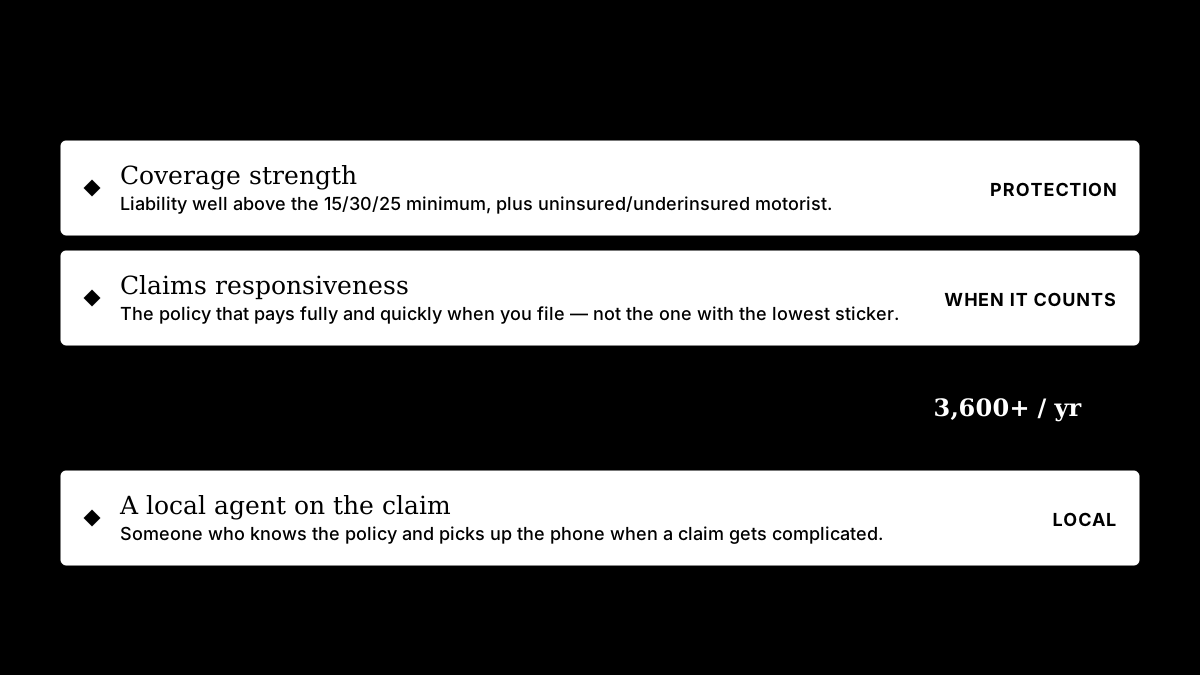
- Coverage adequacy. Limits high enough to protect your income and assets — not just the legal minimum. In Louisiana that means liability well above 15/30/25 and real uninsured/underinsured motorist coverage.
- Claims responsiveness. How fast and fairly the carrier investigates, decides fault, and pays. This is the whole point of insurance, and it's invisible on a quote sheet.
- Financial strength. The carrier's ability to pay large or clustered claims — which matters enormously in a state that sees hurricanes and catastrophic loss events.
- Real local service. Someone who knows Louisiana roads, weather, and rules, and who picks up when a claim gets complicated.
The lowest quote can win on exactly one of these four and lose on the rest. The “best” policy is the one that's priced fairly and holds up on all four.
How do you read a policy for real protection?
Read past the premium to the coverage that decides your out-of-pocket cost after a crash. Four lines matter most on a Louisiana auto policy.
- Liability limits. This pays for injuries and damage you cause. Louisiana's minimum is just 15/30/25 — $15,000 for injury to one person, $30,000 for injuries per accident, and $25,000 for property damage — per the Louisiana Department of Insurance's Consumer's Guide to Auto Insurance. A single serious injury can blow past that fast, and anything above your limits comes out of your pocket. Our team usually starts the conversation at 100/300/100, and the Insurance Information Institute's advice points the same way: buy more than the state minimum, enough to protect assets like your home and savings. Higher limits cost far less than the gap they cover.
- Uninsured/underinsured motorist (UM/UIM). This protects you when the at-fault driver has no insurance or not enough. Louisiana isn't the uninsured hotspot people assume — the Insurance Research Council put the state at 11.7% uninsured in 2023, below the 15.4% national rate, per the Insurance Information Institute — but with a $15,000-per-person legal minimum, the driver who hits you can be fully legal and still nowhere near able to cover your injuries. Under R.S. 22:1295, UM/UIM is part of every Louisiana auto policy unless you reject it or select lower limits in writing — so if a quote is missing it, someone signed it away. See our guide to uninsured motorist coverage in Louisiana.
- Comprehensive and collision. Collision pays for your car in a crash; comprehensive covers flood, hail, wind, theft, and animal strikes — all very real here. On a newer or financed car, dropping these is rarely worth the savings.
- Deductibles. The amount you pay before coverage kicks in. A higher deductible lowers your premium, but only choose an amount you could comfortably cover after a loss.
One more line that never shows up on a quote: what happens if you let coverage lapse. Louisiana's “No Pay, No Play” law (R.S. 32:866, amended effective August 1, 2025) bars an uninsured driver from recovering the first $100,000 of bodily-injury damages and the first $100,000 of property damage after a crash — even when the other driver caused it. A quote that looks cheap because it quietly trims these coverages isn't cheaper — it just moves the cost to the worst possible moment.
Which discounts should a good Louisiana policy already include?
The best policy is usually the one where every discount you qualify for is already applied — not the one with the lowest teaser rate. Ask about each of these by name.
- Bundling. Carrying auto with home, renters, or condo coverage is typically the largest single discount; the Insurance Information Institute's nine ways to lower your auto insurance costs notes that many insurers give you a break for buying two or more types of insurance.
- Multi-vehicle and safe-driver credits. Insuring more than one car on the policy, and keeping a clean record, both lower the rate.
- Telematics. Programs that price on how you actually drive can reward careful, low-mileage drivers. Allstate's version is Drivewise — our Drivewise discount guide explains what it tracks and who it helps most.
- Good student, defensive-driving course, anti-theft, paperless, autopay, pay-in-full. Small on their own, real when stacked.
- Credit history. The same III guide notes that most insurers use credit information to price auto policies, so a solid credit history lowers what you pay over time.
A carrier that applies these automatically is doing part of the “best policy” job for you. One that makes you ask is still fine — as long as you ask.
How can you check a carrier's complaint record and financial strength yourself?
You don't have to take a rating on faith — Louisiana gives you the tools to check a carrier before you buy, for free. Three checks take about ten minutes.
First, confirm the company is actually authorized to sell insurance in Louisiana using the Department of Insurance Active Company Search. If a carrier isn't licensed here, that's your answer.
Second, look up how often people complain about that carrier and why, through the Louisiana Department of Insurance Complaint Index. The department's 2024–25 annual report counts 3,960 consumer complaints received that fiscal year — 2,374 of them about property and casualty products like auto — and $10.7 million recovered for consumers. The index lets you see patterns — slow claims, denied claims, billing disputes — that a glossy ad won't show you. For the kinds of issues that come up most, our post on the common complaints Louisiana insurance carriers face in 2026 breaks down what to watch for.
Third, check that the company can pay through a bad year. Five independent agencies — A.M. Best, Fitch, Kroll, Moody's, and Standard & Poor's — rate insurers' financial strength, and the Insurance Information Institute's guide to assessing financial strength suggests checking two or more before you buy or keep a policy, because the agencies don't always agree. For the service side, J.D. Power's annual U.S. Auto Insurance Study scores carriers on customer satisfaction by region. A carrier's complaint history and ratings tell you more about your future claim than its price does.
Why does a local agent beat a 15-minute app when a claim gets complicated?
Because the app was built for the easy day, and a serious claim is the hard day. Buying coverage in fifteen minutes online works fine right up until a hurricane totals your car or the other driver turns out to be uninsured — and then you're navigating fault, adjusters, and limits alone.
A local agent's job is to be the person who already knows your policy when that call comes. We help size your limits to your real risk before anything goes wrong, then help you actually use the coverage when it does. For why that local relationship matters when a claim gets messy, see our guide to finding the best Allstate agent in Baton Rouge. The difference between a good and bad claim experience is rarely the logo on the card — it's whether someone picks up and advocates for you.
What questions should you ask before you buy?
Before you commit to any policy, get straight answers to a short list. Each one exposes whether a cheap quote is actually good coverage.
- Are my liability limits high enough to protect what I own, or just the legal minimum?
- Do I have uninsured/underinsured motorist coverage — and at what limit? Did anyone sign a form rejecting or lowering it?
- Does this include comprehensive and collision, and what are the deductibles?
- How does the claims process work, and who do I call after a wreck?
- Am I getting every discount I qualify for — bundling, multi-vehicle, safe driver, telematics?
- Is the carrier licensed in Louisiana and financially stable?
You don't have to answer these alone. Walking through them with a licensed agent is exactly how you turn “cheapest quote” into “best policy for me.”
Ready to see how your policy stacks up?
If you want to know whether your current coverage is genuinely good — not just cheap — a quick policy review is the easiest next step. The team at The Root Agency — Steve Root's Allstate agency in Baton Rouge — will check your limits, look for gaps like missing uninsured-motorist coverage, and make sure your carrier and price actually fit your risk. When you're ready, start on our auto insurance page or contact your Baton Rouge team, and we'll walk through it with you.
This article is general information, not a quote or insurance advice. Coverage, limits, and pricing vary by your specific situation — talk with a licensed agent about your policy.