

Why Motorcycles Need Separate Insurance: A Rider’s Guide

Motorcycles require a separate insurance policy because standard auto policies exclude motorcycles entirely, leaving riders with zero liability or physical damage protection if they rely on their car insurance alone. This is not a technicality buried in fine print. It is a fundamental underwriting distinction that affects every rider in Louisiana, Mississippi, and all 50 states. The motorcycle insurance necessity comes down to one fact: motorcycles carry a distinct risk profile that auto policies are never designed to cover. Understanding that distinction is the first step toward riding with real protection behind you.
Why motorcycles need separate insurance by law and by risk
The legal case for separate motorcycle coverage is straightforward. Motorcycle liability insurance is required to ride on public roads in 49 U.S. states. That means nearly every rider in the country has a legal obligation to carry a standalone motorcycle policy, not just an auto policy with the same insurer.
Florida is the primary exception, but even Florida requires financial responsibility for damages caused in an at-fault accident. An at-fault crash can easily produce five-figure expenses in medical bills, property damage, and legal costs. Riding without coverage in Florida is not a free pass. It is a personal financial gamble with serious consequences.
State minimums typically include:
- Bodily injury liability: Covers injuries you cause to other people in an accident
- Property damage liability: Covers damage you cause to another person’s vehicle or property
- Uninsured motorist coverage: Required or strongly recommended in states with high rates of uninsured drivers, including Louisiana
- Medical payments coverage: Covers your own medical costs regardless of fault, often sold as a separate endorsement on motorcycle policies
Meeting state minimums keeps you legal. It does not necessarily keep you financially whole. That gap between legal compliance and real protection is where most riders get hurt.
How does motorcycle insurance differ from car insurance?
The risk profile of a motorcycle is fundamentally different from a car, and that difference drives every coverage distinction between the two policy types.

A car surrounds its occupants with a steel frame, airbags, and crumple zones. A motorcycle offers none of that. When a motorcyclist is involved in a collision, the rider absorbs the impact directly. Higher injury severity for motorcyclists demands higher uninsured motorist and medical payment coverage than typical auto policies provide. That is not an opinion. It is an underwriting reality that every insurer prices into motorcycle premiums.
Theft patterns are also distinct. Motorcycles have higher total loss rates than cars, partly because a motorcycle can be loaded into a van and removed from a parking lot in minutes. Comprehensive coverage on a motorcycle policy accounts for this specific theft exposure in a way that auto comprehensive coverage does not.
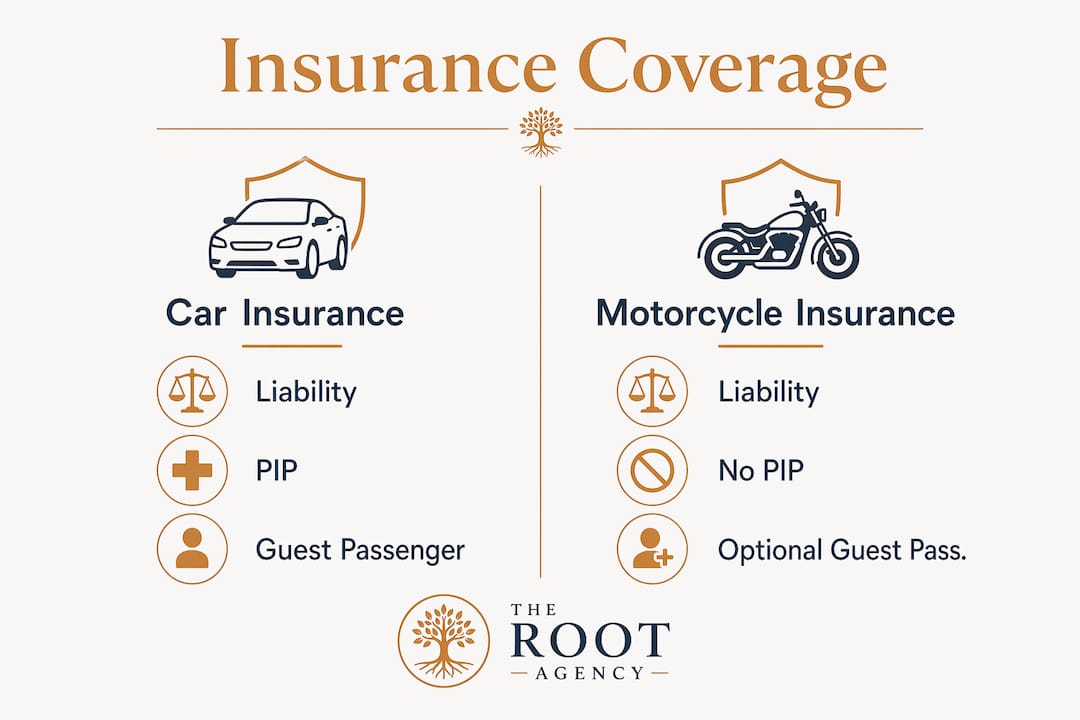
The coverage gaps go further than most riders realize:
| Coverage Type | Car Insurance | Motorcycle Insurance |
|---|---|---|
| Liability (bodily injury/property damage) | Standard inclusion | Standard inclusion |
| Collision and comprehensive | Standard option | Standard option |
| Personal injury protection (PIP) | Standard in PIP states | Often not available; requires medical payments endorsement |
| Guest passenger liability | Standard | Often requires separate endorsement |
| Safety gear and apparel | Not covered | Available as add-on |
| Custom parts and accessories | Limited or excluded | Available as add-on |
| Seasonal lay-up option | Not available | Available in most states |
Motorcycle policies differ from auto in lacking standard PIP and guest passenger coverage, which means riders need to actively request those protections rather than assume they are included.
Pro Tip: If you carry a passenger regularly, confirm that your motorcycle policy includes guest passenger liability. Many base policies exclude it, and one accident without it can expose you to a personal injury lawsuit.
Why is motorcycle insurance sold as a separate policy?
Even when you buy motorcycle and auto insurance from the same carrier, the policies remain completely separate documents with separate premiums and separate coverage terms. This is not a sales tactic. It reflects how insurers calculate risk.
Motorcycle underwriting considers factors that simply do not apply to cars:
- Rider experience and training: Completion of a Motorcycle Safety Foundation (MSF) course often qualifies for a premium discount
- Engine displacement: A 1200cc touring bike carries a different risk profile than a 250cc commuter
- Seasonal usage: Riders in northern states or those who store bikes during winter months may qualify for lay-up discounts
- Bike type: Sport bikes, cruisers, touring bikes, and off-road bikes each carry distinct accident and theft patterns
- Custom modifications: Aftermarket parts affect both the bike’s value and its risk exposure
Because these variables are so different from auto underwriting, a single combined policy cannot accurately price both risks. Separate policies allow the insurer to apply the correct rating factors to each vehicle.
The good news is that bundling motorcycle and auto insurance often yields multi-policy discounts between 5% and 15%. You get the savings of bundling without losing the precision of separate coverage terms. At The Root Agency, we write both policies under the same roof so you get that discount without the hassle of managing two different insurers.
Pro Tip: Ask your agent to run a bundled quote for your auto and motorcycle policies together. The discount rarely shows up automatically. You have to ask for it.
How do you choose the right motorcycle coverage level?
Choosing between liability-only and full coverage comes down to three factors: the bike’s value, whether it is financed, and your personal financial exposure.
Financed or leased motorcycles
Financed or leased motorcycles require full coverage as mandated by the lender, with no flexibility. The lender’s financial interest in the bike is the reason. If the motorcycle is totaled and you only carry liability, the lender loses their collateral. Full coverage, meaning both collision and comprehensive, protects that interest and keeps you in compliance with your loan agreement.
The 10x rule for unfinanced bikes
For bikes you own outright, a practical rule applies: if the bike’s replacement value exceeds about 10 times the yearly cost of full coverage, carrying full coverage is the financially sound choice. If your motorcycle is worth $8,000 and full coverage costs $600 per year, the math clearly favors full coverage. If the bike is worth $1,500 and full coverage costs $400 per year, liability-only may be reasonable.
Coverage options worth considering
- Liability only: Covers damage and injuries you cause to others. Required by law. Does not cover your bike or your injuries.
- Collision coverage: Pays to repair or replace your bike after an accident, regardless of fault.
- Comprehensive coverage: Covers theft, vandalism, weather damage, and other non-collision losses.
- Uninsured/underinsured motorist: Covers your injuries and damages when the at-fault driver has no insurance or insufficient coverage. Critical in Louisiana, where uninsured driver rates are among the highest in the country.
- Medical payments coverage: Pays your medical bills after an accident, regardless of who caused it.
- Safety gear and apparel coverage: Replaces helmets, jackets, gloves, and boots damaged in a covered accident.
- Custom parts and accessories: Covers aftermarket upgrades not included in the bike’s base value.
- Seasonal lay-up coverage: Seasonal lay-up insurance for motorcycles allows premium reduction during storage months, reflecting the lower risk when the bike is not on the road.
| Coverage | Best For | Skip If |
|---|---|---|
| Full coverage (collision + comprehensive) | Financed bikes, bikes worth over $5,000 | Older bikes with low market value |
| Uninsured motorist | All riders, especially in Louisiana | No valid reason to skip this |
| Medical payments | Riders without strong health insurance | You have robust health coverage |
| Safety gear add-on | Riders with quality gear investments | You ride with minimal gear |
| Seasonal lay-up | Riders who store bikes 3+ months per year | Year-round riders |
Key takeaways
Motorcycles require separate insurance because auto policies exclude them entirely, and the distinct risks motorcycles carry demand coverage terms that car insurance is never built to provide.
| Point | Details |
|---|---|
| Auto policies exclude motorcycles | Standard car insurance provides zero liability or physical damage coverage for motorcycles. |
| 49 states require separate coverage | Motorcycle liability insurance is legally mandated in nearly every state, with financial responsibility required everywhere else. |
| Risk profiles are fundamentally different | Higher injury severity, theft rates, and lack of passenger protection demand specialized underwriting. |
| Bundling saves money without merging policies | Multi-policy discounts of 5%–15% are available when you insure auto and motorcycle with the same carrier. |
| Full coverage is mandatory for financed bikes | Lenders require collision and comprehensive coverage to protect their financial interest in the motorcycle. |
What 20 years of claims has taught me about motorcycle coverage
I have seen riders come through our door after accidents with nothing but a liability-only policy on a bike worth $12,000. They thought they were covered. They were not. Liability covers what you do to others. It does not touch your bike, your gear, or your medical bills. That gap is where real financial pain lives.
The riders who fare worst after an accident are the ones who made coverage decisions based on the lowest monthly premium rather than the actual risk they were carrying. A $200 annual savings on a comprehensive premium is not a win if it costs you $8,000 out of pocket after a theft or a collision.
My honest advice: treat your motorcycle policy the same way you treat your health. Do not wait until something goes wrong to find out what you actually have. Review your coverage limits, confirm your uninsured motorist protection is in place, and make sure your gear is covered. In Louisiana, where we have some of the highest rates of uninsured drivers in the country, riding without uninsured motorist coverage is one of the riskiest decisions a rider can make.
The other mistake I see regularly is riders assuming their auto policy extends to their motorcycle because it is with the same company. It does not. These are separate contracts with separate terms. If you are not sure what your motorcycle policy actually covers, call us. That is exactly what we are here for.
— Steve Root
Get the right motorcycle coverage for louisiana roads

At The Root Agency, we write motorcycle insurance for Louisiana riders who want real protection, not just a card in their wallet that satisfies the minimum. Steve Root has spent more than 20 years helping riders in Baton Rouge and across Louisiana find coverage that actually holds up when it matters. With 356 Google reviews at 4.9 stars and recognition as one of Baton Rouge’s best, we bring the same level of care to every motorcycle policy we write. We also offer bundled auto and motorcycle coverage to help you get the most complete protection at the best combined rate. Call us at (225) 926-0160 or visit us at 8676 Goodwood Blvd Ste 303, Baton Rouge, LA 70806. We offer bilingual service in English and Spanish, and we are available 24/7 for claims support.
FAQ
Is motorcycle insurance legally required in louisiana?
Yes. Louisiana requires motorcycle liability insurance to ride on public roads, consistent with the 49-state mandate for minimum liability coverage. Riding without it exposes you to fines, license suspension, and full personal liability for any damages you cause.
Does my car insurance cover my motorcycle?
No. Auto policies exclude motorcycles entirely, including liability and physical damage coverage, even when both vehicles are insured with the same company. A separate motorcycle policy is always required.
What is the minimum motorcycle insurance i need in louisiana?
Louisiana requires bodily injury liability and property damage liability at state-mandated minimums. Uninsured motorist coverage is strongly recommended given Louisiana’s high rate of uninsured drivers, and medical payments coverage fills gaps that standard liability does not address.
Can i save money by bundling my motorcycle and auto insurance?
Yes. Bundling motorcycle and auto insurance with the same carrier typically produces multi-policy discounts between 5% and 15%. The policies remain separate documents with separate coverage terms, but the combined premium is lower than buying each independently.
Do i need full coverage on a motorcycle i own outright?
Full coverage is not legally required on an unfinanced bike, but it is financially wise if the bike’s replacement value exceeds roughly 10 times the annual cost of full coverage. For financed motorcycles, lenders require full coverage with no exceptions.
Recommended
- Motorcycle Insurance Louisiana | Baton Rouge Coverage | The Root Agency
- Louisiana Auto Insurance Guide for Baton Rouge Drivers | The Root Agency
- Liability-Only Car Insurance in Louisiana — Who It’s Right For | The Root Agency
- Uninsured Motorist Coverage in Louisiana — Why You Need It | The Root Agency