

What Triggers Insurance Coverage: A Louisiana Guide

Insurance coverage is activated by a specific event or condition defined in your policy, known in the industry as a “coverage trigger.” Understanding what triggers insurance coverage determines whether your insurer pays a claim or denies it. In Louisiana and Mississippi, that distinction carries real weight. Hurricanes, tropical storms, and flooding test policies every year, and the difference between an occurrence policy and a claims-made policy can mean the difference between a paid claim and a coverage gap. This guide explains how triggers work, what state regulations require, and what every policyholder in our region needs to know before disaster strikes.
What are the main types of insurance coverage triggers?
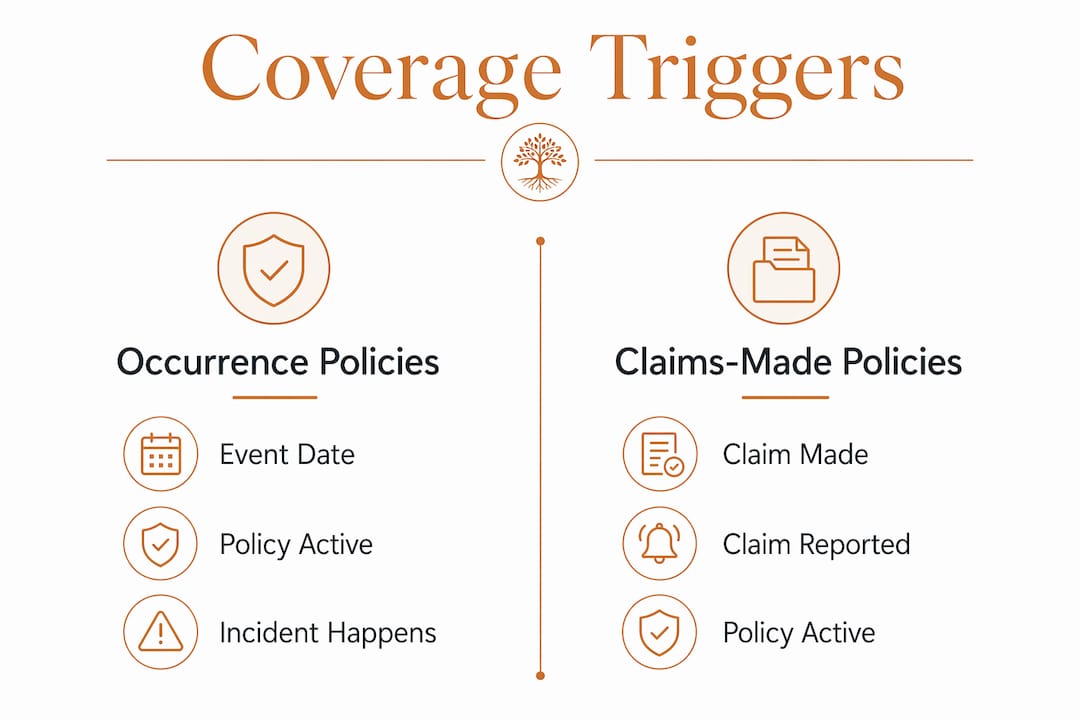
Insurance coverage triggers are primarily categorized as occurrence or claims-made, and each type defines a different moment when your insurer’s obligation activates.
Occurrence policies
An occurrence policy covers any incident that happens during the active policy period, regardless of when you file the claim. If a contractor causes property damage in march 2024 but you don’t discover it until 2026, an occurrence policy from 2024 still responds. This makes occurrence policies popular for homeowners and general liability coverage because the protection follows the event, not the paperwork.

Claims-made policies
A claims-made policy covers claims that are both made and reported during the active policy period. The policy also includes a retroactive date, which is the earliest date from which covered incidents are recognized. If the incident happened before that retroactive date, the claim is denied even if the policy is active. Claims-made policies are common in professional liability and medical malpractice coverage.
| Feature | Occurrence policy | Claims-made policy |
|---|---|---|
| Coverage activation | When the incident happens | When the claim is filed and reported |
| Retroactive date | Not applicable | Required; limits how far back coverage applies |
| Tail coverage needed | No | Yes, when switching policies |
| Common uses | Home, auto, general liability | Professional liability, errors and omissions |
| Claim timing flexibility | High | Low without extended reporting period |
Pro Tip: If you switch from a claims-made policy to a different carrier, purchase tail coverage immediately. Without it, any claim filed after the switch for a past incident goes unpaid, even if the incident occurred while you were fully insured.
How do natural disasters and emergency regulations affect coverage triggers in Louisiana and Mississippi?
Louisiana sits in the bullseye for hurricanes and tropical storms, and state regulators know it. Emergency rules exist specifically to protect policyholders when normal deadlines and procedures would work against them during a disaster.
Louisiana’s Emergency Rule 50 was enacted on july 2, 2026, in response to Tropical Storm Arthur. It prohibits insurers from canceling or non-renewing policies solely because of claims filed from that storm, with protections running through july 22, 2026. That rule gives policyholders breathing room to file claims without fear of losing coverage mid-process.
Louisiana law mandates that insurers acknowledge claims within 14 days, begin loss adjustment within 30 days for catastrophic claims, and issue payment within 60 days after proof of loss is submitted. These deadlines are not suggestions. Insurers who miss them face regulatory consequences.
Key emergency coverage provisions policyholders should know:
- Cancellation suspension: Insurers cannot cancel policies solely due to disaster-related claims during a declared emergency period.
- Claims acknowledgment: Louisiana requires written acknowledgment within 14 days of claim submission.
- Loss adjustment timeline: Catastrophic claims must see adjustment activity begin within 30 days.
- Payment deadline: Full payment is due within 60 days of proof of loss in Louisiana.
- Proof of loss forms: Louisiana insurers must provide proof of loss forms within 15 days of a policyholder’s request.
- Bill of Rights: Mississippi’s statutory Bill of Rights empowers policyholders to contest improper denials with regulatory backing.
If you live in an affected parish and your insurer is dragging its feet, these rules give you legal standing to push back. The Louisiana Department of Insurance and the Mississippi Insurance Department both enforce these timelines.
What policy terms and conditions affect the activation of coverage beyond the basic trigger?
A coverage trigger is the starting point, not the finish line. Several additional conditions must also be satisfied before your insurer writes a check.
Retroactive dates are the most consequential condition in claims-made policies. Failing to manage retroactive dates is the single most common reason businesses face serious coverage gaps. When a business switches insurers without securing tail coverage, past incidents become uninsured liabilities overnight. That exposure can easily reach five figures or more.
Policy exclusions also modify or negate a trigger entirely. A homeowner’s policy may have a valid occurrence trigger for wind damage but exclude flood damage in the same event. In Louisiana and Mississippi, where storms routinely bring both wind and water, understanding which peril is excluded matters enormously. Separate flood insurance coverage fills that gap, but only if you have it before the storm.
| Coverage condition | Louisiana requirement | Mississippi requirement |
|---|---|---|
| Claims acknowledgment | 14 days | Prompt acknowledgment required |
| Loss adjustment start | 30 days (catastrophic) | Reasonable timeframe |
| Payment after proof of loss | 60 days | Reasonable timeframe |
| Proof of loss form delivery | 15 days from request | Prompt delivery required |
| Report access for policyholders | Insurer must provide | Adjuster and engineer reports accessible under 19 Miss. Admin. Code 1-34.04 |
Business owners face a specific pitfall here. Commercial policies often carry claims-made triggers for professional liability and occurrence triggers for general liability, sometimes within the same coverage package. Treating both as identical is a mistake that surfaces only when a claim is denied.
Pro Tip: After filing a claim in Mississippi, formally request the adjuster’s report and any engineer assessments in writing. You have the right to that documentation, and it often reveals discrepancies between the insurer’s findings and the actual damage.
How do trigger theories apply to complex or long-tail insurance claims?
Standard occurrence and claims-made definitions work cleanly for sudden events like a car accident or a kitchen fire. They break down when damage develops slowly over months or years. Courts and insurers apply specialized trigger theories to resolve these situations.
Courts adopt different theories to allocate coverage for gradual or latent damages, particularly in environmental contamination, mold, asbestos, and pollution claims. The four main theories are:
- Manifestation trigger: Coverage activates only when damage becomes visible or discoverable. One policy period responds.
- Exposure trigger: Coverage activates when the claimant was first exposed to the harmful condition. This can reach back years.
- Injury-in-fact trigger: Coverage activates during the period when actual physical harm occurred, regardless of discovery.
- Continuous trigger: All policies in force from first exposure through manifestation share responsibility. Multiple policy years respond.
The continuous trigger theory is the most favorable for policyholders in long-tail claims because it pulls in coverage from multiple policy years. Insurers prefer the manifestation theory because it limits their exposure to a single policy period. Louisiana and Mississippi courts have addressed these theories in mold and environmental cases, and the outcome often depends on which state’s law governs the claim.
For business owners dealing with gradual property damage or long-term liability exposure, understanding which theory applies to your situation determines how many years of coverage are available. A claim that looks like a single-year problem may actually draw on five years of policies if the right trigger theory applies.
Key Takeaways
Insurance coverage activates only when a specific trigger condition is met, and knowing your policy type, state deadlines, and applicable trigger theory determines whether your claim gets paid.
| Point | Details |
|---|---|
| Two primary trigger types | Occurrence policies cover events when they happen; claims-made policies cover claims when they are filed. |
| Retroactive dates matter | Claims-made policyholders must manage retroactive dates carefully to avoid uncovered gaps when switching insurers. |
| Louisiana emergency rules protect you | Emergency Rule 50 suspends cancellations and sets firm claims-handling deadlines during declared disasters. |
| Long-tail claims use multiple theories | Manifestation, exposure, and continuous trigger theories each produce different coverage outcomes for gradual damage. |
| Documentation is a legal right | Policyholders in Louisiana and Mississippi have the right to request adjuster reports and proof of loss forms within defined timeframes. |
What I’ve learned after 20 years of Louisiana claims
Most policyholders find out how their coverage trigger works at the worst possible moment. A storm rolls through, they file a claim, and then they learn that a policy exclusion or a missed reporting deadline has left them holding the bill. I’ve seen it happen after every major storm we’ve had in this region, and it never gets easier to watch.
The most common mistake I see from business owners is assuming that all their policies work the same way. A general liability policy and a professional liability policy can sit in the same binder and operate on completely different trigger systems. When a claim crosses both, the timing and documentation requirements diverge, and a missed step on one policy can void the other.
What I tell every client is this: read the declarations page, know your retroactive date if you carry a claims-made policy, and call your agent before a storm, not after. Louisiana’s emergency rules give you real protections, but they don’t fix a policy that was wrong before the event. The insurance agent you choose should be able to walk you through your trigger type, your exclusions, and your state-specific deadlines in plain language. If they can’t, find one who can.
The Louisiana Supreme Court ruled in 2026 that any insurance payment resets the statute of limitations clock for lawsuits. That ruling has real implications for how and when you accept partial payments after a disaster. It’s the kind of detail that most policyholders never hear about until it affects their legal options. Knowing it in advance changes how you manage a claim.
— Steve Root
Coverage reviews tailored for Louisiana and Mississippi policyholders
Understanding your policy’s trigger type is not a one-time exercise. Policies change, businesses grow, and storm seasons remind us every year that coverage gaps are expensive.

The Root Agency has served Louisiana and Mississippi policyholders for more than 20 years, with a 4.9-star rating across 356 Google reviews and a catastrophe response team that deploys directly to disaster zones. We review occurrence and claims-made policies side by side, explain your retroactive dates in plain language, and make sure your coverage matches the risks you actually face. Whether you need commercial insurance coverage for your business or want a full personal lines review, we are here to help. Call us at (225) 926-0160 or visit us at 8676 Goodwood Blvd Ste 303, Baton Rouge, LA 70806.
FAQ
What triggers insurance coverage on a standard homeowners policy?
A standard homeowners policy uses an occurrence trigger, meaning coverage activates when a covered peril, such as wind, fire, or theft, occurs during the active policy period. Flood damage requires a separate flood policy because it is typically excluded from standard homeowners coverage.
What is the difference between an occurrence and a claims-made trigger?
An occurrence trigger activates coverage based on when the incident happens, while a claims-made trigger activates coverage based on when the claim is filed and reported. Claims-made policies also require the incident to fall on or after the policy’s retroactive date.
How does Louisiana’s Emergency Rule 50 affect my coverage trigger?
Emergency Rule 50 suspends insurer cancellations and non-renewals for policyholders in disaster-impacted parishes, protecting your policy from lapsing while you file storm-related claims. It does not change your underlying trigger type but preserves your right to use it.
What is tail coverage and when do I need it?
Tail coverage, formally called an extended reporting period, allows you to file claims after a claims-made policy ends for incidents that occurred while the policy was active. You need it any time you cancel, switch, or let a claims-made policy lapse.
Can I access the adjuster’s report after filing a claim in Mississippi?
Mississippi law under 19 Miss. Admin. Code 1-34.04 gives policyholders the right to request and receive adjuster and engineer reports. Requesting these documents in writing after filing a claim helps you verify that the insurer’s findings accurately reflect your actual loss.