

What Is Product Liability Coverage for Your Business?

Product liability coverage is defined as insurance protection that pays for claims when a product your business makes, sells, distributes, or handles causes bodily injury or property damage to a third party. For business owners in Louisiana and Mississippi, this coverage is not a luxury. It is the financial line between a manageable lawsuit and a business-ending judgment. Most businesses carry it without fully understanding what it covers, what it excludes, and whether their current limits are actually enough.
What is product liability coverage and what does it protect against?
Product liability coverage financially protects a business when someone claims a product the business made, sold, distributed, or handled caused bodily injury or property damage. The industry term for this protection within a standard policy is “products and completed operations” coverage, often abbreviated as PCO. You will see this language in your Commercial General Liability (CGL) policy.
The coverage applies to three primary categories of product defects:
- Manufacturing defects: A flaw introduced during production, such as a food product contaminated during packaging.
- Design flaws: A product that is inherently unsafe by design, even when built correctly.
- Failure to warn: Inadequate labeling or instructions that lead to user injury, such as a cleaning chemical sold without proper safety warnings.
Coverage pays defense costs, settlements, and judgments even if your business is not found at fault. That last point matters more than most business owners realize. A single allegation, even a baseless one, can cost tens of thousands of dollars in legal fees before a verdict is ever reached.
What product liability does NOT cover is equally important to understand:
- Employee injuries (those fall under workers’ compensation)
- Damage to your own product or inventory
- Product recalls
- Intentional acts
Pro Tip: Read your exclusions before you need your coverage. Most business owners only discover gaps after a claim is filed.
How does product liability work within a general liability policy?
Product liability is typically included in a standard Commercial General Liability policy as the products and completed operations component. This means most businesses already have some form of product liability protection without purchasing a separate standalone policy. The critical word is “some.”
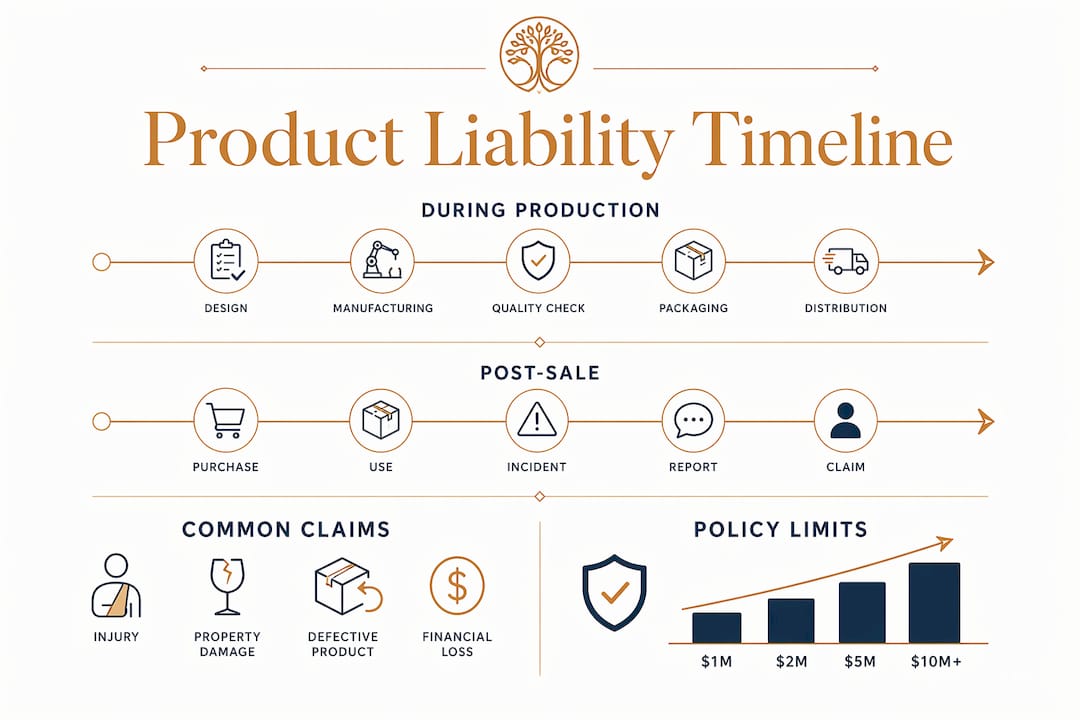
Understanding the timing distinction in PCO coverage is essential. Here is how the two components differ:
- Ongoing operations coverage applies while work or production is actively happening. If a contractor injures someone while on a job site, ongoing operations coverage responds.
- Products and completed operations coverage applies after the product is sold or the job is finished. Completed operations coverage protects against harm that surfaces days, months, or even years after the transaction is complete.
This timing distinction is where many claims fall through the cracks. A restaurant owner in Baton Rouge who sells a contaminated dish faces a claim after the customer leaves the premises. A contractor in Jackson, Mississippi who installs a faulty water heater faces a claim months after the job is done. Both scenarios require completed operations coverage to respond properly.
| Coverage Type | When It Applies | Common Example |
|---|---|---|
| Ongoing operations | During active work or production | Injury on a job site while work is in progress |
| Products and completed operations | After sale or job completion | Injury from a product purchased last month |
| Standalone product liability | Higher-risk businesses needing broader limits | Manufacturer with high-volume distribution |

Policy limits add another layer of complexity. Per-occurrence limits cap what the insurer pays for a single claim. Aggregate limits cap the total payout across all claims in a policy period. A business with a $1 million aggregate limit that faces two significant claims in the same year may find its coverage pool depleted before the second claim is fully resolved.
How do Louisiana and Mississippi contracts drive product liability requirements?
Product liability insurance is not legally mandated by Louisiana or Mississippi state law. No licensing board in either state requires a standalone product liability policy. What they do require is general liability coverage that includes products and completed operations, and that distinction matters.
Here is how coverage requirements typically show up for local businesses:
- Contractor licensing boards in Louisiana and Mississippi require proof of general liability, which must include PCO coverage to meet most board standards.
- Commercial landlords routinely require tenants to carry general liability with PCO before signing a lease.
- Government contracts at the city, parish, and state level in Louisiana often specify minimum liability limits, sometimes $1 million per occurrence or higher.
- Retail and distribution partners require certificates of insurance (COIs) that confirm PCO coverage before agreeing to carry or distribute a product.
A certificate of insurance is the document that proves your coverage to a third party. Licensing boards in Louisiana and Mississippi focus on the general liability proof shown on that certificate, not a separate product liability policy. If your COI does not reflect adequate PCO limits, you may lose a contract or fail a licensing requirement even if you technically have coverage.
Pro Tip: Before signing any contract in Louisiana or Mississippi, pull your COI and confirm that your products and completed operations limits match what the contract requires. A mismatch can void your eligibility even if you are otherwise fully insured.
Coverage needs also vary by where you sit in the supply chain. Manufacturers, distributors, and retailers each carry different exposures. A retailer who sells a defective product made by someone else can still be named in a lawsuit. Your policy needs to reflect your actual role in the chain, not just your job title.
What should you look for when reviewing your product liability coverage?
Many business owners assume product liability is included in their general liability policy and stop there. Assuming coverage without verifying details is one of the most common and costly mistakes in commercial insurance. Here is what to actually check:
- Confirm PCO is included. Ask your agent to show you the products and completed operations section of your CGL policy. Some policies exclude it or limit it significantly.
- Check your per-occurrence and aggregate limits. A $500,000 aggregate sounds substantial until one major claim consumes it entirely.
- Review your exclusions list. Product recalls, employee injuries, and damage to your own inventory are standard exclusions. Know what is not covered before you assume it is.
- Assess your risk profile. A food manufacturer in New Orleans carries far more product liability exposure than a consulting firm. Your limits should match your actual risk, not the minimum required to get a license.
- Consider an umbrella policy. Aggregate limits can be depleted by a single large claim, and a standard umbrella policy may not fill every gap. Discuss this specifically with your agent.
| Policy Element | What to Verify | Why It Matters |
|---|---|---|
| PCO inclusion | Confirmed in writing on declarations page | Absence means no post-sale coverage |
| Per-occurrence limit | Matches contract minimums | One claim can exhaust a low limit |
| Aggregate limit | Sufficient for multiple claims | One major claim can wipe out the pool |
| Exclusions | Recalls, own-product damage, employees | Gaps here create uninsured exposure |
| Umbrella coverage | Coordinates with underlying CGL | Fills gaps when primary limits run out |
Small businesses face catastrophic risk from high-cost product liability claims. A single lawsuit can threaten the financial survival of a business that has operated for years without a claim. The cost of adequate coverage is a fraction of the cost of one uninsured judgment.
Pro Tip: Review your commercial policy every year, not just when it renews. Your business changes, your contracts change, and your coverage needs to keep pace.
Key Takeaways
Product liability coverage is the financial protection that keeps a single product claim from ending a business, and most Louisiana and Mississippi businesses already have it inside their general liability policy but rarely verify whether their limits are adequate.
| Point | Details |
|---|---|
| Coverage definition | Product liability pays for third-party injury or property damage claims tied to your products. |
| Where it lives | Most businesses carry it as products and completed operations inside a CGL policy. |
| Timing matters | Completed operations coverage protects against claims that arise after a sale or job is finished. |
| Limits are finite | Aggregate limits can be exhausted by one major claim, leaving later claims unprotected. |
| Local requirements | Louisiana and Mississippi contracts and licensing boards require proof of PCO coverage on your COI. |
What I have seen after 20 years of covering Louisiana businesses
After two decades of working with business owners across Louisiana and Mississippi, the pattern I see most often is not a business that skipped coverage entirely. It is a business that had coverage but never looked closely enough at the details.
A contractor in Baton Rouge carries a general liability policy and assumes he is covered for everything. He wins a government contract, submits his COI, and gets rejected because his products and completed operations aggregate is $500,000 and the contract requires $1 million. He loses the job. That is a real outcome I have seen more than once.
The other scenario I see is a business owner who discovers after a claim that their aggregate limit was already partially consumed by an earlier claim in the same policy year. They thought they had $1 million in coverage. They had $400,000 left. The judgment was $750,000.
Cheap policies and unreviewed policies produce the same result: a gap when you need coverage most. The businesses that survive claims are the ones that worked with an agent who asked the right questions before the claim happened. That is not a sales pitch. That is what the evidence shows, year after year, in this region.
— Steve Root
Commercial coverage built for Louisiana and Mississippi businesses
The Root Agency has served business owners across Louisiana and Mississippi for more than 20 years, with 356 Google reviews at 4.9 stars and a reputation built on showing up when it counts.
If you run a business that makes, sells, or distributes any product, your commercial insurance coverage needs to be verified, not assumed. The Root Agency reviews your existing policy, confirms your PCO limits, checks your exclusions, and aligns your coverage with your actual contracts and risk profile. We offer 24/7 claims support and bilingual service in English and Spanish. Call us at (225) 926-0160 or visit us at 8676 Goodwood Blvd Ste 303, Baton Rouge, LA 70806. You can also explore all coverage options online.
FAQ
What is the product liability coverage definition?
Product liability coverage is insurance that pays for claims when a product your business makes, sells, or distributes causes bodily injury or property damage to a third party. It is formally called products and completed operations coverage within a Commercial General Liability policy.
Does general liability insurance include product liability?
Most standard general liability policies include products and completed operations coverage, which is the industry term for product liability protection. Business owners should confirm this is included and verify the limits match their contract requirements.
Is product liability insurance required in Louisiana or Mississippi?
Neither Louisiana nor Mississippi legally mandates standalone product liability insurance. However, most contracts, licensing boards, and business partners in both states require proof of general liability coverage that includes products and completed operations.
What are common examples of product liability claims?
Common product liability claims include injuries from contaminated food products, burns from improperly labeled chemicals, and property damage from defective equipment. Coverage pays defense costs, settlements, and judgments even when the business is not found at fault.
What happens if my aggregate limit runs out during the policy year?
If your aggregate limit is exhausted by one or more claims during the policy period, your insurer will not pay additional claims until the policy renews. An umbrella policy may provide additional coverage, but it must be structured correctly to coordinate with your underlying general liability limits.
Recommended
- Commercial Insurance Baton Rouge LA | Business & BOP Coverage | The Root Agency
- Liability-Only Car Insurance in Louisiana — Who It’s Right For | The Root Agency
- Golf Cart Insurance Louisiana | LSV & Course Coverage | The Root Agency
- Boat Insurance Louisiana | Watercraft Coverage Baton Rouge | The Root Agency