

What Is Excess Liability Coverage? A Family Guide

Excess liability coverage is defined as a secondary insurance policy that extends your liability limits after your primary policy is completely exhausted. It does not expand what your policy covers. It simply adds more money on top of what your auto, home, or renters policy already provides. For Louisiana families with property, savings, or any meaningful income, a single catastrophic lawsuit can wipe out everything a primary policy leaves unprotected. Understanding excess liability coverage explained in plain terms is the first step toward closing that gap before it costs you everything.
What is excess liability coverage and how does it work?
Excess liability coverage activates only after the limits of your underlying primary policy are fully used up. Think of it as a second reservoir of funds that sits behind your auto or homeowners policy. When a claim drains your primary limits dry, the excess policy takes over and pays the remainder up to its own limit.
The defining feature of excess liability insurance is its “follow-form” nature. Excess liability mirrors the exact terms, conditions, and exclusions of the primary policy beneath it. If your homeowners policy excludes a specific type of claim, your excess policy excludes it too. There is no expansion of coverage scope, only an extension of the dollar amount available.

Excess liability policies are typically sold in $1 million increments. That structure makes it straightforward to stack layers of protection as your assets grow. A family might carry $300,000 in auto liability and add a $1 million excess policy on top, giving them $1.3 million total protection against a serious accident claim.
One detail that catches many families off guard: defense costs in excess liability policies are typically paid from within the policy limit. Every dollar spent on attorneys reduces the amount left for a settlement. That is a meaningful distinction when legal fees alone can reach six figures in a serious case.
Pro Tip: Ask your agent to confirm whether your excess policy pays defense costs inside or outside the policy limit. The answer changes how much real protection you actually have.
Key mechanics to know before you buy:
- Excess liability activates only after primary limits are fully depleted, not before.
- The policy follows the same terms and exclusions as the underlying coverage.
- Coverage is sold in layers, commonly starting at $1 million.
- Defense costs often reduce the settlement funds available under the policy.
- You must maintain the required underlying policy limits to keep the excess policy valid.
How does excess liability differ from umbrella insurance?
Excess liability and umbrella insurance are not the same product. Families and financial planners often use the terms interchangeably, but the difference matters when a claim hits.
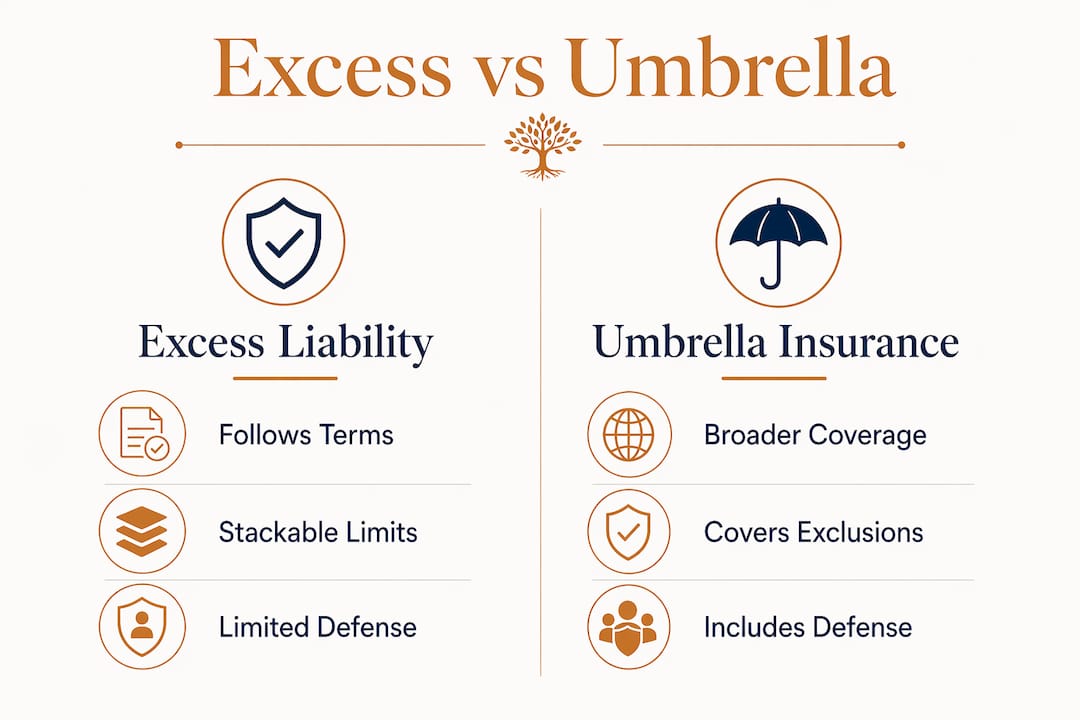
Excess liability strictly follows the underlying policy’s terms and cannot cover claims the primary policy excludes. Umbrella insurance, by contrast, can cover additional risks not included in any underlying policy, such as libel, slander, or certain personal injury claims. Umbrella policies can also “drop down” to cover gaps when an underlying policy does not respond at all. Excess liability cannot do that.
The table below shows the core differences clearly:
| Feature | Excess liability | Umbrella insurance |
|---|---|---|
| Follows primary policy terms | Yes, strictly | Partially |
| Expands coverage scope | No | Yes |
| Covers gaps in primary policy | No | Yes |
| Defense costs | Usually inside the limit | Often outside the limit |
| Best use case | Adding depth to existing coverage | Adding both depth and breadth |
For a deeper look at how umbrella policies work, the distinction becomes even clearer when you map it against real claim scenarios. A family that wants broader protection across multiple risk categories typically benefits more from an umbrella policy. A family that already has strong underlying coverage and simply wants higher dollar limits is a better fit for excess liability.
Layering both products is also possible. Stacking excess liability on top of an umbrella policy allows individuals to reach very high total coverage limits with a customized protection structure. That approach is common among families with significant assets or complex risk profiles.
Who needs excess liability insurance?
The short answer is: more families than realize it. Only 28% of individuals who worry about lawsuits actually carry excess liability or umbrella policies. That gap represents real financial exposure for people who believe their primary policy is enough.
Excess liability is not just for the wealthy. Anyone with property, driving habits, or hosting responsibilities faces risk that can exceed standard primary limits. A serious car accident, a guest injured at your home, or a dog bite claim can generate damages well above what a typical auto or homeowners policy pays.
Determining the right coverage amount follows a clear process:
- Add up your total assets. Include your home equity, retirement accounts, college savings, investment accounts, and any other property you own.
- Estimate your future earning potential. Courts can garnish future wages in a judgment. Your income over the next 10–20 years is part of what a plaintiff’s attorney will calculate.
- Review your current primary limits. Identify the gap between what you own and what your existing policies cover.
- Set your excess limit to cover the gap. Coverage levels should match the total value of your assets plus your future earning potential.
- Revisit annually. As your assets grow, your coverage needs grow with them.
Pro Tip: If you own a home, drive regularly, have teenage drivers on your policy, or host gatherings at your property, you are a strong candidate for excess liability coverage. You do not need a net worth in the millions to face a million-dollar lawsuit.
Louisiana families face specific risks that make this coverage especially relevant. The state’s litigation environment is active, and common auto insurance gaps leave many drivers exposed to claims that far exceed their policy limits. A $100,000 auto liability limit sounds substantial until a serious accident involves medical bills, lost wages, and legal fees for multiple parties.
How to add excess liability coverage to your existing insurance
Adding excess liability coverage starts with confirming your underlying policies are in place and meet the minimum limits required. Most excess liability policies require you to carry specific minimum limits on your auto and homeowners policies before the excess layer can attach.
Steps to get coverage in place:
- Confirm your current auto and home policy limits with your agent.
- Identify the minimum underlying limits your excess policy requires.
- Decide how much excess coverage you need based on your assets and income.
- Ask whether bundling your excess policy with existing coverage reduces your premium.
- Review the policy’s follow-form exclusions so you understand exactly what it will and will not cover.
A $1 million excess liability policy typically costs between $200 and $400 per year. That cost is low relative to the protection it provides for a home, retirement fund, or college savings account. The price varies based on your driving record, claims history, property type, and the limits of your underlying policies.
Working with a single agent who manages all your policies makes coordination far simpler. When your auto, home, and excess liability policies are all in one place, your agent can confirm the limits align, identify any gaps, and make sure the excess policy attaches correctly. Fragmented coverage across multiple carriers creates the kind of gaps that only show up at claim time.
Key Takeaways
Excess liability coverage is the most cost-effective way for families to protect their assets and future income against catastrophic claims that exceed primary policy limits.
| Point | Details |
|---|---|
| Activates after primary limits | Excess liability pays only after your auto or home policy limits are fully exhausted. |
| Follow-form coverage | The policy mirrors your primary policy’s terms and exclusions exactly, with no expanded scope. |
| Sold in $1 million layers | Coverage is added in $1 million increments, making it easy to scale as your assets grow. |
| Defense costs reduce limits | Legal fees typically come out of the policy limit, reducing funds available for settlement. |
| Low cost, high protection | A $1 million policy costs $200–$400 per year, protecting homes, savings, and future income. |
Why I recommend excess liability for nearly every Louisiana family
I have been in this business for more than 20 years, and I have sat across from families after a claim who thought they were covered. The ones who hurt the most are not the ones who had no insurance. They are the ones who had insurance but not enough of it.
Louisiana is a high-litigation state. Juries here award large verdicts, and a single serious accident can generate a claim that blows past a standard $100,000 or $300,000 auto liability limit without much effort. I have seen it happen to careful drivers, good homeowners, and responsible people who simply did not know their primary limits were not enough.
Financial planners call excess liability a critical financial backstop for families facing catastrophic liability events. I agree completely. What I would add is that the cost is almost never the barrier. At $200–$400 a year, this is one of the most affordable protections available. The barrier is awareness. Most families do not know this product exists until they need it.
The families I worry about are the ones who own a home, have retirement savings, and carry teenagers on their auto policy. They have real assets to protect and real exposure from the road. A $1 million excess policy on top of solid underlying coverage gives them a layer of protection that can mean the difference between financial recovery and financial ruin.
My advice is simple. Do not wait for a claim to find out your limits were not high enough. Call us, review your current coverage, and let us show you exactly where your protection ends and where it needs to go.
— Steve Root
The Root Agency can help you build the right coverage
Protecting your family’s financial future takes more than a basic auto or home policy. At The Root Agency, we review your full coverage picture and identify exactly where your limits leave you exposed.

With more than 20 years of experience and 356 five-star Google reviews, The Root Agency has helped Louisiana and Mississippi families build protection that holds up when it matters. We offer comprehensive insurance coverage across 11 lines, including umbrella and excess liability options designed to work alongside your existing home insurance and auto policies. Our team is available 24/7, bilingual in English and Spanish, and backed by a mobile catastrophe response unit that shows up in person after a storm. Call us at (225) 926-0160 or visit us at 8676 Goodwood Blvd Ste 303, Baton Rouge, LA 70806.
FAQ
What does excess liability mean in simple terms?
Excess liability means your insurance pays additional funds after your primary policy limit runs out. It does not change what is covered. It only increases the dollar amount available for a covered claim.
How much does excess liability insurance cost?
A $1 million excess liability policy typically costs between $200 and $400 per year. The exact price depends on your driving record, claims history, and the limits of your underlying policies.
What is the difference between liability and excess coverage?
Standard liability coverage pays claims up to a fixed limit set in your primary policy. Excess coverage kicks in after that limit is exhausted, providing additional funds for the same type of claim without expanding the coverage categories.
Who needs excess liability insurance?
Anyone with a home, savings, retirement accounts, or regular driving exposure is a candidate. Excess liability is not limited to high-net-worth individuals. A serious accident or injury claim can exceed standard limits for any family.
Can I stack excess liability on top of an umbrella policy?
Yes. Layering excess liability on top of an umbrella policy allows you to reach higher total coverage limits. This approach works well for families who want both broader coverage from an umbrella policy and higher dollar limits from an excess layer. Learn more about umbrella coverage options available in Louisiana.