
Concurrent Causation Doctrine: What Louisiana Homeowners Need to Know
When a covered peril and an excluded peril combine to cause a single, indivisible loss, the concurrent causation doctrine can require your insurer to pay the entire claim — but only if your policy does not contain language that overrides it. In Louisiana, that “only if” carries real weight. Here is what to do right now if you have a combined-peril loss:
- Document everything immediately. Photograph and video every damaged area before any cleanup. Capture timestamps, weather reports, and any visible sequence of damage (wind first, then water intrusion).
- Notify your insurer and your agent the same day. Late notice can compromise your rights regardless of which doctrine applies. Call The Root Agency at (225) 926-0160 for same-day guidance.
- Preserve all physical evidence. Do not discard damaged materials until an adjuster or engineer has inspected them. Hire a licensed public adjuster or engineer if the loss is large.
Policy language and the state where your property sits will determine which doctrine controls your claim. A quick policy review before a storm is far cheaper than a denied claim after one.
Table of Contents
- What does the concurrent causation doctrine mean for your coverage?
- Anti-Concurrent Causation clauses and how they can flip your claim
- How state law and key cases change the outcome
- What a concurrent causation claim fight actually looks like
- A practical checklist for reading your policy and protecting your claim
- How The Root Agency supports you through a concurrent causation dispute
- Key Takeaways
- Why policy language matters more than legal doctrine
- The Root Agency is ready before the storm and after it
- Useful sources and further reading
What does the concurrent causation doctrine mean for your coverage?
The concurrent causation doctrine is a legal principle that can require an insurer to cover an entire loss when a covered peril and an excluded peril independently combine to produce one indivisible injury. The key word is indivisible: if you cannot separate the damage caused by the covered event from the damage caused by the excluded event, courts applying this doctrine have historically sided with the policyholder.
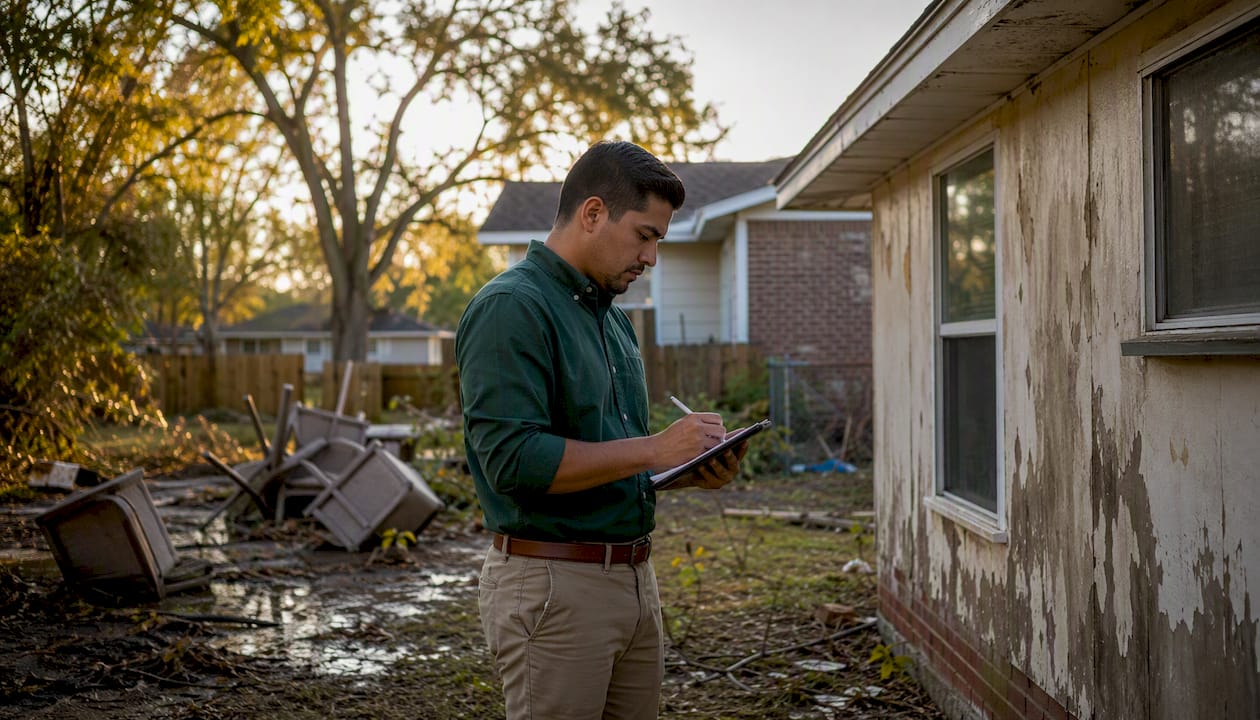
A plain-English scenario makes this concrete. Suppose a hurricane pushes wind through a gap in your roof. Rain follows through that same opening and soaks your attic insulation and drywall. The wind damage is typically covered under a standard homeowners policy. Flood or surface-water damage is typically excluded. Because the two perils worked together to produce one soaked, structurally compromised attic, the loss is arguably indivisible. Under the traditional concurrent causation doctrine, the insurer may owe the full loss even though an excluded peril contributed.
Contrast that with divisible damage: if wind tears off your fence (covered) and a separate flood event fills your garage (excluded), those are two distinct losses. Courts and adjusters can allocate them. The divisibility question is where most disputes begin.
“Under the concurrent causation doctrine, losses caused jointly by an excluded peril, such as flooding, and some other peril not excluded by the policy, such as negligence by a third party, are covered. In some historical cases, coverage was found when the nonexcluded peril played any role in the loss, even a minor one.” — Property Casualty 360
That last phrase — “even a minor one” — is why insurers pushed back hard and began writing Anti-Concurrent Causation clauses into nearly every modern policy.
Anti-Concurrent Causation clauses and how they can flip your claim
Most modern insurance policies include Anti-Concurrent Causation (ACC) clauses specifically designed to override the default concurrent causation outcome. The language typically appears inside an exclusion and reads something like this:
That phrase “directly or indirectly” is doing enormous work. It means the insurer does not need to prove the excluded peril was the main cause. If flood contributed at all, the entire loss is excluded. “Regardless of any other cause or event” closes the door on the argument that covered wind damage should still be paid.
The practical effect is a near-complete reversal of the pro-insured default. After Hurricanes Katrina and Rita, the majority of jurisdictions that addressed ACC clauses enforced them when the policy language was clear. Insurers learned from that litigation cycle and tightened their wording. Today, ACC language appears in most standard homeowners forms, including ISO-based policies widely used in Louisiana.
Pro Tip: Open your policy’s “Exclusions” section and search for the phrases “directly or indirectly,” “regardless of any other cause,” and “in any sequence.” If you find all three in the same exclusion, you have a strong ACC clause. Get a copy of your declarations page and that exclusion to your agent before the next storm season.
What policyholders often miss is that ACC wording can vary between policy years for the same insurer. An endorsement added or removed at renewal can change your exposure entirely. Never assume last year’s coverage matches this year’s form.
How state law and key cases change the outcome
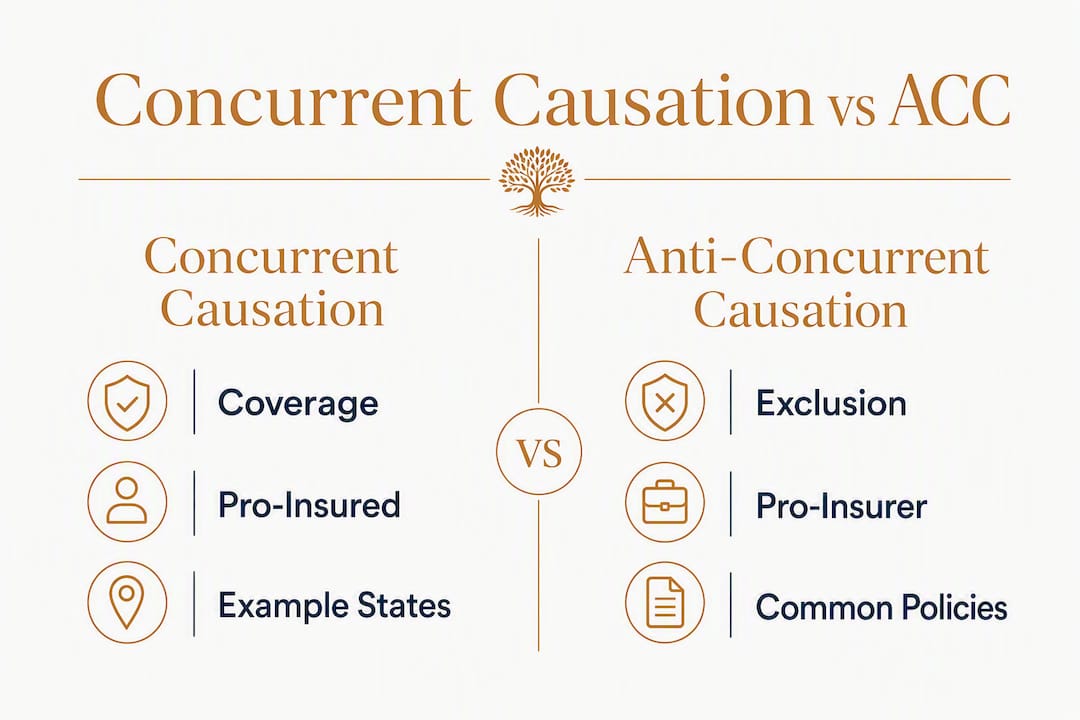
The legal doctrine applied in your state can be the difference between a paid claim and a denied one. Three main approaches exist across U.S. jurisdictions.
| Approach | Core Rule | Pro-Insured? | Example States |
|---|---|---|---|
| Concurrent causation doctrine | Coverage if any covered peril contributed, even a minor one | Yes | Historically California (pre-ACC), some Midwest states |
| Efficient proximate cause (EPC) | Coverage if the covered peril was the dominant cause | Partially | California (codified), Louisiana (default), Washington |
| ACC clause enforcement | Exclusion controls if excluded peril contributed at all | No | Texas, Louisiana (when ACC language is clear), most post-Katrina jurisdictions |
Sebo v. American Home Assurance Co. (Florida)
Sebo is the most-cited modern case on this doctrine. The Florida Supreme Court held that when covered and excluded perils combine to cause an indivisible loss, the concurrent causation doctrine applies and the insurer owes coverage. The case involved faulty workmanship (not excluded) and rain intrusion (not excluded under the specific policy), but the court’s reasoning — that indivisible losses triggered by any covered peril deserve coverage — has been cited broadly. Florida does not allow ACC clauses to override the EPC rule in all circumstances, making it one of the more policyholder-friendly jurisdictions.
Louisiana: default EPC, but ACC clauses are routinely enforced
Louisiana’s default rule historically favors the efficient proximate cause doctrine, meaning a covered peril that is the dominant cause of loss should produce coverage. In practice, however, Louisiana courts and federal courts applying Louisiana law frequently enforce ACC clauses when the policy language is unambiguous. A 2021 federal decision, Chad Little v. Aegis Security Insurance Co. (W.D. La.), granted summary judgment to the insurer, upholding the ACC exclusion for combined wind-and-flood hurricane damage. The court found that once the insurer showed flood contributed to the loss, the ACC clause precluded coverage for the entire claim.
Texas: concurrent causation with strict allocation
Texas courts follow the concurrent causation doctrine and enforce ACC clauses where policy language is clear, but they also require careful segmentation of damage. An insured who can prove which portion of the loss came solely from a covered peril may still recover that portion. This allocation burden falls on the policyholder and demands detailed documentation.
States that resist ACC enforcement
Some states, including certain rulings in California, Washington, and West Virginia, have held that ACC language cannot override the common-law efficient proximate cause rule, creating genuine jurisdictional unpredictability. California has codified EPC by statute, meaning insurers cannot simply write it away with policy language. Washington courts have similarly protected policyholders from blanket ACC enforcement.
The takeaway: where your property sits, and which court hears your dispute, shapes the outcome as much as the facts of the loss.
What a concurrent causation claim fight actually looks like
Most policyholders do not realize how quickly the burden can shift once an insurer identifies an excluded peril. Here is how these disputes typically unfold and what you can do about it.
Common insurer tactics:
- Deny under ACC language. The adjuster cites the “directly or indirectly” clause and closes the claim without allocating any payment.
- Argue indivisibility against the insured. The insurer claims the wind and flood damage cannot be separated, so the flood exclusion swallows the entire loss.
- Offer a partial allocation payment. The insurer pays only what it attributes to the covered peril, often using its own engineer’s report to minimize that figure.
What shifts the burden back to you:
Failure to segregate damages between covered and excluded perils is often fatal to recovery. An insurer that proves an excluded peril contributed can, under enforceable ACC wording, preclude coverage for the entire loss unless the insured shows an exception applies. That means the burden-of-proof shift is real and consequential.
Evidence that matters most:
- Timestamped photos and video taken before any cleanup or repair
- Weather service records showing wind speed and storm surge timing
- A licensed structural engineer’s report that separates wind damage from water damage
- Contractor estimates broken out by cause of damage, not just by room or material
- Your policy’s declarations page, exclusions section, and any endorsements from the current policy year
- Written communications with your insurer (dates, names, claim numbers)
Early documentation and an independent engineering report are the two most powerful tools a policyholder has. An adjuster’s report prepared by the insurer’s vendor is not neutral; your own expert’s findings carry independent weight in any dispute or litigation.
A practical checklist for reading your policy and protecting your claim
Knowing what to look for before a loss is the most underused advantage a homeowner has. Use this checklist during your next policy review and keep it handy after any storm.
Before a loss: policy review checklist
| What to find | Where to look | What it means |
|---|---|---|
| ACC exclusion language | Exclusions section | “Directly or indirectly” wording can bar the entire claim |
| Flood/surface-water exclusion | Exclusions section | Standard homeowners policies exclude flood; separate NFIP or private flood policy required |
| Wind vs. flood deductibles | Declarations page | Hurricane deductibles in Louisiana are often percentage-based, not flat dollar amounts |
| Endorsements and sublimits | Policy endorsements pages | Water backup, roof age, and ordinance/law endorsements change coverage materially |
| Policy form number and year | Declarations page | Policy language changes between years; confirm your current form matches what you expect |
Questions to ask your agent in writing
- Does my policy contain an ACC clause, and which perils does it apply to?
- Do I have separate flood coverage, and does it cover storm surge?
- What is my hurricane deductible, and how is it calculated?
- Are there endorsements that restore coverage the base policy excludes?
After a loss: immediate actions
- Call your agent and file your claim the same day.
- Photograph and video every damaged area before touching anything.
- Keep all receipts for emergency repairs, hotel stays, and temporary fixes.
- Request a copy of the adjuster’s report and any engineering findings.
- If the loss is large or the denial seems wrong, consult a public adjuster or a licensed insurance attorney before signing any release.
Pro Tip: Ask your agent for the specific policy form number and edition date, not just the coverage summary. Two policies from the same insurer in consecutive years can have meaningfully different ACC wording. A Louisiana insurance coverage review before storm season costs nothing and can prevent a five-figure dispute.
How The Root Agency supports you through a concurrent causation dispute
Louisiana homeowners face a specific combination of risks that makes this doctrine more than a law-school concept: hurricane wind, storm surge, inland flooding, and aging construction often collide in a single event. The Root Agency was built for exactly that reality.
What we bring to a concurrent causation claim:
Steve Root has spent more than 20 years reviewing Louisiana policies, fielding calls after major storms, and helping policyholders understand what their coverage actually says before they need it. The agency carries a 40-year family legacy in Louisiana insurance. When a storm hits, the team does not disappear. The Root Agency is one of the only agencies in Louisiana with a mobile catastrophe response unit that deploys RVs directly to disaster zones, capturing on-site documentation and connecting policyholders with adjusters and engineers while the evidence is still fresh.
That on-the-ground presence matters. Local expertise and faster evidence capture after a storm materially improve claim outcomes because adjusters and engineers work from what they can see, and what they can see depends on how quickly someone documented it.
The agency’s numerous highly positive Google reviews reflect what happens when a local team picks up the phone at any hour after a storm and stays with a client through the claim. Bilingual service in English and Spanish means no policyholder is left navigating a denial letter alone. And 24/7 claims support means the call you need to make at midnight after a tornado is a call that gets answered.
If you have questions about your current policy’s ACC language, flood exclusions, or hurricane deductibles, a policy review with The Root Agency is the fastest way to know where you stand before the next storm.
Key Takeaways
The concurrent causation doctrine can require full coverage when a covered and excluded peril combine to cause one indivisible loss, but ACC clauses in most modern policies can override that protection entirely.
| Point | Details |
|---|---|
| ACC clauses override the default | “Directly or indirectly” language in your policy can exclude the entire loss even when a covered peril contributed. |
| Jurisdiction shapes the outcome | Louisiana enforces clear ACC clauses; Florida and some other states protect policyholders more through EPC rules. |
| Documentation is decisive | Timestamped photos, independent engineering reports, and segregated contractor estimates are the evidence that wins or loses claims. |
| Policy language changes year to year | Never assume identical coverage at renewal; confirm your current form’s ACC wording with your agent before storm season. |
| The Root Agency offers free policy reviews | Steve Root’s team reviews Louisiana and Mississippi policies, deploys catastrophe RVs after storms, and provides 24/7 bilingual claims support. |
Why policy language matters more than legal doctrine
Most articles about concurrent causation spend their energy on the doctrine itself. After more than 20 years in Louisiana insurance, I think the doctrine is almost secondary. What actually determines whether a Louisiana homeowner gets paid after a storm is the specific wording in the specific policy form they signed, and whether they documented their loss before the adjuster arrived.
I have seen policyholders with strong claims lose coverage because they could not separate wind damage from flood damage in their documentation. I have seen others with policies that looked identical on the surface produce completely different outcomes because one had an endorsement the other did not. The legal doctrine gives courts a framework. The policy language gives insurers a tool. And the documentation gives the policyholder leverage.
The families who come out of a storm in the best position are not the ones who paid the lowest premium. They are the ones who reviewed their policy before the storm, called their agent the day of the loss, and had an agent who actually showed up. That is what we built The Root Agency to be.
The Root Agency is ready before the storm and after it

If you own a home in Louisiana or Mississippi, your biggest coverage risk may be a clause you have never read. The Root Agency offers homeowners insurance policy reviews that go line by line through your ACC exclusions, flood coverage gaps, and hurricane deductibles — before you need to file a claim. For properties in flood-prone areas, we also review and place flood insurance coverage that works alongside your homeowners policy so you are not left with an indivisible loss and no coverage for half of it.
Our catastrophe RV team deploys directly to disaster zones. Our claims line is answered 24/7, in English and Spanish. Call us at (225) 926-0160 or visit steverootagency.com/products to schedule your policy review today.
Useful sources and further reading
| Source | What it covers |
|---|---|
| Anti-Concurrent Causation Clauses: State of the Law | Academic survey of ACC enforceability across U.S. jurisdictions; covers all three doctrinal approaches |
| Hurricanes Katrina and Rita: ACC Clauses Enforcement and Implications | Post-storm litigation analysis; explains why most jurisdictions enforce clear ACC language |
| Concurrent Causation in Louisiana: The Basics | Louisiana-specific overview of EPC default and ACC enforceability; burden-of-proof mechanics |
| Louisiana Federal Court Upholds ACC Exclusion (2021) | Chad Little v. Aegis Security Insurance Co.; key precedent for wind-and-flood ACC disputes in Louisiana |
| Concurrent Cause Issues in Insurance (JD Supra) | Practitioner analysis of indivisibility arguments and documentation strategies |
| Legal History of Concurrent Causation and EPC (PC360) | Historical overview of both doctrines and how courts have applied them |
| Hurricane Laura: Texas and Louisiana Claims Outlook | State-by-state comparison of ACC enforcement and allocation requirements |
This article provides general information about insurance law and policy interpretation. It is not legal advice. Coverage outcomes depend on your specific policy language, jurisdiction, and the facts of your loss. Consult a licensed insurance professional or attorney for guidance on your individual situation.
Recommended
- Homeowners Insurance Cobertura: What Louisiana Homeowners Need to Know | The Root Agency
- Renters vs. Homeowners Insurance: What’s the Difference? | The Root Agency
- What Triggers Insurance Coverage: A Louisiana Guide | The Root Agency
- Umbrella Insurance Coverage Examples in Louisiana | The Root Agency