

What Is Commercial Auto Insurance? A 2026 Guide

Commercial auto insurance is a specialized policy that covers vehicles used for business purposes, providing liability and physical damage protection that personal auto insurance explicitly excludes. If you use a vehicle to deliver goods, transport clients, haul equipment, or visit job sites, a personal policy will not protect you when something goes wrong. The industry term is commercial automobile insurance, and it applies to everything from a single contractor’s pickup truck to a fleet of delivery vans. Understanding what it covers, how it is priced, and why Louisiana law requires it is the first step toward protecting your business the right way.
How does commercial auto insurance differ from personal auto insurance?
The core difference is this: personal auto policies exclude business use, and that exclusion is not buried in fine print. It is a foundational underwriting rule. If you have an accident while making a delivery or driving to a client meeting in a vehicle covered only by a personal policy, your insurer can deny the claim outright and cancel your policy.
Commercial auto insurance is built differently from the ground up. Underwriters assess the business’s overall risk profile, not just one driver’s record. Rates factor in vehicle class, driver history as a group, loss history, and required state and federal filings. That is a fundamentally different calculation than what drives a personal premium.

Here is a direct comparison of how the two policy types handle common scenarios:
| Scenario | Personal Auto Policy | Commercial Auto Policy |
|---|---|---|
| Delivery driver has an accident on the job | Claim denied, policy at risk of cancellation | Covered under liability and physical damage |
| Employee uses personal car for a business errand | No coverage for business liability | Covered under HNOA endorsement |
| Company-owned truck damaged in a storm | Excluded if used commercially | Covered under comprehensive coverage |
| Multi-vehicle business fleet | Cannot be rated as a fleet | Rated as a group with fleet discounts available |
The consequences of relying on a personal policy for business driving are severe. Claim denial leaves you personally liable for bodily injury and property damage costs. Policy cancellation makes future coverage harder and more expensive to obtain. No Louisiana business owner should carry that risk.
Scenarios that require commercial coverage include:
- Contractors transporting tools and materials to job sites
- Real estate agents driving clients to property showings
- Caterers and food vendors using vehicles for deliveries
- Landscaping companies operating trucks and trailers
- Any business with employees who drive on company time
What types of coverage are included in commercial auto insurance?
Commercial vehicle coverage is not a single product. It is a package of protections you build based on your business’s specific exposures. Liability coverage is the foundation, required in most states for any vehicle used in business operations. It pays for bodily injury and property damage you cause to others in an at-fault accident.
Beyond liability, a well-structured business auto insurance policy typically includes:
- Collision coverage: Pays to repair or replace your vehicle after an accident, regardless of fault.
- Comprehensive coverage: Covers non-collision losses including theft, fire, flood, and storm damage. In Louisiana, where severe weather is a constant reality, this is not optional.
- Medical payments / PIP: Covers medical expenses for you and your passengers after an accident, regardless of fault.
- Uninsured/underinsured motorist coverage: Protects your business when the at-fault driver carries no insurance or not enough. Louisiana has one of the highest rates of uninsured drivers in the country.
- Hired and Non-Owned Auto (HNOA): Covers liability when employees drive their personal vehicles or rented vehicles for business purposes. Personal policies do not cover employees driving their own vehicles for work, which creates serious litigation risk without this endorsement.
- Cargo coverage: Protects goods in transit against loss or damage.
- MCS-90 endorsement: Required for interstate trucking operations under federal law.
Pro Tip: HNOA coverage typically costs just $50–$300 per year, yet it protects your business from liability claims that can reach six figures. If any employee ever drives their own car for a work errand, you need this coverage.
The optional endorsements matter more than most business owners realize. An MCS-90 filing, for example, is mandatory for motor carriers operating across state lines. Missing it does not just create a coverage gap. It creates a federal compliance violation.
What factors influence the cost of commercial auto insurance?
Commercial auto insurance costs range from $1,800–$3,500 annually for solo light-duty operators to $7,000–$15,000 or more for heavy-duty trucks. That wide range reflects how many variables go into pricing a commercial policy.
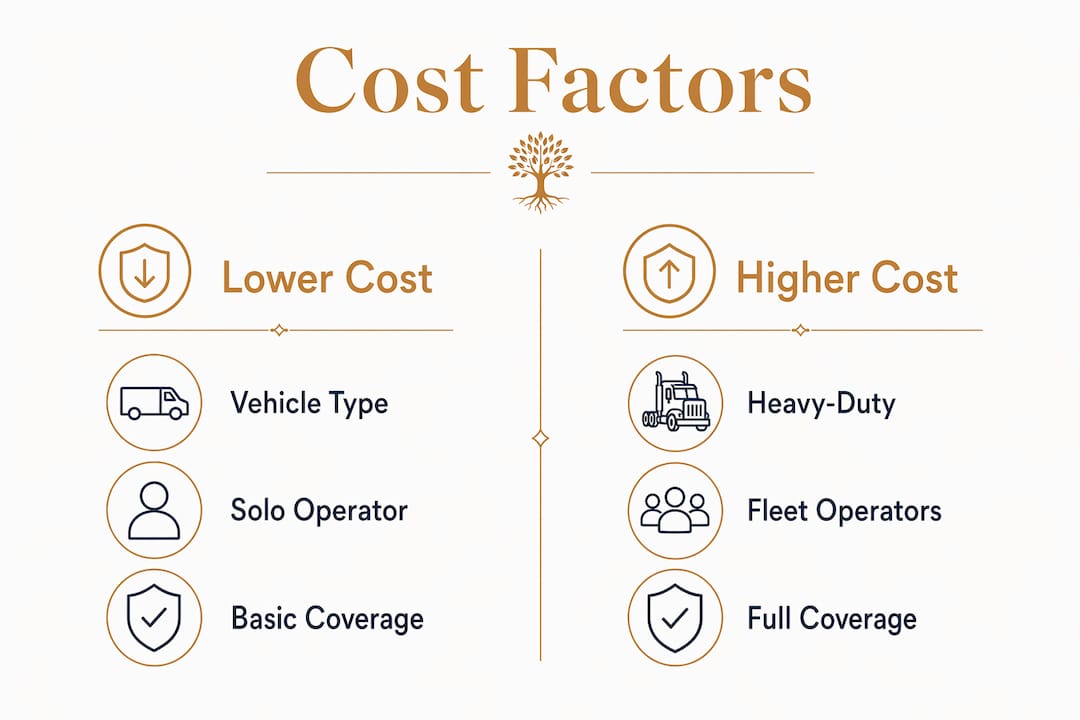
The table below shows the primary cost drivers and their typical impact:
| Cost Factor | Lower Cost | Higher Cost |
|---|---|---|
| Vehicle type | Light-duty pickup or sedan | Heavy-duty truck or specialized rig |
| Driver records | Clean MVRs across all drivers | Multiple violations or prior claims |
| Business territory | Rural or suburban routes | Urban high-traffic corridors |
| Annual mileage | Low mileage, local use | High mileage, interstate routes |
| Federal filings | Not required | MCS-90 or BMC-91 required |
Federal compliance filings like MCS-90 and BMC-91 are required for interstate commercial truck operations and directly affect both coverage terms and premium cost. Carriers price these filings into the policy because they increase the insurer’s exposure.
Underwriting for commercial auto insurance assesses vehicle type, driver history, territory, and endorsements to build a policy that matches the actual risk. This is why working with an experienced agent matters. A generic quote from an online aggregator will not account for your specific fleet composition, loss history, or Louisiana-specific exposures.
Pro Tip: Request commercial auto insurance quotes from an agent who reviews your drivers’ motor vehicle records as a group, not individually. A single driver with violations can affect your entire fleet’s rate, and proactive driver screening is the most effective way to control that cost.
Why do louisiana businesses need commercial auto insurance?
Nearly all states require commercial auto insurance for business vehicles, and Louisiana is no exception. The Louisiana Office of Motor Vehicles mandates minimum liability limits for commercial vehicles, with higher thresholds for larger trucks and vehicles operating under state or federal authority.
Louisiana businesses face a specific set of risks that make proper commercial vehicle coverage more critical here than in most states:
- Storm and flood exposure: Louisiana sits in the bullseye for hurricanes and tropical storms. Comprehensive coverage on your commercial vehicles is not a luxury. It is a necessity when a named storm can total your entire fleet overnight.
- High litigation environment: Louisiana’s legal climate is aggressive. A commercial vehicle accident without adequate liability limits can result in a judgment that threatens your entire business.
- Uninsured motorist exposure: Louisiana consistently ranks among the states with the highest percentage of uninsured drivers. Without uninsured motorist coverage on your commercial policy, your business absorbs that loss.
- Contract compliance: Commercial auto insurance helps businesses secure contracts and meet insurance minimums required by clients, general contractors, and government agencies. Without a certificate of insurance showing proper commercial coverage, you cannot bid on many jobs.
- Scalable protection: As your business grows from one vehicle to a full fleet, a commercial policy scales with you. Personal policies cannot accommodate that growth.
The combination of legal requirements, weather risk, and litigation exposure makes Louisiana one of the states where cutting corners on commercial auto coverage carries the highest price.
How can businesses choose the right commercial auto policy?
Choosing the right business auto insurance policy starts with an honest assessment of how your vehicles are actually used. Follow these steps to build coverage that protects your business without gaps:
-
Catalog your vehicles and their uses. List every vehicle your business owns, leases, or regularly uses. Note whether employees drive personal vehicles for work, which triggers the need for HNOA coverage.
-
Determine your liability exposure. Higher-risk operations like hauling heavy loads, transporting passengers, or operating in dense urban areas require higher liability limits. The minimum required by law is rarely enough to protect a real business.
-
Select the right policy symbol. This is where many business owners get tripped up. Symbol 1 (Any Auto) provides broad coverage, while Symbol 7 (Specifically Described Autos) restricts coverage only to listed vehicles and creates gaps if an unlisted vehicle is involved in an accident. Choosing the wrong symbol is one of the most common and costly mistakes in commercial auto coverage.
-
Add endorsements that match your operations. Cargo coverage, on-hook towing, and MCS-90 filings are not add-ons for edge cases. They are protections for real exposures your business faces every day.
-
Review your policy annually. Businesses change. You add vehicles, hire drivers, expand territory, or take on new types of work. A policy that fit your business two years ago may have significant gaps today.
-
Work with a local agent who knows your industry. A local expert reviews your full operation, not just the vehicles. The Root Agency has served Louisiana businesses for over 20 years and understands the specific compliance requirements, weather risks, and litigation environment that affect commercial auto coverage here.
Pro Tip: Ask your agent to walk you through your policy’s declarations page and confirm which symbol applies to your coverage. If you cannot get a clear answer, that is a sign your policy may have gaps worth addressing before a claim happens.
Key takeaways
Commercial auto insurance is the only policy type that legally and financially protects vehicles used for business, covering liability, physical damage, and employee driving exposures that personal policies exclude entirely.
| Point | Details |
|---|---|
| Personal policies exclude business use | Driving for work under a personal policy risks claim denial and cancellation. |
| Coverage is a package, not one product | Liability, collision, comprehensive, HNOA, and endorsements combine to fill real gaps. |
| Cost depends on business risk profile | Annual premiums range from $1,800 to $15,000 or more based on vehicle type and operations. |
| Policy symbol selection is critical | Choosing Symbol 1 vs. Symbol 7 determines whether unlisted vehicles are covered. |
| Louisiana adds unique risk layers | Storm exposure, high litigation rates, and uninsured drivers make proper coverage non-negotiable. |
What 20 years of louisiana claims taught me about commercial auto coverage
I have reviewed a lot of commercial auto claims over the years, and the pattern is almost always the same. A business owner assumed their personal auto policy was “close enough.” They were driving a company truck, making a business delivery, or letting an employee run an errand. Then an accident happened, and the personal insurer denied the claim. By the time they called me, the damage was done.
The most dangerous gap I see is not the obvious one. It is not the uninsured fleet or the contractor with no coverage at all. It is the business owner who has some coverage but the wrong kind. A personal policy with a commercial vehicle listed on it is not a commercial auto policy. It is a false sense of security.
What I tell every client is this: the cost of a proper commercial auto policy is a fraction of what one denied claim costs. One accident, one lawsuit, one judgment against your business can wipe out years of savings. The right policy, structured correctly with the right symbols and endorsements, is what stands between your business and that outcome.
Louisiana businesses also need to think about what happens after a storm. If your commercial vehicles are totaled by a hurricane and you do not have comprehensive coverage, you are replacing them out of pocket while also trying to keep your business running. That is a situation I have watched destroy businesses that survived the storm itself.
My advice is simple. Do not shop for the cheapest commercial auto policy. Shop for the most complete one, built by someone who knows your business and your state.
— Steve Root
Protect your business vehicles with the root agency
The Root Agency has spent more than 20 years helping Louisiana businesses build coverage that holds up when it matters. With 356 Google reviews at 4.9 stars and recognition as one of Baton Rouge’s best agencies, we bring local expertise and personal service to every commercial auto policy we write. Whether you operate one work truck or a full fleet, we review your actual operations, identify the gaps, and build a policy that fits.
We offer commercial auto coverage alongside 10 other lines of personal and commercial insurance, all backed by 24/7 claims support and a catastrophe response team that deploys directly to disaster zones. Call us at (225) 926-0160 or visit steverootagency.com/auto-insurance to get a quote tailored to your Louisiana business.
FAQ
What is commercial auto insurance in simple terms?
Commercial auto insurance is a policy that covers vehicles used for business purposes, paying for liability, vehicle damage, and medical costs that personal auto policies exclude. Any vehicle used to generate income or conduct business operations needs this coverage.
Does my personal auto insurance cover business driving?
No. Personal auto insurance policies exclude all commercial and business vehicle uses, which means an accident during business driving can result in a denied claim and policy cancellation.
What does commercial auto insurance cover for employees?
A commercial policy covers company-owned vehicles driven by employees, and a Hired and Non-Owned Auto (HNOA) endorsement extends coverage to employees using their personal vehicles for business errands. Without HNOA, personal policies do not cover that exposure, leaving your business open to litigation.
How much does commercial auto insurance cost in louisiana?
Costs range from approximately $1,800 per year for a single light-duty vehicle to $15,000 or more annually for heavy-duty trucks, depending on vehicle type, driver records, territory, and required federal filings.
Is commercial auto insurance required in louisiana?
Yes. Louisiana requires commercial auto insurance for business vehicles, with minimum liability limits set by state law and additional federal requirements for larger trucks or interstate operations.
Recommended
- Commercial Insurance Baton Rouge LA | Business & BOP Coverage | The Root Agency
- Auto Insurance Baton Rouge LA | Car Insurance Quotes | The Root Agency
- Boat Insurance Louisiana | Watercraft Coverage Baton Rouge | The Root Agency
- Louisiana Auto Insurance Guide for Baton Rouge Drivers | The Root Agency