
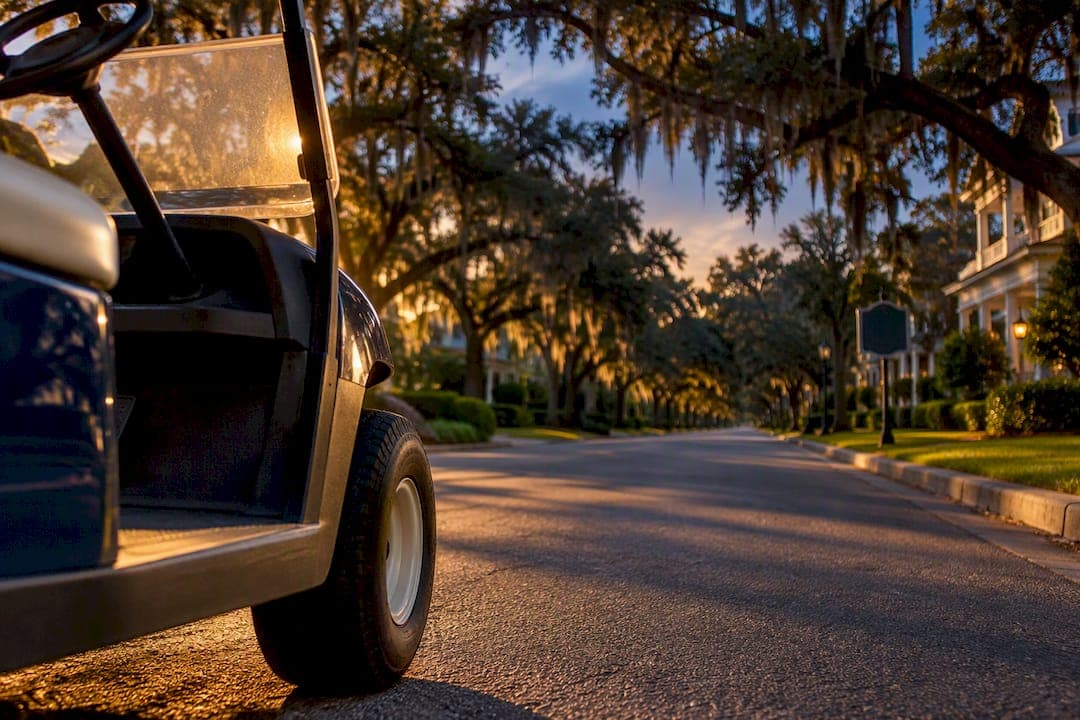
Avoid Citations: Make Your Golf Cart Street Legal in Louisiana

Golf carts are not allowed on Louisiana public roads by default. Under R.S. 32:299.4, a parish or municipality must specifically designate the street and post signage before a golf cart can legally travel on it. Before you drive one anywhere near a public road, confirm that designation with your local government, then confirm your registration and insurance are in order.
TL;DR:
- Louisiana law permits golf carts on public roads only if specifically designated and signed by local governments; otherwise, operation remains illegal.
- Equipment standards for golf carts include brakes, steering, tires, lights, and reflectors, along with registration and decal display from the Office of Motor Vehicles.
- Low-speed vehicles differ from golf carts by meeting federal standards, having VINs, license plates, and access to roads with speed limits up to 35 miles per hour.
- Confirm local golf cart designation and signage with your parish or municipality before driving, and ensure driver licensing and liability insurance are in order.
- Many families overlook insurance gaps, with homeowners policies often limited and auto policies typically excluding golf carts unless specifically endorsed.
Table of Contents
- What R.S. 32:299.4 says about golf carts in Louisiana
- Equipment and registration you need before driving on a designated street
- Low-speed vehicles versus golf carts: why the distinction matters
- How to check your parish or town’s golf cart rules
- Driver’s license and insurance rules you need to confirm first
- A step-by-step compliance checklist before you drive on a public street
- What we see most often when Louisiana families get golf cart coverage wrong
- Why proper coverage matters more than the premium
- Talk to The Root Agency about your golf cart coverage
- Sources
- FAQ
What R.S. 32:299.4 says about golf carts in Louisiana
Louisiana law defines a golf cart as an electric, four-wheeled vehicle designed to carry passengers at speeds up to 25 miles per hour. Under R.S. 32:299.4, operating one on a public road or street is prohibited, full stop, unless your parish or municipality has taken the extra step of designating that specific road for golf cart use and posting signage to prove it.
That designation requirement is the whole ballgame. There is no statewide green light for golf carts on Louisiana roads, no matter how well equipped or registered your cart might be. The law ties permission to a local government’s judgment about traffic safety on that particular street, not to your equipment list. A fully outfitted, properly registered cart is still illegal on a road the parish or town has not designated and signed. If you have not seen a sign or an ordinance naming your street, assume the answer is no until you check.

Equipment and registration you need before driving on a designated street
Once your street carries the proper designation, the statute sets a statewide equipment floor you have to meet. Local governments are free to require more, so check your parish or municipal ordinance for anything added on top.
- Efficient brakes and reliable steering
- Safe tires and a rearview mirror
- Red reflectorized warning devices, front and rear
- Headlamps, front and rear turn signals, tail lamps, and brake lamps
Beyond the equipment, R.S. 32:299.4 requires you to register the golf cart with the Office of Motor Vehicles as an off-road vehicle and display the OMV-issued decal on the cart. Skip either step and you are operating illegally even on a properly designated street. Keep your registration paperwork and decal confirmation somewhere you can produce them quickly, since a citation or an insurance claim will ask for both.
Low-speed vehicles versus golf carts: why the distinction matters
A low-speed vehicle, or LSV, is a different animal under Louisiana law, and confusing the two categories can leave you either underprepared or needlessly restricted. R.S. 32:300.1 governs LSVs and requires them to meet the federal equipment standard in 49 C.F.R. 571.500, a stricter bar than the state’s golf cart rule.
- LSVs need a vehicle identification number, a license plate, and OMV registration similar to an ordinary car
- LSVs meeting federal standards can use roads with posted speed limits up to 35 miles per hour under the conditions the statute sets
- A golf cart that does not meet federal LSV equipment standards stays limited to whatever a parish or town has designated, nothing broader
The practical upshot: an LSV that clears the federal bar earns road access a standard golf cart never gets, but it also gets treated like a motor vehicle for registration and insurance purposes.
How to check your parish or town’s golf cart rules
Designation rules live at the local level, so the state statute only gets you partway. Here is how to nail down the specifics for your street.
- Call your parish or municipal clerk’s office and ask directly whether golf carts are designated for any roads near you.
- Request the ordinance text, a designated-route map, and confirmation of the signage plan before you assume anything.
- Ask whether the Louisiana Department of Transportation and Development has a role in your area, since some highway crossings require DOTD signage approval.
- Save the written confirmation and photograph the posted signs once you find them.
Local exceptions exist and they do not travel. Legislative texts have authorized marked golf cart crossings or paths in towns like Westlake, Church Point, and Lake Arthur, often conditioned on a valid driver’s license, insurance, and DOTD approval. Golden Meadow goes further still, with a statute allowing shoulder operation on roads posted at 30 miles per hour or less, provided the operator carries local registration and proof of insurance. None of these examples generalize to your parish. Treat every one as evidence that Louisiana handles this street by street, not statewide.
Driver’s license and insurance rules you need to confirm first
A valid driver’s license is required to operate a golf cart on any designated parish or municipal road, no exceptions written into the statute. That rule alone catches people off guard, especially families who assume a golf cart is closer to a bicycle than a vehicle.
Insurance works the same way: public-road use generally calls for liability coverage, but which policy actually covers you depends on how your cart is classified and used.
- A homeowners policy may offer limited liability protection for a cart used only on your own property, not on public roads
- An auto policy typically will not extend to a golf cart unless it is specifically added
- A dedicated golf cart policy is often the cleanest way to cover public-road use, passengers, and liability in one place
Before you take a cart onto a designated street, get a written coverage check from your agent and keep it with your registration paperwork. Verbal assurances do not hold up when a claim is on the line.
A step-by-step compliance checklist before you drive on a public street
- Identify your vehicle’s category: golf cart under R.S. 32:299.4 or LSV under R.S. 32:300.1, and document its top speed and VIN if it has one.
- Get written confirmation from your parish or municipal clerk of the designated streets, plus a route map if one exists.
- Install and test every required piece of equipment, then photograph the finished setup for your records.
- Register the cart with the Office of Motor Vehicles as an off-road vehicle and display the decal.
- Confirm every driver has a valid license and secure liability insurance matched to public-road use.
- Recheck local ordinances periodically, since parish and municipal designations can change.
Pro Tip: Keep digital copies of your ordinance confirmation, OMV decal, and insurance declarations page on your phone. If you are ever stopped, you want proof in thirty seconds, not a phone call to the clerk’s office.
What we see most often when Louisiana families get golf cart coverage wrong
Steve Root has spent more than 20 years building The Root Agency on a 40-year family legacy in Louisiana insurance, and golf cart coverage gaps are one of the most common surprises families run into. The agency holds 356 Google reviews at 4.9 stars and was named to The Advocate’s 2025 Best of Baton Rouge, built on catching exactly these kinds of gaps before they become claims.
- Homeowners policies often limit liability coverage once a cart leaves your own property
- Auto policies usually exclude golf carts unless a rider or endorsement adds them specifically
- A dedicated golf cart policy is worth the conversation once you plan to use designated streets regularly
Bring your registration, current policies, and any local ordinance paperwork to a review, and we will tell you plainly where you stand.
Why proper coverage matters more than the premium
We have watched Louisiana families learn the hard way that a cheap policy is really no policy at all once a storm hits or a claim gets filed. A golf cart accident on a designated street is a liability exposure like any other vehicle, and the families who come out fine afterward are the ones who checked their coverage before they needed it, not after.
That is why we would rather answer your questions honestly than sell you the smallest policy that technically qualifies. A local agent who picks up the phone and shows up after a storm is worth more than the $30 a month you might save shopping around.
— Steve Root
Talk to The Root Agency about your golf cart coverage
Protecting your family on a designated Louisiana street means having the right policy in place before you ever drive past your driveway, not after something goes wrong. The agency has built its reputation on being a local provider with a mobile catastrophe response unit and 24/7 claims support.

We offer a straightforward coverage review for golf carts used on public roads, and we will tell you exactly where your current policy falls short.
- Bring your vehicle specs, VIN, and top speed documentation
- Bring your current homeowners, auto, or renters policy for comparison
- Bring a copy of your local ordinance or designated-route confirmation
Start with our golf cart insurance page or browse the full lineup on our products page to see where golf cart coverage fits alongside your other policies.
This article is general information, not a substitute for advice from a qualified lawyer. Consult a qualified legal professional about your own circumstances before acting on anything here.
FAQ
What are the new laws for Louisiana in 2026?
Louisiana has not enacted a statewide change opening public roads to golf carts generally. The governing framework remains R.S. 32:299.4 for golf carts and R.S. 32:300.1 for low-speed vehicles, with parish and municipal designation still controlling where carts may legally operate.
What states allow street legal golf carts?
Rules vary widely by state, and even within Louisiana, permission depends on parish or municipal designation rather than a blanket statewide allowance. Always verify the specific statute and local ordinance for your state and municipality before assuming your cart qualifies.
Is there a golf cart that is street legal?
A golf cart can be operated on public streets in Louisiana only after meeting the equipment requirements in R.S. 32:299.4 and after the parish or municipality designates and signs that specific street. A cart meeting federal low-speed vehicle standards under R.S. 32:300.1 can access a broader range of roads with posted speed limits up to 35 miles per hour.
Is DUI a felony in Louisiana in 2026?
Louisiana DUI classification depends on factors like prior offenses, injury involved, and blood alcohol level, and it can be charged as a misdemeanor or a felony depending on those circumstances. Because a valid driver’s license is required to operate a golf cart on designated streets, a DUI conviction can directly affect your ability to drive one legally, and you should confirm your specific situation with a licensed attorney.