

Renters vs. Homeowners Insurance: What’s the Difference?

The difference between renters and homeowners insurance is this: homeowners insurance covers the physical structure of your home, while renters insurance covers only your personal belongings and liability as a tenant. That single distinction drives every other difference in cost, coverage scope, and policy responsibility. For residents of Louisiana and Mississippi, where hurricane season runs june 1 through november 30 and flood risk is a daily reality, knowing which policy applies to your situation is not optional. It is the foundation of financial protection.

What does homeowners insurance cover, and why is dwelling coverage essential?
Homeowners insurance is built around one core protection that renters insurance never provides: dwelling coverage. Dwelling coverage pays to repair or rebuild your home’s physical structure after a covered loss, whether that is wind damage from a hurricane, fire, or a fallen tree. Without it, a homeowner faces the full cost of reconstruction out of pocket.
A standard homeowners policy covers four major areas:
- Dwelling coverage: Protects the home’s structure, including walls, roof, and attached fixtures.
- Detached structures: Covers garages, fences, and other outbuildings on your property.
- Personal property: Replaces your furniture, electronics, clothing, and other belongings after a covered loss.
- Liability protection: Pays legal and medical costs if someone is injured on your property.
- Additional living expenses (ALE): Covers hotel stays and meals if your home becomes uninhabitable after a covered event.
In Louisiana and Mississippi, homeowners insurance costs $1,200 to $3,000 or more annually. That range reflects the elevated risk in both states. Coastal parishes face higher wind exposure, and flood-prone areas like the Baton Rouge metro saw catastrophic losses in 2016 that reshaped how carriers price risk here.
One critical point: standard homeowners policies exclude flood damage. A separate flood policy, available through the National Flood Insurance Program or private carriers, is required to cover rising water. Most policies also carry a 30-day waiting period before flood coverage activates, so timing matters.
What protections does renters insurance provide to tenants?
Renters insurance is defined by what it does not cover as much as what it does. The landlord’s policy insures the building. Your renters policy insures everything inside it that belongs to you. That boundary is absolute, and many tenants learn it the hard way after a fire or break-in.
Renters insurance includes three key protections: personal property coverage, personal liability, and loss of use. Personal property coverage replaces your belongings if they are stolen, damaged by fire, or destroyed by a covered peril. Personal liability protects you if a guest is injured in your apartment and sues. Loss of use pays for a hotel and meals while your rental is being repaired.
- Personal property: Covers furniture, electronics, clothing, and valuables up to your policy limit.
- Liability protection: Limits typically range from $100,000 to $500,000; many landlords require at least $100,000.
- Loss of use: Pays additional living costs when your rental becomes uninhabitable after a covered event.
- Medical payments: Covers minor medical bills for guests injured in your unit, regardless of fault.
Pro Tip: Loss of use coverage is the most financially critical protection renters overlook. After Hurricane Ida, many displaced tenants spent months in hotels. Without loss of use coverage, every one of those nights came out of their own pocket.
Louisiana and Mississippi landlords can legally require renters insurance as a condition of the lease. Failing to carry it can constitute a lease violation. In larger managed properties across Baton Rouge, New Orleans, and Jackson, this requirement is increasingly standard.
How do renters and homeowners insurance costs compare in Louisiana and Mississippi?
The price gap between these two policy types is significant, and it exists for one reason: dwelling coverage is expensive to provide. Homeowners insurance in Louisiana and Mississippi typically runs $1,200 to $3,000 or more per year. Renters insurance, which carries no structural coverage obligation, costs $150 to $300 annually for most tenants.
That affordability makes renters insurance one of the best values in personal finance. For roughly $15 to $25 per month, a tenant protects thousands of dollars in belongings and gains liability coverage that could otherwise result in a lawsuit.
Deductibles add another layer of complexity in this region. Standard renters insurance deductibles range from $250 to $1,000. Choosing a higher deductible lowers your monthly premium but increases what you pay after a claim. In coastal Louisiana parishes, named-storm deductibles can equal 2%–5% of your personal property limit for wind damage. That is a meaningful out-of-pocket exposure that most renters do not anticipate.
Homeowners face similar named-storm deductible structures, often calculated as a percentage of the dwelling’s insured value rather than a flat dollar amount. A home insured for $300,000 with a 2% hurricane deductible carries a $6,000 out-of-pocket threshold before the policy pays for wind damage. Understanding that number before a storm is far better than discovering it after one.
What special risks do Louisiana and Mississippi residents face?
Louisiana sits in the bullseye for hurricanes, and Mississippi’s Gulf Coast is not far behind. That geography creates insurance realities that residents in other states simply do not encounter.
The most consequential of these is the moratorium rule. During active hurricane threats, insurers issue binding moratoriums that prevent new policies from being issued or existing policies from being changed. These moratoriums typically apply during named storm events between june 1 and november 30. If you wait until a storm is in the Gulf to buy renters or homeowners insurance, you will not be able to.
- Buy coverage before hurricane season begins. Waiting until june means risking a moratorium that leaves you unprotected.
- Flood is always a separate policy. Standard policies exclude flood damage, and the National Flood Insurance Program typically requires a 30-day waiting period before coverage activates.
- Wind coverage endorsements matter. In high-risk ZIP codes, wind coverage may be limited or excluded from a base policy and must be added separately.
- List your landlord as an interested party. Adding your landlord to your renters policy keeps them informed of changes or cancellations and satisfies most lease requirements.
- Review civil authority provisions. Some policies cover additional living expenses when a government-ordered evacuation prevents access to your home, but the conditions vary by policy.
Pro Tip: Wind coverage in Louisiana varies by ZIP code. A policy that covers wind in Baton Rouge may exclude it in a coastal parish. Always confirm wind coverage explicitly with your agent before signing.
How do renters and homeowners insurance compare side by side?
The table below summarizes the core differences between the two policy types for quick reference.
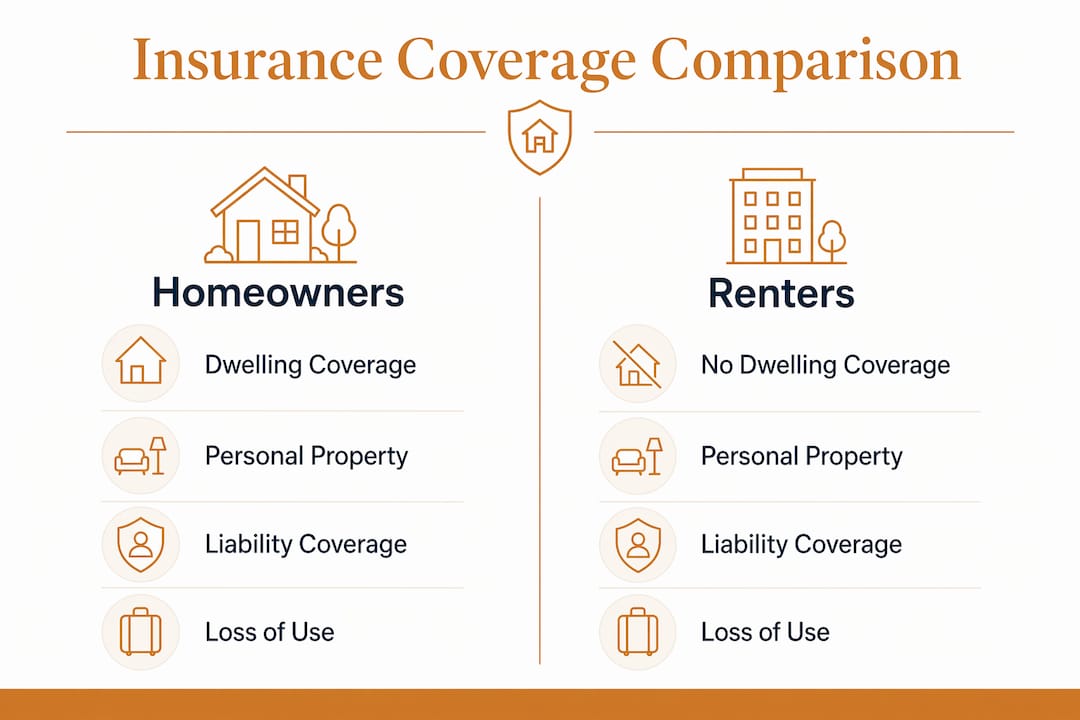
| Coverage area | Homeowners insurance | Renters insurance |
|---|---|---|
| Dwelling (structure) | Covered | Not covered (landlord’s responsibility) |
| Detached structures | Covered | Not covered |
| Personal property | Covered | Covered |
| Personal liability | Covered | Covered |
| Loss of use / ALE | Covered | Covered |
| Flood damage | Excluded (separate policy required) | Excluded (separate policy required) |
| Annual cost range | $1,200–$3,000+ | $150–$300 |
Both policies share personal property, liability, and loss of use coverage. The defining gap is the structure itself. Homeowners pay more because they are insuring a building. Renters pay less because that obligation belongs to the landlord.
Key Takeaways
The core difference between renters and homeowners insurance is dwelling coverage: homeowners policies protect the structure, renters policies protect belongings and liability, and both require separate flood insurance in Louisiana and Mississippi.
| Point | Details |
|---|---|
| Dwelling coverage is the key divide | Homeowners insurance covers the structure; renters insurance never does. |
| Renters insurance is affordable | Annual cost runs $150–$300, making it one of the most accessible protections available. |
| Flood requires a separate policy | Standard renters and homeowners policies both exclude flood; purchase flood coverage before the 30-day waiting period applies. |
| Buy before hurricane season | Moratoriums block new policies during active storms, so coverage must be in place before june 1. |
| Liability coverage matters for both | Both policy types include personal liability, typically $100,000–$500,000, protecting against lawsuits. |
What 20 years of Louisiana claims taught me about these two policies
After more than two decades helping Louisiana and Mississippi families through storms, floods, and fires, I have seen the same mistake repeat itself: people confuse what their policy covers with what they assume it covers. Renters believe their landlord’s policy protects their belongings. It does not. Homeowners believe their policy covers flood. It does not.
The loss of use provision is the one that surprises people most after a disaster. When a family is displaced for three months after a hurricane, the hotel bills and restaurant meals add up fast. Renters who carry loss of use coverage sleep better during those months. Those who do not are paying out of pocket while also trying to rebuild their lives.
The other mistake I see constantly is waiting too long to buy or update coverage. Every year, someone calls us after a storm is already named and in the Gulf. By then, we cannot help them. The moratorium is in place. The window has closed. The time to review your policy is in april or may, not when the cone is pointing at your parish.
My honest advice: do not shop for the cheapest policy. Shop for the right policy, reviewed by someone who knows this region. The $30 you save on a lower premium will not feel like savings when you are sitting in a hotel room with no coverage to fall back on.
— Steve Root
Coverage built for Louisiana and Mississippi residents
The Root Agency has served Louisiana and Mississippi families for more than 20 years, and we have not left when storms made it hard. We offer both homeowners coverage and renters insurance tailored to the real risks of this region, including guidance on wind endorsements, flood policy timing, and lease compliance requirements.
With 356 Google reviews at 4.9 stars and a catastrophe response team that deploys directly to disaster zones, The Root Agency is the agency that shows up when it matters. Browse our full insurance products or call us at (225) 926-0160. We offer bilingual service in English and Spanish, and we are ready to help you get the right coverage before the next storm season begins.
FAQ
What is the main difference between renters and homeowners insurance?
Homeowners insurance covers the physical structure of the home along with personal property and liability. Renters insurance covers only personal belongings and liability, since the landlord’s policy insures the building.
Does renters insurance cover flood damage in Louisiana?
No. Standard renters insurance excludes flood damage. Tenants in Louisiana and Mississippi need a separate flood policy, typically through the National Flood Insurance Program, which carries a 30-day waiting period before coverage activates.
Can a Louisiana landlord require renters insurance?
Yes. Louisiana and Mississippi landlords can legally require renters insurance as a lease condition. Failing to carry it can constitute a breach of the lease agreement.
How much does renters insurance cost in Louisiana?
Renters insurance typically costs $150 to $300 per year in Louisiana. Policies in coastal parishes may carry additional named-storm deductibles of 2%–5% of the personal property limit for wind damage.
When should I buy renters or homeowners insurance in Louisiana?
Buy coverage before june 1, when hurricane season begins. Insurers issue moratoriums during active named storms that prevent new policies from being issued or existing policies from being changed.
Recommended
- Renters Insurance Baton Rouge LA | Apartment Coverage | The Root Agency
- Home Insurance Baton Rouge LA | Homeowners Coverage | The Root Agency
- Insurance Agent vs. Company: Roles Every Homeowner Should Know | The Root Agency
- Commercial Insurance Baton Rouge LA | Business & BOP Coverage | The Root Agency