
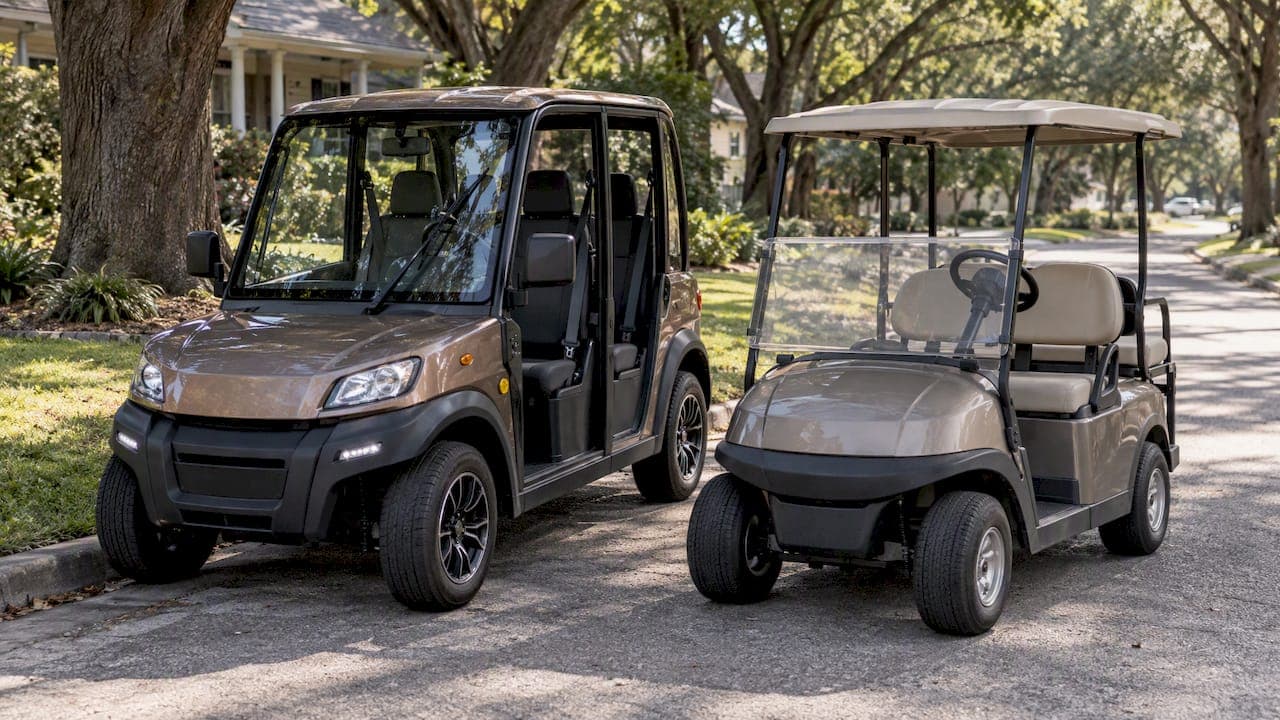
LSV vs. Golf Cart: What Louisiana Drivers Need to Know

An LSV, or low-speed vehicle, is a factory-built, four-wheeled vehicle that is legal on public roads posted at 35 mph or less. A standard golf cart is not. In Louisiana, an LSV tops out above 20 mph but below 25 mph and carries required safety equipment. A golf cart can use public streets only where a parish or city has said so. That difference decides where you can drive, what paperwork you need and how your insurance has to be written.
I’m Steve Root. I’ve run this agency for more than 20 years, and I’ve sat across the desk from plenty of neighbors who bought a cart for the subdivision, drove it a few blocks too far, and learned the rules after something went wrong. This guide is meant to save you that conversation.
TL;DR
- An LSV is a factory-built, four-wheeled vehicle with a top speed between 20 and 25 mph and required safety equipment. A golf cart is built for courses and private grounds.
- Louisiana allows LSVs on roads posted 35 mph or less. Golf carts are allowed on public roads only where local ordinances permit.
- Mississippi has no comprehensive state golf cart road law. Cities decide, and you must show proof of insurance on public roads.
- An LSV on the road must meet Louisiana’s compulsory liability insurance rules. A golf cart used on neighborhood streets deserves the same level of protection.
- The right policy follows how you actually use the vehicle, not what it was sold as.
Table of Contents
- What an LSV is, and how it relates to NEV
- LSV vs. golf cart at a glance
- Speed, construction and safety equipment
- Where you can drive each one in Louisiana
- What changes in Mississippi
- Insurance: the part people skip until it matters
- How to choose: a simple decision path
- Perspective: what we tell every golf cart owner
- Cover your cart or LSV with a local expert
- FAQ
- Sources
What an LSV is, and how it relates to NEV
LSV stands for low-speed vehicle. NEV, or neighborhood electric vehicle, is the name many people use for the electric versions. You will see the terms used loosely, and dealers sometimes call an LSV a “street-legal golf cart.” That label causes most of the confusion.
Louisiana’s statute defines an LSV as a four-wheeled electric or gasoline-powered vehicle with a top speed greater than 20 mph but less than 25 mph, plus specified safety equipment (Louisiana Revised Statutes). So an LSV can be gas or electric. “NEV” describes a power type, while “LSV” describes the legal class.
The practical point: an LSV is built as a small road vehicle. A golf cart is built to move you between holes or around a private community.
LSV vs. golf cart at a glance
| Feature | LSV | Standard golf cart |
|---|---|---|
| Legal class | Low-speed motor vehicle | Golf cart, regulated locally |
| Top speed in Louisiana | Above 20 mph, below 25 mph | Not defined as an LSV class |
| Where it can go | Roads posted 35 mph or less, with limited exceptions | Only where a parish or city ordinance permits |
| Safety equipment | Required by law | Varies by model and local ordinance |
| Origin | Built as a road-capable vehicle | Built for courses and private grounds |
| Insurance on public roads | Compulsory liability security | Proof of insurance expected where local rules allow road use |
Speed, construction and safety equipment
Speed is the headline difference, but construction matters more. LSVs are designed from the factory to meet safety requirements for road use. Micah Toll, writing for Electrek, makes a point worth remembering: street legality for an LSV depends on the manufacturer’s original design meeting federal safety standards, and owners generally cannot modify a non-legal cart into a legal LSV (Electrek).
That matters if you are shopping used. A cart with a lift kit, a light bar and a larger motor is not an LSV because it looks like one. Before you buy, ask for the paperwork that shows how the vehicle was originally built and classed. If you want the Louisiana-specific checklist for a cart you already own, we cover it in our guide to making a golf cart street legal in Louisiana.
In plain terms:
- An LSV is a road vehicle. It carries the equipment the law requires and is classed as a motor vehicle.
- A golf cart is a local-permission vehicle. It may be allowed on certain streets, but only because a local government said yes.
- Modifications don’t change the class. Adding accessories won’t turn a cart into an LSV.
Where you can drive each one in Louisiana
Louisiana allows LSVs on roads posted at 35 mph or less, with specified exceptions for crossings and quarter-mile connectors (Louisiana Revised Statutes). That means a neighborhood street or a lower-speed town road can be fine, while a 45 mph parish road is not.
Golf carts follow a different path. There is no blanket statewide permission. Instead, individual parishes and municipalities adopt ordinances. One example is Golden Meadow, where an ordinance may authorize golf carts on the shoulder of public roads with speed limits of 30 mph or less, with a named highway excluded, and carts must be registered with the governing authority (Louisiana Revised Statutes). Your town may be stricter or looser, so call the city or parish office before you rely on a neighbor’s advice.

One rule surprises people. On permitted parish roads or municipal streets, the golf cart operator must hold a valid driver’s license, according to the Louisiana Department of Public Safety (Office of Motor Vehicles guidance). A teenager without a license behind the wheel, even a few blocks from home, is a problem on both the legal and the insurance side.
What changes in Mississippi
Mississippi handles this differently. The state does not have a comprehensive golf cart road-use law, but it lets local municipalities authorize operation within their jurisdictions, according to a Louisiana Transportation Research Center review of state legislation. Mississippi Code section 63-32-5 sets the baseline: golf carts and LSVs operated on public roads must be registered with the city and display a decal, and operators need proof of financial responsibility (Mississippi Code § 63-32-5).
If you live on the Gulf Coast or anywhere in Mississippi where golf carts are popular, start with city hall. Registration rules, decal requirements and permitted roads are set locally, so two towns ten miles apart can differ.

Insurance: the part people skip until it matters
Here is where my 20 years of claims conversations come in. People buy a cart or LSV, assume the homeowners policy handles it, and discover the gap after an accident.
Louisiana requires LSVs operated on roads to comply with compulsory motor vehicle liability security requirements (Louisiana Revised Statutes). Mississippi requires proof of financial responsibility while operating a golf cart or LSV on public roads (Mississippi Code § 63-32-5). So the law treats road use seriously, and a claim that involves another driver, a pedestrian or a passenger can get expensive fast. If you want to understand what you may owe when someone is hurt, how accident liability works is a clear place to start.
The coverage question depends on use:
- Course and private property only. Coverage focuses on the cart itself and liability on the grounds.
- Neighborhood streets where your town allows carts. You want liability limits that fit your assets, plus physical damage coverage, because a collision with a car on a road is a very different event than a bump in the driveway.
- LSV on posted roads. Treat it like a small automobile: compulsory liability, and strong limits above the minimum.
We have written about how this plays out in practice in golf cart insurance for neighborhood streets and with real scenarios in our golf cart coverage examples. If you own a home and have meaningful assets, an umbrella policy adds liability protection above your base limits. Our umbrella coverage starts from $150 per year.
If your household is new to the state, our Louisiana insurance requirements for new residents guide covers the broader picture, and Louisiana car insurance laws explains how the state treats motor vehicle liability in general.
How to choose: a simple decision path
- Decide where you’ll drive. Only inside a gated community or on a course? A golf cart is fine. Running errands on town streets posted 35 mph or less? An LSV is built for that.
- Check your local rules. Call the city, town or parish office. In Mississippi, ask about registration and the decal. In Louisiana, ask whether an ordinance allows carts on your streets.
- Confirm the vehicle’s classification. Ask the seller how it was built and classed. Don’t assume accessories make it legal.
- Confirm who will drive. Licensed drivers only on public roads.
- Insure it for the use you actually have. Tell your agent about the roads, the passengers and the storage. Coverage written for a course cart may not fit a daily neighborhood vehicle.
We often see families buy a cart as a toy and end up using it as a second vehicle for the neighborhood. The policy should match that second life.
Perspective: what we tell every golf cart owner
Most of the golf cart claims conversations I wish had gone differently started the same way: “I didn’t think it counted as a real vehicle.”
It does. The moment a cart or an LSV leaves private property and shares a road with a pickup truck, it carries real liability. The law in Louisiana and Mississippi treats road use as serious business, and so should your policy.
At The Root Agency, we don’t sell you the cheapest line item and hope you never need it. We ask where you drive, who rides along, who drives when you’re not looking, and what you own that a lawsuit could reach. Then we build coverage around the answers. That is the difference between a policy that exists and a policy that works.
We’ve stayed in Louisiana through the storms when other carriers and agents walked away. Our catastrophe team shows up in person after a disaster, and our 356 Google reviews at 4.9 stars come from neighbors who called us when it counted. A local agent who picks up the phone is worth far more than a few dollars a month saved on a thin policy.
Steve Root
Cover your cart or LSV with a local expert
The Root Agency is an Allstate exclusive agency in Baton Rouge, serving all of Louisiana and Mississippi, with 24/7 claims support and service in English and Spanish. We write golf cart insurance for carts used on courses, in communities and on neighborhood streets, and we’ll walk you through what your vehicle needs.

Start with our golf cart insurance page, or call us at (225) 926-0160. Baton Rouge owners can also see our Baton Rouge golf cart coverage and, east of the city, our Denham Springs page. If you want to review everything you own in one conversation, see all our insurance lines.
FAQ
What does LSV mean on a golf cart?
LSV means low-speed vehicle. In Louisiana it is a four-wheeled electric or gasoline vehicle with a top speed above 20 mph but below 25 mph and required safety equipment. It is a legal road class, not a trim package.
Is a neighborhood electric vehicle the same as an LSV?
Nearly. NEV is the common name for electric low-speed vehicles, while LSV is the legal class that also covers gas-powered models. Shoppers often use the terms interchangeably, so confirm how a specific vehicle is classed before you buy.
Can I make my golf cart an LSV?
Generally no. Street legality for an LSV depends on the manufacturer’s original design meeting federal safety standards, and owners usually cannot modify a non-legal cart into a legal LSV. If you need road capability, buy a vehicle built and classed as an LSV.
Do I need insurance to drive a golf cart on public roads?
In Mississippi, yes: operators need proof of financial responsibility on public roads. In Louisiana, LSVs on roads must meet compulsory liability security requirements, and golf carts on permitted streets are governed by local ordinances. Either way, carry liability coverage that fits what you own.
Do I need a driver’s license to drive a golf cart in Louisiana?
On permitted parish roads or municipal streets, yes. The Louisiana Department of Public Safety says operators must hold a valid driver’s license. Check your local ordinance for any further requirements.
Sources
- Louisiana Revised Statutes, LSV definition and local golf cart ordinance
- Louisiana Revised Statutes, LSV road use and compulsory security
- Electrek, how to know if micro-cars, LSVs and NEVs are street legal
- Louisiana Transportation Research Center, Golf Carts on Public Roads literature review
- Louisiana Department of Public Safety, Office of Motor Vehicles guidance
- Mississippi Code § 63-32-5
- Car Accident Liability Explained