

$2,386 Average: Louisiana Car Insurance Rates and Agent Tips for 2026

Louisiana car insurance rates average a few thousand dollars a year for statewide minimum and blended coverage, with full coverage running well above that in cities like New Orleans and Baton Rouge. If you’re paying near the state average, or more, the number itself is not the problem. What matters is whether your policy actually protects you when a storm, a lawsuit, or an uninsured driver puts it to the test. That’s a conversation worth having with a local agent, not a reason to chase the cheapest quote you find.
TL;DR:
- Louisiana drivers face high auto insurance costs mainly due to severe bodily injury claim rates and frequent litigation, not insurer greed.
- Poor weather exposure, especially hurricane flooding and storm damage, significantly drives up claim severity and repair costs across the state.
- The uninsured driver rate is high, increasing overall premiums since insurers must cover the risks associated with uninsured collisions.
- Actual premiums vary widely based on zip code, driver age, driving record, vehicle type, and usage, making statewide averages less predictive.
- Focusing on proper coverage, avoiding minimal liability limits, and regularly reviewing policies with a local agent offer better protection than chasing the lowest quote.
Table of Contents
- Louisiana Car Insurance Rates: The Statewide Averages and Why They Differ
- Why Louisiana Auto Insurance Costs Run Above the National Average
- How Your Rate Compares by Driver, Vehicle, and City
- Choosing Coverage That Actually Protects You
- How to Lower Your Louisiana Car Insurance Premium the Right Way
- Louisiana’s Legal Minimum Coverage and Where to Verify Rate Filings
- What a Local Agent Sees That the Averages Don’t Show
- Why Chasing the Lowest Rate Is the Wrong Strategy in Louisiana
- Get a Louisiana Car Insurance Policy Review That Actually Protects You
- Where These Numbers Come From
- Sources
Louisiana Car Insurance Rates: The Statewide Averages and Why They Differ
Ask three data sources what Louisiana drivers pay and you’ll get three different answers, and none of them are wrong. Experian puts the statewide average near $2,386 a year for full coverage. Other aggregator analyses report blended full coverage averages that run considerably higher once city-level rating factors get folded in, with statewide blended averages well above the national figure and enormous spread between New Orleans, Baton Rouge, and rural parishes. Minimum coverage alone typically lands in the $700 to $1,000 a year range, which sounds affordable until you realize how little it actually covers.
The gap between these numbers comes down to methodology, not disagreement about reality. A few things drive the variance:
- ZIP-level blending. Some reports average every ZIP code equally; others weight by population, which pulls the number toward high-litigation urban parishes.
- Data cutoff timing. Insurers file new rates constantly, so a report pulled in January and one pulled in September can reflect genuinely different market conditions.
- Coverage definitions. “Full coverage” means something different depending on whether the source assumes state minimum liability limits or a more realistic 100/300/100 policy with comprehensive and collision.
The Louisiana Department of Insurance’s April 2026 market update noted that several insurers finalized rate decreases earlier this year, some of them significant, affecting millions of policies statewide. That’s genuinely good news, but it doesn’t mean every driver saw their bill drop. Rate changes get filed by company and by coverage program, so a decrease approved for one carrier’s book of business doesn’t touch a policy written by a competitor down the street.
Treat any published average as a starting point for your own research, not a prediction of what you’ll pay. Your actual premium depends on your driving record, your ZIP code, the car you drive, and which company is competing hardest for your business this quarter. That’s exactly why a policy review with someone who can pull real quotes, rather than a statewide estimate, tells you more than any published figure ever will.
Why Louisiana Auto Insurance Costs Run Above the National Average
Louisiana’s rates aren’t high because insurers are gouging drivers. They’re high because the state’s claims environment is genuinely more expensive to insure than most of the country, and the data backs that up in specific, measurable ways.
The litigation and bodily injury problem stands out first. About 49% of Louisiana auto accidents result in a bodily injury claim, compared to a 26% national average, according to Better LA’s analysis of the state’s insurance market. That’s nearly double the rate of comparable claims nationwide, and bodily injury claims are the most expensive category an insurer pays out. Louisiana’s litigation environment amplifies this further. Attorney involvement and lawsuit frequency in auto claims run high compared to peer Southern states, and litigation and claim severity patterns explain more of the premium gap than accident frequency alone.
Uninsured drivers add a second layer of cost. When an uninsured motorist hits you, your own uninsured motorist coverage picks up the loss, and insurers price that risk into everyone’s premium. Louisiana’s uninsured driver rate sits well above what most states report, which pushes UM/UIM pricing up statewide.
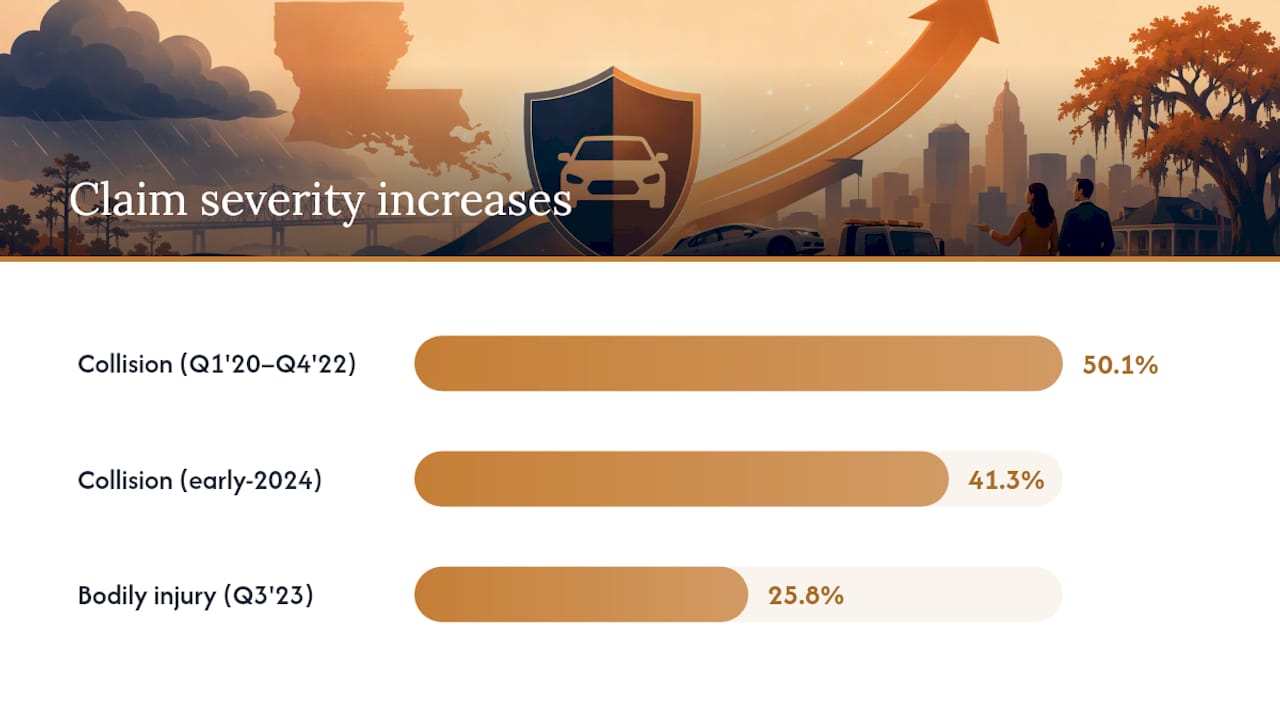
Claim severity has climbed sharply since 2020. Collision claim severity rose 50.1% from the first quarter of 2020 through the fourth quarter of 2022, and remained 41.3% higher as of early 2024. Bodily injury claim severity hit record highs in the third quarter of 2023, up 25.8% from pre-pandemic levels, according to industry data presented to the Louisiana Legislature.
Then there’s weather. Louisiana sits in the bullseye for hurricanes, and every major storm season brings a spike in comprehensive claims from flooding, wind damage, and total losses on flooded vehicles. Repair costs have climbed right alongside claim severity, driven by:
- Parts and labor inflation that hasn’t fully reversed since the pandemic
- Vehicle price increases that raise the cost of every total-loss payout
- Demand surge after major storms, when contractors and repair shops raise prices under pressure from a flood of simultaneous claims
Each of these factors alone would nudge premiums upward. Together, they explain why Louisiana consistently ranks among the most expensive states in the country to insure a car.
How Your Rate Compares by Driver, Vehicle, and City
Averages hide a lot of variation, and understanding where you fall in the range matters more than the statewide number itself.
Age and experience move the needle first. Drivers under 25 pay materially more than drivers in their 40s and 50s, sometimes double or more, because insurers price inexperience as risk. That gap narrows with a clean record over time, but it never fully disappears until a driver ages out of the highest-risk brackets.
Your driving record carries more weight than almost anything else you control. A single at-fault accident or a serious ticket, like reckless driving or a DUI, can raise your premium noticeably at your next renewal and keep it elevated for three to five years depending on the violation. Multiple violations compound the effect rather than simply stacking.
Vehicle type and how you use it both factor into your quote. A daily highway commute rates differently than occasional weekend driving. Vehicles with strong safety ratings and factory anti-theft features often earn discounts, while high-performance or frequently stolen models carry a surcharge.
Location may be the single biggest lever you don’t control. City-level differences in Louisiana are stark:
- New Orleans carries some of the highest premiums in the state, driven by dense traffic, high theft rates, and heavy litigation activity.
- Baton Rouge runs high as well, though generally below New Orleans, reflecting a similar but less concentrated risk profile.
- Lafayette and other mid-size metros typically land in the middle of the range.
- Rural parishes often see meaningfully lower premiums, thanks to lower traffic density and fewer claims per capita.
If you want a deeper breakdown of exactly how insurers weigh these factors, The Root Agency’s guide to how car insurance rates are calculated in Louisiana walks through the underwriting variables in more detail.
Choosing Coverage That Actually Protects You
The cheapest policy and the right policy are rarely the same thing, and nowhere is that more true than in Louisiana.
Minimum liability coverage meets the legal requirement, nothing more. It pays for damage and injuries you cause to others. It pays nothing toward your own vehicle if you’re at fault, or if an uninsured driver hits you and vanishes. Full coverage, meaning liability plus comprehensive and collision, protects your own vehicle against accidents, theft, weather, and flooding, and it’s effectively mandatory anyway if you’re still making car payments, since lenders require it.
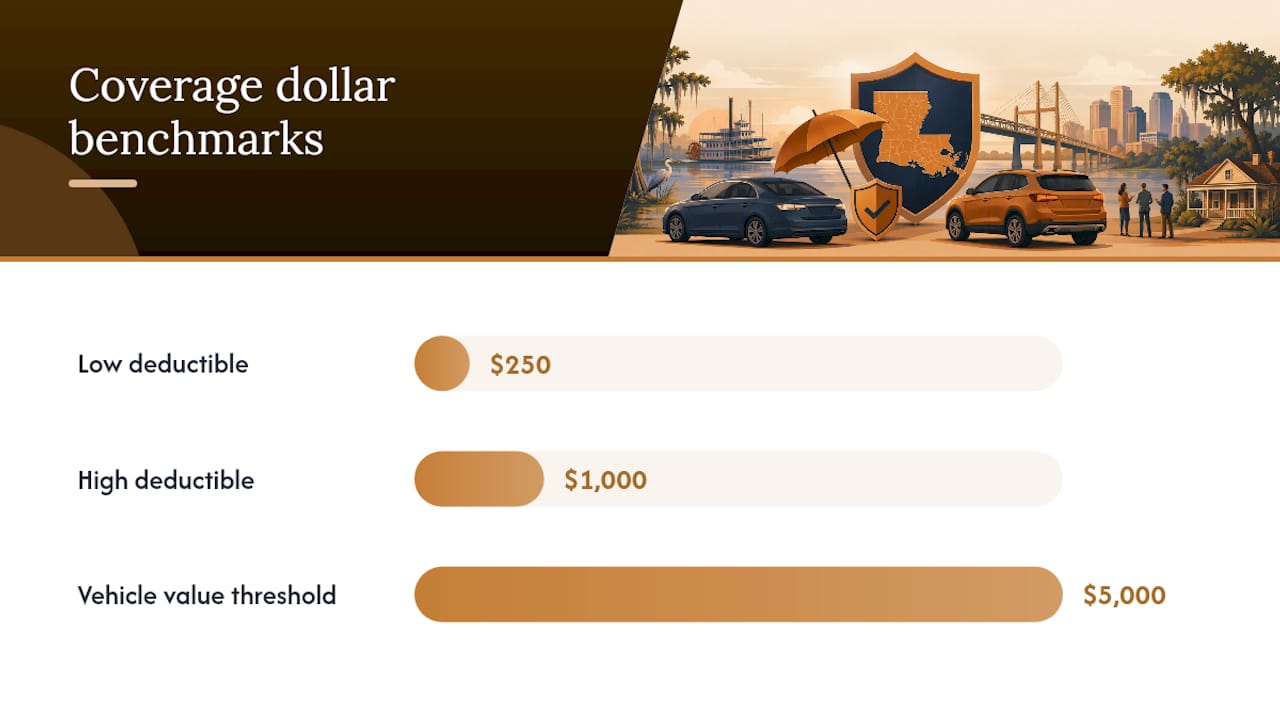
Your deductible choice is a direct tradeoff between premium and out-of-pocket risk. A $1,000 deductible lowers your monthly payment compared to a $250 deductible, but it also means you’re covering the first $1,000 of any claim yourself. For an older, lower-value vehicle, a higher deductible often makes sense. For a newer car you’re still financing, a lower deductible protects your cash flow when something goes wrong.
Uninsured/underinsured motorist coverage deserves special attention in Louisiana specifically. Given how many drivers on Louisiana roads carry no insurance at all, skipping this coverage to save a few dollars a month is one of the costliest mistakes a driver can make. It’s the coverage that pays when the other driver can’t.
Because Louisiana’s flood risk is a fact of life, comprehensive coverage and, where applicable, flood insurance for your home and property deserve real consideration alongside your auto policy, not as an afterthought once storm season starts.
- Liability alone leaves your own vehicle unprotected in almost every scenario
- Full coverage is close to mandatory for financed or leased vehicles
- Deductible choice should reflect your vehicle’s value and your cash reserves
- UM/UIM coverage matters more in Louisiana than in most states
- Document any flood or storm damage immediately; proper documentation after a flood or hurricane claim can make the difference in how quickly and fully a claim gets paid
Pro Tip: If your vehicle is paid off and worth less than $5,000, run the math on dropping collision coverage specifically, while keeping comprehensive and UM/UIM intact. A local agent can show you the actual numbers rather than a rule of thumb.
How to Lower Your Louisiana Car Insurance Premium the Right Way
Lowering your premium doesn’t have to mean lowering your protection. It means being deliberate about where the savings actually come from.
- Collect real information before you shop. Gather your current policy details, driving record, annual mileage, and vehicle VINs. Quotes are only comparable when every insurer is pricing the same coverage limits and deductibles.
- Ask about every discount you qualify for. Multi-policy bundling (auto with home, renters, or flood), good-student discounts, defensive driving course completion, and low-mileage discounts all add up, sometimes substantially.
- Consider a telematics program if you’re a genuinely low-risk driver. These programs track driving behavior, braking patterns, and mileage, and can lower your rate meaningfully if your habits qualify. They can also raise it if they don’t, so understand the terms before enrolling.
- Bundle your policies with one agency instead of scattering them. Carrying auto, home, and umbrella coverage under one roof typically earns a better combined rate than shopping each line separately.
- Raise your deductible only if you have the cash reserve to back it up. A higher deductible lowers your premium, but only helps if you can actually cover it when a claim happens.
- Review your policy every renewal, not just when you’re shopping for a new one. Rates shift, your vehicle ages, and your coverage needs change. An annual check with your agent catches gaps before they cost you.
Pro Tip: Never cut liability limits down to the state minimum just to hit a lower number. If you cause a serious accident, the gap between what your policy pays and what you owe comes straight out of your pocket, and Louisiana juries do not award small verdicts.
If you want a Louisiana-specific breakdown of which of these tactics tend to move the needle most, The Root Agency’s guide on lowering your Louisiana car insurance rate covers it in more depth.
Louisiana’s Legal Minimum Coverage and Where to Verify Rate Filings
Louisiana law requires every driver to carry liability coverage of at least 15/30/25: $15,000 per person for bodily injury, $30,000 per accident for bodily injury, and $25,000 for property damage. Driving without it is illegal and can result in fines, license suspension, and vehicle impoundment.
That minimum is a legal floor, not a safety net. It says nothing about protecting your own vehicle, which is why lenders financing or leasing a car almost universally require comprehensive and collision coverage on top of it.
- The 15/30/25 minimum applies statewide with no exceptions for low-mileage or occasional drivers
- Financed and leased vehicles require full coverage as a loan condition, regardless of the state minimum
- The Louisiana Department of Insurance’s auto insurance consumer page publishes current rate filing information and shopping guidance
- Recent LDI market updates through April 2026 list which insurers filed rate changes and by how much
For a full walkthrough of what these requirements mean for your specific situation, see The Root Agency’s guide to Louisiana’s mandatory insurance minimums for 2026.
What a Local Agent Sees That the Averages Don’t Show
Statewide data tells you why rates are high. It doesn’t tell you what happens the week after a hurricane, when your car is underwater and every adjuster in the region has a backlog three weeks deep. That’s where a local agency earns its place, not at quote time, but at claim time.
The Root Agency has built its practice around exactly that gap. Steve Root has personally run this agency for more than 20 years, building on a family legacy in Louisiana insurance that stretches back 40 years. The agency holds 356 Google reviews at 4.9 stars and was named to The Advocate’s 2025 Best of Baton Rouge. It offers bilingual service in English and Spanish, 24/7 claims support, and one of the only mobile catastrophe response units in Louisiana, deploying RVs directly to disaster zones so policyholders get in-person help when it matters most.
If it’s been more than a year since your last policy review, or since a storm passed through your parish, that’s your signal to call.
Why Chasing the Lowest Rate Is the Wrong Strategy in Louisiana
The data in this article makes one thing clear: Louisiana’s high premiums aren’t a pricing quirk you can shop your way around entirely. They reflect a litigation environment, a weather pattern, and an uninsured-driver problem that every insurer operating here has to price for. Drivers who chase the absolute lowest quote often do it by stripping UM/UIM coverage or dropping to state minimums, and that’s precisely the coverage most likely to matter when a claim actually happens.
Conventional advice tells you to compare five quotes and pick the cheapest. That’s incomplete. Compare five quotes, yes, but weigh them against what happens when you file a claim after a hurricane, not just what you pay in a normal month. The agencies that stayed in Louisiana through the hard years, the ones with a claims team that shows up in person rather than a call center that puts you on hold, are worth more than a marginal monthly savings.
My honest read: the driver who reviews coverage annually with someone who knows the local claims environment ends up better protected and often pays about the same as the driver who shops blindly every renewal. Protection compounds. Cheap policies don’t.
— Steve Root
Get a Louisiana Car Insurance Policy Review That Actually Protects You
The Root Agency is the local alternative to shopping blind through a comparison site. Instead of a generic quote based on statewide averages, you get a policy reviewed by an agency that has spent 20 years watching what actually happens to Louisiana drivers after a storm, a lawsuit, or an uninsured-driver collision.
Before you request a quote or schedule a review, have your current policy declarations page, driving record, vehicle VIN, and annual mileage estimate ready. That’s enough for The Root Agency to compare your existing coverage against what actually fits your risk, not just what’s cheapest on paper. The agency’s bilingual team offers 24/7 claims support and a mobile catastrophe response unit that shows up in person when disaster strikes, not just a claims number to call. If you’re financing a vehicle or simply tired of guessing whether your coverage would hold up in a real claim, request a Louisiana car insurance quote and get a straight answer from someone who’s been doing this in Louisiana for two decades.
Where These Numbers Come From
The figures and claims in this article draw from the Louisiana Department of Insurance’s consumer pages and rate filings, Better LA’s analysis of litigation and bodily injury trends, industry claim-severity data presented to the Louisiana Legislature by the US Risk Center, and aggregator reporting on 2026 city-level rate variation. Each source offers a different lens on the same underlying market.
This article is general information, not a substitute for advice from a qualified financial advisor. Consult a qualified financial professional about your own circumstances before acting on anything here.
Sources
- Why Louisiana Auto Insurance Rates Are So High - Better LA
- 4-30-26 Louisiana Insurance Market Update Through April 2026
- Trends in Underlying Cost Factors in Private Passenger Auto Insurance (US Risk Center / presentation)
- Forty Companies Just Cut Louisiana Auto Insurance Rates So Why Are Drivers Still Paying Through the Roof » Live Insurance News
- Auto Insurance — Louisiana Department of Insurance (LDI)