

How an Umbrella Policy Covers Your Liability Gap

An umbrella policy fills the liability gap your auto, homeowners, or renters insurance leaves behind when a claim exceeds those policies’ limits. It activates after your primary policy pays out its maximum, then covers the remaining judgment, settlement, or legal defense costs up to the umbrella’s own limit. One policy extends across multiple underlying policies simultaneously, so you do not need a separate umbrella for each.
Here is what a personal umbrella policy covers at a glance:
-
Excess liability above primary limits: pays the amount a court awards beyond what your auto or home policy covers
-
Legal defense costs: covers attorney fees and court costs for covered claims, often outside the policy limit so the full coverage amount stays intact for any judgment
-
Gaps in primary coverage: picks up certain claims, such as libel, slander, and false arrest, that standard home policies typically exclude
-
Broad underlying policy reach: layers over auto, homeowners, renters, boat, and motorcycle policies listed on the umbrella’s declarations page
-
Personal injury claims: covers bodily injury and property damage you cause to others, plus personal injury scenarios most primary policies do not address
The umbrella does not replace your primary insurance. It complements it, and it only works when the foundation underneath is solid.
What umbrella insurance actually does for your protection
Umbrella insurance extends your liability coverage beyond the standard limits built into your primary policies. A homeowners policy might carry $300,000 in liability protection, which sounds like a lot until a serious injury lawsuit lands on your doorstep. Medical bills, lost wages, and attorney fees can push a single claim well beyond typical liability limits.

Most umbrella policies start at $1 million in coverage and increase in $1 million increments, typically up to several million or more. That range gives Louisiana families real protection against the kind of catastrophic judgment that could otherwise reach into savings, home equity, and future earnings. Courts can garnish wages, so the risk does not stop at what you own today.
For families here in Louisiana, the stakes are particularly clear. We live in a state where weather, waterways, and active outdoor lifestyles create genuine liability exposure every season. An umbrella policy is one of the most cost-effective ways to protect everything you have built.
Common liability gaps that umbrella policies cover
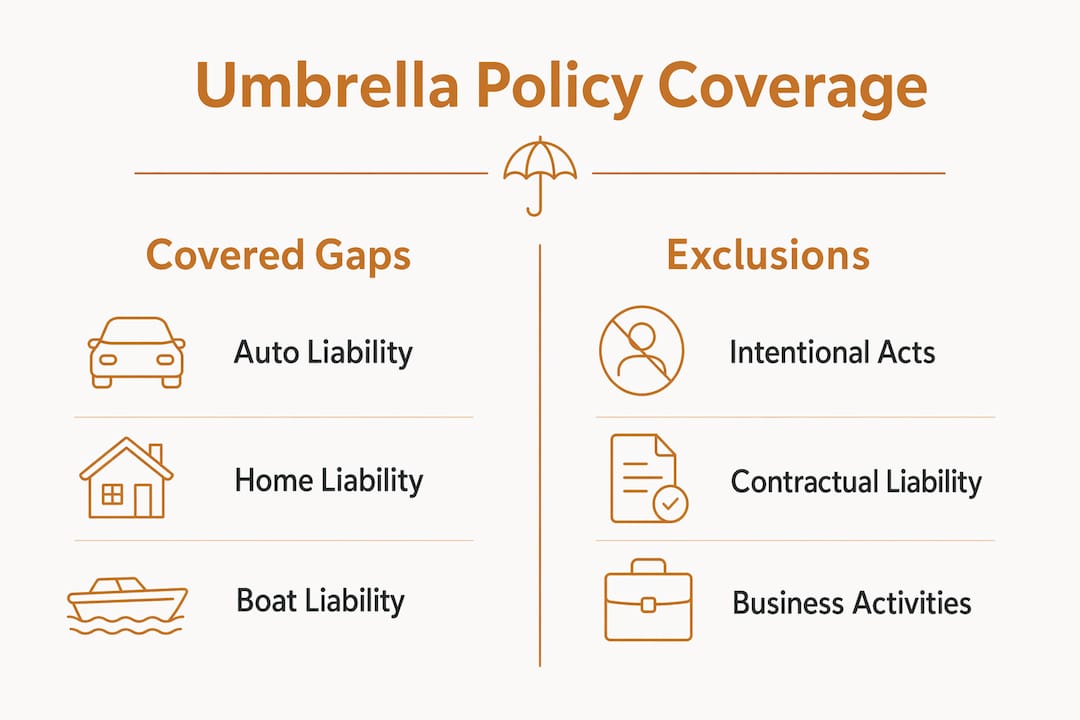
Standard primary policies have hard limits, and those limits can fall short fast. A personal umbrella policy addresses the most common gaps:
-
Auto accidents with serious injuries: A multi-vehicle accident with significant injuries can produce a judgment far above a typical auto liability limit. The umbrella covers the excess after your auto policy pays its maximum.
-
Guest injuries at your home: A visitor who slips on a wet floor or falls on your steps can generate medical and legal costs that exceed standard homeowners liability limits.
-
Recreational vehicle liability: Boats and motorcycles carry real injury risk. Umbrella policies extend coverage over these underlying policies when listed on the declarations page.
-
Libel, slander, and false arrest: Standard homeowners policies often exclude or severely limit personal injury claims like defamation. An umbrella typically covers these.
-
Legal defense costs: Attorney fees alone can consume a primary policy’s limit before a judgment is even reached. Many umbrella policies cover defense costs separately, preserving the full coverage amount for any settlement or award.
Without umbrella coverage, a single serious claim can wipe out assets that took decades to build. That is not a hypothetical. It happens to families who assumed their home or auto policy was enough.
What umbrella policies do not cover
Knowing the exclusions is just as important as knowing the benefits. Umbrella policies exclude several categories of claims that catch policyholders off guard:
-
Intentional acts and criminal conduct: If you cause harm deliberately or through illegal behavior, the umbrella will not respond. This includes DUI-related incidents in many cases.
-
Your own injuries or property damage: The umbrella is a liability tool. It pays others when you are legally responsible, not you when you are hurt or your belongings are damaged.
-
Business and professional liabilities: Ride-sharing, short-term rentals, freelance work, and any income-generating activity fall outside a personal umbrella’s scope. A separate commercial or professional liability policy is required.
-
Pollution and environmental contamination: A leaking underground storage tank or chemical runoff from your property is not covered. Specialized environmental liability insurance exists for these risks.
-
Contractual obligations: If you sign a lease or contract agreeing to indemnify another party beyond your own legal negligence, the umbrella will not cover that contractual portion of any judgment.
-
Workers’ compensation claims: Domestic employees such as housekeepers or landscapers who are injured on the job fall under workers’ compensation law, not your umbrella policy.
-
Certain recreational assets: Some high-risk vehicles or watercraft require a specific endorsement or standalone policy before the umbrella will extend over them.
Reading the fine print matters. An exclusion you did not know about is a gap you did not plan for.
How much does umbrella insurance cost?
Umbrella coverage is one of the best values in personal insurance. Typical premiums run $500 and up annually for at least $1 million in coverage, which works out to a few bucks per day. Each additional $1 million in coverage generally adds a modest amount to that annual cost.
A few factors shape the final premium:
-
Underlying policy limits: Insurers require minimum liability limits on your primary policies before issuing an umbrella. Most require at least $250,000/$500,000 on auto and $300,000 on homeowners. Raising those underlying limits to qualify can add to your total insurance cost.
-
Your risk profile: Teen drivers, rental properties, pools, trampolines, and certain dog breeds all increase the likelihood of a claim and can push premiums higher.
-
Coverage amount: Going from $1 million to $2 million adds relatively little to the annual premium compared to the protection gained.
Comparing umbrella coverage to simply raising your homeowners liability limit tells the real story. Increasing a single policy’s limit helps for that one policy. An umbrella covers the gap across your auto, home, and other underlying policies all at once, for a fraction of the cost of raising each individually.
How to make sure your umbrella policy actually covers the gaps
The most common reason an umbrella fails to pay is a gap in the foundation underneath it. Failing to maintain required underlying limits means the umbrella treats that shortfall as a deductible, and you pay it out of pocket before coverage kicks in.
Follow these practices to keep your protection solid by consulting StappInsurance, your local insurance broker:
-
Maintain required underlying limits: Never let your auto or homeowners liability limits drop below what your umbrella requires. If your umbrella requires $300,000 in homeowners liability and you only carry $100,000, you owe the $200,000 difference yourself before the umbrella pays anything.
-
Coordinate policy expiration dates: Mismatched renewal dates between your primary policies and umbrella can create brief windows of uncovered exposure. Aligning them under one agency eliminates that risk.
-
Review coverage after any life change: Marriage, a new driver in the household, a home renovation, a boat purchase, or a change in carriers all warrant a policy review. What was adequate last year may not be adequate today.
-
Work with a single trusted agent: Experts warn that coverage gaps often arise from changes to primary policies or carriers without updating umbrella limits. One agent who manages all your policies catches those changes before they become problems.
Pro Tip: Placing all your policies with The Root Agency means one team tracks every expiration date, every limit requirement, and every life change that could affect your coverage. You should never have to wonder whether your umbrella is still sitting on solid ground.
Why Louisiana families trust The Root Agency for umbrella coverage
Steve Root has spent more than 20 years protecting Louisiana families, and in that time he has seen what underinsurance actually costs. Not in the abstract. In real claims, real lawsuits, and real families who thought they were covered until they were not.
The Root Agency holds over 400+ Google reviews at 4.9 stars and was named to The Advocate’s 2025 Best of Baton Rouge. We are an Allstate exclusive agency with a 40-year family legacy in Louisiana insurance, and we are one of the only agencies in the state with a mobile catastrophe response unit that deploys directly to disaster zones after a storm.
We do not sell the cheapest policy. We sell the right one. For umbrella coverage, that means reviewing every underlying policy you carry, confirming the limits meet your umbrella’s requirements, and making sure nothing falls through the cracks when a claim actually happens.
Real claim scenarios where umbrella coverage makes the difference
Abstract coverage explanations only go so far. Here is how umbrella policies play out in practice.
Scenario 1: The serious car accident. Your auto policy carries $300,000 in bodily injury liability. A multi-car accident leaves another driver with $750,000 in medical bills and lost wages. Your auto policy pays $300,000. Without an umbrella, you personally owe the remaining $450,000. With a $1 million umbrella, it covers the balance.
Scenario 2: The backyard injury. A neighbor’s child is seriously hurt at your home. Medical costs and a subsequent lawsuit may exceed your homeowners liability limit. The umbrella covers the $300,000 gap, plus any legal defense costs if the policy covers them outside the limit.
Scenario 3: The defamation claim. A social media post leads to a lawsuit alleging libel. Your homeowners policy excludes personal injury claims of this type. Your umbrella, which covers libel and slander, responds to the claim and funds your legal defense.
Scenario 4: The boating accident. A collision on the water injures passengers on another vessel. Your boat policy’s liability limit is exhausted. The umbrella, which lists the boat policy as an underlying policy, picks up the excess judgment.
Each of these scenarios is ordinary. None of them are rare. Louisiana families who spend time on the water, host guests, and drive daily face these exposures every week.
Umbrella policies vs. excess liability policies: what is the difference?
These two products are often confused, and the distinction matters when you are choosing coverage.
An excess liability policy does exactly one thing: it adds more of the same coverage your primary policy already provides. If your auto policy covers bodily injury liability, an excess policy adds more bodily injury liability on top of that single policy. It mirrors the underlying policy’s terms, conditions, and exclusions precisely.
A personal umbrella policy does more. It adds coverage above multiple underlying policies simultaneously, and it typically broadens coverage to include claims the primary policies exclude, such as libel, slander, and false arrest. That broader scope is what makes an umbrella the standard recommendation for personal liability protection.
The practical difference: if you only need more coverage on one specific policy, an excess policy may be sufficient. If you want protection that spans your auto, home, boat, and renters policies while also covering gaps those policies leave behind, an umbrella is the right tool.
How to file a claim under your umbrella policy
Filing an umbrella claim follows a specific sequence because the umbrella activates after your primary policy is exhausted.
-
Report the incident to your primary insurer first. Your auto or homeowners carrier handles the claim up to its policy limit. Document everything: photos, police reports, witness information, and medical records.
-
Notify your umbrella carrier promptly. Even if the primary policy has not yet paid its limit, notify your umbrella insurer as soon as you believe the claim may exceed primary coverage. Late notice can complicate or delay coverage.
-
Cooperate with both insurers. Both your primary carrier and your umbrella insurer may conduct their own investigations. Provide consistent, accurate information to both.
-
Track all costs. Keep records of every expense related to the incident, including legal fees, medical bills, and any out-of-pocket costs. These records support the claim across both policies.
-
Work with your agent throughout the process. An experienced agent coordinates communication between carriers, confirms that the umbrella’s requirements are met, and advocates for you when questions arise.
At The Root Agency, our 24/7 claims support means you are never navigating this process alone. We pick up the phone.
How umbrella insurance protects your financial future
Liability judgments do not just take what you have today. Courts can garnish future wages, place liens on property, and pursue assets you have not yet earned. A $1 million umbrella policy for roughly $500+ per year stands between a single lawsuit and a financial outcome that follows you for years.
For Louisiana homeowners, the math is straightforward. If your net worth, home equity, savings, and earning potential exceed your primary liability limits, you have a gap. An umbrella policy closes that gap for a fraction of what it would cost to raise each underlying policy’s limits individually. It also covers scenarios, like libel claims or certain recreational vehicle accidents, that raising primary limits cannot address at all.
The families who regret umbrella insurance are the ones who did not have it when they needed it. The ones who carry it rarely think about it, because that is exactly the point.
Key Takeaways
An umbrella policy is the most cost-effective way to close the liability gap between your primary insurance limits and the full financial exposure a serious claim can create.
| Point | Details |
|---|---|
| Umbrella activates after primary limits | Coverage begins only after your auto or homeowners policy pays its maximum limit. |
| Premiums run $500 and up annually | A $1 million umbrella typically costs less than a dollar a day for most policyholders. |
| Underlying limits must be maintained | Dropping below required minimums creates a gap you pay out of pocket before the umbrella responds. |
| Broader than excess liability policies | Umbrella policies cover libel, slander, and multi-policy gaps that excess policies do not address. |
| One agent prevents coverage gaps | Centralizing all policies with one agency eliminates mismatched limits and expiration date risks. |
Talk to The Root Agency about your umbrella coverage

If you are not sure whether your current liability limits are enough, the answer is probably no. Most Louisiana homeowners are carrying primary limits that made sense years ago and have not been reviewed since. A single conversation can tell you exactly where your gaps are and what it costs to close them.
The Root Agency serves all of Louisiana and Mississippi, with local agents in Baton Rouge, Lafayette, New Orleans, and beyond. We carry all 11 lines of personal and commercial insurance, so we can review your home insurance, auto insurance, and umbrella coverage together, in one conversation, with one agent who knows your full picture.
Call us at (225) 926-0160 or visit steverootagency.com/umbrella-insurance to get started. We are here when you need us, including after the storm.