
$300 Is Typical: Louisiana Umbrella Insurance Costs and Coverage Needs
A $1 million umbrella policy typically runs between $150 and $600 a year, with most Louisiana households landing around $300 to about $380 annually, according to Insurify’s data on ACE Private Risk Services figures. Carriers sell umbrella coverage starting at $1 million and increase it in $1 million increments from there. Your exact price depends on where you live, what you drive, and how much exposure your lifestyle carries.
TL;DR:
- The annual premium for a $1 million umbrella policy typically ranges from $150 to $600, with most Louisiana households paying around $300 to $380.
- Additional million-dollar layers cost less per dollar since insurers price them as tail risks, making a $5 million policy roughly three to four times the cost of a $1 million one.
- Buying umbrella insurance is especially advisable if you own rental property, have a pool or watercraft, host guests regularly, or have significant assets to protect.
- Underlying auto and homeowners liability limits should meet minimum thresholds, usually $150,000 to $300,000, before adding an umbrella policy to avoid gaps in coverage.
- Local Louisiana risks like storms, coastal rentals, and boat ownership push recommended starting coverage from $1 million to $2 million for high-exposure households.
Table of Contents
- How Much Umbrella Insurance Costs by Coverage Level
- When Is Umbrella Insurance Worth Buying?
- How to Calculate the Umbrella Coverage You Need
- What Affects Your Umbrella Insurance Premium
- Buying Umbrella Insurance: What You Need First
- The Root Agency’s Local Take for Louisiana Homeowners
- Umbrella Insurance vs. Excess Liability Insurance
- How Umbrella Insurance Works With Your Home and Auto Policies
- Exclusions That Affect Your Umbrella Policy and Its Price
- Why the Insurer You Choose Changes the Price
- A Local Perspective on Protecting What You’ve Built
- Get a Louisiana-Specific Umbrella Quote
- Sources
- FAQ
How Much Umbrella Insurance Costs by Coverage Level
The initial million dollars of umbrella coverage typically costs the most per dollar of protection. After that, each additional million gets cheaper. NerdWallet reports that low-risk households can find $1 million in coverage for around $200 a year, while higher-risk profiles push closer to $600. The often-cited industry average, based on the ACE Private Risk Services study, sits near the upper end of typical $300–$380 annual premiums for a household with one home, two cars, and two drivers.
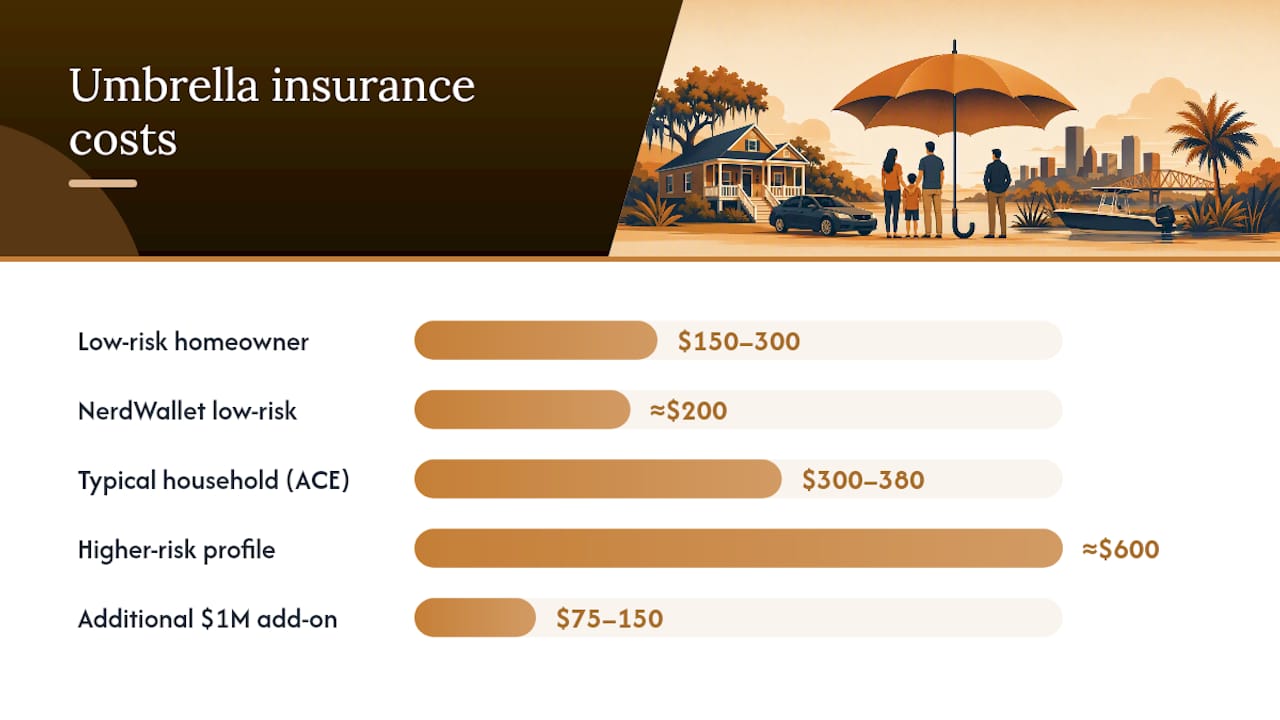
Once you move past that first million, the math changes in your favor. Insurers price the additional layers as tail risk rather than a straight multiple, which means each extra $1 million often adds only $75 to $150 per year rather than doubling your premium. A $5 million policy is not five times the cost of a $1 million policy. It is closer to the base premium plus three or four modest add-ons.
Here is how that typically breaks down across common Louisiana household profiles:
- Low-risk homeowner (one home, no pool, experienced drivers): Coverage costs can fall in the lower part of the typical $150–$300 range per year for $1 million
- Family with a pool and a teen driver: these risk factors increase premiums to the moderate part of the range
- High-exposure homeowner (rental property, boat, multiple vehicles): such exposures often raise premiums closer to the higher part of the range
- $5 million policy for a high-net-worth household: total cost increases modestly beyond the first million, generally well below a linear fivefold increase
Your quote will land somewhere in these bands depending on your specific risk profile, but the pattern holds statewide: the first million costs the most, and protection gets more efficient from there.
When Is Umbrella Insurance Worth Buying?
A commonly advised rule of thumb, including according to Kiplinger, is to carry umbrella coverage equal to your net worth or between one and two times your annual household income. If a jury awards a judgment larger than your home and auto liability limits, everything above those limits comes out of your own pocket, including future wages a court can garnish.
Certain situations tip the scale toward “yes, buy it now”:
- You own a rental property or a second home
- You have a boat, jet ski, or other watercraft
- You have a swimming pool or trampoline
- A teen driver is on your auto policy
- You host guests, coach youth sports, or serve on a nonprofit board
- You have significant home equity or investment accounts
Pro Tip: Don’t just look at your bank balance. A judgment can attach to your future paychecks too, so protecting earning potential matters as much as protecting what you already have saved.
How to Calculate the Umbrella Coverage You Need
Figuring out your number takes three steps, and it does not require a financial advisor to get a solid estimate.
- Add up assets a court could reach. This includes home equity, brokerage accounts, savings, and non-retirement investments — resources like individual insurance can help you evaluate your income and asset exposure.
- Subtract what is typically shielded from civil judgments. Many 401(k) and other ERISA-covered retirement plans carry strong creditor protection, while IRAs often have less protection and stay more exposed, so include those in your total.
- Choose a limit equal to or slightly above that number. Round up to the nearest million, since that is how policies are sold.
Here is a quick example. A Baton Rouge homeowner with $180,000 in home equity, $220,000 in a taxable brokerage account, and $50,000 in an IRA has roughly $450,000 in exposed assets. Their 401(k) balance stays largely out of reach in most judgment scenarios. Rounding up, a $1 million umbrella policy comfortably covers that exposure with room to spare, and costs a few hundred dollars a year to do it.
What Affects Your Umbrella Insurance Premium
Insurers weigh several factors before setting your rate, and understanding them helps explain why two neighbors can get very different quotes.
- Location and litigation climate. States and parishes with higher rates of lawsuits or larger jury awards tend to see higher umbrella premiums, and urban areas usually price higher than rural ones.
- Household risk features. Pools, trampolines, certain dog breeds, teen drivers, and owning multiple properties or boats all raise your risk profile.
- Claims and driving history. A clean record keeps your umbrella premium closer to the low end of the range; recent claims or moving violations push it up.
- Underlying policy limits. Raising your base auto or homeowners liability limits, which carriers often require anyway, can shift your total premium picture before the umbrella layer even applies.
Underwriters are essentially mapping severity risk across your whole household. A pool or a 16-year-old driver influences pricing far more than routine claims history does, because those factors carry outsized potential for a large loss.
Buying Umbrella Insurance: What You Need First
Before any carrier issues an umbrella policy, your underlying auto and homeowners coverage has to meet minimum thresholds. Investopedia notes that typical requirements fall in the $150,000 to $300,000 range for auto liability and $250,000 to $300,000 for homeowners liability, though specific carriers set their own floors.
If your current limits fall short, you will need to raise them first, and that step affects your total cost. Raising underlying limits often adds a modest amount to your base premiums before the umbrella policy itself is even priced. It is a step a lot of buyers skip in their initial cost estimate, then get surprised by later.
A few things worth doing before you shop:
- Pull your current auto and homeowners declarations pages so you know your existing limits
- List out every exposure: rental units, boats, pools, teen drivers
- Ask directly about bundling discounts and any exclusions before signing
Pro Tip: Bundling your umbrella policy with the same carrier holding your home and auto coverage often smooths out underwriting and can catch gaps between policies that a standalone umbrella purchase might miss.
The Root Agency’s Local Take for Louisiana Homeowners
Louisiana carries risk factors that push umbrella limits higher than the national baseline. Storm-related claims, rental units near the coast, and widespread boat ownership all raise the odds of a liability event that a standard auto or homeowners policy alone will not fully cover.
For most Baton Rouge families, The Root Agency recommends starting at $1 million and moving to $2 million for households with rental property, a boat, or a pool. Steve Root has spent more than 20 years building policies for Louisiana homeowners, backed by 356 Google reviews at 4.9 stars and a mobile catastrophe response unit that shows up in person after a storm. That local presence matters most the day you actually need to file a claim.
Umbrella Insurance vs. Excess Liability Insurance
These two terms get used interchangeably, but they are not identical. A personal umbrella policy sits on top of your entire portfolio of underlying policies, home, auto, boat, and typically extends broader liability protection than any single policy carries, sometimes covering claims like libel or slander that your standard home and auto policies exclude entirely.
Excess liability insurance, by contrast, simply raises the limit on one specific policy. It follows that policy’s exact terms and exclusions rather than adding new categories of protection. If your auto policy excludes a certain type of claim, an excess liability rider on that same policy usually excludes it too.
The practical difference shows up when a claim spans more than one policy. Say a guest is injured on your boat and later claims a related injury happened at your home. An umbrella policy can respond across both incidents because it sits above your entire liability picture. An excess policy tied only to your boat coverage would not extend to the homeowners claim.
For most Louisiana families juggling a home, a couple of vehicles, and maybe a boat or rental property, a true umbrella policy offers more flexible protection than stacking excess riders on individual policies one at a time. It is one policy, one limit, and one phone call if something goes wrong across any of your coverage.
How Umbrella Insurance Works With Your Home and Auto Policies
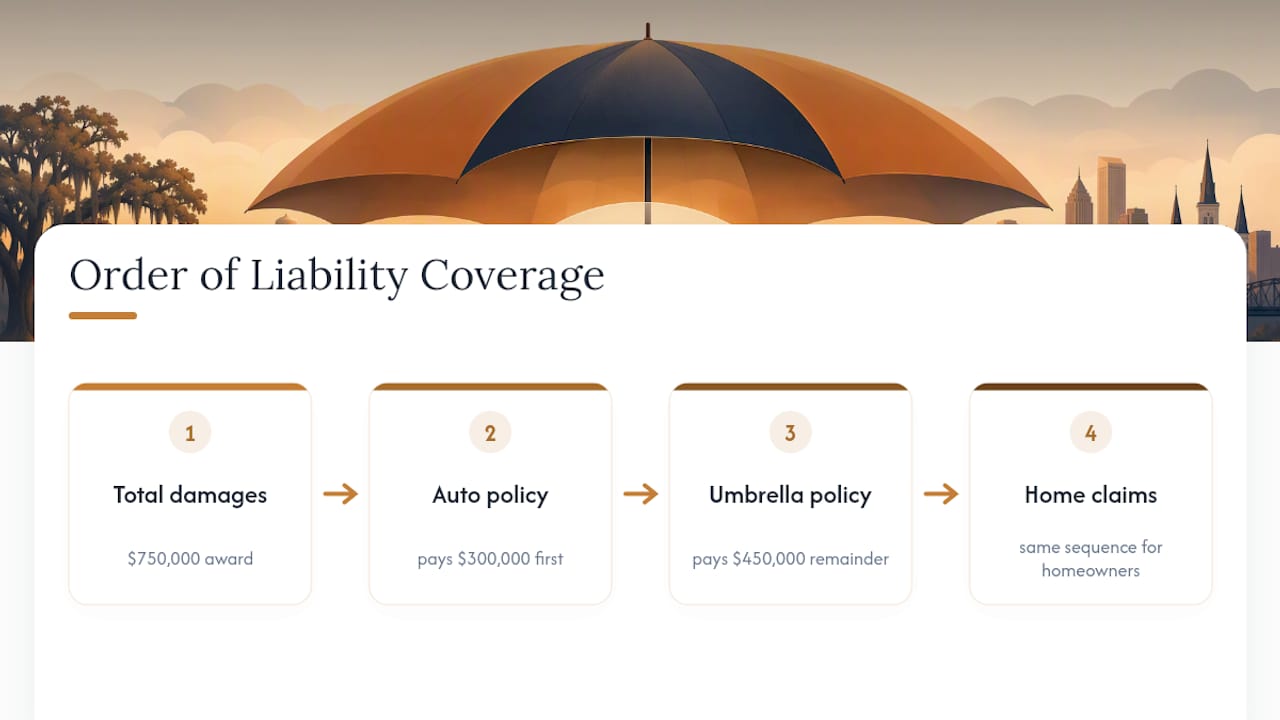
Umbrella coverage never stands alone. It activates only after your underlying home or auto liability limits are exhausted, which is why carriers require those minimum limits before they will even issue an umbrella policy.
Picture a car accident where a court awards $750,000 in damages. If your auto policy carries a $300,000 liability limit, that policy pays out its full $300,000, and your umbrella policy covers the remaining $450,000. The two policies work in sequence, not in competition. The same structure applies to a liability claim on your home, whether it is a slip-and-fall on your porch steps or a dog bite in your backyard.
This is also why reviewing your homeowners and auto declarations matters before you shop for umbrella coverage. If your underlying limits are too thin, you may need to raise them, which changes your overall premium math, or you risk a gap between where your base policy stops paying and where your umbrella kicks in. A good agent checks this alignment before quoting your umbrella premium, not after.
Exclusions That Affect Your Umbrella Policy and Its Price
Umbrella policies are broad, but they are not unlimited. Most exclude intentional acts, business liability tied to a company you own, and contractual liability you agreed to separately. Many also exclude certain watercraft above a stated size or horsepower unless you add a specific endorsement, and some carriers cap coverage for claims involving certain dog breeds or exotic pets.
These exclusions matter for pricing because filling the gaps often costs extra. If you run a business from home, or your boat exceeds a carrier’s standard size threshold, you may need a separate commercial policy or a boat-specific endorsement rather than relying on the umbrella policy to cover it. Skipping that step does not save money. It just means you find out about the gap at the worst possible time, during a claim.
Reading your policy’s exclusions list before you buy is worth the twenty minutes it takes. A local agent can walk through it with you and flag anything that leaves a real exposure uncovered.
Why the Insurer You Choose Changes the Price
Not every carrier prices umbrella risk the same way, and not every carrier writes umbrella policies for every household. Some carriers specialize in bundled home, auto, and umbrella packages and offer meaningfully better pricing when all three sit under one roof. Others price umbrella coverage as a stand-alone product with less flexibility on underlying limit requirements.
Coverage terms vary too. One carrier’s umbrella policy might include worldwide liability protection and legal defense costs outside your standard limits, while another treats defense costs as part of the total payout cap. These differences rarely show up in a quick online quote, which is part of why working with an agent who reviews the actual policy language, not just the price, protects you better than shopping on premium alone.
A Local Perspective on Protecting What You’ve Built
A $1 million umbrella policy usually costs less than $400 a year, yet it stands between one bad afternoon and losing decades of equity, savings, and future income. In 20-plus years of writing policies for Louisiana families, the pattern is consistent: the households that regret their coverage are never the ones who paid a little more for a real limit. Working with a local agent who answers the phone after a claim is worth more than shaving a few dollars off the premium.
— Steve Root
Get a Louisiana-Specific Umbrella Quote
The Root Agency is the local alternative to guessing at your umbrella limit from a generic online calculator. Steve Root and his team review your actual home, auto, and lifestyle exposures, then recommend a specific coverage number instead of a one-size-fits-all figure.

That means a personalized policy review, custom coverage limits built around your rental property, boat, or teen driver, and bilingual claims support available around the clock. When a storm hits, the same catastrophe response team that deploys RVs directly to disaster zones is the one handling your claim, not a call center in another state. Umbrella coverage starts at competitive rates, and reviewing your current home and auto limits alongside it often reveals gaps worth closing before you add a million dollars of protection on top. Visit the full lineup of coverage options to see how umbrella insurance fits with your existing home and auto policies, or call (225) 926-0160 to schedule a policy review with an agent who has spent more than two decades protecting Louisiana families.
Sources
- Umbrella insurance: Coverage & how it works - NerdWallet
- How Much Umbrella Insurance Do I Need? | Kiplinger
- Umbrella personal liability policy - Investopedia
FAQ
How Much Is a $1 Million Umbrella Insurance Policy?
A $1 million umbrella policy typically costs between $150 and $600 a year, with an average around $300 to $383 for a household with one home, two cars, and two drivers, based on ACE Private Risk Services data.
How Much Does a $5 Million Umbrella Policy Cost?
Because insurers price additional coverage as incremental tail risk, a $5 million policy usually costs the base $1 million premium plus roughly $75 to $150 per extra million, often landing between $600 and 850 USD a year total.
How Much Umbrella Insurance Do I Really Need?
Most advisors, including Kiplinger, recommend coverage equal to your total net worth or one to two times your annual household income, rounded up to the nearest million since policies sell in $1 million increments.
What Does Dave Ramsey Say About Umbrella Insurance?
Dave Ramsey generally advises that anyone with meaningful assets to protect should carry an umbrella policy, since the annual cost is small compared to the protection it provides against a lawsuit that exceeds standard auto or home liability limits.
Do I Need Umbrella Insurance if I Don’t Own a Home?
Renters with significant savings, investments, or high-exposure activities like coaching or hosting large gatherings can still benefit from umbrella coverage, since the policy protects your assets and future income regardless of whether you own property.