

How Insurance Premiums Are Calculated in Louisiana

An insurance premium is the price an insurer charges to carry your risk, calculated through a regulated process that combines predicted claims costs, operating expenses, profit margins, and your personal risk profile. Understanding how insurance premiums are calculated is not just academic. For homeowners and families in Louisiana and Mississippi, it is the difference between knowing why your bill went up after a hurricane season and feeling blindsided by it. The Louisiana Department of Insurance and the Mississippi Insurance Department both review every rate filing before it reaches you. The system is structured, not arbitrary.
How are insurance premiums calculated using actuarial science?
Actuaries build predictive models analyzing claims frequency, severity, exposure, and external factors such as climate and economic trends. That modeling ensures premiums cover expected future losses while keeping the insurer financially sound.
For Louisiana and Mississippi, this means actuaries study decades of hurricane claims, flood events, and severe weather losses in specific ZIP codes. A home in Metairie carries a different loss projection than one in Shreveport, even if the houses are identical. The data drives the difference.

Actuaries work with exposure units, which are standardized measures of risk. For homeowners insurance, the exposure unit is typically the insured value of the home. For auto insurance, it is a vehicle-year, meaning one car insured for one full year. Multiplying the expected loss rate by the number of exposure units produces the base premium before any adjustments.
Risk segmentation refines that base further. Age, credit-based insurance scores, and driving history each shift the premium up or down from the pool average. These scores differ from traditional credit scores and weigh financial behaviors that predict claim likelihood. They are not a judgment of character. They are a statistical tool.
Pro Tip: When your premium rises after a major storm season, it often reflects updated actuarial models for your region, not a change in your personal behavior. Asking your agent to explain the specific rating factors behind your increase is always a reasonable request.
How do insurer expenses and profit margins affect your premium?
Operational costs add 25–35% on top of expected claims to every insurance premium. Profit and contingency margins add another 3–10% to maintain financial stability. These figures are not hidden fees. They are built into every rate filing and reviewed by state regulators.
The expense load covers agent commissions, which typically run 10–15% of the premium, plus administrative costs, state premium taxes, and technology infrastructure. Without these, no insurer could process your claim at 2:00 AM after a tornado. The cost is real and the service it funds is real.
Reinsurance is the expense that surprises most policyholders in this region. Reinsurance costs can reach up to 70% of homeowner insurance premiums in high-risk areas like the Mississippi Coast. Reinsurance is insurance that insurers buy to protect themselves against catastrophic losses. When a hurricane wipes out thousands of homes at once, reinsurance is what keeps your carrier solvent enough to pay your claim.
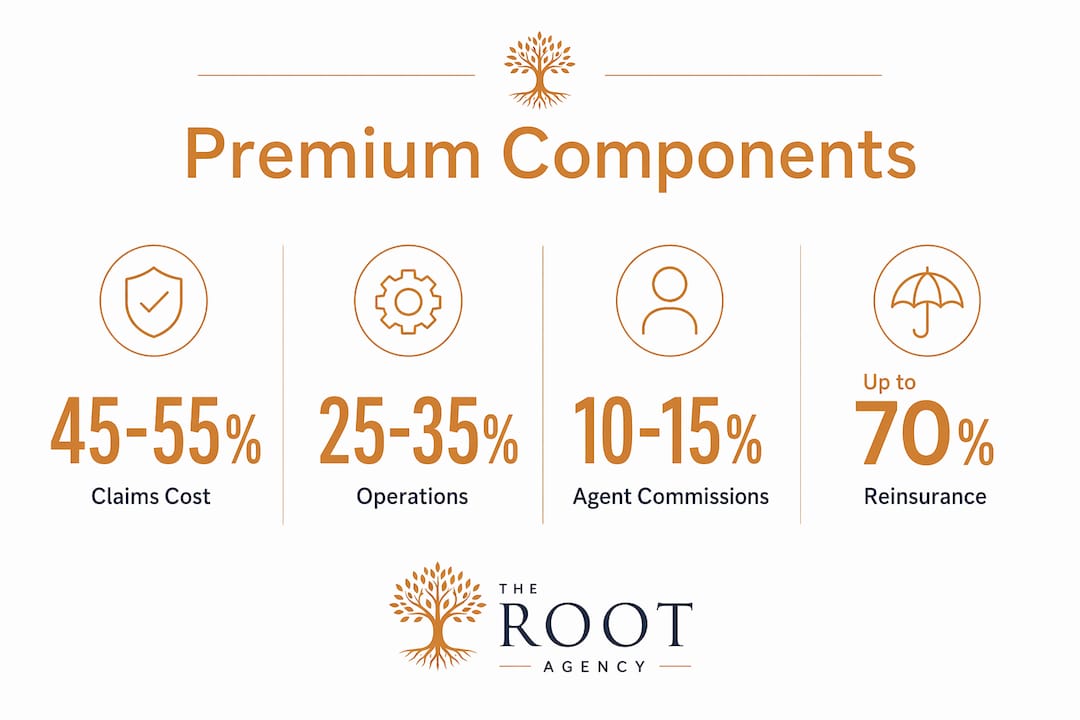
The table below shows how a typical homeowner’s premium dollar breaks down in a high-risk Gulf Coast market.
| Expense component | Approximate share of premium |
|---|---|
| Expected claims (loss cost) | 45–55% |
| Reinsurance | 15–30% |
| Operating expenses and commissions | 15–20% |
| Taxes and fees | 3–5% |
| Profit and contingency margin | 3–10% |
Construction inflation and catastrophe losses push these percentages around from year to year. When lumber prices spike after a storm, the expected claims cost rises, and premiums follow. That connection is direct and measurable.
Which personal and location-based factors affect your premium?
Your ZIP code is one of the most powerful rating factors in Louisiana and Mississippi. Insurers analyze crime rates, fire department response times, distance to the coast, and historical disaster frequency at the ZIP code level. Two neighbors on opposite sides of a parish line can pay meaningfully different premiums for the same coverage.
For homeowners, the physical characteristics of the property matter just as much as the location. Older roofs and non-fortified construction can lead to coverage denial or significantly higher premiums for wind and hail risks. A roof over 20 years old is a liability in the eyes of an underwriter, especially in a state where a single storm can destroy thousands of roofs in one afternoon.
Key personal rating factors for homeowners and auto policies include:
- Roof age and material. Metal and impact-resistant shingles earn lower premiums than aging three-tab asphalt.
- Construction type. Fortified home certification under the Insurance Institute for Business and Home Safety standard can reduce wind premiums.
- Proximity to water. Homes near rivers, bayous, or the Gulf face higher flood and wind exposure scores.
- Vehicle type and age. Newer vehicles with high repair costs carry higher collision premiums.
- Driving history. At-fault accidents and moving violations raise auto premiums for three to five years on average.
- Credit-based insurance score. Louisiana and Mississippi both permit this factor, and it carries significant weight.
Standard homeowners policies exclude flood damage entirely, which means a separate flood policy through the National Flood Insurance Program or a private carrier is a separate premium calculation altogether. Many Louisiana homeowners learn this distinction the hard way.
Pro Tip: Raising your deductible from $1,000 to $2,500 on a homeowners policy can reduce your annual premium noticeably. Just make sure you can cover that deductible out of pocket before a storm hits.
What is the rate filing and regulatory review process?
Premiums result from a formal, regulated rate-filing process that requires insurers to prove their rates are adequate, not excessive, and non-discriminatory before charging consumers. This is not a formality. State regulators can reject or modify filings that fail to meet these standards.
The process works in three stages:
- Data submission. The insurer compiles years of claims data, expense projections, reinsurance costs, and profit targets into a formal actuarial filing.
- Regulatory review. The Louisiana Department of Insurance or the Mississippi Insurance Department examines the filing for mathematical accuracy, fairness, and compliance with state law. Louisiana uses a prior-approval system, meaning rates cannot take effect until the department signs off.
- Approval and implementation. Once approved, the new rates apply to new policies and renewals on a scheduled basis.
A concrete example of this process in action: Mississippi approved a 17.2% average rate increase in january 2026 for dwelling policies in the state wind pool, which covers properties in six South Mississippi counties that cannot find private wind and hail coverage. That increase went through full regulatory review before it reached policyholders. The Affordable Care Act applies a similar framework to health insurance, limiting rating factors to five categories and requiring that at least 80% of premiums fund actual medical care.
Knowing this process exists gives you a tool. If a premium quote looks out of line with your risk profile, you can ask your agent to explain the rate filing behind it. A trustworthy agent will answer that question directly.
How does understanding premium calculations help you make better decisions?
Knowing how rates are built helps you ask the right questions and make choices that match your actual risk. The goal is not to find the cheapest policy. The goal is to find the right coverage at a price that reflects your real exposure.
Practical steps that follow from this understanding:
- Match your coverage limits to replacement cost, not market value. Construction costs in Louisiana have risen sharply since 2020. A policy written three years ago may leave you short.
- Review your deductibles annually. A higher deductible lowers your premium, but only makes sense if your emergency fund can absorb it.
- Ask about fortified home discounts. Louisiana’s Strengthen Alabama Homes program and similar state initiatives offer meaningful premium reductions for qualifying upgrades.
- Separate your flood policy from your homeowners policy. Understanding that these are two distinct premium calculations prevents the most common coverage gap in this region.
- Work with a local agent who knows regional rating factors. An agent familiar with why insurance costs more in Louisiana can identify discounts and coverage structures that a national call center will miss.
Premium increases driven by market conditions, such as reinsurance cost spikes or post-storm construction inflation, are not personal. They reflect the cost of covering everyone in your risk pool. Understanding that distinction removes the frustration and lets you focus on what you can actually control.
Key Takeaways
Insurance premiums are calculated by combining actuarially projected loss costs, insurer operating expenses, reinsurance charges, profit margins, and personal risk factors, all subject to state regulatory approval in Louisiana and Mississippi.
| Point | Details |
|---|---|
| Actuarial models drive base rates | Actuaries analyze local claims history, exposure units, and climate data to set the starting premium. |
| Expenses add 25–35% above claims costs | Operating costs, commissions, and taxes are built into every premium before profit is added. |
| Reinsurance is a major cost driver | In coastal Mississippi, reinsurance alone can account for up to 70% of a homeowner’s premium. |
| Personal factors shift your individual rate | Roof age, credit-based insurance score, ZIP code, and driving history all adjust your premium from the pool average. |
| Regulatory review protects consumers | Louisiana and Mississippi require insurers to prove rates are adequate, fair, and non-discriminatory before implementation. |
What 20 years in this market taught me about premium calculations
Most people assume their premium went up because their insurer got greedy. After more than 20 years working in Louisiana and Mississippi insurance markets, I can tell you that is almost never the full story.
The real driver, especially since 2020, is reinsurance. When global reinsurers raise their prices for Gulf Coast exposure after a bad hurricane season, that cost flows directly into your renewal. Your personal claims history may be spotless, and your premium still climbs. That is not unfair pricing. That is the math of shared risk in a catastrophe-prone region.
What I have seen hurt people the most is not the premium increase itself. It is the decision to drop coverage or reduce limits to offset the increase. After Ida, I watched families discover they were underinsured by $80,000 or more because they had quietly lowered their dwelling coverage years earlier to save a few hundred dollars a year. The savings felt real. The gap felt catastrophic.
The right response to a premium increase is a conversation with your agent, not a coverage reduction. Review what you have, confirm your limits still match replacement cost, and ask whether any mitigation upgrades, like a fortified roof or storm shutters, could bring the rate down without touching your protection. That is the conversation The Root Agency has with every client at renewal. Understanding how car insurance rates are calculated in Louisiana follows the same principle: know the factors, then work them in your favor.
— Steve Root
Get a premium review from The Root Agency
The Root Agency serves all of Louisiana and Mississippi with 11 lines of personal and commercial insurance, including home insurance, flood coverage, auto, life, and commercial policies. Steve Root brings more than 20 years of local market experience and a 4.9-star rating across 356 Google reviews to every client conversation.

When your premium changes, you deserve a clear explanation, not a form letter. The Root Agency offers 24/7 claims support, bilingual service in English and Spanish, and a catastrophe response team that deploys directly to disaster zones. Call (225) 926-0160 or visit steverootagency.com/products to request a personalized coverage review today.
FAQ
What is an insurance premium?
An insurance premium is the amount you pay an insurer, typically monthly or annually, to maintain active coverage. The price reflects your expected claims cost plus the insurer’s operating expenses, reinsurance charges, and profit margin.
Why did my premium increase if I filed no claims?
Premiums rise when regional risk factors change, such as increased reinsurance costs after a hurricane season or higher construction costs, even when your personal claims history is clean. These market-driven increases apply across entire risk pools, not just individual policyholders.
How does my credit score affect my insurance premium?
Insurers use a credit-based insurance score, which differs from a traditional credit score, to predict claim likelihood. Louisiana and Mississippi both permit this rating factor, and a lower score can meaningfully increase your premium.
Does flood insurance have a separate premium calculation?
Yes. Standard homeowners policies exclude flood damage, so flood insurance is a separate policy with its own premium calculation. The National Flood Insurance Program and private flood carriers each use their own rating models based on your property’s flood zone and elevation.
Can I lower my premium without reducing coverage?
Yes. Upgrading your roof to a fortified or impact-resistant standard, raising your deductible if your savings allow it, and bundling multiple policies with one carrier are all ways to reduce your premium without cutting the protection you need.