

How Anti-Concurrent Causation Clause Works: What Louisiana Homeowners Must Know

An anti-concurrent causation (ACC) clause lets your insurer deny an entire property loss the moment an excluded peril contributes to that loss — even if a covered peril did most of the damage. Wind tears off your roof, storm surge floods the interior, and the ACC in your homeowners policy can turn a covered wind claim into a full denial because flood is excluded. That is not a hypothetical. It happens after nearly every major hurricane in Louisiana.
Three things you should do right now:
- Pull out your policy and search for the words “concurrently or in any sequence.” That phrase is the ACC trigger. If you find it, read every exclusion it attaches to.
- Confirm whether flood and earth movement are covered. Most standard homeowners policies exclude both. A separate flood insurance policy is the only way to close that gap.
- Document your property’s pre-loss condition today. Time-stamped photos, a room-by-room video, and a current home inventory give you the segregation evidence you will need if ACC is ever invoked against your claim.
Courts have upheld full claim denials in cases where an excluded peril contributed to any part of the total damage. The percentage of contribution is irrelevant when ACC language is enforced—any contribution by an excluded peril can be enough to bar recovery entirely.
Table of Contents
- How an anti-concurrent causation clause works and how it differs from other causation doctrines
- What ACC wording actually looks like and the red flags to find in your policy
- Real-world examples showing how ACC can flip a covered loss to a denial
- How courts and states treat ACC clauses differently
- What insurers typically do when they invoke ACC and the mistakes that make it worse
- Practical steps to protect your coverage before and after a loss
- What to do when your insurer denies a claim citing an ACC clause
- Key Takeaways
- Why ACC clauses keep me up at night for Louisiana clients
- How The Root Agency helps you stay covered when ACC is in play
- Useful sources and further reading
How an anti-concurrent causation clause works and how it differs from other causation doctrines
Before ACC clauses existed, policyholders had two legal doctrines working in their favor. Understanding what those doctrines do — and how ACC dismantles them — is the fastest way to grasp why this clause matters.

Concurrent causation doctrine is the most policyholder-friendly approach. Under this rule, if at least one contributing cause of a loss is covered, the insurer owes coverage for the entire loss, even if other excluded perils also contributed. A house damaged by both wind (covered) and flood (excluded) would be fully covered under pure concurrent causation.
Efficient proximate cause (EPC), also called the dominant cause approach, asks a different question: which peril was most responsible for setting the loss in motion? If the dominant initiating cause is covered, the insured recovers, even if subsequent excluded events followed. Some states protect EPC by statute, making it difficult for insurers to contract around it.
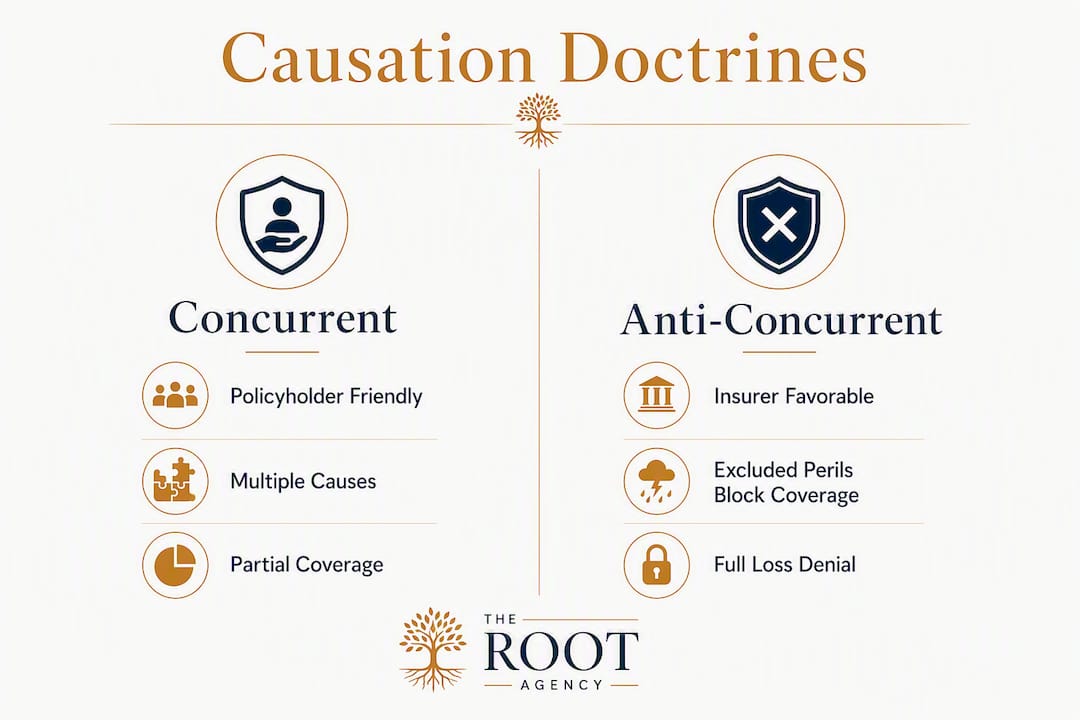
ACC clauses are specifically designed to override both doctrines. As legal scholarship on ACC enforceability explains, insurers use ACCs to contract out of EPC and concurrent causation protections, shifting the outcome decisively in their favor whenever any excluded peril touches a loss.
A concrete example: hurricane winds cause a levee to breach, and flooding then destroys the home. Under EPC, wind might be the dominant initiating cause, triggering coverage. Under ACC, the flood exclusion combined with that clause language bars coverage entirely, regardless of which peril struck first or did more damage.
What ACC wording actually looks like and the red flags to find in your policy
The canonical example comes from ISO Form CP 10 30, the standard commercial property exclusions form. Its lead-in language reads:
Breaking that down phrase by phrase:
- “Regardless of any other cause or event” — the insurer does not care what else contributed. The excluded peril’s presence alone is enough.
- “Contributes concurrently” — if the excluded peril acted at the same time as a covered peril, the exclusion applies.
- “Or in any sequence” — if the excluded peril acted before or after the covered peril, the exclusion still applies. Sequence is irrelevant.
That language appears in the exclusions preamble on standard ISO forms, where most policyholders can at least find it. The more dangerous version is what field practitioners call the proprietary-form trap: ACC-equivalent wording buried inside individual exclusion definitions. An earth movement exclusion might read “regardless of whether combined with water” without ever using the phrase “anti-concurrent causation.” The effect is identical, but most policyholders never notice it during a routine policy review.
Red flags to look for when reviewing your policy:
- The phrase “concurrently or in any sequence” anywhere in the exclusions section
- “Regardless of any other cause or event” attached to flood, earth movement, or mold exclusions
- Earth movement exclusions that include language like “whether combined with water or not”
- ACC trigger language sitting inside exclusion definitions rather than in the preamble, where it is easier to miss
- Mold exclusions that reference water damage “regardless of source”
Pro Tip: Don’t just read the exclusions list. Read the full text of each exclusion definition. ACC language is often hidden in the body of the definition, not the heading.
Real-world examples showing how ACC can flip a covered loss to a denial
Three scenarios illustrate how ACC operates in practice and what evidence matters most.
Wind and storm surge after a hurricane
A coastal home sustains roof and wall damage from Category 4 winds before storm surge arrives two hours later and floods the interior. The homeowner files a claim for both. The insurer’s adjuster frames the entire loss as a “wind and flood event” in the initial report. With ACC language in the policy and flood excluded, the carrier denies the full claim, arguing that flood contributed to the loss regardless of sequence.
What shifts the balance: a structural engineer’s report showing that specific roof sheathing failures, broken windows, and interior wall damage occurred before any waterline evidence. Waterline marks and sediment deposits are physical evidence of surge; wind-driven debris patterns and sheathing nail-pull failures are evidence of wind. Separating those two damage profiles with forensic precision is what makes segregation possible.
Burst pipe leading to mold
A pipe bursts in winter, the homeowner is away, and mold develops over several weeks before the loss is discovered. The insurer acknowledges the pipe burst is covered but invokes the mold exclusion with ACC language attached, denying the mold remediation costs entirely because mold “contributed concurrently” to the overall property damage.
The policyholder’s strongest argument: the mold is a direct, sequential consequence of the covered water event, not an independent excluded peril. Whether that argument succeeds depends heavily on the state and the specific policy language.
Earth movement following heavy rain
Saturated soil causes a foundation to shift after a major rainfall event. The homeowner argues the rain (potentially covered as a water event) caused the earth movement. The insurer invokes the earth movement exclusion with ACC language reading “regardless of whether combined with water,” denying the entire foundation claim.
The practical lesson across all three scenarios: the moment you describe your loss as a combined event (“wind and flood,” “water and mold”), you hand the insurer the framing it needs to invoke ACC. Describe each damage type separately, by location and physical characteristic, from your very first contact with the adjuster.
Pro Tip: Hire a licensed contractor or structural engineer before the adjuster’s first visit when the loss involves multiple potential causes. Their written scope, prepared independently, carries far more weight than a verbal description you give at the door.
How courts and states treat ACC clauses differently
There is no uniform national rule on ACC enforceability. Academic analysis of ACC law identifies three main judicial approaches, and where your property sits determines your legal options.
1. Strict enforcement states treat ACC clauses as valid contracts. The majority of U.S. jurisdictions with clear rules fall into this category. Texas is among the most recent states to firmly adopt strict enforcement. Alabama courts have also upheld ACC clauses, finding that clear policy language unambiguously excludes the loss when an excluded peril contributes.
2. Efficient proximate cause states limit ACC enforcement when the dominant initiating cause is covered. California’s Insurance Code § 530 embodies this protection, and the California Supreme Court’s Garvey decision established that if a jury finds earth movement was the EPC of a loss, the insurer must cover it despite the ACC and exclusion. Washington State’s Supreme Court reached a similar result in Safeco Insurance Co. v. Hirschmann, holding that insurers cannot contract out of the EPC doctrine. West Virginia’s high court has taken the same position.
3. Apportionment and mixed approaches require the insurer and insured to segregate covered from excluded damage, with recovery limited to the covered portion. North Dakota has applied this framework.
Mississippi presents a nuanced picture. The Corban v. USAA decision limited ACC application to truly simultaneous causes, offering some protection to policyholders when perils operated sequentially. That distinction matters enormously for post-hurricane claims where wind precedes surge by hours.
Florida courts often enforce ACC language when the policy wording is clear, but they place the burden on the carrier to demonstrate that the excluded peril actually contributed to the specific damage at issue. That burden requirement gives Florida policyholders a meaningful procedural lever.
| State | General Approach | Key Authority |
|---|---|---|
| California | EPC limits ACC; § 530 protects policyholders | Garvey (Cal. Supreme Court) |
| Washington | ACC unenforceable; EPC controls | Safeco v. Hirschmann |
| West Virginia | ACC unenforceable by judge-made law | State Supreme Court |
| Texas | Strict ACC enforcement | Recent appellate decisions |
| Alabama | Strict ACC enforcement | State Farm v. Slade |
| Florida | ACC enforced when clear; insurer bears burden of proof | Case-by-case; policy-form dependent |
| Mississippi | ACC limited to simultaneous causes | Corban v. USAA |
| North Dakota | Apportionment approach | W. Nat’l Mut. v. Univ. of ND |
Louisiana’s treatment of ACC is still developing through its courts, which makes the quality of your documentation and your agent’s guidance before a loss especially consequential. A state-by-state survey of ACC enforceability is the most practical reference for checking your jurisdiction’s current position.
What insurers typically do when they invoke ACC and the mistakes that make it worse
Knowing the insurer’s playbook lets you avoid the moves that weaken your position before you even realize the claim is in trouble.
Common insurer tactics when ACC is invoked:
- Issuing an early blanket denial that cites the excluded peril without a property-specific analysis of which damage that peril actually caused
- Framing the entire loss as a single blended event in the adjuster’s initial report, which makes segregation arguments harder to advance later
- Relying on generalized meteorological or geotechnical statements (“storm surge reached this elevation in your area”) rather than evidence tied to your specific structure
- Paying covered items while reserving rights on blended damage, which can create a partial settlement that complicates later disputes
Common policyholder mistakes that make ACC denials harder to challenge:
- Describing the loss as “wind and flood” or “water and mold” in the first phone call or written statement
- Failing to photograph damage area-by-area before cleanup or repairs begin
- Accepting a single combined estimate from a contractor without line-item separation by damage type
- Not requesting the adjuster’s written position and scope before signing anything
These mistakes are not minor. Field guidance on ACC claim handling specifically warns that an insured’s own early description of a blended event becomes difficult to reverse and often supports a carrier’s ACC denial throughout the life of the claim.
Proactive documentation checklist:
- Time-stamped photographs of every affected room, wall, ceiling, and exterior surface taken immediately after the loss
- Separate written descriptions of damage by location and apparent cause
- Preservation of any physical evidence (debris, waterline marks, structural fragments) until an engineer can inspect
- Flood zone maps and elevation certificates if storm surge or flooding is involved
- A written request to the adjuster for a line-item scope and the carrier’s written coverage position
Practical steps to protect your coverage before and after a loss
The best time to address ACC risk is before a storm is named.
Pre-loss actions
Ask your agent to walk through your policy’s exclusions section with you and point out every place ACC language appears. If your agent cannot do that, find one who can. Buy separate flood coverage if your homeowners policy excludes flood, which it almost certainly does. Request written endorsements for any coverage you add so the scope is clear. Document your property’s current condition with a room-by-room video and a written inventory of major items, stored somewhere other than the property itself.
Post-loss actions
Preserve everything. Do not allow cleanup or repairs to begin until you have photographed every damaged surface from multiple angles. Request the adjuster’s written coverage position before any settlement discussion. Demand a line-item scope and invoice that separates damage by type and location. If the loss is large or the cause is disputed, secure an independent engineering or forensic report before the adjuster finalizes the file.
When to bring in outside help:
- A public adjuster is worth considering when the claim exceeds your deductible by a meaningful margin and the insurer’s scope appears to undercount covered damage.
- An independent structural or forensic engineer is worth the cost when segregation of covered versus excluded damage is the central dispute and the dollar difference is significant.
- An attorney becomes appropriate when the carrier refuses to produce the adjuster’s file, the denial appears to misapply the policy language, or bad-faith conduct is a realistic concern. For hurricane-related property damage claims, understanding your rights after a storm is a useful starting point before consulting counsel.
Pro Tip: Request the adjuster’s file in writing within the first week after a denial. In many states, carriers are required to produce it. That file often contains the meteorological reports and internal notes that form the basis of the ACC denial — and those documents are your starting point for any challenge.
What to do when your insurer denies a claim citing an ACC clause
A denial letter citing an ACC clause is not the end of the road. It is the beginning of a documentation and escalation process.
- Get the denial in writing immediately if you have not already. A verbal denial is not sufficient. The written letter must state the specific policy language and the factual basis for invoking it.
- Request the adjuster’s complete file in writing, including all reports, photographs, meteorological data, and internal notes used to support the denial.
- Preserve all physical evidence at the property. Do not repair or discard anything until you have independent documentation.
- Set internal deadlines. Most policies have time limits for submitting proofs of loss and initiating appraisal or dispute procedures. Missing those deadlines can waive your rights.
- Commission independent reports. An engineering report establishing physical and temporal separation of covered damage from excluded-peril damage is the single most effective tool in an ACC challenge.
- Prepare a demand letter that includes: an itemized breakdown of covered damage with supporting contractor and engineering reports; meteorological or geographic evidence showing the limited reach of the excluded peril at your specific property; and a clear citation of the policy language you believe supports coverage.
- Escalate when warranted. If the carrier refuses to produce the adjuster file, if a material factual dispute remains after the internal appeal, or if the denial appears to misapply the policy language, consult an insurance claim attorney who handles property coverage disputes.
Key demand points to include in any written appeal:
- Itemized segregation of covered damage with line-item contractor estimates
- Independent engineering or forensic report with physical evidence of covered-peril causation
- Meteorological data specific to your property’s location and elevation
- A written statement of the policy language that supports coverage, with the ACC trigger language quoted and addressed directly
- A request for the carrier’s written response within a defined timeframe
Key Takeaways
An ACC clause can eliminate coverage for an entire loss the moment any excluded peril contributes, regardless of sequence or percentage — making pre-loss policy review and post-loss documentation the two most consequential actions a Louisiana homeowner can take.
| Point | Details |
|---|---|
| ACC overrides favorable doctrines | ACC eliminates both concurrent causation and efficient proximate cause protection in a single clause. |
| Any contribution triggers denial | Courts have upheld full denials when an excluded peril contributed even a fraction of the total loss. |
| Jurisdiction determines your options | States like California and Washington limit ACC via EPC; Texas and Alabama enforce it strictly. |
| Early descriptions lock in the narrative | Describing your loss as a blended event in the first call can support an ACC denial throughout the claim. |
| The Root Agency | Policy reviews, separate flood coverage, and 24/7 claims support help Louisiana homeowners stay protected before and after a storm. |
Why ACC clauses keep me up at night for Louisiana clients
Louisiana sits in the bullseye for exactly the kind of blended losses ACC clauses were designed to address. Wind, storm surge, flooding, and saturated soil do not arrive one at a time. They arrive together, and they leave a damage profile that is genuinely difficult to separate without forensic help. That complexity is not an accident of nature. It is the environment in which ACC clauses do their most damaging work.
What I have seen over more than 20 years running The Root Agency is that the policyholders who fare worst after a major storm are not the ones with the most damage. They are the ones who did not know what their policy excluded, did not have separate flood coverage, and described their loss in the wrong words on the first phone call. By the time they understand what an ACC clause is, the insurer has already built its file around that early description.
The legal scholarship on this topic is clear that ACC enforcement is the majority rule in most U.S. jurisdictions. Louisiana policyholders cannot count on a court to rescue a claim that was poorly documented from the start. What they can count on is preparation: knowing the clause exists, knowing what it says, and having an agent who will walk through the exclusions with them before the storm season opens.
The Root Agency’s catastrophe response unit deploys directly to disaster zones after major storms. That is not a marketing line. It means we are on the ground, helping clients document damage and communicate with adjusters, at the moment when those first descriptions matter most. That is the difference between an agency that sells you a policy and one that stands behind it.
How The Root Agency helps you stay covered when ACC is in play

Louisiana homeowners and business owners face a specific, well-documented risk: blended hurricane losses that give insurers an opening to invoke ACC clauses and deny claims that should be covered. The Root Agency addresses that risk at every stage, from the policy review before the storm to the claims support after it.
We will review your current policy’s exclusions section, identify ACC trigger language, and tell you plainly what is and is not covered. If you need separate flood coverage or additional endorsements, we will help you get them in place before a loss occurs. Our bilingual team is available 24/7 when a claim is filed, and our mobile catastrophe unit deploys to disaster zones so we can help document damage on-site, at the moment it matters most.
For homeowners, the starting point is a home insurance policy review. For business owners, we offer the same review for commercial property coverage. To explore all available coverage options and endorsements, visit our coverage overview page.
Call us at (225) 926-0160 or visit steverootagency.com to schedule your policy review. Protection is worth more than the lowest premium, and the right time to find out what your policy actually covers is before you need to file a claim.
Useful sources and further reading
The following sources were used in preparing this article and are worth bookmarking if you are assembling an appeal or sharing documentation with counsel.
-
Carback, Joshua T. “Anti-Concurrent Causation Clauses in Insurance Contracts: The State of the Law in 2017.” University of Tennessee Transactions Journal. Full text available here. Use this for the three-doctrine framework (concurrent causation, EPC, apportionment) and the state-by-state legal survey. Cite it directly in any demand letter that challenges ACC enforceability on EPC grounds.
-
HKR Law: Survey of State Law on Enforceability of Anti-Concurrent Causation Clauses. Available at hkr.law. The most practical reference for checking your state’s current treatment of ACC. Print this and share it with any attorney you consult.
-
Frontera Claims: Anti-Concurrent Causation Clause Field Guide. Available at fronteraclaims.com. Covers ISO CP 10 30 sample language, proprietary-form traps, and documentation best practices. Useful for understanding how adjusters and public adjusters approach ACC in the field.
-
Richmond Law Scholarship: Concurrent Causation Interpretive Approaches and Policyholder Defenses. Available at scholarship.richmond.edu. Outlines six common policyholder defenses and the interpretive approaches courts use. Relevant when building a legal argument against an ACC denial.
-
Williams Law: What Is an Anti-Concurrent Causation Clause? Available at williamspa.com. A consumer-facing explanation with Florida-specific context on how courts handle the insurer’s burden of proof.
| Source | Best Used For |
|---|---|
| Carback (UT Law) | Legal doctrine overview; state survey; demand letter citations |
| HKR Law state survey | Checking your state’s current ACC enforcement position |
| Frontera Claims field guide | Policy review checklist; documentation strategy; ISO form language |
| Richmond Law scholarship | Policyholder defenses; interpretive arguments for counsel |
| Williams Law FAQ | Florida-specific burden-of-proof arguments; consumer explanation |
Save or print these sources before filing an appeal. An adjuster or carrier attorney who sees a demand letter supported by primary legal authority treats that claim differently than one that does not.
Recommended
- Homeowners Insurance Cobertura: What Louisiana Homeowners Need to Know | The Root Agency
- Renters vs. Homeowners Insurance: What’s the Difference? | The Root Agency
- First Home Insurance Policy Setup: A Louisiana Guide | The Root Agency
- What Triggers Insurance Coverage: A Louisiana Guide | The Root Agency