

Avoid Contract and COI Risks: Hired and Non Owned Auto for Louisiana

Hired and non-owned auto (HNOA) is the liability endorsement that protects your business when employees drive personal or rented vehicles for work. It steps in after personal auto or rental limits fall short, and it costs far less than the litigation it prevents. Check your current policy and call your agent before your next employee rents a car or runs an errand.
TL;DR:
- Businesses with employees who drive personal or rented vehicles for work should add HNOA to cover liability when personal auto policies are exhausted.
- HNOA does not cover physical damage to vehicles, medical costs for employees, or criminal acts, requiring additional coverage or waivers for those gaps.
- The typical premium ranges from $200 to $600 per year, which is a cost-effective way to protect against potentially multi-million-dollar lawsuits.
- Use written endorsements and confirm HNOA is listed as an underlying or scheduled coverage, especially when adding umbrella policies or working with vendors.
- Companies should inventory vehicle use, verify coverage with vendors, and request proof of HNOA endorsement pages before signing contracts or renting vehicles.
Table of Contents
- What Is Hired and Non-Owned Auto (HNOA) and Drive Other Car Coverage?
- Hired vs. Non-Owned vs. DOC: A Quick Comparison
- What HNOA Covers, and What It Won’t Pay For
- How HNOA Works With Your Personal Auto, Rental, and Umbrella Coverage
- Who Needs HNOA, and What Should You Budget?
- The Vendor and Contract Checklist Every Business Owner Should Use
- How to Get HNOA Coverage: What to Bring Your Agent
- Why Louisiana Businesses Can’t Afford to Skip This Coverage
- Get Your Business Properly Covered Before the Next Claim
- Sources
What Is Hired and Non-Owned Auto (HNOA) and Drive Other Car Coverage?
Hired and non-owned auto insurance covers your business’s liability when someone drives a vehicle your company doesn’t own for a work purpose. “Hired” means a vehicle your business rents or leases temporarily. “Non-owned” means an employee’s personal vehicle used on the clock. A related coverage, Drive Other Car (DOC), protects named individuals, usually owners or executives, for personal use of vehicles the business doesn’t title.
Picture the scenarios that create exposure every week across Louisiana:
- A sales manager rents a car for a Lafayette conference and clips another vehicle in a parking garage
- An office assistant drives her own car to the bank for a deposit and rear-ends a delivery van
- A contractor hires a box truck for a weekend job and the driver runs a red light
- A business owner lets a friend borrow a company-titled truck for the weekend
HNOA is almost always added as an endorsement to a general liability, business owner’s policy, or commercial auto policy, according to Hired and Non-Owned Auto Insurance (HNOA) guidance from FHIA. It rarely stands alone.
Hired vs. Non-Owned vs. DOC: A Quick Comparison
These three coverages sound similar but answer different questions about who was driving, whose car it was, and why.
- Hired auto covers vehicles your business rents or leases for business use, like the moving truck for an office relocation
- Non-owned auto covers vehicles employees own but drive for work tasks, like a home health aide visiting clients in her own car
- Drive Other Car (DOC) covers named individuals, typically owners or officers, when they drive vehicles not titled to the business, even for personal errands
All three tend to sit as excess protection layered on top of whatever the vehicle’s own policy pays first, whether that’s a rental company’s liability coverage or an employee’s personal auto policy. The distinction matters most when a claim gets big enough to blow through the underlying limits, and that’s exactly when your business becomes the target of a lawsuit.
What HNOA Covers, and What It Won’t Pay For
HNOA pays third-party bodily injury and property damage claims when a covered driver causes an accident, plus the legal defense costs that come with a lawsuit. Those defense costs alone can rival the settlement in a serious wreck.
What it typically excludes:
- Physical damage to the hired or non-owned vehicle itself
- Medical costs for your own employee (that’s a workers’ compensation matter)
- Intentional acts or criminal conduct behind the wheel
- Livery, delivery, or ride-share use unless specifically scheduled
That first exclusion catches business owners off guard constantly. HNOA is liability-only, meaning it won’t repair the rented vehicle or your employee’s car. You need the rental company’s collision damage waiver or a paid hired auto physical damage endorsement to cover that.
Pro Tip: Buy the rental company’s damage waiver for any short-term rental tied to a work trip. It’s cheap, and it closes the exact gap HNOA leaves open.
Typical small-business HNOA premiums run roughly $200 to $600 per year, depending on industry and how often employees drive for work. Against a lawsuit that could run into six or seven figures, that’s not a line item worth skipping.
How HNOA Works With Your Personal Auto, Rental, and Umbrella Coverage
HNOA usually functions as excess coverage, stepping in after the employee’s personal auto policy or the rental company’s liability coverage pays out first. When an employee only carries Louisiana’s state-minimum limits, that thin personal coverage often gets exhausted fast, and your business’s HNOA endorsement becomes the real source of recovery for the injured party’s attorney.
Your umbrella policy has to name HNOA exposures as an underlying coverage, or the umbrella won’t respond when a claim exceeds your primary limits.
Common gaps we see:
- Employees carrying only Louisiana’s minimum personal auto limits
- Umbrella policies written without HNOA listed as scheduled underlying coverage
- Rental agreements assumed to include liability protection they don’t actually provide
Pro Tip: Ask your agent to confirm in writing that your umbrella schedule specifically lists HNOA as underlying coverage. A verbal assurance won’t hold up when a claims adjuster starts asking questions.
Who Needs HNOA, and What Should You Budget?
Businesses that need HNOA share a pattern: employees who drive for work, even occasionally, in vehicles the company doesn’t own. That includes consulting firms, home service contractors, event vendors, sales teams, and any business that rents a truck or car more than once or twice a year.
Cost drivers to expect:
- Industry risk (delivery-adjacent work costs more than office-based consulting)
- Frequency of employee driving and rental use
- Claims history and fleet size, if you also carry scheduled commercial auto
When sizing limits, think past the state minimum. Consider what a serious injury claim actually costs in Louisiana courts, what your client contracts require, and whether your umbrella layer scales with your real exposure, not just your comfort level.
The Vendor and Contract Checklist Every Business Owner Should Use
Before you sign a contract with a vendor whose employees will drive on your job site or for your benefit, verify their coverage directly, not just their promise of it.
- Request the actual endorsement page, not just a certificate of insurance summary
- Confirm Additional Insured status with primary and non-contributory wording
- Require a waiver of subrogation if the contract calls for it
- Verify limits meet your minimum, typically $1 million combined single limit
- Walk away, or require proof of HNOA coverage, if a vendor can’t produce endorsement pages
A certificate of insurance can list limits without confirming HNOA language actually exists on the policy. Ask for declarations pages when a COI feels thin.
How to Get HNOA Coverage: What to Bring Your Agent
Start by inventorying how vehicles actually get used across your operation, then bring that picture to your agent rather than guessing at limits.
- List every employee who drives personal or rented vehicles for company business
- Describe how often your business rents trucks, cars, or equipment
- Ask directly: does HNOA respond as primary or excess coverage on my policy?
- Confirm whether your umbrella schedule lists HNOA as underlying coverage
- Ask if hired auto physical damage is available and worth adding
- Confirm whether 1099 contractors are covered under your policy language
Keep the endorsement pages and declarations page on file once coverage is bound. You’ll want them the day a vendor asks for proof.
Why Louisiana Businesses Can’t Afford to Skip This Coverage
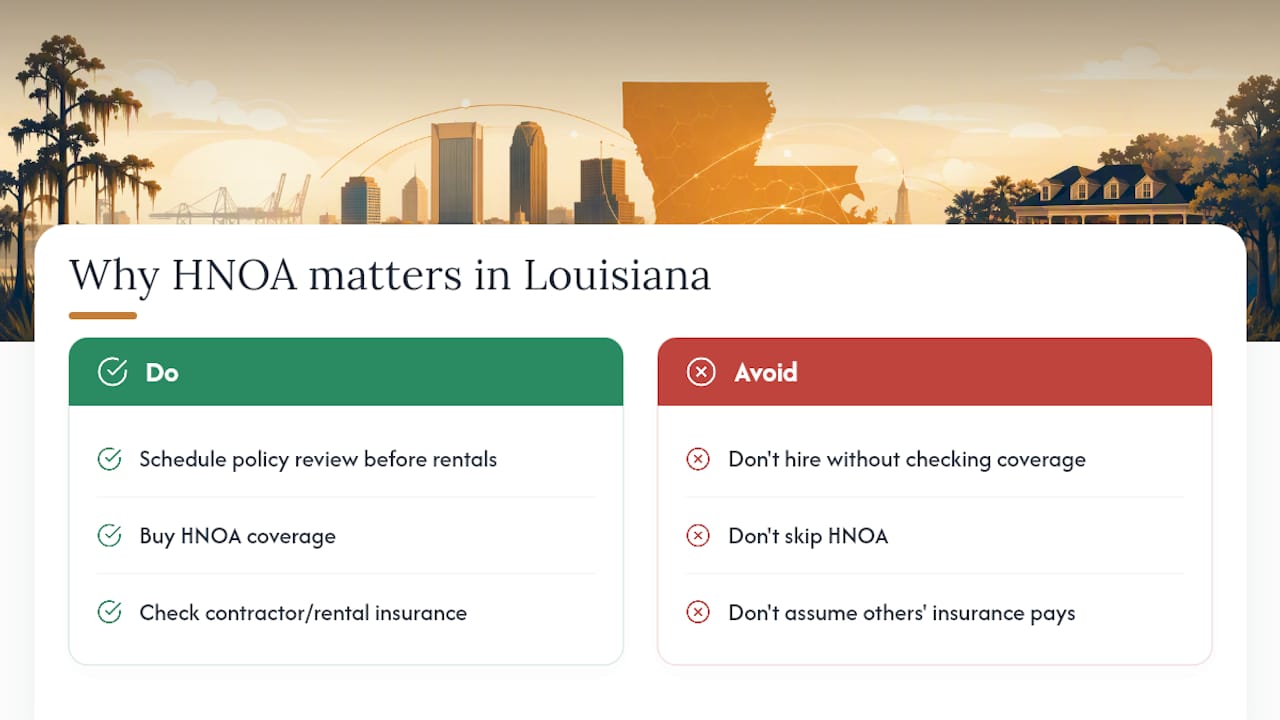
Steve Root has spent more than 20 years watching Louisiana businesses learn this lesson the expensive way, building on a family legacy in this state’s insurance business that goes back 40 years. After hurricanes and floods, we’ve watched businesses hire contractors and rental trucks under pressure, then get named in lawsuits when a driver caused a wreck. HNOA is one of the reasons The Root Agency’s 356 five-star reviews keep growing. It’s cheap protection against a claim that could sink a company.
Schedule a policy review before your next rental or hire.
— Steve Root
Get Your Business Properly Covered Before the Next Claim
The Root Agency is the alternative to guessing your way through commercial coverage. We review your contracts, vendor certificates, and umbrella schedule line by line, then add the exact HNOA endorsement your operation needs, not a generic template pulled from a call center script.
Steve Root’s team has spent over 20 years handling exactly these exposures for Louisiana and Mississippi business owners, backed by 356 five-star Google reviews and a mobile catastrophe response unit that shows up in person after a storm, not weeks later on the phone. We also carry agency liability obligations seriously, which is why we document every endorsement in writing so you’re never relying on a verbal promise. Whether you need HNOA added to an existing policy or a full commercial insurance review, request a quote today and get answers from someone who picks up the phone when it matters.
Sources
For deeper reading on the legal and contractual side of this coverage, consult Cornell’s explanation of respondeat superior and the independent agent’s guide to hired, non-owned, and Drive Other Car coverage.
This article is general information, not a substitute for advice from a qualified financial advisor. Consult a qualified financial professional about your own circumstances before acting on anything here.
- Hired and Non-Owned Auto Insurance (HNOA) | FHIA
- Hired & Non-Owned Auto Coverage Explained: Contracts, COIs and Costly Gaps to Avoid – Insurance Curator