
Golf Cart Insurance for Neighborhood Streets: 2026 Guide
Golf cart insurance for neighborhood streets is defined as specialized coverage that protects owners from liability and property damage when operating a golf cart on public or community roads beyond private property. Your homeowners policy does not cover this. Homeowners insurance excludes liability the moment your cart leaves your driveway and rolls onto a public road, even inside a gated or HOA community. Federal standards from the National Highway Traffic Safety Administration (NHTSA) and state vehicle codes further shape what insurance you need. Getting this wrong means a single accident could expose you to tens of thousands of dollars in out-of-pocket costs.
What insurance coverage options exist for golf carts on neighborhood streets?
Golf cart coverage options fall into four distinct categories, and choosing the wrong one leaves real gaps. Each type serves a different level of use and risk.
Homeowners endorsements add limited golf cart protection to your existing home policy. They typically cost $50–$150 per year but cover only private property use. The moment you drive onto a neighborhood street, that coverage stops.

Standalone liability-only policies are the entry point for on-road protection. Liability-only policies start around $75 per year and cover bodily injury and property damage you cause to others. This is the minimum you need for neighborhood street use.
Full coverage golf cart policies add collision, comprehensive, medical payments, and accessory protection. These policies run $200–$500 annually depending on cart value, location, and usage. For owners with modified or high-value carts, full coverage is the right call.
Low-Speed Vehicle (LSV) auto policies apply when your cart is officially classified and registered as an LSV under NHTSA standards. These policies meet state auto insurance minimums and treat the cart like a street-legal motor vehicle. Florida, for example, requires $10,000 in Personal Injury Protection and $10,000 in Property Damage Liability for LSVs on public roads. Louisiana has its own minimums, and The Root Agency can walk you through exactly what applies in your parish.
| Coverage type | Annual cost | Best for |
|---|---|---|
| Homeowners endorsement | $50–$150 | Private property use only |
| Standalone liability-only | Starting ~$75 | Basic on-road protection |
| Full coverage policy | $200–$500 | High-value or modified carts |
| LSV auto policy | Varies by state | Registered street-legal carts |
Pro Tip: If you drive your cart to a neighbor’s house, to a community pool, or along a shared street, you are on a public road in the eyes of your insurer. A homeowners endorsement will not protect you there.
Which regulations and permits govern golf cart use on neighborhood streets?
Regulations for neighborhood golf cart use come from three levels: federal, state, and local. Each layer adds requirements you must meet before you can legally and safely operate on public roads.
At the federal level, NHTSA defines the LSV classification. A cart qualifies as an LSV if it travels between 20 and 25 miles per hour and meets specific safety equipment standards, including headlights, turn signals, mirrors, seat belts, and a windshield. Carts that do not meet these standards are not street-legal under federal guidelines, regardless of local rules.
State vehicle codes set liability insurance minimums and registration fees. Registration fees typically range from $50 to $155 depending on the state. Louisiana law requires registration for LSVs operated on public roads, and the state sets its own liability minimums that your policy must satisfy.
At the local level, cities and counties add another layer. Many municipalities require annual permits or registration stickers costing $15–$30 beyond state fees. Some jurisdictions restrict golf carts to roads with speed limits of 35 mph or lower. Others ban them from certain roads entirely.
HOAs carry their own authority on top of all of this. HOAs often require proof of insurance and may restrict operating hours, designate specific roads, and set minimum driver age requirements. Violating HOA rules can result in fines even when you are fully compliant with state law.
Operating a golf cart on public roads transforms it from a leisure vehicle into a street vehicle with significantly higher personal liability exposure that must be insured accordingly.
How to assess risk and choose the right coverage level
Risk assessment for neighborhood golf cart use starts with how, where, and how often you drive. A cart used twice a week in a quiet subdivision carries different risk than one used daily in a dense community with heavy foot traffic.
-
Evaluate your usage pattern. How often do you drive on neighborhood streets? Do you carry passengers, including children? The more frequent and complex your usage, the higher your liability exposure.
-
Consider your community density. In dense golf-cart-heavy communities, carrying higher-than-minimum liability limits is advised to manage the increased frequency of interactions. A single pedestrian injury claim can exceed state minimums quickly.
-
Add medical payments coverage. Golf carts have a higher center of gravity and a real rollover risk. Injuries can be severe even at low speeds. Medical payments coverage protects your passengers regardless of fault, which matters when your cart tips on a curb or gets clipped by a car.
-
Include uninsured motorist coverage. Standard homeowners endorsements lack uninsured motorist protection, leaving you exposed if an underinsured driver hits your cart. Standalone and LSV policies can include this coverage. It is one of the most overlooked protections in golf cart insurance.
-
Assess your cart’s value and modifications. Custom sound systems, upgraded seats, enclosures, and lift kits add real value that basic policies do not cover. Accessory coverage prevents financial loss from modifications that significantly increase your cart’s worth. If you have invested in your cart, protect that investment.
Pro Tip: Do not anchor your liability limits to the state minimum. State minimums are the floor, not the standard. In a community where carts share roads with pedestrians and children, carry at least $100,000 in bodily injury liability.
Steps to insure your golf cart for neighborhood street travel
Getting properly insured is a straightforward process when you know what to gather and who to call. Follow these steps to avoid gaps.
-
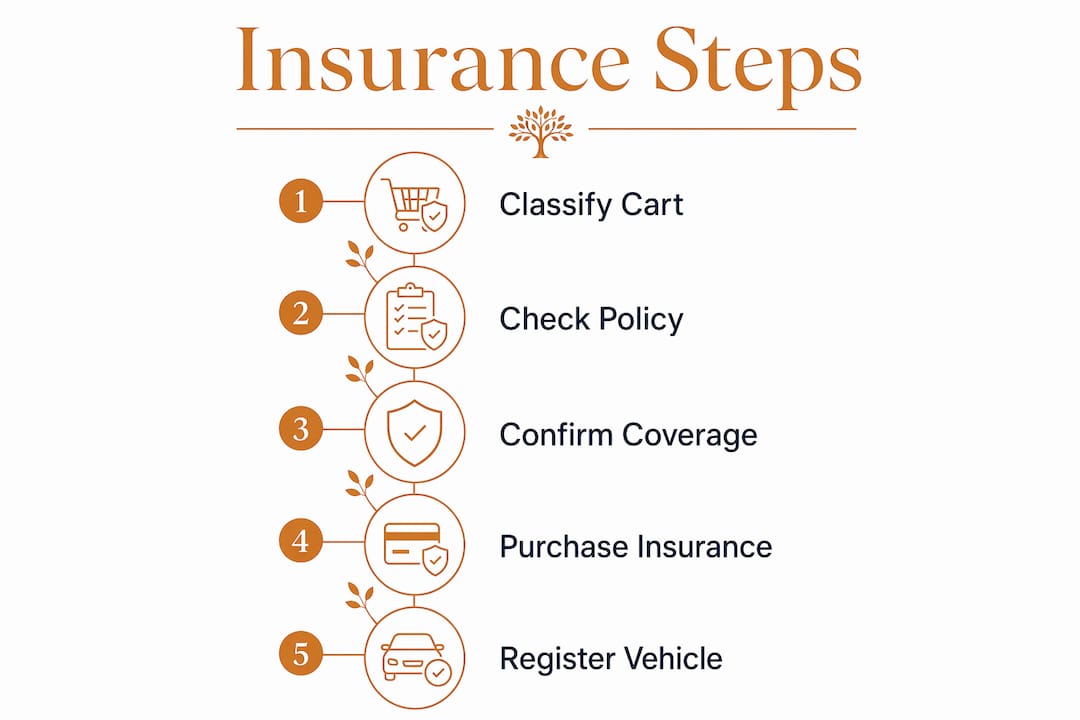
Verify your cart’s classification. Determine whether your cart qualifies as an LSV under NHTSA standards. This affects registration requirements, insurance minimums, and which policy type you need.
-
Check local laws and permit requirements. Contact your city or parish office to confirm road restrictions, permit fees, and any local insurance mandates. Do not assume your state registration covers everything.
-
Gather your cart’s details. Collect the make, model, year, purchase price, and a list of modifications. Note where you store the cart and how frequently you use it on public roads. Insurers use all of this to price your policy accurately.
-
Consult an experienced local agent. A Louisiana-licensed agent familiar with golf cart and LSV coverage understands the specific parish-level rules and state minimums that apply to you. Generic online quotes often miss these details.
-
Request quotes for appropriate coverage. Ask for liability-only, full coverage, and LSV policy options side by side. Compare not just price but what each policy actually covers on neighborhood streets.
-
Review your policy terms carefully. Confirm the policy explicitly covers neighborhood street use, passenger medical payments, and any accessories you have added. If the policy is silent on street use, ask for written confirmation or choose a different policy.
-
Keep your documents accessible. Store your insurance card, registration, and any local permits in your cart. Many municipalities require you to produce these on request.
| Step | What to confirm |
|---|---|
| Classify your cart | LSV or standard golf cart under NHTSA standards |
| Check local rules | Permits, road restrictions, and age requirements |
| Gather cart details | Value, modifications, usage frequency, storage |
| Review policy terms | Street use, passengers, and accessories explicitly covered |
Key takeaways
Golf cart owners who drive on neighborhood streets need a standalone or LSV policy because homeowners insurance excludes public road use entirely, leaving owners without liability, medical, or physical damage protection.
| Point | Details |
|---|---|
| Homeowners policies fall short | Coverage ends at your property line; public road use requires a separate policy. |
| Standalone policies start low | Liability-only golf cart insurance starts around $75 per year for basic on-road protection. |
| LSV classification changes requirements | NHTSA-classified LSVs must meet state auto insurance minimums and carry registration. |
| Medical payments matter | Golf carts carry real rollover risk; medical payments coverage protects passengers regardless of fault. |
| Local rules add layers | Municipal permits, HOA rules, and state registration fees stack on top of each other. |
What 20 years in Louisiana insurance taught me about golf cart coverage
Most golf cart owners I talk to assume their homeowners policy has them covered. They are surprised, and sometimes upset, when I explain that homeowners policies exclude motor vehicle liability on public roads, including inside gated communities. That gap is not a technicality. It is a real financial exposure that I have seen play out badly for families.
The other thing I see constantly is owners who buy the cheapest standalone policy available and stop there. They skip medical payments. They skip uninsured motorist coverage. Then they carry a grandchild in the cart, hit a pothole, and face a medical bill their policy does not touch. Many owners underestimate medical payments coverage because golf carts feel safe and slow. They are not cars, but they are not toys either.
Louisiana communities are full of golf carts. Subdivisions in Baton Rouge, Mandeville, and Covington have them everywhere. That density means more interactions, more risk, and more reason to carry proper limits. The auto insurance gaps that hurt Louisiana drivers on the road hurt golf cart owners the same way, just at lower speeds.
My advice is simple. Buy coverage that matches how you actually use the cart, not how you imagine you use it. If it leaves your driveway, it needs a real policy. The cost difference between a bare-bones endorsement and a proper standalone policy is smaller than most people expect. The difference in protection is enormous.
— Steve Root
The Root Agency’s approach to golf cart and LSV insurance
Golf cart owners in Louisiana and Mississippi deserve coverage that actually works when something goes wrong, not a policy that looks fine until you file a claim.

The Root Agency offers dedicated golf cart insurance and LSV coverage through Allstate, with policies built for neighborhood street use, passenger protection, and accessory coverage. Steve Root has spent more than 20 years helping Louisiana families get this right. The agency holds 356 Google reviews at 4.9 stars and was named to The Advocate’s 2025 Best of Baton Rouge. Call (225) 926-0160 or visit steverootagency.com to get a quote tailored to how you actually use your cart. You can also review the full range of coverage options available for personal and specialty vehicles.
FAQ
Does homeowners insurance cover golf carts on neighborhood streets?
No. Homeowners insurance excludes golf cart liability on public roads, including inside gated or HOA communities. A standalone golf cart policy or LSV auto policy is required for any on-road use.
Do you need insurance for a golf cart in Louisiana?
Yes, if you operate it on public roads. Louisiana requires LSV registration and liability insurance meeting state minimums for any golf cart driven on public streets. Local permits may also apply depending on your municipality.
What is the difference between a golf cart and an LSV?
A Low-Speed Vehicle (LSV) meets NHTSA safety standards and is certified to travel 20–25 mph. Standard golf carts do not meet these requirements and are not street-legal on most public roads without additional modifications and registration.
How much does golf cart insurance cost per year?
Liability-only policies start around $75 per year, while full coverage policies range from $200 to $500 annually. Cost depends on cart value, location, usage frequency, and the coverage limits you choose.
Does golf cart insurance cover passengers?
Only if your policy includes medical payments coverage. Basic liability-only policies cover damage and injury to others, not your own passengers. Adding medical payments coverage protects everyone riding in your cart regardless of who caused the accident.