
Save $350–$900: Search for an Existing Louisiana Elevation Certificate

Whether you need an elevation certificate in Louisiana depends on your flood zone. If you’re building, rebuilding, or renovating in Zone A or V, a certified EC is usually required for your permit and possibly your lender. If you’re not in a high-risk zone, it’s optional but can still lower your flood insurance rate. Before paying for a new survey, check with your parish or city floodplain manager and call your insurance agent. There’s a good chance one already exists on file.
TL;DR:
- Most existing elevation certificates in Louisiana are available from local floodplain managers, permit files, or insurers, saving homeowners money on unnecessary surveys.
- A new certificate is required for new construction, substantial improvements, storm repair, map change requests, or lender demands, regardless of existing records.
- Certified elevation surveys must be conducted and signed by licensed professionals such as land surveyors, engineers, or architects; unlicensed data lacks official validity.
- Residential survey costs typically range from $350 to $900, with higher prices in coastal or hard-to-access areas and for expedited service.
- An approved elevation certificate can lower flood insurance premiums under FEMA’s Risk Rating 2.0 system, especially if actual elevations are better than FEMA’s assumptions.
Table of Contents
- Where to Check First for a Louisiana Elevation Certificate
- When You Must Get a New Elevation Certificate in Louisiana
- Who Can Prepare and Certify an Elevation Certificate in Louisiana
- Typical Cost and Turnaround for a Louisiana Elevation Certificate
- How an Elevation Certificate Affects Flood Insurance Today
- Using an Elevation Certificate for Map Changes and Permits
- How to Order an Elevation Certificate: A Step-by-Step Checklist
- Why a Local Agent Matters More Than the Certificate Itself
- Get Help With Your Elevation Certificate and Flood Policy Review
- Official Forms and Local Contacts Worth Bookmarking
- An Agent’s Perspective on Getting This Right
- Sources
Where to Check First for a Louisiana Elevation Certificate
Most homeowners assume they have to order a brand new survey. That assumption costs people money every year. FEMA’s own guidance points to local floodplain managers as the primary source for existing certificates, and plenty of Louisiana communities have kept these records for decades.
Before you call a surveyor, work through this list:
- Contact your parish or city floodplain manager and ask if an EC is on file for your address.
- Search your own permit file, especially if you built or renovated after 1975.
- Ask the seller, the builder, your lender, or your insurer, since any of them may have received a copy.
- Check your flood zone designation through FEMA’s Flood Map Service Center to confirm your panel and effective date.
In New Orleans, homeowners can request copies from the Department of Safety and Permits, either by email or in person. Other parishes handle requests through their permit or planning offices, so a five minute phone call before you spend money on a new survey is worth the effort every time.
When You Must Get a New Elevation Certificate in Louisiana
An old certificate on file doesn’t always cover you. FEMA guidance notes that an EC generally stays valid unless the building or the surrounding grade has physically changed, but several situations demand a fresh one regardless of what’s already on record.
- New construction or substantial improvement in Zones A or V. Parish and city ordinances typically require a certified EC before final permit approval.
- Permit compliance after storm damage. If repairs qualify as substantial improvement, your local building department will likely ask for updated elevation data.
- LOMA or LOMR submissions. FEMA’s own instructions specify that Section C surveyed elevations are required for most map change requests.
- Optional but smart moves. Lenders sometimes request one at closing, and homeowners chasing a better insurance rate often order one voluntarily.
Who Can Prepare and Certify an Elevation Certificate in Louisiana
Not just anyone can sign a Louisiana EC. State law restricts certification to a licensed Professional Land Surveyor, a registered professional engineer, or an architect qualified to perform the survey work. Local floodplain officials can sometimes complete portions of the form for existing structures, but they cannot certify new elevation data themselves.
Before hiring anyone, run through this checklist:
- Verify the license through the Louisiana Professional Engineering and Land Surveying Board, not just a business card or website claim.
- Ask how many FEMA elevation certificates the firm has completed in your parish specifically.
- Require a written scope: completed FEMA form, sealed signature, dated photographs, stated datum, and how many copies you’ll receive.
- Get a firm turnaround estimate in writing before you pay a deposit.
Pro Tip: A quote that skips the site visit or won’t name the datum reference is a red flag. Every legitimate EC ties elevation measurements to a specific vertical benchmark, and a surveyor who glosses over that detail is cutting corners somewhere else too.
Typical Cost and Turnaround for a Louisiana Elevation Certificate
Straightforward residential jobs in Louisiana commonly run $350 to $900. Coastal parishes, hard-to-access lots, or properties with multiple structures can push that number past $1,000.
A few factors move the price and the clock:
- Distance from the surveyor’s office and site accessibility.
- Number of buildings on the parcel needing separate certification.
- Whether you need permit-stage elevations or final as-built certification.
- Rush requests, which almost always carry a premium.
Ask for a written estimate before work begins, and confirm whether the quoted price includes the sealed PDF and the number of copies you’ll actually need for your insurer and permit office.
How an Elevation Certificate Affects Flood Insurance Today
FEMA’s Risk Rating 2.0 system pulls elevation data from its own datasets by default when it prices your policy. A certified EC can replace that estimate with your property’s actual First Floor Height, and when your real elevation is more favorable than FEMA’s model, your premium can drop.
You don’t need an EC to buy an NFIP policy. But skipping one means you’re rated on FEMA’s assumptions, not your home’s actual numbers. That gap matters most for homes built above minimum flood elevation, where the certificate proves you’re a better risk than the map suggests.
Two sections of the form matter here. Section C requires surveyed elevations from a licensed professional. Section H allows owner-provided measurements in specific limited cases, but insurers generally weight surveyed Section C data far more heavily when calculating a rate.
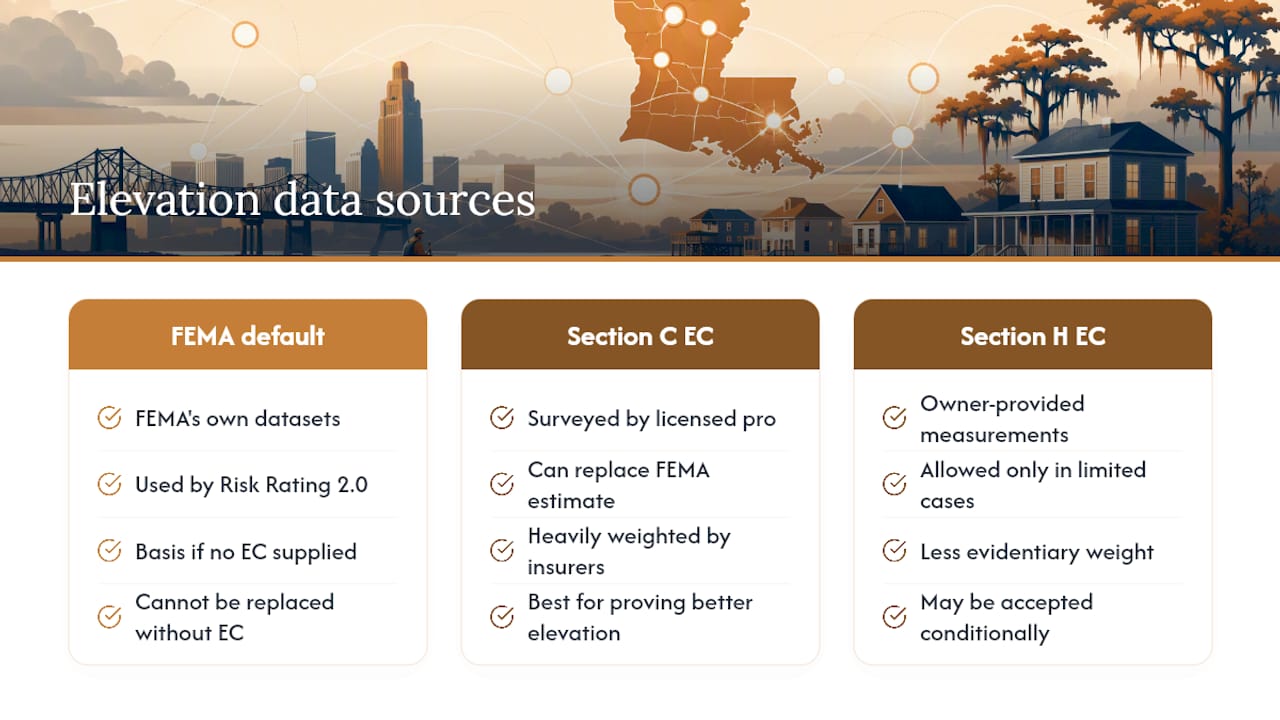
Statistic Callout: Under Risk Rating 2.0, FEMA can adjust your premium once a certified elevation replaces its default dataset estimate, according to FEMA’s own guidance. Whether that adjustment helps you depends entirely on how your actual elevation compares to what FEMA assumed.
Before you spend money on a survey purely for insurance purposes, talk to your agent first. A quick review of your current Risk Rating 2.0 pricing can tell you whether an EC is likely to move the needle before you commit to the cost.
Using an Elevation Certificate for Map Changes and Permits
An EC isn’t just an insurance document. It’s the backbone of several official processes homeowners run into after a storm, a remap, or new construction.
- LOMA and LOMR-F requests. FEMA requires the certified EC to include correct datum references and supporting exhibits, and mismatched benchmarks can delay a review for months.
- Community record-keeping. Parishes participating in FEMA’s Community Rating System keep ECs on permit files, which supports the discounts that entire community earns.
- Post-storm and post-construction submissions. Expect your parish or city permit office to request a copy for the file, and expect that copy to matter the next time you sell the home or file a claim.
How to Order an Elevation Certificate: A Step-by-Step Checklist
Before you call a surveyor, gather your address, parcel number, prior permit records, and the reason you need the EC, whether that’s a lender request, a permit, or an insurance re-rate.
On site, the surveyor will establish a benchmark, measure your first floor height against the lowest adjacent grade, and photograph the required elevation reference points, following procedural steps for obtaining elevation certificates.
- Confirm before the appointment whether interior access is needed for accurate first floor height readings.
- Require a sealed, completed FEMA form as your deliverable, not just a summary letter.
- Ask for enough copies to cover your insurer, your lender, and your parish permit file.
- Once delivered, submit copies promptly. A certificate sitting in an email folder helps no one.
Pro Tip: Keep a digital and printed copy of your finished EC permanently. You’ll need it again the next time you refinance, sell, or file a flood claim, and tracking one down years later costs far more than saving it now.
Why a Local Agent Matters More Than the Certificate Itself
An elevation certificate is a piece of paper until someone knows how to use it. I’ve watched homeowners pay for a survey and then sit on the results for months because nobody walked them through submitting it for a rate review. That’s where a local agent earns their keep, not by selling you a policy, but by knowing exactly which form section moves your premium and which parish office needs a copy for your permit file.
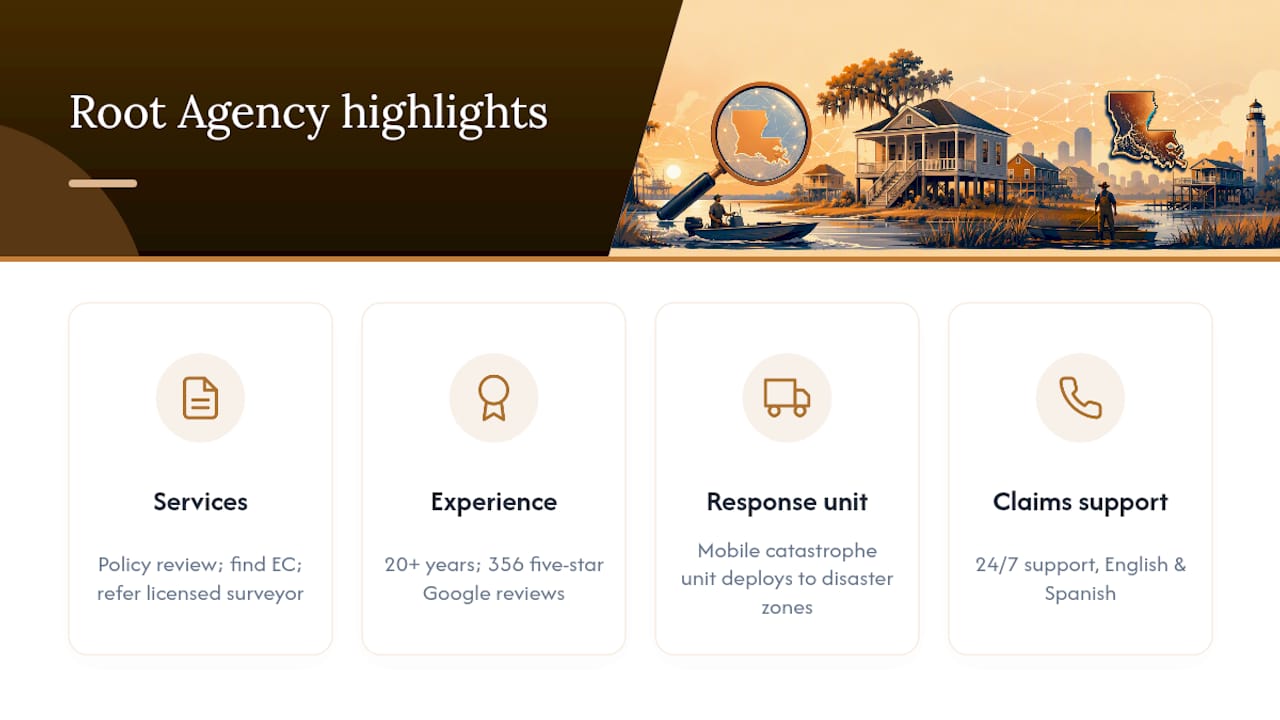
The Root Agency handles that legwork directly: reviewing your current flood policy, uploading your EC for re-rating consideration, and connecting you with licensed surveyors when you need a new one. We’ve built that process around two decades of watching Louisiana homeowners get it wrong the hard way, and around a mobile catastrophe response team that shows up in person, not a call center in another state.
Get Help With Your Elevation Certificate and Flood Policy Review
The Root Agency is the local alternative to shopping flood insurance blind. Instead of guessing whether your elevation certificate will actually lower your premium, we review your current policy, help you track down an existing EC, or point you to a licensed surveyor if you need one built from scratch.

Steve Root has spent more than 20 years writing flood policies for Louisiana homeowners who learned the hard way what underinsurance costs. That experience, backed by 356 five-star Google reviews and a mobile catastrophe response unit that deploys directly to disaster zones, means someone actually answers when your claim matters most. We offer 24/7 claims support and bilingual service in English and Spanish, because a flood doesn’t wait for business hours.
If you’re sitting on an old elevation certificate wondering whether it could lower your rate, or you’re starting from zero and need direction, visit our flood insurance page or call (225) 926-0160. We’ll tell you plainly whether a new certificate is worth the cost before you spend a dollar on one.
Official Forms and Local Contacts Worth Bookmarking
Download the FEMA Elevation Certificate form, verify a surveyor through LAPELS, and contact your parish floodplain manager directly for permit file records before ordering anything new.
An Agent’s Perspective on Getting This Right
Every homeowner I’ve talked to about elevation certificates has the same first instinct: pay for a new one immediately. That instinct is almost always premature. The record search costs nothing, and a phone call to your parish floodplain office takes less time than filling out an online insurance quote form. Skipping that step is the single most common way Louisiana homeowners waste a few hundred dollars they didn’t need to spend.
The bigger misconception, though, is thinking an EC alone fixes your insurance rate. It doesn’t. It’s raw data. What actually moves your premium is someone comparing that data against your current flood insurance requirements and FEMA’s Risk Rating 2.0 assumptions, then submitting it correctly. I’ve seen certificates sit in a drawer for years, doing nothing, simply because nobody connected the dots between the survey and the policy.
Louisiana homeowners who’ve been through a storm already know that paperwork done halfway is worse than no paperwork at all. An elevation certificate is only as useful as the person who knows what to do with it next.
— Steve Root
Sources
- Get an elevation certificate | National Flood Insurance Program
- Louisiana Flood Certification: Elevation Certificate Cost | Find Land Surveyor
- Permits & Licenses - Building - Elevation Certificates | City of New Orleans