
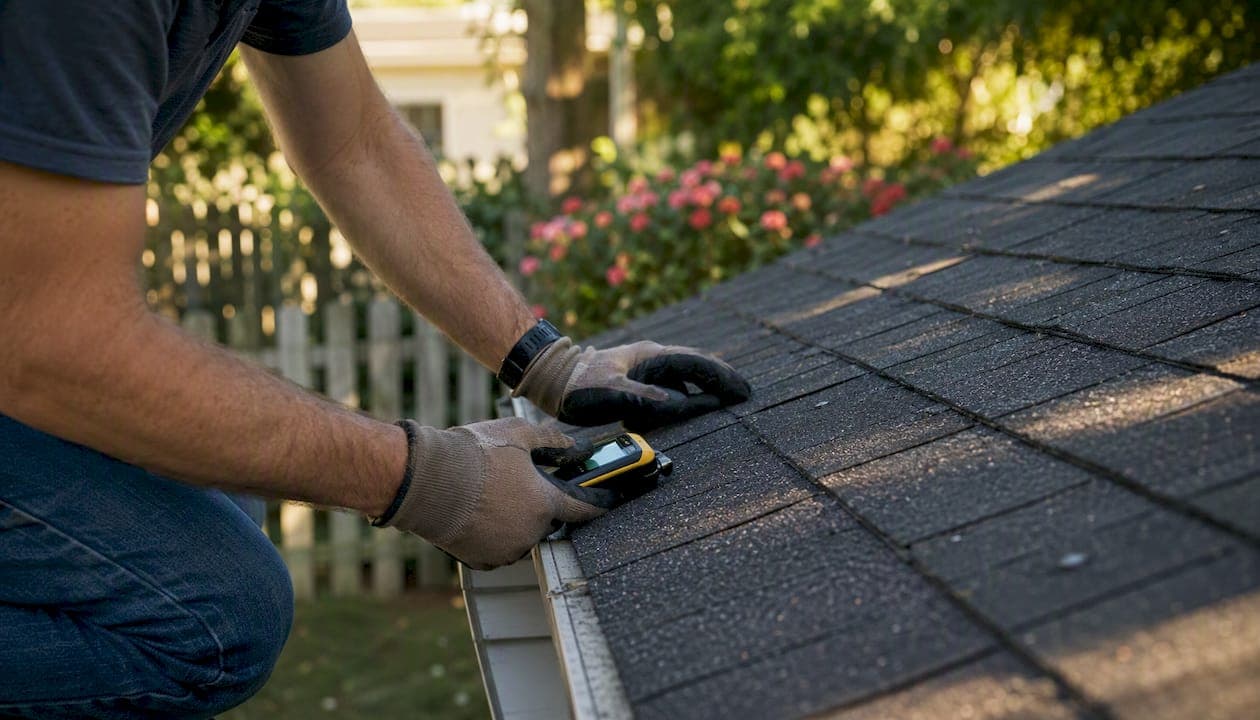
Wind Mitigation Inspection Mistakes LA & MS Homeowners Make
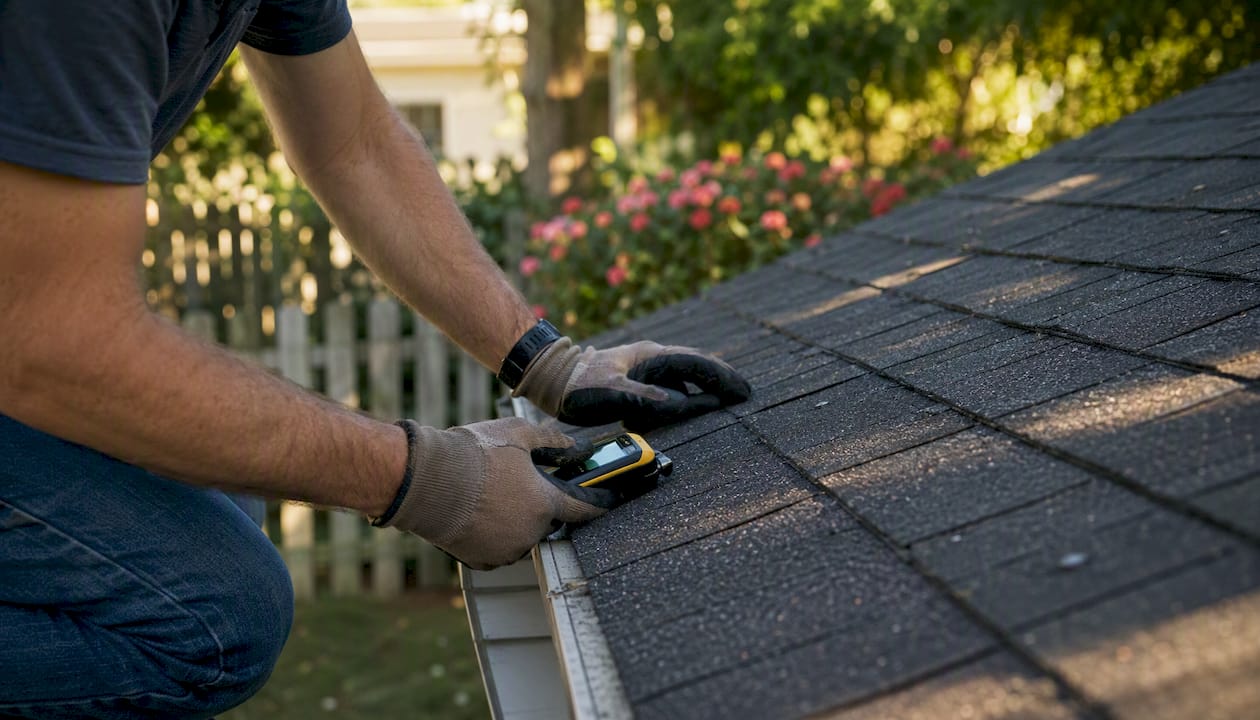
The single most common wind mitigation inspection mistake is missing or incomplete documentation. Homeowners schedule the inspection, the inspector shows up, and then credits get marked “unknown” because there are no permits, no contractor invoices, and no labeled photos to prove what was actually installed. The fix is straightforward: assemble your permit PDFs, contractor invoices with product approval numbers, and at least three labeled attic photos before the inspector ever sets foot on your property.
The next three highest-cost mistakes are:
- Hiring an unqualified inspector who is unfamiliar with the current OIR-style form, resulting in a report carriers reject or discount
- Scheduling the inspection before permit closeout, so public records are incomplete and credits cannot be verified
- Blocking attic or garage access, which forces the inspector to mark key features as unverifiable
Your action item for today: log into your parish permitting portal, download your roof permit PDF, and take three dated photos of your attic showing roof-to-wall connectors. That alone puts you ahead of most homeowners.
Key Takeaways
Documentation assembled before the inspection is the single factor that most determines whether wind mitigation credits are applied, denied, or downgraded at the carrier level.
| Point | Details |
|---|---|
| Documentation comes first | Permits, invoices, and labeled photos must be ready before the inspector arrives. |
| Form validity is five years | The completed OIR-style form is valid for five years unless material changes occur to the home. |
| Inspector qualifications matter | Verify hurricane mitigation training and familiarity with the April 1, 2026 form before booking. |
| A low score is fixable | Request the PDF, gather missing documents, prioritize high-ROI retrofits, then reinspect. |
| The Root Agency | Submits reports, interprets findings, and coordinates reinspection for Louisiana and Mississippi homeowners. |
Table of Contents
- Why wind mitigation inspections matter for Louisiana and Mississippi homeowners
- What are the most common wind mitigation inspection mistakes?
- How to prepare your home and paperwork before the inspector arrives
- Choosing a qualified wind mitigation inspector: what to verify and what to ask
- What insurers expect to see in documentation and photos
- What to do if your inspection returns a low score
- A printable homeowner checklist: avoid these mistakes before, during, and after the inspection
- What I’ve learned after 20 years of Louisiana insurance
- The Root Agency helps you get wind mitigation credits applied correctly
- Sources
Why wind mitigation inspections matter for Louisiana and Mississippi homeowners
Louisiana sits in the bullseye for hurricanes. So does coastal Mississippi. A wind mitigation inspection documents the wind-resistant construction features of your home and gives your insurer the verified proof it needs to apply premium credits. Without that documentation, carriers assume the worst and price accordingly.
The inspection covers six specific areas: roof covering, roof deck attachment, roof-to-wall connections, roof shape, secondary water resistance (SWR), and opening protection. Each one carries its own credit potential. Roof-to-wall connectors alone are often the largest single credit driver on the entire report.
Statistic callout: Per the Florida CFO consumer guide, a completed Uniform Mitigation Verification Inspection Form is valid for five years unless material changes occur to the home. A new form was approved for use on or after April 1, 2026.
The form used is the Uniform Mitigation Verification Inspection Form, updated by the Office of Insurance Regulation (OIR). Louisiana and Mississippi carriers increasingly recognize this OIR-style form as the standard for applying credits. Having a local agent who understands how to submit it correctly and follow up with the underwriter is the difference between a credit that lands on your bill and one that sits in a file somewhere.
Pro Tip: Ask your agent to confirm which form version your carrier currently accepts before you schedule the inspection. The April 1, 2026 form update changed several documentation fields, and an older form may not trigger the full credit.
What are the most common wind mitigation inspection mistakes?
-
Missing permits and contractor invoices. No paper trail means no credit. Inspectors mark features “unknown” when they cannot verify installation through public records or contractor documentation. Fix: Pull your roof permit from the parish office and request a final invoice with product approval numbers from your contractor.
-
Unlabeled or missing photos. Photos without dates, location labels, or context are often rejected by underwriters. Fix: Label every photo with the feature name, date, and location (e.g., “NW corner roof-to-wall connector, March 2025”).
-
Hiring an inspector unfamiliar with the current form. Inspectors who rush or who do not know the updated OIR-style form are a frequent cause of missed credits. Fix: Ask for a sample completed report with photos before you hire.
-
Inspecting before permit closeout. If the permit is still open, public records are incomplete and carriers often reject credits. Fix: Confirm permit closure with your parish office before scheduling.
-
Confusing wind mitigation with a 4-point inspection. A 4-point inspection evaluates current system condition for underwriting; wind mitigation documents construction features for discounts. They are separate reports with separate purposes. Fix: Order both if your carrier requires both, but never submit one in place of the other.
-
Blocked attic or garage access. Painted-shut hatches and stored boxes in front of the attic entry regularly prevent verification of connectors and deck attachment. Fix: Clear access at least 48 hours before the inspection.
-
Assuming a visible roof covering proves underlayment or connectors. Once shingles are down, an inspector cannot see what is underneath without a permit or contractor release photo taken during installation. Fix: Request installation-stage photos from your roofer before they leave the job site.
-
Incomplete opening protection documentation. Impact windows and doors require product approval numbers and installation permits. Without them, the opening protection line item defaults to the lowest credit tier. Fix: Collect product approval numbers from window and door manufacturers and attach them to your permit file.
-
Failing to send the completed report to your insurer. The inspection is not the finish line. Credits only apply when the carrier receives and processes the form. Fix: Submit the PDF to your agent the same day you receive it and request written confirmation that it was forwarded to the underwriter.
-
Letting the inspector skip required photos. Some inspectors complete the form without photographing every required feature. Fix: Walk the inspection with the inspector and confirm photos are taken of each of the six inspection areas before they leave.
Pro Tip: For roof-to-wall connectors, the best photos show the connector itself, the fasteners into the top plate, and the rafter or truss it attaches to, all in a single frame. A flashlight and a wide-angle smartphone lens get you there without opening the deck.
Pro Tip: Coordinate your inspection date with your contractor’s permit closeout date. A one-week gap between permit closure and inspection day is enough buffer for public records to update.
How to prepare your home and paperwork before the inspector arrives
The single highest-impact preparation is assembling your permits and contractor invoices and making the attic accessible. Everything else is secondary.
Before inspection day:
- Pull the roof permit from your parish permitting office (most Louisiana parishes now offer online downloads)
- Collect the contractor’s final invoice showing installation dates and product approval numbers
- Gather impact window and door product approval numbers and installation permits
- Download any prior wind mitigation report if one exists, even if it is expired
- Confirm the attic hatch opens freely and is not blocked by insulation batts or stored items
- Clear a path to the garage door track and any secondary entry points
Photo preparation:
- Take dated photos of roof-to-wall connectors, roof deck attachment, and any SWR underlayment visible at the eave edge
- Use your smartphone’s timestamp feature or write the date on a notecard held in frame
- Save files with a naming convention: feature_location_date (e.g., “connector_NW_corner_2026-03-15.jpg”)
Pro Tip: Set your smartphone camera to embed GPS coordinates in the photo metadata. It takes 30 seconds in settings and gives underwriters a verifiable location stamp they cannot dispute.
Choosing a qualified wind mitigation inspector: what to verify and what to ask
Verify that the inspector holds statutory hurricane mitigation training and uses the current OIR-style form before you book. Per OIR guidance, accepted inspector types include licensed home inspectors with approved hurricane mitigation training, licensed contractors, licensed professional engineers or architects, and certified building code inspectors.
Verification checklist:
- Confirm license type and number through your state licensing board
- Ask specifically about hurricane mitigation training hours and exam completion
- Request a sample completed report that includes photos for all six inspection areas
- Confirm familiarity with the April 1, 2026 form update
- Ask for references from Louisiana or Mississippi homeowners or local contractors
Questions to ask before booking:
- Which version of the Uniform Mitigation Verification Inspection Form do you use?
- Do you photograph all six inspection areas, including connectors and deck attachment?
- How do you handle features that require permit verification?
- Will you provide the completed PDF the same day?
- Have you completed inspections in this parish before?
Request the completed PDF report immediately after the inspection. Do not wait for a mailed copy.
What insurers expect to see in documentation and photos
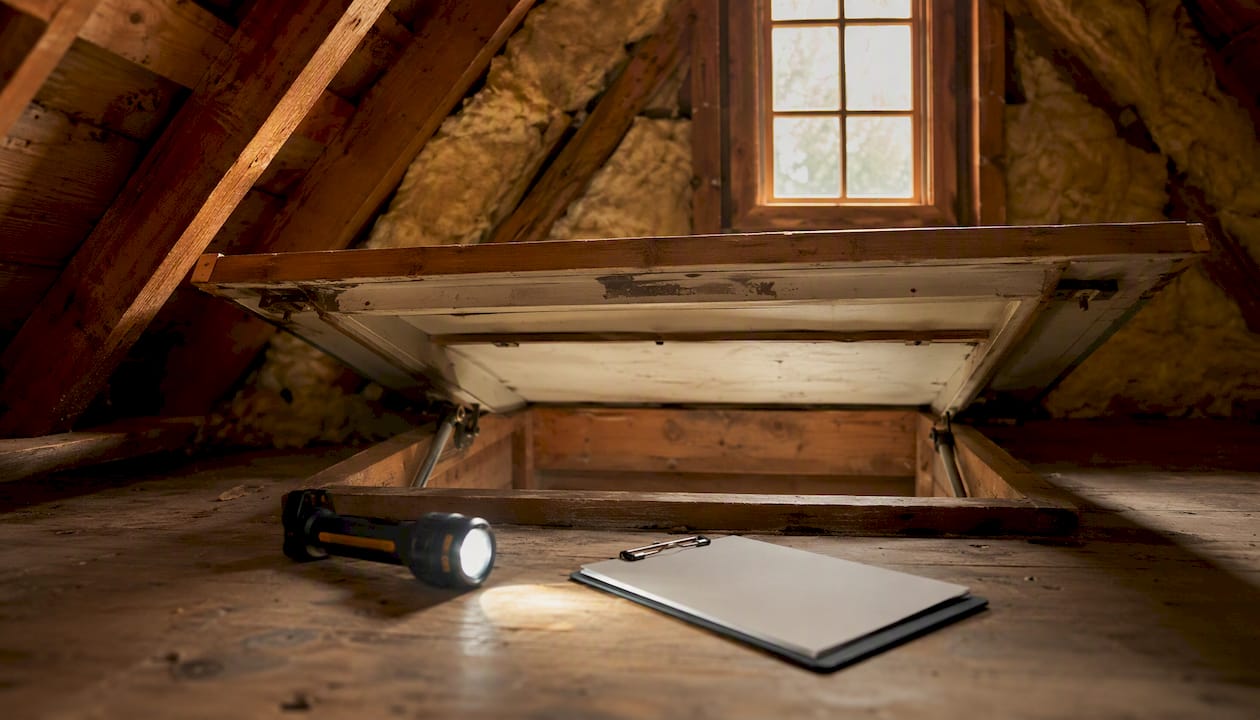
Insurers require clear, dated proof: permits, invoices, product approval numbers, and labeled photos tied directly to line items on the form. Vague or undated photos are the most common reason credits are downgraded after submission.
| Mitigation Feature | Acceptable Documentation |
|---|---|
| Roof-to-wall connectors | Labeled photo of connector and fasteners; contractor invoice noting connector type |
| Secondary water resistance (SWR) | Permit with SWR notation; contractor invoice; installation-stage photo at eave |
| Opening protection | Product approval numbers; installation permit; labeled photo of each protected opening |
| Roof deck attachment | Permit specifying nail size and spacing; contractor invoice; installation-stage photo |
| Roof covering | Permit; contractor invoice with product approval number; labeled photo of shingle type |
| Roof shape | Inspector measurement and photo; no additional homeowner document typically required |
Submission checklist:
- Completed OIR-style form (PDF) from the inspector
- Permit copies for roof, windows, and doors
- Contractor invoices with product approval numbers and installation dates
- Labeled, dated photos for each of the six inspection areas
- Written confirmation from your agent that the carrier received and processed the form
Keep digital copies of everything for five years. The form itself is valid for five years absent material changes, per the Florida CFO consumer guide, and you may need to produce supporting documents if the carrier audits the credits at renewal.
What to do if your inspection returns a low score
A low score is a roadmap, not a denial. Start with documentation, then cost-effective retrofits, then reinspection.
- Request the full PDF immediately and review which line items are marked “unknown” or at the lowest credit tier.
- Gather missing permits and invoices for any feature marked unknown. Sometimes the credit is already there; it just was not documented.
- Get contractor estimates for the highest-ROI upgrades. Roof-to-wall connectors and opening protection typically deliver the largest credit improvements relative to installation cost.
- Coordinate permit closure before scheduling reinspection. Confirm with your parish office that all permits are closed and reflected in public records.
- Schedule reinspection after permit closeout, allowing at least one week for records to update.
- Submit the new report to your agent the same day and request written confirmation of the updated credit.
Pro Tip: Time your reinspection for the same billing cycle as your policy renewal. Credits applied mid-term are prorated; credits applied at renewal take full effect immediately.
The Root Agency can help you interpret a low-score report, identify which upgrades carry the best insurance ROI, and submit the updated form directly to your carrier. Call us at (225) 926-0160 or visit Steverootagency to talk through your options.
A printable homeowner checklist: avoid these mistakes before, during, and after the inspection
The objective is simple: document, verify, submit.
Before the inspection:
- [ ] Download roof permit from parish permitting portal
- [ ] Collect contractor invoice with product approval numbers and installation dates
- [ ] Gather window and door product approval numbers and installation permits
- [ ] Clear attic hatch and confirm it opens freely
- [ ] Clear path to garage door track and secondary entries
- [ ] Take dated photos of connectors, deck edge, and any visible SWR underlayment
- [ ] Confirm inspector’s license and hurricane mitigation training
At the inspection:
- [ ] Walk the inspection with the inspector
- [ ] Confirm photos are taken for all six inspection areas
- [ ] Provide permit and invoice copies on the spot
- [ ] Request the completed PDF before the inspector leaves
After the inspection:
- [ ] Submit the PDF to your agent the same day
- [ ] Request written confirmation the carrier received and processed the form
- [ ] Save digital copies of the report, permits, and invoices for five years
- [ ] Confirm the credit appears on your next policy statement or renewal declaration
Keep a folder, physical or digital, labeled with your address and inspection date. If your carrier questions a credit at renewal, that folder is your defense.
What I’ve learned after 20 years of Louisiana insurance
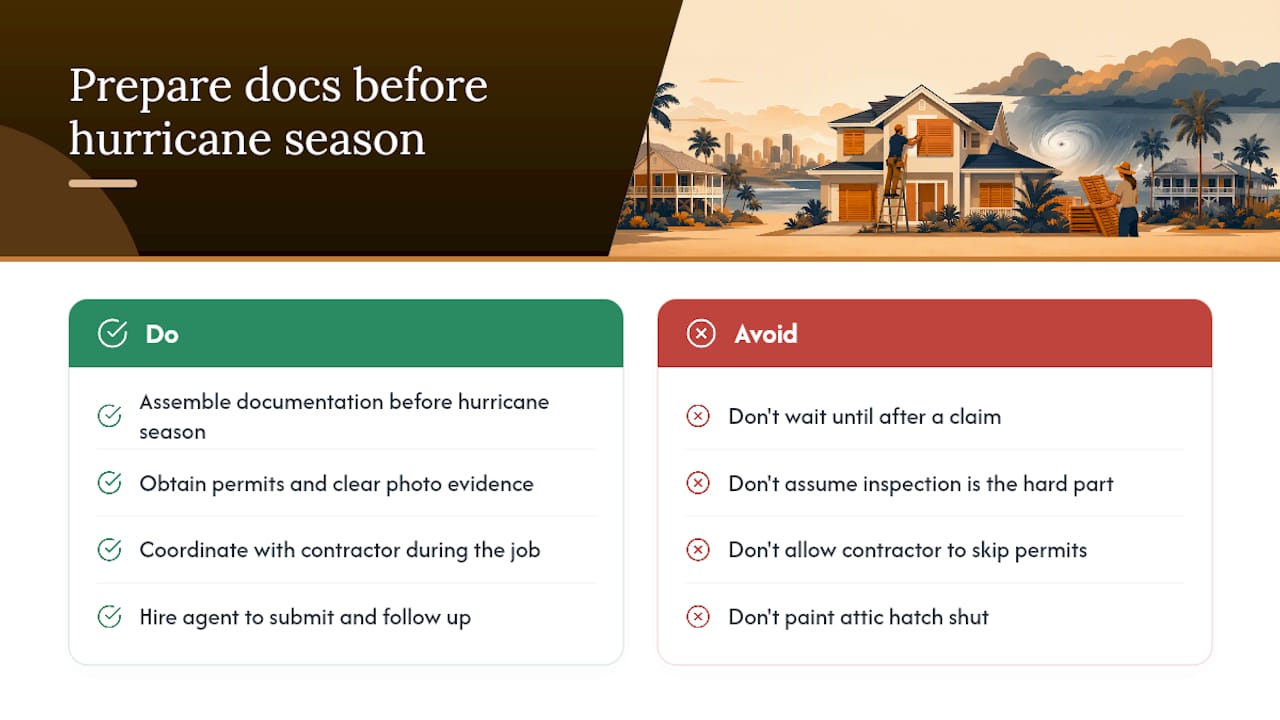
Most homeowners I talk to assume the inspection is the hard part. It is not. The hard part is the paperwork that should have been gathered before the inspector arrived. I have seen homeowners with genuinely hurricane-resistant roofs walk away with minimal credits because their roofer never pulled a permit or because the attic hatch was painted shut for a decade.
The 2026 OIR form update raised the documentation bar. Carriers now expect more specific photo evidence and clearer permit trails than they did five years ago. That is not a burden if you are prepared. It is actually an opportunity, because a well-documented home in Louisiana or Mississippi can see meaningful premium relief that compounds at every renewal.
What I tell every homeowner who calls us after a storm: the time to build your documentation file is before the next hurricane season, not after the next claim. Coordinate with your contractor during the job, not six months later when they have moved on to the next project. And work with an agent who knows how to submit the report correctly, follow up with the underwriter, and confirm the credit actually landed.
The common complaints Louisiana homeowners face with carriers almost always trace back to documentation gaps, not the quality of the home itself.
The Root Agency helps you get wind mitigation credits applied correctly
Getting the inspection done is step one. Getting the credits applied to your policy is where most homeowners lose ground, and where The Root Agency earns its place.

We review your completed wind mitigation report, identify any documentation gaps before submission, and submit directly to your Allstate underwriter with the supporting permits and invoices attached. If the report comes back with low scores, we help you prioritize the retrofits with the best insurance ROI and coordinate the reinspection timeline. Steve Root has more than 20 years of Louisiana insurance experience, 356 five-star Google reviews, and a catastrophe response team that has deployed RVs to disaster zones across the state. When you bring your report to us, bring your policy, your most recent mitigation report if you have one, and your permit and invoice PDFs. We will take it from there. Start with a home insurance policy review or call us directly at (225) 926-0160.
Sources
The official forms, guidance documents, and inspection references below are the most reliable starting points for Louisiana and Mississippi homeowners.
- Premium discounts for hurricane loss mitigation - Florida CFO consumer guide
- Windstorm Mitigation in Florida: What It Is and Why It Can Lower Your Insurance - Hurricane Safety Program
- Wind Mitigation Inspection: Why It’s Essential for Protecting Your Home and Lowering Insurance Costs - Florida Inspection Solutions, LLC
- Wind Mitigation Explained: How It Strengthens Homes and Saves Money
The five-year validity window on a completed form means an older report may still be acceptable at renewal, provided no material changes have occurred. Confirm with your carrier or agent whether your existing report remains current before scheduling a new inspection.
This article is general information, not a substitute for advice from a qualified financial advisor. Consult a qualified financial professional about your own circumstances before acting on anything here.
Recommended
- First Home Insurance Policy Setup: A Louisiana Guide | The Root Agency
- Renters vs. Homeowners Insurance: What’s the Difference? | The Root Agency
- Homeowners Insurance Cobertura: What Louisiana Homeowners Need to Know | The Root Agency
- How Anti-Concurrent Causation Clause Works: What Louisiana Homeowners Must Know | The Root Agency