

Does a Certificate of Insurance Make You an Additional Insured?

A certificate of insurance does not make you an additional insured. It never has. That piece of paper only tells you a policy exists, who wrote it, and when it expires. The actual protection, the right to defense and indemnity if a claim lands on your desk, comes from an endorsement attached to the other party’s liability policy, not from the certificate itself.
If you’re a landlord, general contractor, or business owner in Louisiana or Mississippi relying on a certificate of insurance additional insured notation to protect you, you’re standing on a piece of paper that “confers no rights upon the certificate holder,” in the ACORD form’s own words. Here’s what to do instead:
- Ask the vendor, contractor, or tenant’s insurance agent for the actual additional insured endorsement, not just the certificate.
- Confirm which endorsement form was used. CG 20 10 and CG 20 37 are the two you’ll see most often, and they cover different time periods.
- Save that endorsement with your signed contract, not in a folder you’ll never open again.
Key Takeaways
A certificate of insurance only proves a policy exists; actual additional insured protection comes exclusively from an endorsement like CG 20 10 or CG 20 37 attached to the underlying policy.
| Point | Details |
|---|---|
| COI is not coverage | The certificate confers no rights on its own; request the actual endorsement from the insurer. |
| Know your endorsement forms | CG 20 10 covers ongoing operations; CG 20 37 covers completed operations, closing the post-project gap. |
| Contract language needs backup | “Primary and noncontributory” and “waiver of subrogation” only matter if a matching endorsement exists. |
| Re-check long projects | Policies can lapse or change mid-project, so verify coverage periodically, not just at signing. |
| Get a local expert’s review | The Root Agency reviews COIs and endorsements for Louisiana and Mississippi clients, backed by Steve Root’s 20+ years of local experience. |
Table of Contents
- Additional Insured vs. Certificate Holder: What’s the Real Difference?
- What Do CG 20 10, CG 20 37, and Other Endorsements Actually Cover?
- Who Asks for Additional Insured Status, and What Should the Contract Say?
- How Do You Verify a COI Actually Gives You Additional Insured Coverage?
- Where Additional Insured Coverage Falls Short
- Why the Paperwork Alone Never Protects You
- How The Root Agency Helps You Confirm the Right Coverage
- Sources
Additional Insured vs. Certificate Holder: What’s the Real Difference?
An additional insured has actual liability protection under someone else’s policy. If a claim arises from the named insured’s operations, the additional insured can call on that policy for defense and indemnity, up to its limits, according to Investopedia’s coverage of the mechanics. A certificate holder or “additional interest” gets something far thinner: notice. The insurer will tell them if the policy cancels, and that’s the extent of it. Being listed as a certificate holder never gives you the right to file a claim, according to illumend’s breakdown of the distinction.
This confusion causes real disputes. Plenty of business owners assume that having their name printed on a COI means they’re covered if something goes wrong. It doesn’t. Coverage lives in the endorsement, period.
Here’s how it plays out in practice:
- A landlord gets added as an additional insured on a tenant’s general liability policy so that if a customer slips in the tenant’s leased space, the landlord isn’t left defending the claim alone on his own dime.
- A general contractor requires additional insured status on every subcontractor’s policy before work begins, so a roofing sub’s mistake doesn’t become the GC’s liability exposure.
- A wedding venue or event hall requires the caterer or vendor to name the venue as additional insured, protecting the property owner if a guest is injured because of the vendor’s negligence.
What Do CG 20 10, CG 20 37, and Other Endorsements Actually Cover?
The endorsement form printed on the policy, not the box checked on a COI, decides whether you’re protected and for how long. A handful of standard ISO forms cover almost every situation you’ll run into in Louisiana or Mississippi construction, leasing, and vendor contracts:
- CG 20 10 grants additional insured status for liability arising from ongoing operations, meaning while the work is actively happening.
- CG 20 37 extends that protection to completed operations, covering claims that surface after the job is finished, which matters enormously for construction defects that show up months later.
- CG 20 11 covers managers or lessors of premises, common for landlords adding themselves to a tenant’s policy.
- CG 24 04 is the waiver of subrogation endorsement, which stops the insurer from turning around and suing the additional insured to recover what it paid out.
The timing gap between CG 20 10 and CG 20 37 trips up more people than any other part of this process, according to LegalClarity’s certificate-reading guide. A roofer’s work might look fine on completion day and fail eighteen months later. If that roofer’s policy only carries CG 20 10, the building owner has no coverage for that delayed claim. For any project with a real chance of latent defects, ask for both endorsements or a blanket form covering both timeframes.
Who Asks for Additional Insured Status, and What Should the Contract Say?

General contractors, landlords, event venues, and clients hiring outside vendors are the parties who typically require additional insured status before work begins or a lease gets signed. It’s standard risk allocation, not a sign that anyone doubts your competence. The GC who skips this step on every subcontractor is the one taking the real gamble.
Contracts that actually deliver protection use specific language, not vague assurances. Watch for these phrases and make sure they show up as real endorsements, not just promises in an email:
- “Additional insured by endorsement” — confirms coverage exists on the policy itself, not just a verbal agreement.
- “Primary and noncontributory” — means the other party’s policy pays first, before your own insurance gets touched. Without this language, your carrier could get stuck sharing the loss.
- “Waiver of subrogation” — blocks the insurer from suing you after paying a claim, closing a backdoor risk that catches a lot of Louisiana business owners off guard.
Noting these terms on a certificate isn’t enough on its own. If the underlying policy doesn’t carry the matching endorsement, that language may not hold up when a claim gets contested.
How Do You Verify a COI Actually Gives You Additional Insured Coverage?
Before you sign a contract or let a contractor start work on your property, run through this checklist. It takes fifteen minutes and can save you months of dispute later.
- Read the ACORD 25 carefully. Check the insurer’s name, policy number, and effective and expiration dates. Look at the “ADDL INSD” column. A checked box there is a signal, not proof.
- Check the Description of Operations box. This is where required endorsements, project details, and language like “primary and noncontributory” usually get referenced, according to LegalClarity’s guide to certificates. But a mention here still isn’t the endorsement itself.
- Request the actual endorsement document. Ask specifically whether it’s CG 20 10, CG 20 37, CG 20 11, or another form. Get it in writing, not a verbal confirmation over the phone.
- Confirm primary/noncontributory and waiver of subrogation endorsements exist, if your contract requires them, since a COI note alone won’t hold up in a contested claim.
- Get written confirmation from the issuing agent, then file the COI and endorsement with your signed contract. For projects lasting more than a few months, re-check coverage periodically. Policies lapse, get canceled, or change carriers mid-project more often than people expect.
Pro Tip: When something on a COI doesn’t add up, or a contractor hesitates to produce the actual endorsement, call your local agent for a quick review before you sign anything, like the team at StappInsurance who specializes in agent services and COI assistance. Steve Root’s team at The Root Agency has walked enough Louisiana contracts through this exact process to spot a gap in about the time it takes to read the document.
Where Additional Insured Coverage Falls Short
Additional insured status has real limits, and assuming otherwise is how homeowners and business owners end up underinsured after a claim hits. Coverage applies only to liability arising from the named insured’s operations. If you, as the additional insured, are independently negligent, your own actions likely fall outside that protection.
- Coverage can end at project completion unless a completed-operations endorsement like CG 20 37 is in force.
- Policy limits still cap what’s available, and if the endorsement isn’t primary and noncontributory, your own policy could end up paying first anyway.
- Vague or missing endorsement language is exactly how coverage disputes start. Insurers will read the fine print closely when money is on the line, and so should you.
Why the Paperwork Alone Never Protects You
Most people treat a certificate of insurance like a finish line. It isn’t. It’s a receipt telling you a policy was in force on a given date, nothing more. The real work, requesting the specific endorsement, confirming the form number, checking whether it’s primary and noncontributory, happens after the certificate lands in your inbox, not instead of it.
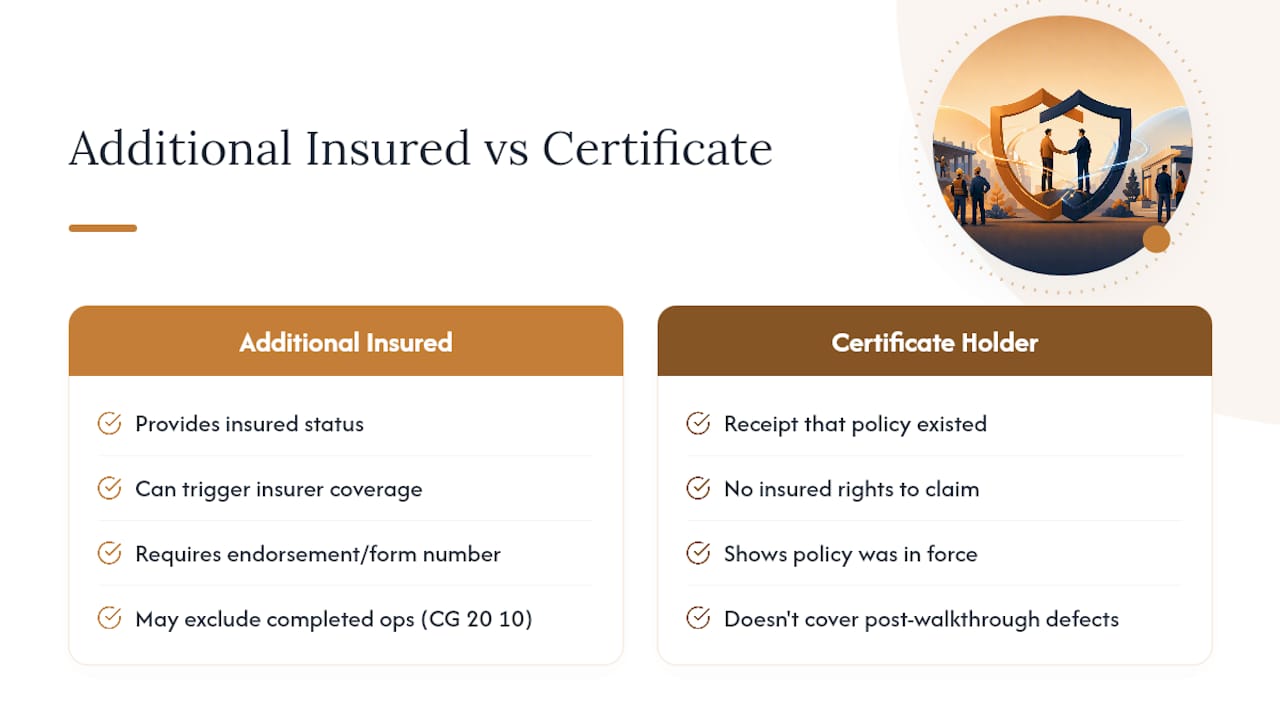
What gets overlooked most in Louisiana and Mississippi contracts isn’t the additional insured request itself. It’s the completed-operations gap. A contractor who only carries CG 20 10 looks fully covered on paper right up until a defect surfaces a year after the final walkthrough, and by then the ongoing-operations endorsement has nothing left to say about it. Homeowners rebuilding after hurricane damage, and business owners bringing in multiple trades on tight timelines, are exactly the people who get burned by this gap because nobody asked the second question.
The habit worth building isn’t complicated: request the endorsement, read the form number, and keep a copy with the signed contract. Twenty years of reviewing Louisiana policies has shown that the people who ask that one extra question almost never end up fighting their own insurer over a claim that should have belonged to someone else.
— Steve Root
How The Root Agency Helps You Confirm the Right Coverage
The Root Agency is the local alternative to guessing your way through a stack of insurance paperwork, and here’s the real difference: we read the endorsement, not just the certificate. Before you sign a lease, hire a contractor, or book a vendor for an event, we’ll review the COI, confirm which endorsement form actually applies, and check whether your contract’s primary and noncontributory and waiver of subrogation language is backed by real policy language or just wishful phrasing.

Steve Root has spent many years building policies for Louisiana and Mississippi families and business owners, carrying forward a long family legacy in this state’s insurance market. That experience is reflected in numerous positive reviews and local recognitions, but it shows up even more clearly when a storm hits and our mobile catastrophe response unit deploys directly to the disaster zone instead of leaving you on hold. We offer 24/7 claims support in English and Spanish, because coverage questions don’t wait for business hours.
If you need a commercial policy reviewed for additional insured requirements, or you’re not sure your current commercial insurance in Baton Rouge actually protects you the way your contracts assume it does, call The Root Agency at (225) 926-0160 and get a straight answer from someone who’s read thousands of these endorsements.
Sources
- How to Read a Certificate of Insurance: COI Checklist - LegalClarity
- Additional Insured definition - Investopedia
- Additional Insured: Definition, Benefits & Examples | illumend
Recommended
- Commercial Insurance Baton Rouge LA | Business & BOP Coverage | The Root Agency
- Umbrella Insurance Louisiana | Extra Liability Coverage | The Root Agency
- Auto Insurance Baton Rouge LA | Car Insurance Quotes | The Root Agency
- Insurance Agent vs. Company: Roles Every Homeowner Should Know | The Root Agency